
 Union Navy
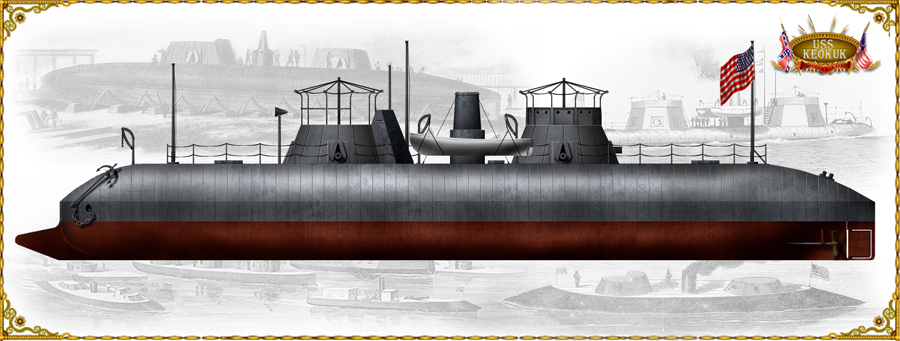
A turtleback Union Turret Ironclad Ram
The Union warship known as Keokuk was born USS Moodna, built on purpose as an experimental ironclad, with several innovative features. She was designed by engineer Charles W. Whitney for New York City’s J.S. Underhill Shipyards, 11th Street. She was named after the eponym city in Iowa and launched on 6 December 1862, with one of the shortest active life or any USN vessel to date.
The Keokuk was the first US warship to be almost entirely built of iron, as wood only apply to deck planking and to fill the armor cladding support. The hull comprised five iron box keelsons and the armor was made of 100 iron frames, one by four feets thick spaced 18in between centers, alternated with yellow pine slats.
The hull was then covered by 1/2 in armour plates, for a total side thickness of 5.75 in (156mm). The decks comprised integral iron cross beams with no transverse planking. Although the ship was quite wide, the bridge itself, due to the sloped sides, was narrow. The bow and stern section were water ballasts which could be flooded to lower the waterline and present the slopest angle to enemy fire -the water itself was seen as an excellent protection below the waterline.
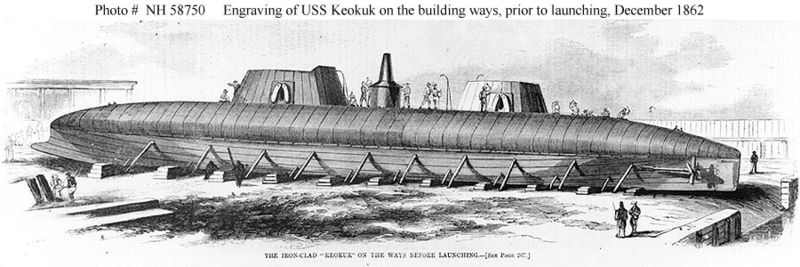
USS Keokuk in construction (no source information) (cc)
The ship was 160ft x 36ft x 8ft6 (48.6 x 11 x 2.6m), with a 688 short tons dispacement. It was propelled by two shafts, actioned by two 2-cylinder 250hp steam engines, and could reach 9 knots at full speed. There were nine auxiliary steam engines for various electrical systems on board.
The armament comprised two eight-face turrets pierced by multiple ports, each with a single 11-in Dahlgren rifled guns, and the reinforced ram.
The USS Keokuk was accepted in service in march 1863, with Commander Alexander C. Rhind as commander and a crew of 92 officers and men. First assignation was the South Atlantic Blockading Squadron.
She was due to participate in the attack of Charleston. But en route, on march, 17, one of her propeller was fouled in an anchor buoy line, and she has to be repaired at Hampton roads. On the 26, she steamed to port Royal, then took part in laying buoys with USS Bibb, to guide the approaches to Charleston for Admiral Francis DuPont fleet of 11 ironclads.
The attack was postponed due to bad weather, and renewed on April, 7. But the operation was a near fiasco and few progresses were made due to torpedoes and other Southern obstructions, until the fleet was in reach of Fort Moultrie and Fort Sumter. Then, other obstructions combined to a very high tide made the ships unmanageable, while being sitting ducks for the fort’s accurate fire.
The Keokuk, to avoid collision with the USS Nahant, almost ran aground at only 600 yards (550m) of Fort Sumter. For half an hour, she was pounded at point-blank range, hit ninety times, hopefully attracting the gunners attention while other ships could disengage. The underwater protection was quickly proven insufficient after been hit several times, and the ship was flooded. Eventually USS Keokuk was able to disengage and leave “completely riddled”, thanks to the skills of the pilot, Robert Small.
The crew managed to keep her afloat until the next day, when a breeze aggravated the flooding, and the ship listed and finally sank off Morris Island, slowly enough to be evacuated. 14 men of the crew were wounded, including Captain Rhind and the quartermaster Robert Anderson (later awarded the Medal of Honor). Gunnery Ensign Mackintosh was the only man to die later from his wounds.
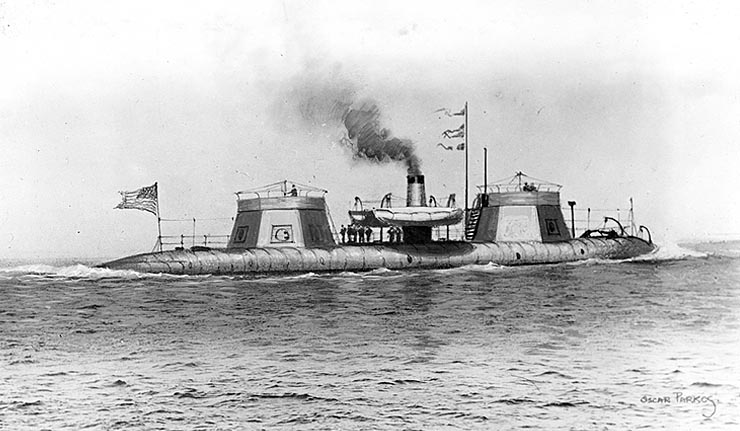
USS Keokuk at sea, Courtesy of Dr. Oscar Parkes, London, England, 1936. United States Naval History and Heritage Command. (cc)
Later on, a federal survey concluded that the ship, filled with sand, was unable to be refloated and it was decided to left the wreck there. CSS officer P.G.T. Beauregard however mounted a salvage operation for retrieving the two precious Dahlgren guns. The operation led by civil engineer Adolphus W. LaCoste was performed at night, at low tide, under the protection of the CSS Palmetto State and Chicora. The guns were later mounted ashore and active until the end of the war.
 Latest Facebook Entry -
  X(Tweeter) Naval Encyclopedia's deck archive
 Instagram (@navalencyc)


 French Navy
 Royal Navy
 Russian Navy
 Armada Espanola
 Austrian Navy
 K.u.K. Kriegsmarine
 Dansk Marine
 Nautiko Hellenon
 Koninklije Marine 1870
 Marinha do Brasil
 Osmanlı Donanması
 Marina Do Peru
 Marinha do Portugal
 Regia Marina 1870
 Nihhon Kaigun 1870
 Preußische Marine 1870
 Russkiy Flot 1870
 Svenska marinen
 Søværnet
 Union Navy
 Confederate Navy
 Armada de Argentina
 Imperial Chinese Navy
 Marine Haitienne
 Marinha do Portugal
 Mexico
 Kaiserliche Marine
 1898 US Navy
 Argentina
 Brazil
 Chile
Chile Cuba
Cuba Peru
Peru Bulgaria
 Denmark
 Greece
 Netherlands
 Norway
 Portugal
 Romania
 Sweden
 China
China Thailand
 Sovietskiy Flot
 Royal Canadian Navy
 Royal Australian Navy
 RNZN Fleet
 RIN Fleet
 Chinese Navy 1937
 Kriegsmarine
 Chilean Navy
 Danish Navy
 Finnish Navy
 Hellenic Navy
 Polish Navy
 Romanian Navy
 Turkish Navy
 Royal Yugoslav Navy
 Royal Thai Navy
 Minor Navies
 Albania
 Austria
 Belgium
 Columbia
 Costa Rica
 Cuba
Cuba Czechoslovakia
 Dominican Republic
 Haiti
Haiti Hungary
 Honduras
 Estonia
 Iceland
 Eire
Eire Equador
 Iran
Iran Iraq
Iraq Latvia
 Liberia
 Lithuania
 Mandchukuo
 Morocco
 Nicaragua
 Persia
 San Salvador
 Sarawak
 Uruguay
 Venezuela
 Zanzibar
 Warsaw Pact Navies
 Bulgaria
 Hungary

 Bundesmarine
 Dutch Navy
 Marina Militare
 Yugoslav Navy
 Chinese Navy
 Indian Navy
 Indonesian Navy
 JMSDF
JMSDF North Korean Navy
 Pakistani Navy
 Philippines Navy
 ROKN
ROKN Rep. of Singapore Navy
 Taiwanese Navy
 Vietnam People’s Navy
 IDF Navy
 Saudi Navy
 Royal New Zealand Navy
 Egyptian Navy
 South African Navy


 Ukrainian Navy