
 Reichsmarine vs
  Russian Navy
Fire on the Baltic
The fact that the Baltic did not saw naval major battles like Heligoland or Jutland don’t have to mask the myriad of naval actions that occurred in this war between the Russian Navy -albeit reduced after the crippling losses of 1905 in this theater- and the powerful Reichsmarine, that kept the bulk of the Hochseeflotte facing the north sea, waiting for opportunities to engage the Royal Navy.
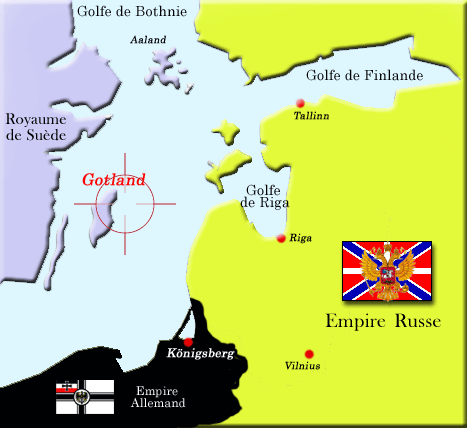
This battle of Gotland, also called Battle of Åland Islands occurred nearby one of the largest island (if not the largest) of the baltic sea, the fortress guarding Swedish east coast. These already seen (and will see) many other clashes between German and Russian ships, but also testified of age-old clashes between Russians and Swedes in the past. This was a serious gun battle between cruisers of many types from both sides, the Germans loosing eventually the Albatross, and the Russian retiring with two badly damaged armoured cruisers.
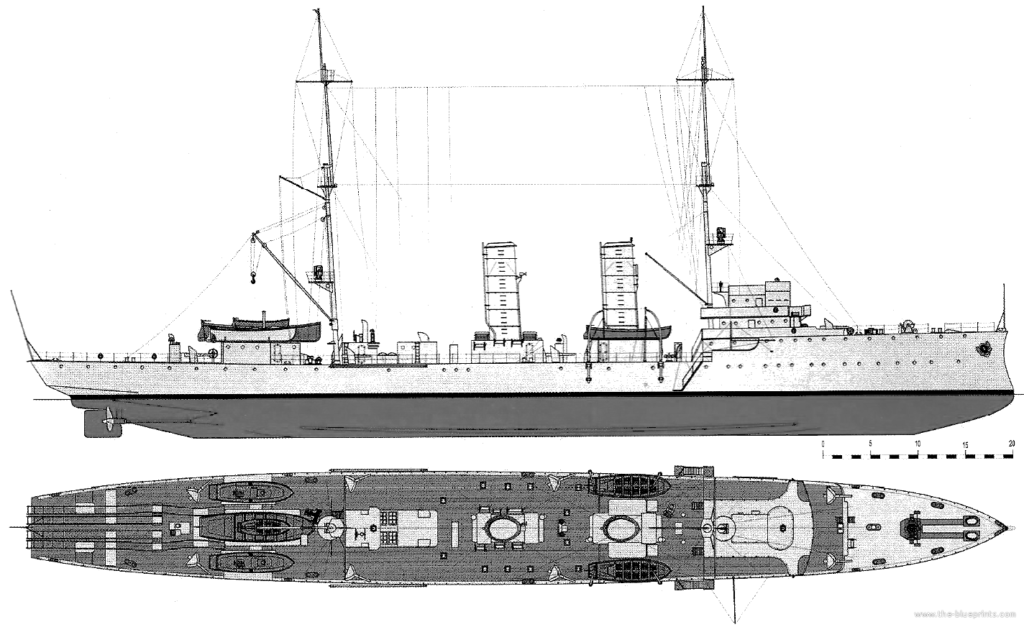
Blueprint of the SMS Albatross
The day before the battle of Gotland, Kommodore Johannes Von Karf had been ordered to anchor a vast minefield off the Aäland Islands, closing the Gulf of Bothnia. He departed with the minelayer cruiser Albatross (frigate captain Fritz West), escorted by the armoured cruiser Roon, and the SMS Augsburg, Lübeck, as well as 12 destroyers. Following Odensholm’s action on 26 August, the Russians seized the codebooks and signals from the Hochseeflotte, and thus intercepted messages, enabling them to know the squadron’s exact departure. On the 2nd, a force comprising the armoured cruisers Admiral Makaroff and Bayan, assisted by the cruisers Oleg and Bogatyr sailed from Saint-Petersburg under the orders of Rear Admiral Mikhail Bakhirev in the hope of intercepting it. This force was joined and assisted by a British submersible.
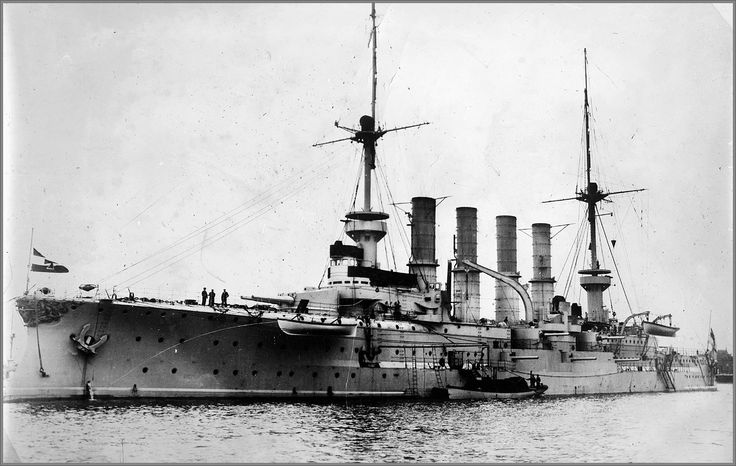
SMS roon (1907), this class preceded the Scharnhorst and was strongly related
On the morning of the 2d, the German fleet was mooring mines in front of the Aaland Islands, when the black plumes of the Russian squadron were spotted. Immediately the operations in progress were abandoned, and the ships turned and headed south. However, the time to carry out the maneuver, the Russian cruisers were at gun range, and the slowest cruiser, SMS Albatross was catch and fired upon. The ship only had a few 88 mm pieces to oppose 203 and 152 mm guns on the Russian cruisers. This resembled quickly therefore to a real execution. However, the Roon and two light cruisers replied, but the duel of artillery was not conclusive. The two fleets advanced in parallel, heading south, and arrived off Gotland when Von Karf was informed of the arrival of two other armoured cruisers, the Prinz Heinrich and the Prinz Adalbert, which just sailed to the rescue. The balance was about to swap in favor of the Germans.
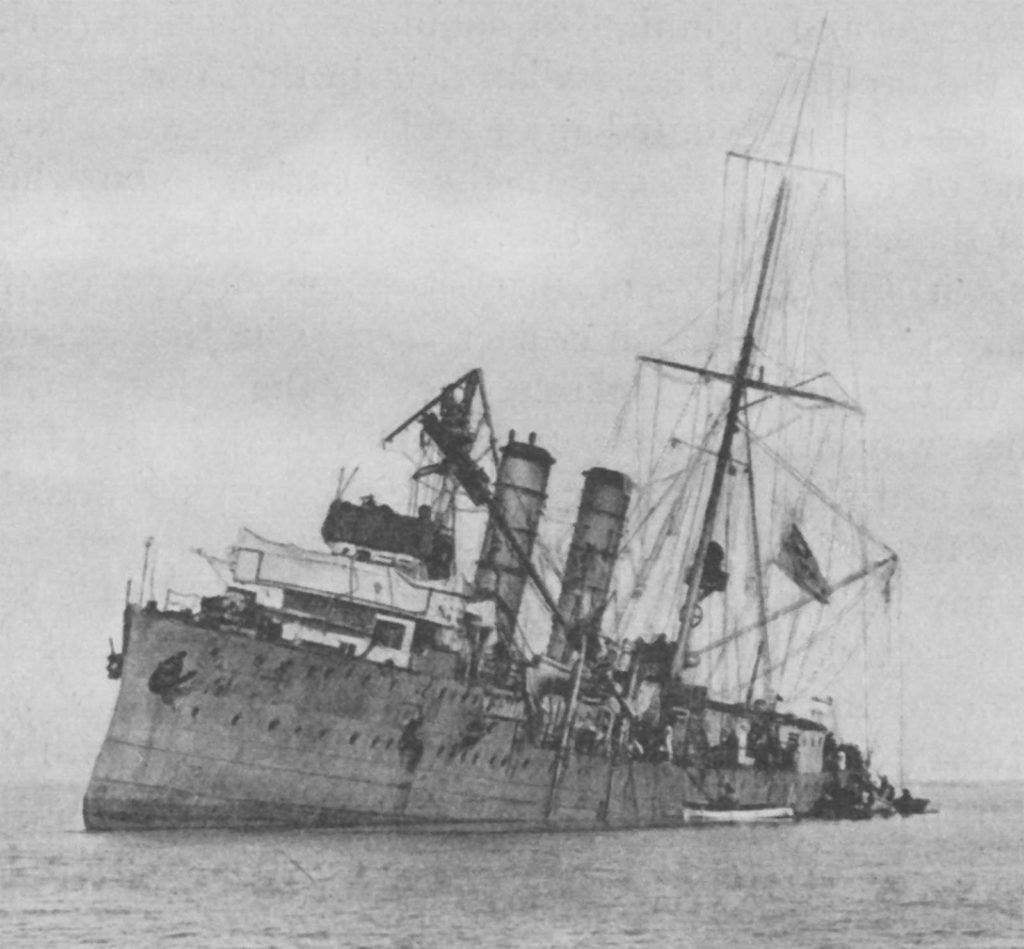
The minelaying cruiser Albatross failed after her fight against the Oleg and the Bogatyr.
The Russians for their part, brought out the Rurik, one of the most powerful armoured cruisers in the world, assisted by the destroyer Novik, no less formidable. They just set sail at the time the news of the clash off the Aaland Islands, and force-steamed south-west in an attempt to cut off Von Karf’s retreat. The threat was very serious, and the battle began to swap again, and this time, taking on a disastrous scale for the Germans. The Albatross, caught by the Oleg and Bogatyr, was severely hit, her machines partially drowned, drifting, silenced, crippled, and eventually ran aground on a sand bank off Gotland. Meanwhile Von Karf from his flagship Admiral Roon, was attacked by the Bayan and Makaroff, being hit several times and severely damaged. Getting the news of the arrival of the Rurik Von karf decided to break off the fight and retreat south-east towards Königsberg.
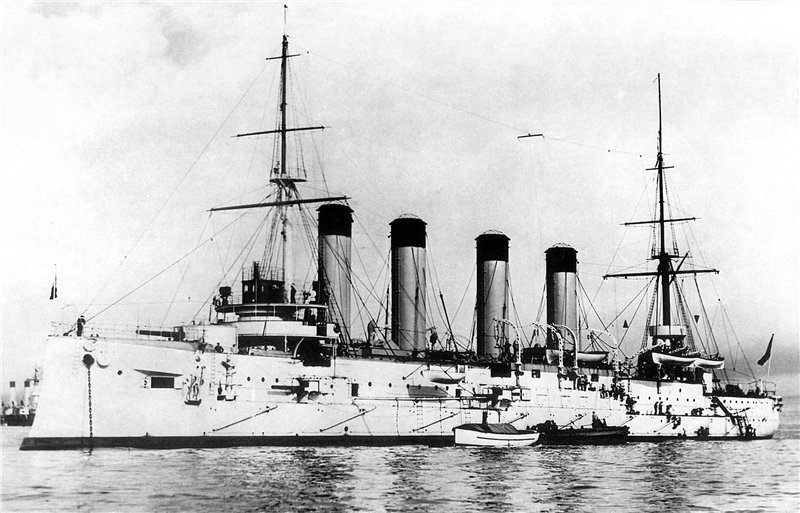
Russian cruiser Bayan
The two German armoured cruisers which came to reinforce, just informed of Von Karf’s decision to retreat, decided to head south, but the Prinz Adalbert was intercepted by British submarine E9 waiting in ambush, and was torpedoed. She survived thanks to the promptness of her crew, clogging the leaks with Makaroff slippers, and thus avoiding the entire engine room being submerged. The cruiser dragged herself to the coast and ran aground on a sand bank off Danzig. She would be later towed and repaired, but shortly after her return in service, on 23 October, she will be torpedoed once again, this time by E8, and sent to the bottom for good.
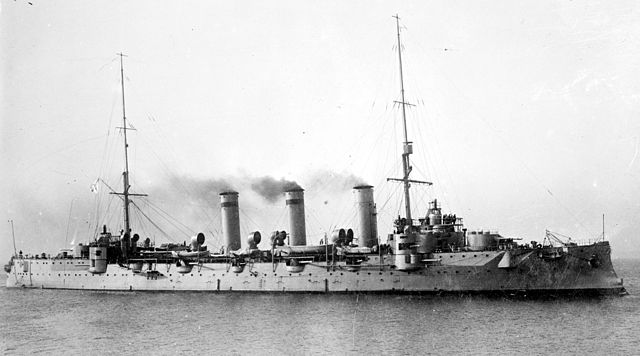
Russian Cruiser Oleg
In the end, Russian losses were difficult to evaluate but it is clear that the Bayan and Makaroff received some hits. The exact balance of the Russian side remains mysterious. In any case, the verdict was severe for the Germans, who, without ever suspecting being spied on or capable to explain the sudden arrival of the Russians to this point, lost the Albatross, which they never attempted to tow. Her surviving crew reached the boats in good order, sailing to the coast of Gotland (Sweden), and from there rejoined Germany afterwards. The Albatross was towed to be broken up later in 1921. The Germans were also deprived of the Roon and Prinz Adalbert, in repairs for long months. Worst still, mines of the Aaland Islands were quickly raised dredged by the Russians. So in the end, we have to see this battle of Gotland as a Russian tactical and strategic victory (three ships eliminated and a minefield).
 Latest Facebook Entry -
  X(Tweeter) Naval Encyclopedia's deck archive
 Instagram (@navalencyc)


 French Navy
 Royal Navy
 Russian Navy
 Armada Espanola
 Austrian Navy
 K.u.K. Kriegsmarine
 Dansk Marine
 Nautiko Hellenon
 Koninklije Marine 1870
 Marinha do Brasil
 Osmanlı Donanması
 Marina Do Peru
 Marinha do Portugal
 Regia Marina 1870
 Nihhon Kaigun 1870
 Preußische Marine 1870
 Russkiy Flot 1870
 Svenska marinen
 Søværnet
 Union Navy
 Confederate Navy
 Armada de Argentina
 Imperial Chinese Navy
 Marine Haitienne
 Marinha do Portugal
 Mexico
 Kaiserliche Marine
 1898 US Navy
 Argentina
 Brazil
 Chile
Chile Cuba
Cuba Peru
Peru Bulgaria
 Denmark
 Greece
 Netherlands
 Norway
 Portugal
 Romania
 Sweden
 China
China Thailand
 Sovietskiy Flot
 Royal Canadian Navy
 Royal Australian Navy
 RNZN Fleet
 RIN Fleet
 Chinese Navy 1937
 Kriegsmarine
 Chilean Navy
 Danish Navy
 Finnish Navy
 Hellenic Navy
 Polish Navy
 Romanian Navy
 Turkish Navy
 Royal Yugoslav Navy
 Royal Thai Navy
 Minor Navies
 Albania
 Austria
 Belgium
 Columbia
 Costa Rica
 Cuba
Cuba Czechoslovakia
 Dominican Republic
 Haiti
Haiti Hungary
 Honduras
 Estonia
 Iceland
 Eire
Eire Equador
 Iran
Iran Iraq
Iraq Latvia
 Liberia
 Lithuania
 Mandchukuo
 Morocco
 Nicaragua
 Persia
 San Salvador
 Sarawak
 Uruguay
 Venezuela
 Zanzibar
 Warsaw Pact Navies
 Bulgaria
 Hungary

 Bundesmarine
 Dutch Navy
 Marina Militare
 Yugoslav Navy
 Chinese Navy
 Indian Navy
 Indonesian Navy
 JMSDF
JMSDF North Korean Navy
 Pakistani Navy
 Philippines Navy
 ROKN
ROKN Rep. of Singapore Navy
 Taiwanese Navy
 Vietnam People’s Navy
 IDF Navy
 Saudi Navy
 Royal New Zealand Navy
 Egyptian Navy
 South African Navy


 Ukrainian Navy