
 Marine Nationale 1991-Today
 Current strength (2025-26): c40,000+ personnel, 7,000 civilians, 180 ships, 178 aircraft.
As of 2026, the Marine Nationale benefits of an augmented budget (Loi de programmation 2024-2030, 36Bn Euros) to accelerate French’s rearmament following the 2022 invasion of Ukraine and 2% NATO commitment to the PIB, with two major programmes, the new SLNE 3G (3nd gen. SSBN) and new aircraft carrier FS “France Libre”. This is a clear bounce off the previous trajectory of massive bugdet restrictions, low PIB percentage, surfing on the “dividends of peace” since 1995, despite’s the country world’s second largest EEZ. The fleet had been completely renewed through many programs and no longer counts any legacy cold war vessels, apart the Lafayette class Frigates and current carrier FS Charles de Gaulle, both initiated in the 1980s.
The Modern French Navy (Marine Nationale) is very much the product of the cold war’s end like most European Navies, meaning a massive decread in military spending. But with a twist: France left NATO by a decision of president De Gaulle and only joined back from 2004 with an official full integration officialized in 2009 under Pdt. Nicolas Sarkozy. Also France had in 1991 and still today, the world’s second largest EEZ, and thus, kept the same responsibility to maintain a large off-shore navy, usually with corvettes, light frigates or OPVs and crowned by the Aircraft Carrier Main Battle Group if things became awry at any point around the globe. The second constant, not abrogated by the end of the cold war, was French deterrence, now incarnated almost only by french SSBNs since the land component was discarded in the early 2000s and the air component was drastically reduced. The cost of maintainin a fully independent deterrent is still a burden to the French military expenditures today, eating the part of budget for the Marine Nationale that could have been used to build extra frigates.
From 1991 to this Day
Order of Battle, 1991
If the war broke out just before the actual fall of USSR in January 1991 for example, what would have been the French contribution to the western war effort at sea ?
France had the following:
-2 aircraft carriers (Clemenceau class) of the size of a WW2 Essex class (discarded 1998-2000).
-1 guided missile cruiser, flagship FS Colbert (discarded May 1991 so still around)
-10 destroyers: La Galissonière (d.1990 but still around), Duperré (trials ships and still around), and Du Chayla (d.1991) of the early generation, modernized, 2 Suffren class large GMDs (D.2001-2007), 3 Tourville class GMDs (D.1999-2013), 2 Cassard class GMDs (Last entering service in 1991).
-7 Frigates: 7 Commandant Rivière class (+1 mothballs, d.1990-96)
-17 D’Estienne d’Orves class corvettes (D.2000s)
-6 fast attack craft: 1 La Combattante, 5 Trident class
-17 OPVs: Sterne, 7 Leopard class, 10 Audacieuse class (+Grebe in completion)
-45 Amphibious assault ships: 2 Ouragan class LSDs (1965), Bougainville (1986), 2 Foudre (1 completing), 5 Champlain class, 2 Sabre, Gapeau, 2 Rapière, 16 CTM class, 19 CTM-17 class
-20 Mine warfare ships: 5 Circé, 10 Eridan (+6 const.), 4 Vulcain +1 Narvik class
-c50+ Auxiliaries: Albatros, D’Entrecasteaux, P778 motor launches (1974), P770 motor launches (1975), P760 motor launches, ATHOS patrol boats (1980). In construction: STELLIS motor launches (1992)
- FS Charles de Gaulle (1993)
- Mistral class LHDs
- Le Triomphant class SSBN
- Suffren (Barracuda) class SSNs
- Forbin (Horizon) class Frigates
- Aquitaine class Frigates
- Alsace class Frigates
- Lafayette class Frigates
- Adm. Ronarch(FDI) class Frigates
- Floreal class Frigates
- Auguste Bénébig class
- D’Entrecasteaux class OPV/M
- Loire class OPV/M
- La Confiance class OPV
- Flamant class OPV
- Jacques Chevalier class Supply ships
- French Minehunters
- French special ships
General Context: France 1991-today
Since 1991, France’s geopolitical position has been shaped by four major developments:
The end of the Cold War and emergence of a multipolar world, with deepening European integration, globalization and new security threats (terrorism, migration, cyberwarfare), renewed great-power competition, especially involving Russia, China, and the United States.
Post-Cold War Adjustment (1991–2001):
The collapse of the Soviet Union in 1991 removed the main threat around which Western security policy had been organized. France had to redefine its strategic role. France supported NATO’s adaptation to the new environment while also promoting a stronger European security identity through the new European Union established by the 1992 Maastricht Treaty:
Support for European integration and the creation of the EU’s Common Foreign and Security Policy.
Participation in peacekeeping and intervention efforts during the conflicts in the former Yugoslavia.
Continued emphasis on strategic autonomy, a tradition rooted in Gaullist foreign policy.
The War on Terror Era (2001–2011): Following the September 11 attacks, France became deeply involved in international counterterrorism efforts.
Key moments: Participation in NATO operations in Afghanistan. Opposition to the 2003 Iraq War, with President Jacques Chirac and Foreign Minister Dominique de Villepin arguing that military intervention lacked sufficient international legitimacy. Reintegration into NATO’s integrated military command structure under President Nicolas Sarkozy in 2009, ending a separation that had existed since 1966.
This period demonstrated France’s balancing act between alliance commitments and independent diplomacy.
Intervention and European Leadership (2011–2019)
France became one of Europe’s most active military powers: Libya (2011) – France played a leading role in the NATO intervention against the government of Muammar Gaddafi. Africa: France launched major operations against jihadist groups, with Operation Serval in Mali (2013), Operation Barkhane across the Sahel region
These interventions reflected France’s historic political, economic, and military ties to Francophone Africa.
Within the European UnionFrance increasingly advocated for Stronger EU defense capabilities, a greater “strategic autonomy” from dependence on the United States
Closer military cooperation among EU members, all highlighted by the relations with the US under the second Trump Administration. The Rise of Terrorism was also an important factor as France suffered major terrorist attacks, with Charlie Hebdo (2015), and the Paris attacks (November 2015), Nice attack (2016).
These events significantly influenced domestic and foreign security policy.
Renewed Great-Power Competition (2020–Present):
The current period is defined by rivalry among major powers and growing uncertainty. Russia and Ukraine: The 2014 annexation of Crimea and especially the 2022 Russian invasion of Ukraine transformed European security. France has Supported Ukraine politically, financially, and militarily. Increased defense spending was also a consequence, with strengthened NATO commitments in Eastern Europe. As for European Strategic Autonomy, President Emmanuel Macron has strongly advocated Greater European defense independence, Reduced reliance on U.S. security guarantees and a stronger geopolitical role for the EU.
France views China simultaneously as a major economic partner, a strategic competitor and a challenge to the international rules-based order.
French policy generally seeks cooperation while limiting strategic dependence.
France’s influence in Africa has faced significant challenges with military withdrawals from Mali, Burkina Faso, and Niger after coups motivated by an efficient Russian propaganda campaign rising anti-French sentiment in parts of West Africa, and to the benefit of groups such as Wagner and later the Africa Corps. It lost its influence over growing Russian and Chinese gradual takeover of the continent. This was the most significant shift in French foreign policy since decolonization.
Key Geopolitical Characteristics are dictated by France remaining a nuclear power, a permanent member of the United Nations Security Council, a founding member of the European Union, a leading member of NATO, one of Europe’s largest military powers and its stance as an advocate of European strategic autonomy now having a willing audience. France is still a global diplomatic actor with territories and interests in Europe, Africa, the Indo-Pacific, the Caribbean, and South America.
As refleted by the latest Programmation Law 2025-2030, France needs to be a “balance power”.
For the Navy, between its nuclear commitments and large EEZ, the Navy needs to be maintained at a minimal level whatever the budgetary changes.
Fortunately there is a mechanism though the DGA (General Armament Direction) that “sanctuarize” long term programs (like building a new carrier) whatever the majority in power’s political color.

In 2015, France was standing strong of her almost 400 years constituted navy (since 1624) by sending across the Atlantic the Hermione, the replica frigate that carried in 1780 Lafayette and his message to the continental army that the French army was coming. The USS Mitscher (DDG 57), Arleigh-Burke class destroyer, escort her in the vicinity of the Battle of Virginia Capes. USN – 150602-N-OA702-009 VIRGINIA CAPES (June 2, 2015) The Arleigh Burke-class guided-missile destroyer USS Mitscher (DDG 57), right, provides a warm welcome to the French tall ship replica the Hermione in the vicinity of the Battle of Virginia Capes off the East Coast of the United States. The original Hermione brought French General Marquis de Lafayette to America in 1780 to inform General Washington of France’s alliance and impending support of the American Revolutionary War. The symbolic return of the Hermione will pay homage to Lafayette and the Franco-American alliance that brought victory at the Battle of Yorktown in 1781. The Hermione will visit Yorktown, Va. June 5 and then continue up the east coast visiting cities of Franco-American historical significance. (U.S. Navy photo by Mass Communication Specialist 1st Class Michael Sandberg/Released)
(In redaction)
Current Organization

The chief of the naval staff stands for the duration of a government, between presidential and parliamentary elections. Current one (2026) is Amiral Nicolas Vaujour. By November 2024 the active strenght of the Navy was some 38,000 military personnel, 3,000 civilian staff. There are four main operational force commands:
-The Force d’Action Navale (Naval Action Force) or the Surface fleet for daily operations.
-The Forces Sous-marines (Submarine forces): The Nuclear-powered ballistic missile submarines and fleet submarines.
-The Aviation Navale (Naval air force) a support Ground and sea-based aircraft, also called “Aéronavale”.
-The Fusiliers Marins (Naval riflemen), traditional naval infantry, including special forces (Commandos Marine).
There is also a part of the National Gendarmerie maintaining a maritime force of patrol boats, also managed by the French Navy, called the “Gendarmerie maritime” which is its “coast guard”.
In the Cold War, like previous conflicts in 1914 and 1939, this force was spread between two major squadrons, in Brest and Toulon, respectively in charge of the western and mediterranean forces, but a single fleet, not two as in some countries. In fact prior to 1914, the Med Sqn. frequently passed the Gibraltar strait for combined Atlantic operations with the Atlantic sqn. It was also common in the interwar to see Atlantic ships assined to the Med and vice-versa.
In the cold war and until 1995, there were the ALESCLANT (Atlantique squadron command under an admiral) and ALESCMED (Med Sqn, same). With the restructuration called Optimar ’95, they were divided into the Naval Action Force (ALFAN) and Antisubmarine Group (ALGASM), again two admirals. So a submarine and a surface force, theoretically independent of geography. It is true however that the main SSBN base is at the Ile Longue (“long island”) in Britanny, thus, the Atlantic, and the bulk of the surface fleet, starting with the current flagship Charles de Gaulle, as were the two Clemenceau class before, are at Toulon naval base, certainly one of the largest in the Med and even in Europe.
Toulon Naval base
Created in 1514 when a natural anchorage was protected by a bastion (the “royal tower”) the “rade” or “Road” (protected place near shore, where ships can ride at anchor) remains one of the best natural anchorages on the Mediterranean and largest in Europe, protected by the peninsula of Giens and peninsula of Saint-Mandrier-sur-Mer, sheltering the latter port as well as La Seyne-sur-Mer (with main shipyards) and the arsenal anf foundries of the military port of Toulon alongside the commercial port, second of the Riviera besides Marseilles. La Seyne saw the establishement of what became gradually a single shipyard, Forges & Chantiers de la Med. (FCM) which built from three deckers to ironclads and modern battleships and cruisers until WW2. The major extension and modernization of Toulon was under Cardinal Richelieu, who wanted under Louis XIII, to make France of the early 1600s a dominant power in the Mediterranean.
Brest Naval Base
(To be updated)
Lorient Naval Base
(To be updated)
Cherbourg Naval Base
(To be updated)
Current Strenght, Class by Class
Flagship: FS Charles de Gaulle (1994)
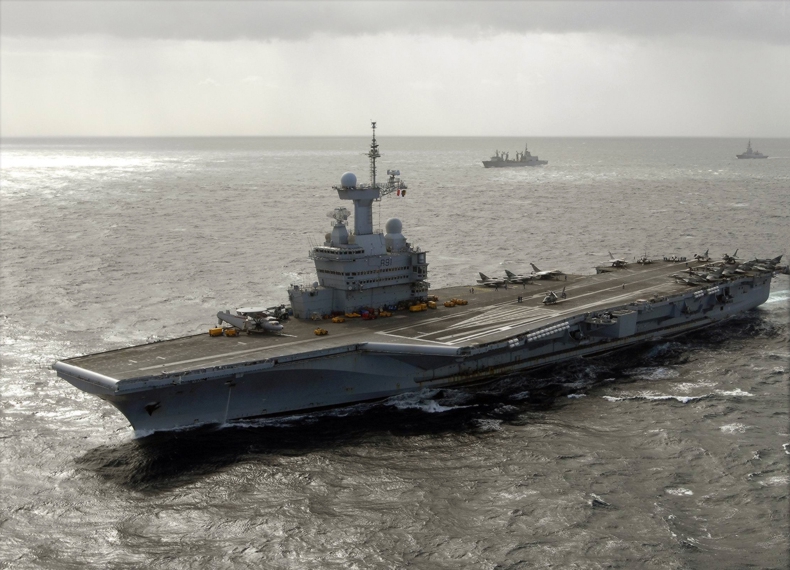 FS Charles de Gaulle (Ex-Richelieu) was designed back in 1975 as a successor of the Clemenceau class, two fleet carriers built in the late 1950s. She was to be the lead ship of a class of two, only one was completed. FS Charles De Gaulle was commissioned in 2001 and is now the flagship of the Marine Nationale, taking part in many engagements around the globe as well as NATO international exercizes. Only nuclear carrier in Europe, she is herself scheduled for replacement by a new 80,000 tonnes nuclear fleet carrier planned for 2035, the PANG, now FS France Libre, another throwback of De Gaulle’s legacy.
Specs:
42,500t FL, 261.5 x 66.5 x 9.43m.
Propulsion: 2 shafts K15 PWR 150 MWt, Alstom steam turbines 61 MW, 4 diesel-electric for 27 knots (50 km/h; 31 mph) 20–25 years refuel.
Armament: 4×8 A-43 MBDA Aster 15 SAM, 2×6 Sadral Mistral, 3× Nexter Narwhal
Sensors: DRBJ 11 B 3DR, Thales SMART-S MK2, DRBV 26D, DRBV 15C, see notes
Protection: NBC, Bulkheads around Nuclear core, ammo storage, see notes
Assault capacity: 800 commandos, 500 t ammo, 30+ helicopters
Air Group: 40 Max, Rafale M, E2C Hawkeye, see notes
Crew: 1,350 ship + 600 air group
Le Triomphant class SSBN (1994)

Current assets maintaining French’s nuclear deterrence. Class: Le Triomphant, Le Téméraire, Le Vigilant, Le Terrible built at DCNS/Naval Group 1986-2010.
Program Sous-Marin Nucléaire Lanceur d’Engins de Nouvelle Génération or SNLE-NG initiated in 1980. The first was laid down in 1986 after years of R&D for a total cost of €17.1 billion (2009) (equivalent to €22.2 billion in 2025) for 4 units and €3.1 billion (2009) (equivalent to €4 billion in 2025) for Le Terrible. They were upgraded from the original M45 intermediate-range missile to the M51 missile installed on Le Terrible. 2nd gen. SSBN after the Redoutable class of 1971.
Specs:
12,640/14,335 tonne, 138 x 12.50 x 10.60 m.
Propulsion: 1x K15 PWR 150 MWth/turboreductor pump jet 30,5 MW for 30,519 kW (40,927 hp), 2x emergency diesel-powered SEMT Pielstick 8PA4V200 SM (700 kW (940 hp)) auxiliaries.
Speed: Over 25 kn (46 km/h); classified. Range Unlimited 20–25 years before fuel overhaul. Tested under 400 m (1,300 ft). Crew 15 officers+ 96 sailors
Sensors: Sonar DMUX 80, DUUX 5, DSUV 61B VLF, Racal Decca, SCC TCC, ARUR 13 EW.
Armament: 16x M45/M51/51.3 each 6-10 TN 75 150 kt/TNO 100-300 kt thermonuclear WHs., 4x 533 mm TTs F17 torpedoes/Exocet SM39.
Amethyste class SSNs (1986)

The previous Rubis class were the furst French SSNs, a program launched in the 1970s and sanctioned with the construction of six attack submarines. However the first four were modernized in the 2000s along the Amethyste upgrade, with a reconstruction of the hull, new electronics, armament, ect. As of 2026, only the last two, S605 Améthyste and S606 Perle are in service, pending replacement by later Suffren class SSNs. However the first four are currently mothballed, not scrapped, maintained in order to be recommissioned if needed.
Specs:
Dimensions: 73.6 m (241 ft 6 in) length, CAS-48 (48 MW), 2 TBs (2x 3,150 kW) EM (8,448 shp), auxiliary SEMT Pielstick, rafting and hull coating: 25 kts.
Armament: 4 × 533 mm TTs (14) Exocet SM39, mines, F21 Artemis torpedoes
Sensors: DMUX 20 A/P sonar, ETBF DSUV 62C towed array, DSUV 22 passive sonar, DRUA 33 radar, ARUR 13
Suffren class SSNs (2019)

The Suffren-class (Barracuda program, started in 1999) is the current class of French nuclear-powered attack submarines, designed by the Naval Group (DCNS), intended to replace the Rubis-class. Construction started in 2007 for the lead boat Suffren, commissioned on 6 November 2020, operational on 3 June 2022. Duguay-Trouin and Tourville were later commissioned and De Grasse replacing Emeraude in 2026. The next two in class will be Rubis (LD 2019, TB launched 2027 TBC 2028) and Casabianca (LD 2020 TLC 2028 TBC 2029). Recrating the force of 6 SSNs as the previous Rubis class, two more than thre actual number of SSBN. The theory is to have two SSBNs and four SSNs at sea at all times, one screening the SSBN in operation and the other deployed in a theater of operation as support for the Charle de Gaulle Battle Group, or another posting. Studies already started for the SNA 3G (3rd gen. SSN) planned FY2040+.

Specs:
4,765t/5,300t 99.5 x 8.8 x 7.3 m
Propulsion: 1 × K15 PWR 150 MW (200,000 hp), 2× turbo generator groups 10 MW (13,000 hp) each, 2× SEMPT Pielstick emergency diesel generators 480 kW (640 hp) each, pump-jet electrically driven. Top speed classified, 23 knots+ (43 km/h; 26 mph) submerged, 14 knots (26 km/h; 16 mph) surfaced, unlimited range. 70 days endurance or more with 2 crews.
Test depth 350 m+ (1,150 ft), classified. Crew 12 officers, 48 petty officers
Sensors: SYCOBS CMS, NEMESIS EW +CANTO-S decoys, Thales PARTNER com. 3 optronic masts, Sonar Thales UMS-3000 (hull) ETBF DSUV 62C towed, obstacle avoidance, broadband sonar interceptor, navigation echo sounder. DIVESAT satcom Syracuse link and Link 11, 16 22. Thales TUUM-5 MK2.
Armament: 4 × 533 mm TTs (20): F21 torpedoe, MdCN missiles, Exocet SM39 Mod2, D-19T UUV, FG29 mines.
Mistral class LHD (2004)

The three Mistral-class (BPC) are the French main amphibious assault carriers. The class comprised the Mistral, Tonnerre, and Dixmude. Alongside these, two more were built for Russia but never delivered before the sanctions related to the war in Ukraine. They eventually found a new customer, Egypt. The BPC are dock landing ships and helicopter carriers reminiscent of the PH75 project (see above). They are highly versatile ships, in service since 2006 and 2012 for the last, and way cheaper than the ambitious PH75 with their classic propulsion and civilian grade manufacture (contracted in civilian yards).
The class comprised for the moment:
L9013 Mistral (10 July 2003, 6 October 2004, February 2006)
L9014 Tonnerre (26 August 2003, 26 July 2005, December 2006)
L9015 Dixmude (18 April 2009, 17 September 2010[, 27 December 2012).
Two were exported, famously to Russia, contract signed in 2010, with the first two being named Vladivostok and Sevastopol cancelled with the invasion in Crimea by December 2014. They were sold to Egypt after an arrangement with Russia to cede their own air group, now in service as the Gamal Abdel Nasser and Anwar El Sadat.
Specs:
16,500/21,500 tonnes 199 x 32 x 6.3 m
Powerplant: 3 Wärtsilä diesel 16 V32 (6.2 MW) +auxiliary 18V200 (3 MW), 2 Rolls-Royce Mermaid thrusters 7 MW: 18.8 knots
Range 10,800 km/18 knots or 19,800 km/15 kts
Capacity: 4x LMC, EDA-R/S, LCAC, 70 vehicles (13 Leclerc MBT) or full 40-strong Leclerc tank battalion 450 troops.
Crew 20 officers, 80 petty officers, 60 quarter-masters
Sensors: DRBN-38A Decca Bridgemaster E250 NAVR, MRR3D-NG ASR, optronic fire control
Armament: 2 × Simbad SAM, 2x 20 mm F2, 2 × 30 mm Breda-Mauser RWS, 2 x 7.62mm M134 miniguns, 4 × M2HB HMG
Aircraft: 2 Schiebel Camcopter S-100, 16 heavy or 35 light helicopters, 6 landing spots+ hangar
Horizon-class frigate (2002)

The Horizon class is the current French air-defence destroyers, coming fromt the Italo-French FREMM program. Albeit classed in France as frigates, they are destroyers for the Italians and generally assimilated as “large frigates” despite their pennant, with NATO classification “D”. Former 1990s CNGF three-nation collaboration (UK was in the loop until 1999 and created the Type 45 destroyer). They were built using the same company structure as the Horizon project, leading to four ships for Italy and two for France, Forbin (completed 2008) and Chevalier Paul (2009).
piccc
Specs:
7,050t/5,290t, 152.87 x 20.3 x 5.4 m.
Propulsion: CODOG: 2 × GE LM2500+ TAG, 2× diesel SEMT Pielstick, 4× diesel generators, bow thruster.
Speed: 29 knots+ Range 6,100 nm (11,000 km) at 18 knots (33 km/h) Crew c250
Sensors: Selex ES EMPAR radar, Thales S1850M, UMS 4110 CL sonar, Selex ES IFF SIR R/S, ES RTN-30X FR Sagem IRST Vampir MB (IRAS), SIGEN EW, OTO Melara ODLS-H decoy, SLAT anti torpedo system
Armament: PAAMS: 48-cell A50 Sylver VLS (Aster 15/30), Exocet MM40 B3. 2× OTO Melara 76 mm, 2×2 Sadral Mistral CIWS, 3 × 20 mm Narwhal RWs, 2× WASS B515/1 TT MU90 Impact (24). AW101 helicopter. FD & Hangar.
Aquitaine class Frigates (2010)
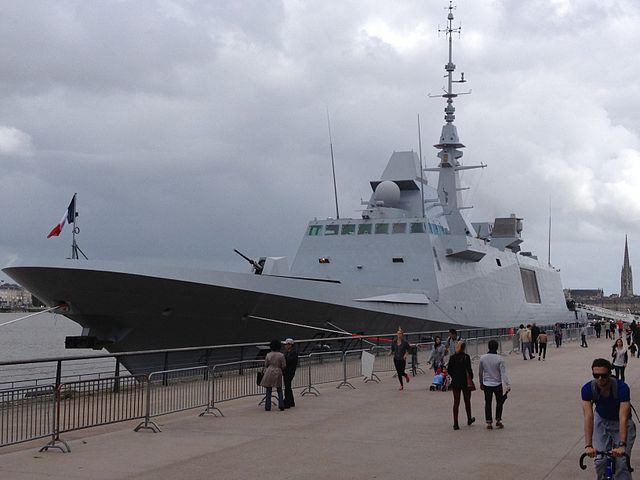
FREMM class frigate Aquitaine, lead ship (8 ships, 2006-2020) ASW and multipurpose.
Class: Aquitaine, Normandie, Provence, Languedoc, Auvergne, Bretagne, Alsace, Lorraine: 6 Aquitaine class (FREMM) anti-submarine destroyers and 2 Alsace class (FREMM-DA) air defense destroyers. Part of the developement of the FREMM multipurpose frigate program, Franco-Italian. Lea ship started construciton in 2007, completed in 2012.
picc
Specs:
6,000 tons, 142 x 19.8 x 4.9 m
Sensors: Héraklès AESA radar, CAPTAS-4 towed-array sonar, UMS 4110 CL hull-mounted sonar
Armament: 1 x 76 mm SR, 3 x 20 mm Narwhal RWS, VLS 16-cell SYLVER Aster 15/A70 MdCN, 8 x Exocet MM40 B3c 2×2 B-515 TT MU90.
Lafayette class (1992)
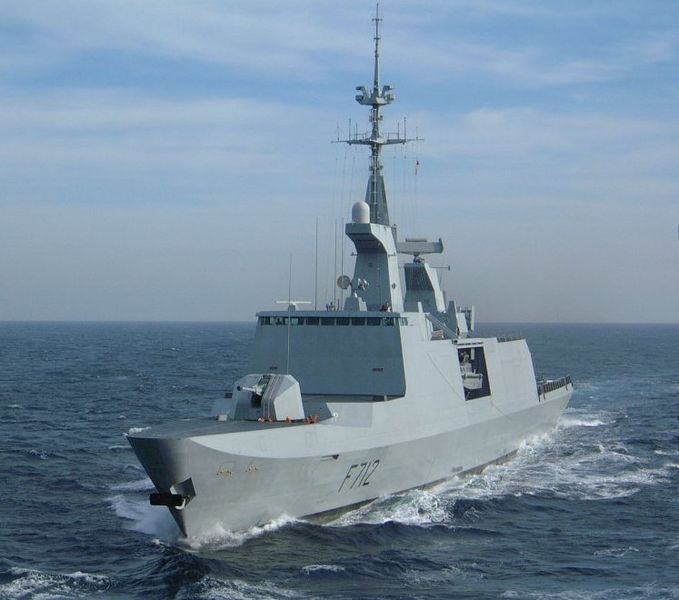
Lafayette class Courbet, multipurpose frigate. Five ships built 1992-99 with advanced stealth characteristics for the time. The older Georges Leygues class (1985) are secheduled for decommission in 2022.
Class: 5 Frigates (F710-714), active: La Fayette, Surcouf, Courbet, Aconit, Guépratte.
The Lafayette class were the last French Frigates designed in the Cold War, with a construction which started in 1990 and five completed until 2001, all active today and modernized. Their specificity was to embrace fully the stealthy characteristics we are all familiar today. Designed and built at DCN, they were medium-sized (3000t) and versatile, and turned to be well adapted to the post-cold war low intensity conflicts, having only defensive SAMs and SSMs and no VLS. The design made quite a splash internationally and led to the adoption of such features in virtually all modern constructions. The Lafayette class earned further orders to DCN, such as the well modified Saudi Al Riyadh class, Taiwanese Kang Ding class and Singaporean Formidable class.
picccc
Specs:
Displacement 3,200 t/3,800 t, 125 x 15.4 x 4.1 m
Propulsion: 4 diesel SEMT Pielstick 12PA6V280 STC2: 21,000 hp (16,000 kW): 25 knots
Range: 350t fuel: 9,000 nmi (17,000 km; 10,000 mi) at 12 kts
Armament: 100 mm TR gun, 2× 20 mm F2, 2×4 Exocet SSM, Crotale CN2/Sadral(Mistral) SAM, 1x Panther or NH90
Sensors: DRBN34, DRBN34, DRBV 15C, TAVITAC CC/SENIT FLF CMS, CN2 FCS, ARBG 1/ARBR 21, Dagaie, CANTO ECM
Crew: 164+(6)
FDI clas frigates

The Amiral Ronarc’h-class frigates are a new class of 1st-rank French frigates to complement the Aquitaine class and in long term replacement of the Lafayette class. The acrony is “Frégate de Défense et d’Intervention” (Defence and Intervention Frigate) former “Frégate de Taille Intermédiaire” Medium-Size Frigate/FTI) in 2015. By February 2022, five were ordered with the lead ship Amiral Ronarc’h, commissioned in 2026. In 2021, 3 units were ordered by Greece (Kimon class) and in 2026, 4 were ordered by Sweden (Luleå-class).
picccc
Specs:
Current Upcoming Programs (2026)
FS France Libre (2026)

The PANG (ex-PA1) programme was launched during the COVID pandemic, confirmed in 2020, with the R&D declared “ready” for the 1st phase with its naming announced by Pdt. Emmanual Macron on 18 March 2026. PANG stood for “Porte Avions Nucléaire/Nouvelle Generation” or “next-gen nuclear carrier”. It notably inherited studies from the cancelled PA2 considerably revised as its air group was to integrated the planned SCAF or “Future Combat Air System” 6th gen. multitole aircraft (now cancelled for the main fighter) albeit the naval UAV could be derived from the already existing Dassault NeuRon. Other confirms are the Dassault Rafale MF5 (2030+) E-2D Hawkeye, NH90 Caïman. It was anounced from the start to be equipped with the EMAL catapult and possibly also the advanced arrestor system of the current Ford class.
The France Libre is currently in pre-laying down phase at St Nazaire Atlantic Yards, with a laying down effected in 2031 for sea trials c2035, commission c2038.
If effected, this will be the largest warship ever built in Europe, at 80,000 tonnes, the largest non-US nuclear carrier, albeit China’s Type 004 will be much larger at 120,000 tonnes with the lead ship completed also much sooner. Discussions about a second carrier in class seemed definitely closed as funds are prioritzed to the Army since 2024. This will leave the Marine Nationale without any carrier during her overhauls.
L’invincible class (2027)

The L’Invincible class were started as the SNLE 3G for “third generation nuclear ballistic missile submarine” to replace the Triomphant class. The first is scheduled for completion in 2035 for an active service planned as far as 2090. Steel was cut in March 2024 and she was named on 2 March 2026 by President Emmanuel Macron “L’Invincible” while in construction for a commission in 2036 or sooner. The first phase was announced on 18 February 2021 by MoD Florence Parly. They will carry the same payload of 16 ballistic missiles, but of the larger and more advanced M51 successors.
Specs:
15,000 tons submerged, leghht 150 m (490 ft), power K222 PWR, 20 MW (300,000 hp). 20–25 years core refuel.
Armament: 16x M51 missiles and successors, 6x 533 mm (21 in) TTs F21 torpedoes exocet SM40 or successor
Sensors: Classified.
Plans for 2030 and beyond

USS John C Stennis escorted by Chevalier Paul in Mediterranean Operations
Since we will not venture soon into a dedicated modern section encompassing the post-cold war era, from 1990 to 2020, of thirty years, here it is there. That’s a good way to assess the modern French Marine Nationale. With 36,331 personnel as of 2016 and 2800 civilians cooperants serving 180 ships and about the same number of aircraft (including helicopters) (AVIA, the French Naval Aviation), the Marine Nationale’s command structure comprised the ones seen above plus Marine Infantry (FORFUSCO). The latter is not the equivalent of a large “Marine” force like in the US but rather small, highly trained elite units called the Marine Commandos and Naval Fusiliers. More of a Spec Ops unit.
Missions however also include security on all Marine sites on land and at sea (on the ships). The structure also calls for traditional units such as the Marins Pompiers (marine firefighters), Gendarmerie Maritime (a coastguard security unit), and the Service de soutien de la Flotte, the fleet supply force.
Home HQs are Brest (Atlantic), as well as the secondary HQs at Cherbourg & Lorient, Toulon (Mediterranean). Overseas HQs concerns Fort de France (Caribbeans), Degrad des Cannes (Fr. Guyana, South America), Port des Galets (La Reunion, Indian Ocean), Dzaoudzi (Mayotte), Nouméa (New Caledonia), Papeete (Tahiti, both in the Pacific) but also Dakar and Djibouti for Africa, West and East. Let’s recall French Maritime Surface EEZ is the world’s second, behind the USA.
Let start with the basics, nomenclature of the actual French Fleet:
-Charles de Gaulle Nuclear AC: In service since 1999, the Charles de Gaulle was the planned replacement of the Clemenceau class, with the difference two ships were planned, not just one. The PAN program started in 1980 but was delayed given the prospect of a joint-venture with Great Britain which also seek a new aircraft carrier of a larger standard than the 1979 Invincible class. The joint British-French project was reported for the second French carrier, but eventually failed over technology transfer concerns, the French mainly sticking to their project of a nuclear carrier and the British to their own conventional one. In the end, the Charles de Gaulle took some time for completion but proved quite a daunting engineering task. After all, this is and remains the only non-US nuclear aircraft carrier within NATO and outside Russia (Kuznetsov) and China (Lianoning).
After teething problems the Charles de Gaulle already has served extensively on the international scene for 30 years, going through a major overhaul in the process, but her more crucial problem proved to be the lack of a suitable aircraft, the Rafale program advancing slowly in the meantime. The actual air group of the carrier only comprised the Rafale M as a multirole aicraft and last-generation NH90 helicopters. The conventional PA2 program (now incarnated with the Queen Elisabeth and upcoming Prince of Wales) is now dead in the water and a “sea serpent”, pending budgetary improvements. The problem being the Charles de Gaulle has no backup when in prolongated overhaul. This is somewhat compensated by the three Mistral-class.
Their escort is incarnated by a new generation of ships, 7000 tons Horizon class AA destroyers (Forbin class) of 2005, and the (future) five Aquitaine class ASW destroyers (named after régions like former battleships) of 2010, plus the five older Lafayette class fleet frigates (1992), and five civilian-yard Floréal class patrol frigates (1991). As of today only the Cassard and the two Georges Leygues class remains in service, but until their replacement in 2022-24.
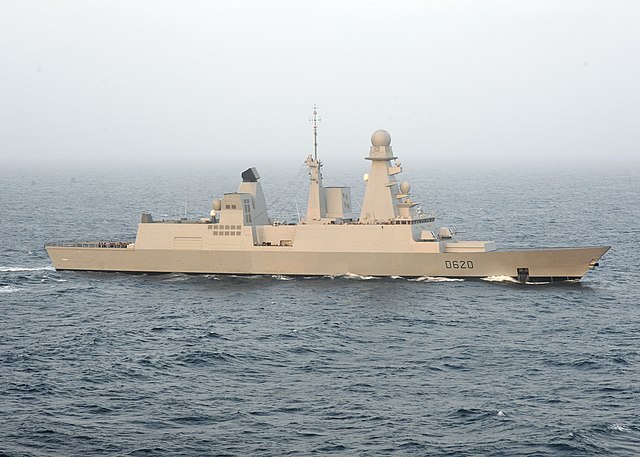
The joint Italian-French Horizon program is one of the last modular destroyer design which is intended to serve until at least 2050.
In addition to this “blue water navy”, the French also operate no less than 15 patrol ships of the D’Entrecasteaux, D’Estienne d’Orves, La Confiance, and L’Audacieuse class. Also 17 mine hunters of the Circé, Vulcain and Antares class, 6 coast guard vessels, the supply vessel Durance, and various specialized ships such as the Monge, Dupuy de Lôme, Alize abd Thetis, three survey ships, two tugs, two support vessels, three training vessels.
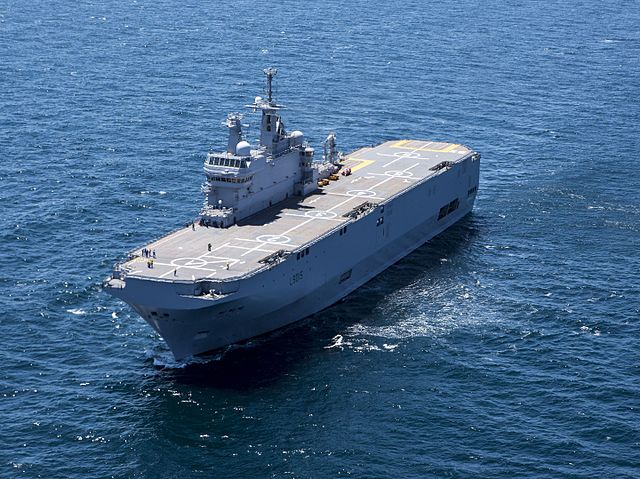
Alongside the Charles de Gaulle, which will remains a single ship, as per budget constraints, there are three BCP of the Mistral class, built with cost savings by using a civilian yard. The key for these ships are versatility. Two others are now in Egyptian service after a constroversial first sale to Russia.
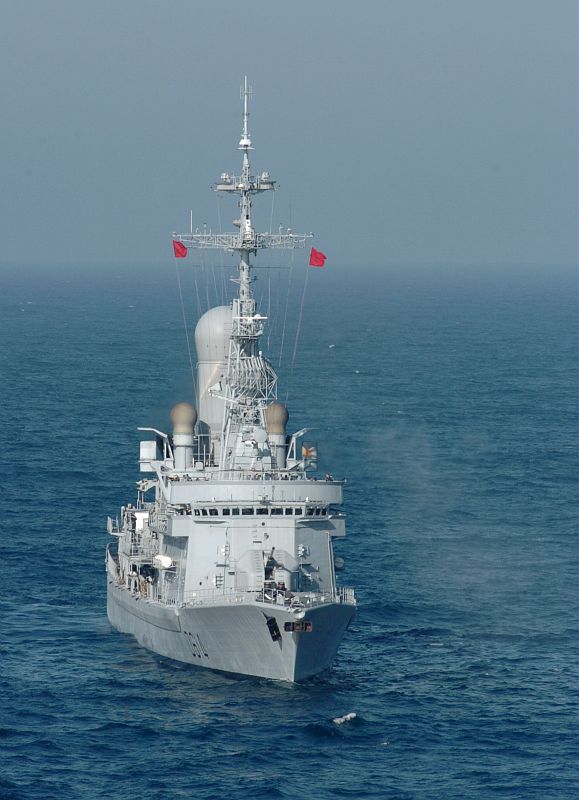
Type 70 CASSARD class AAW Frigate (1982-91). Cassard and Jean Bart are scheduled for replacement by two specialized Aquitaine class vessels in 2025+.
Cooperations
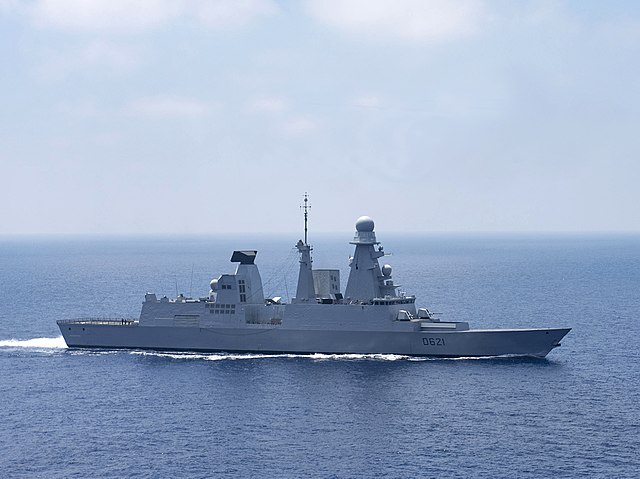
Chevalier Paul, with her sister ship Forbin (2002) one of the two Forbin class vessel, made in partnership with Italy.
Exports
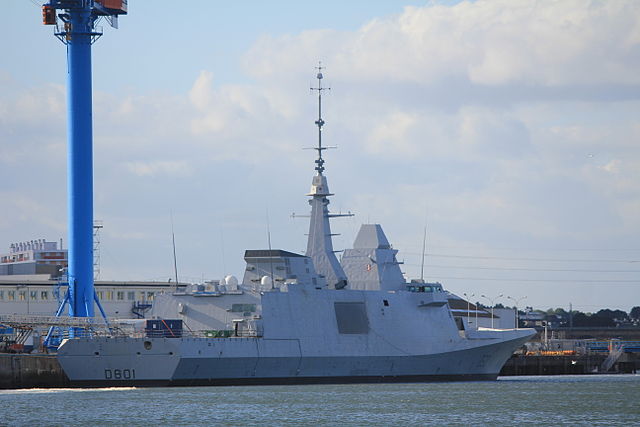
Mohammed VI at Lorient. DCNS also exports the design (Morocco, Egypt) while the Regia Marina planned ten ships (Carlo bergamini class, 2011-2020)
(To come)
Controlling the French EEZ
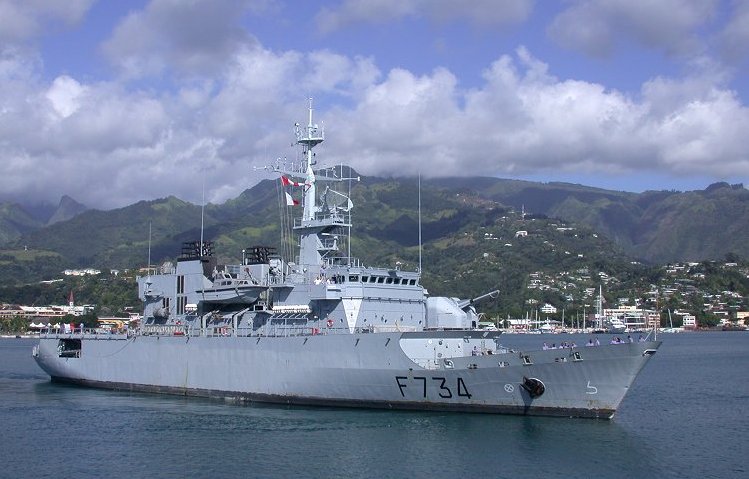
Vendemiaire, of the six Floreal class (1990s). These are second-rate “surveillance frigates” designed to patrol the extensive French EEZ. They had no anti-ship ASW/AAW capabilities and were built on budget using civilian yards.
Organization
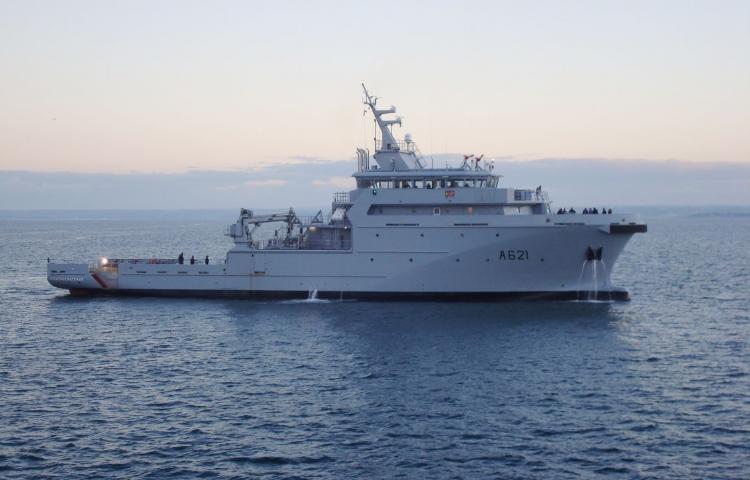
D’Entrecasteaux (2015), one of the four 2300 tonnes Offshore patrol vessel also designed as multi-purpose ships for patrolling the EEZ, notably the Pacific and Indian oceans. Armament is limited to two light MGs.
Assets
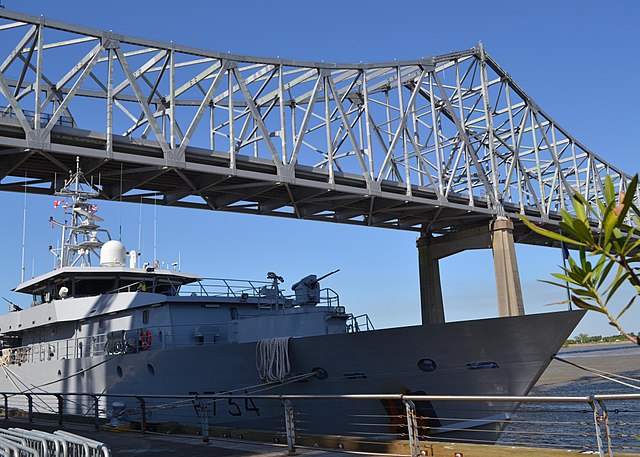
La Resolue, one of the three 700 tonnes OPBs of the La Confiance class (2016)
The “French Coast Guard” also comprised six ships: Malin, Arago, Fulmar, and the three Flamant, Cormoran and Pluvier of the Flamant class (1995) planned for replacement in 2025.
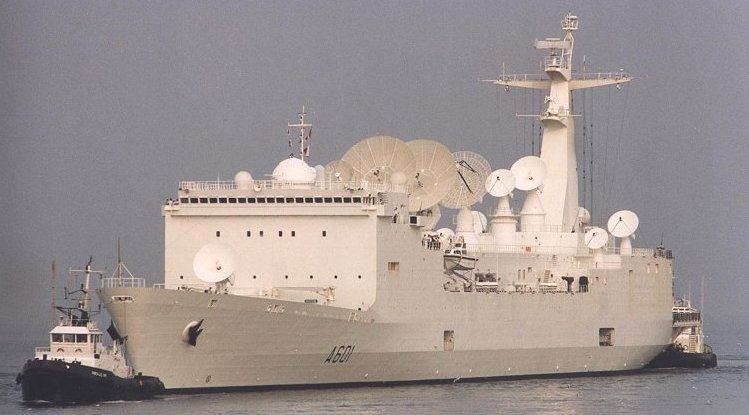
FS Monge, A 21,000 tonnes Tracking ship (1990), one of the largest in the world. She was mainly designed as a missile range instrumentation ship, to track ballistic missile tests, integral to the FOST (French nuclear dissuasion Force).
Another of these specialists of the French Navy is the Dupuy de Lôme (A759) SINGINT (Signals intelligence Ship) of 2005, built in the nertherlands and completed by Thales. There is also the Alizé (A645) of 2004, a diver’s support ship, and the lead ship of the Lapérouse class, Thétis (A785) for Mine-warfare experimentation. Alongside these, the Navy also operates five Oceanographic survey vessels, Beautemps-Beaupré (A758), Pourquoi Pas and three of the Lapérouse class, four oceangoing tugs of the UT507/515 classes, eight vessels of the Argonaute and loire class Support and pollution control and assistance vessels, the eight Léopard class training vessels (1979) for cadets* planned for replacement in 2021, the two Glycine class for navigation training (trawlers type), the UT712/745 class operated under charter and two sailing schooners.
*Cadets can also be trained one of the BPC class ships.
The FOST
The FOST, the submarine force is eating a great part of the naval budget resources, represented by the five 14,000 tons Triomphant class SSBNs and the five Rubis and improved Amethyste class SSNs, pending replacement by the new Barracuda class SNAs, of which the lead ship, Suffren, has been launched recently in July 2019. Commissioning schedule is expected to stage between 2022 and 2030. The Triomphant class are not expected replacement for before around 2040 (launched 1994-2008).
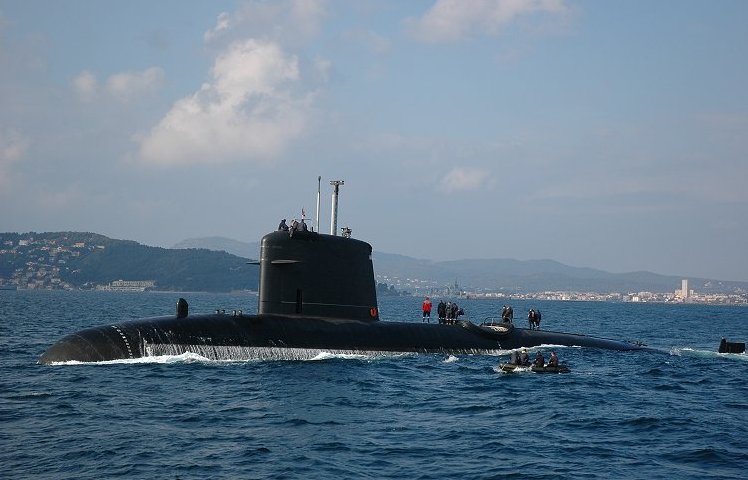
Casabianca, of the Rubis class (now six modernized SSNs), pending replacement by the Barracuda class.
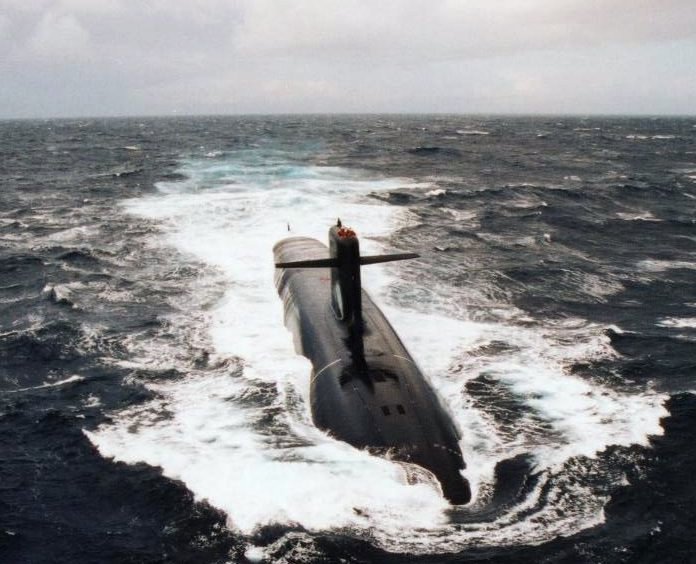
Temeraire, of the Triomphant class (1995) SSBN. No replacement scheduled before 2030 but an upgrade program, notably around the missiles and modular electronics.
So plans until 2030 seems already contained within the current classes we saw, a brand new generation which entered service after the end of the cold war, and quickstarted with the Charles de Gaulle. The FOST is likely to remain unchanged for the next 30 years unless a dramatic international event, the fleet completing acquisition of the Aquitaine class and Barracuda (Suffren) class SNAs. The future ten years of technological advances and innovations could go through the new FTI (or FDI) Frigates developed by Naval Group intended to replace on the long run the 1990 Lafayette class ships. There is no futuristic project showcased recently comparable to the British “dreadnought 2050” but the former DCN “Zumwalt-like” destroyer called the Swordship in 2006.
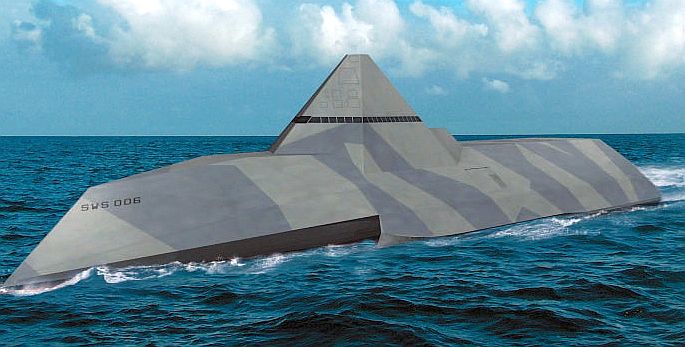
DCN (Now naval group) 2006 Swordship was a futuristic exploration in warship design reminiscent of the Zumwalt style.
Read More
https://www.defense.gouv.fr/marine
https://web.archive.org/web/20250219122802/https://www.navypedia.org/ships/france/fr_index.htm
https://en.wikipedia.org/wiki/French_Navy
https://en.wikipedia.org/wiki/Future_of_the_French_Navy
https://en.wikipedia.org/wiki/Toulon_arsenal
https://en.wikipedia.org/wiki/Brest_Arsenal
https://en.wikipedia.org/wiki/Cherbourg-en-Cotentin
https://en.wikipedia.org/wiki/List_of_active_French_Navy_ships
https://fr.wikipedia.org/wiki/Loi_de_programmation_militaire_2024-2030
 Latest Facebook Entry -
  X(Tweeter) Naval Encyclopedia's deck archive
 Instagram (@navalencyc)


 French Navy
 Royal Navy
 Russian Navy
 Armada Espanola
 Austrian Navy
 K.u.K. Kriegsmarine
 Dansk Marine
 Nautiko Hellenon
 Koninklije Marine 1870
 Marinha do Brasil
 Osmanlı Donanması
 Marina Do Peru
 Marinha do Portugal
 Regia Marina 1870
 Nihhon Kaigun 1870
 Preußische Marine 1870
 Russkiy Flot 1870
 Svenska marinen
 Søværnet
 Union Navy
 Confederate Navy
 Armada de Argentina
 Imperial Chinese Navy
 Marine Haitienne
 Marinha do Portugal
 Mexico
 Kaiserliche Marine
 1898 US Navy
 Argentina
 Brazil
 Chile
Chile Cuba
Cuba Peru
Peru Bulgaria
 Denmark
 Greece
 Netherlands
 Norway
 Portugal
 Romania
 Sweden
 China
China Thailand
 Sovietskiy Flot
 Royal Canadian Navy
 Royal Australian Navy
 RNZN Fleet
 RIN Fleet
 Chinese Navy 1937
 Kriegsmarine
 Chilean Navy
 Danish Navy
 Finnish Navy
 Hellenic Navy
 Polish Navy
 Romanian Navy
 Turkish Navy
 Royal Yugoslav Navy
 Royal Thai Navy
 Minor Navies
 Albania
 Austria
 Belgium
 Columbia
 Costa Rica
 Cuba
Cuba Czechoslovakia
 Dominican Republic
 Haiti
Haiti Hungary
 Honduras
 Estonia
 Iceland
 Eire
Eire Equador
 Iran
Iran Iraq
Iraq Latvia
 Liberia
 Lithuania
 Mandchukuo
 Morocco
 Nicaragua
 Persia
 San Salvador
 Sarawak
 Uruguay
 Venezuela
 Zanzibar
 Warsaw Pact Navies
 Bulgaria
 Hungary

 Bundesmarine
 Dutch Navy
 Marina Militare
 Yugoslav Navy
 Chinese Navy
 Indian Navy
 Indonesian Navy
 JMSDF
JMSDF North Korean Navy
 Pakistani Navy
 Philippines Navy
 ROKN
ROKN Rep. of Singapore Navy
 Taiwanese Navy
 Vietnam People’s Navy
 IDF Navy
 Saudi Navy
 Royal New Zealand Navy
 Egyptian Navy
 South African Navy


 Ukrainian Navy