
 Sjøforsvaret
A famous inheritance
 This country with proud and formidable Viking traditions was Christianized around the year 1000, especially during the reign of the “Missionary Kings”, including Olaf Tryggvason. Norway embraced Luheranism in the 17th century, but stayed since 1430 united in a sort of dual monarchy with Denmark. In fact Denmark became more omnipotent and the Kingdom of Norway lost its independence in fact in 1536, being integrated in “Greater Denmark”. It was only at the beginning of the 19th century, thanks to the Napoleonic wars that the situation began to change. A Danish-Swedish confrontation led in 1814 to the cession of Norway to the Swedish Kingdom, and the creation of a National navy as well. However, the reluctance of the population, fueled by Prince Christian Frederick, resulted in the constitution of an assembly at Eidsvoll. Norway became independent and the Prince became King of a parliamentary monarchy.
Sweden failed in its diplomatic attempts and launched a victorious offensive. As a result of the Moss agreements, Norway retained its autonomy but was attached to Sweden in an new Union which lasted until 1905.
The Kingdom’s economic situation was not brilliant though, aggravated by a conflict between the Norwegian Parliament (The Storting) and the Swedish Royalty which had authority over Norway. It was not until the very end of the nineteenth century that the people could begin to think of leaving the forced union with Sweden: On June 7, 1905, following the resignation of the government, the parliament took the decision of an unilateral move of Norway out of the union that was dissolved. King Hakon VII ascended the throne, and the situation in Sweden began to slowly improve economically. But the country was still poor and suffered mass emigration towards America.
Articles
Haarfarge class coast defence ships (1897)
Norge class coast defence ships (1900)
Scorpionen class monitors (1866)
Monitor HNMoS Thor (1873)
Cruiser HNOMS Frithjof (1895)
Cruiser HNOMS Viking (1891)
Draug class Destroyers (1908)
Varg class TBs (1894)
Hval class TBs (1896)
Hvas class TBs (1898)
Ravn class TBs (1903)
Teist class TBs (1903)
Submersible Kobben (1909)
Minelayer HNOMS Fröya (1916)
Minelayer HNOMS Glommen (1917)
The Norwegian Navy
In 1905 the union between the Norwegian and Swedish kroner was coming to an end, and Norway had only a modest fleet of coastguard and torpedo boats. The weakness of the industrial means of the country forced the government to order its largest units in England, contrary to the Swedes. This fleet was limited to a monitor and 4 coastal battleships, 4 gunboats, a destroyer and 12 torpedo boats. The total strength was 1000 active men reinforced per 1000 conscripts. It was planned to build additional units before 1914: 3 destroyers, 3 torpedo boats, 4 submersibles, and two other coastal battleships were planned.
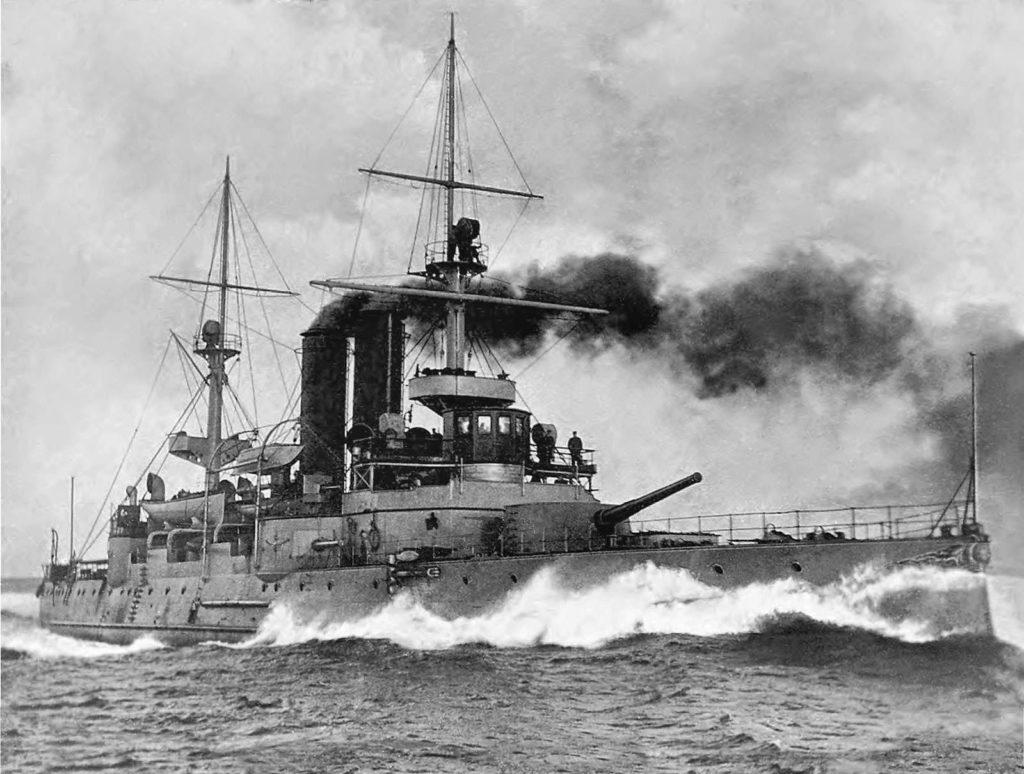
Coastal Battleship HNoMS Norge
Neutral during the war, Norway did not suffer so little was its commercial traffic. Only his iron, also interested English and German, and was the point of attention of his big neighbors. The navy carried out mainly missions of mines dredging and coastal surveillance. However, Norwegian neutrality leaned rather on the side of the allies. In 1916, for example, she intercepted a German diplomatic bag infected with germs intended to contaminate the pockets of plasma intended for the wounded English. It was also proposed in 1918 to involve Norway in stalking the U-Bootes by equipping it with the latest English acoustic equipment, but the proposal had no follow-up. Norway did not take part in the battles of the Great War, its fleet carrying out surveillance missions and remaining alert. Here is what it contained:
4 Coastal Battleships: 2 class Norge (1900), 2 class Haarfarge (1897). Expected (ordered in 1913: 2 class Nidaros, they were requisitioned by the RN in August 1914 and integrated as HMS Gorgon and Glatton).
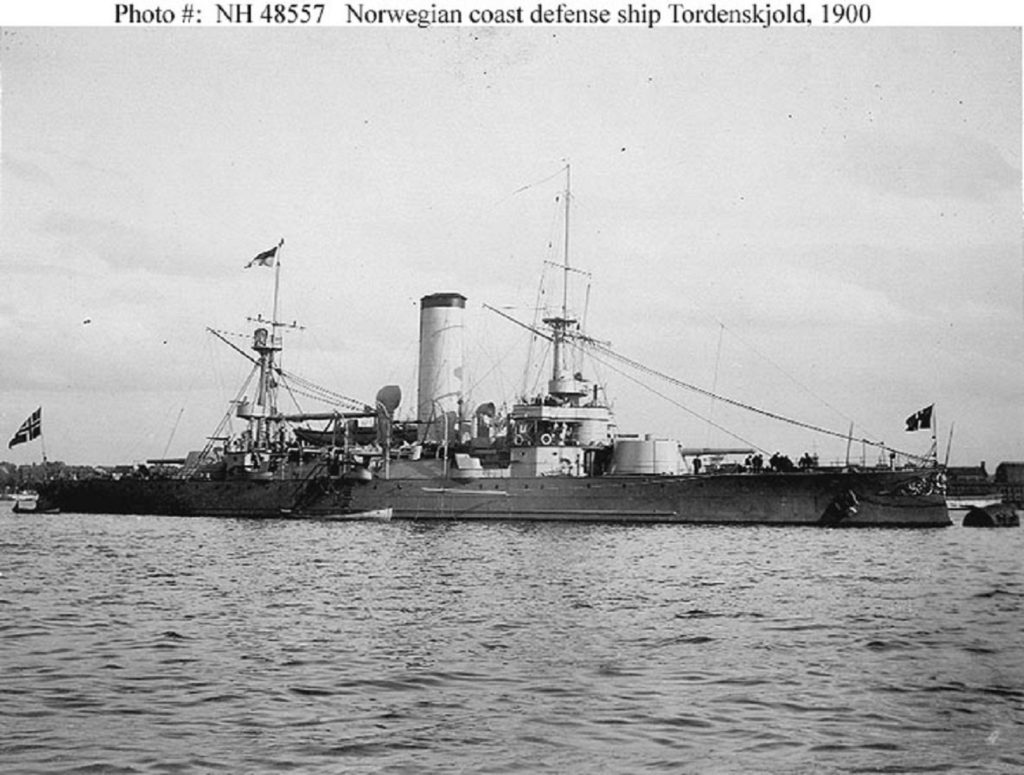
HNoMS Tordenskjold
2 Cruisers: Frithjof (1895), Viking (1891). These two low-tonnage ships were rebuilt and rearmed in 1904-08. Frithjof served as a training ship.
4 Destroyers: Recent: 3 class Draug (1908-13), Valkyrjen (1896).
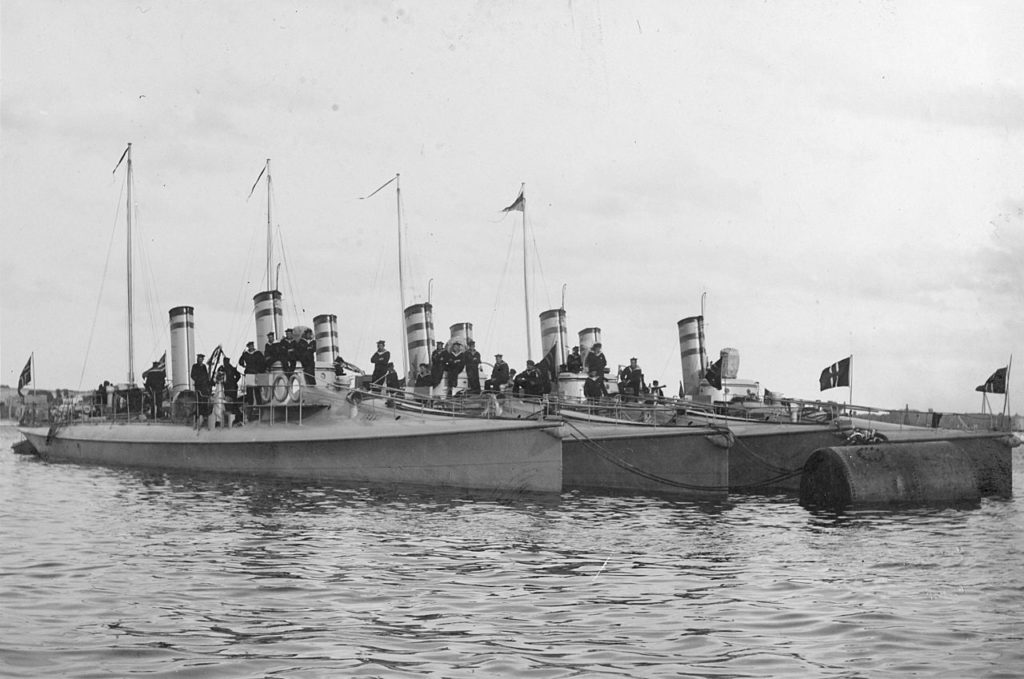
40 Torpedo Boats:
First class: 3 class Teist (1906), 10 class Hval (1896-1901).
Second class: 5 class Ravn (1903), 4 class Hvas (1900), 8 class Varg (1894), 3 class Snar (1888), 4 class Of (1882).
Third class: Rap (1872), Ulven (1878), Myg (1899).
4 Submersibles: Köbben (1909), 3 class A2 (1913). Built in Germany.
11 Miscellaneous: Gunboats Aeger (1893), Ellida (1880), 2 Gor class (1884), 5 Vale class (1874), 2 class Rjukan (1860).
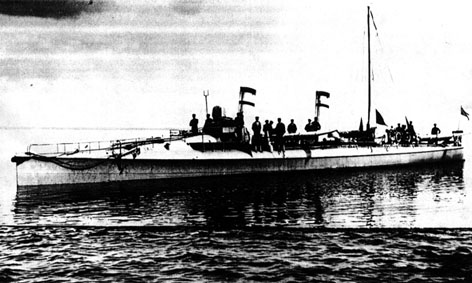
HNoMS Sael
Tonnage 1914:
Armored Coast Guard 4 – Cruisers 2 – Destroyers 1 – Raiders 40 – Submersibles 4 – Miscellaneous 11
The Norwegian Navy during the First World War:
Some units were built during the war: Three torpedo class Trygg, completed in 1919-21; the Orkla gunboat (1917), the Fröya mine anchor (1916), and the two other Glommen class (1917).
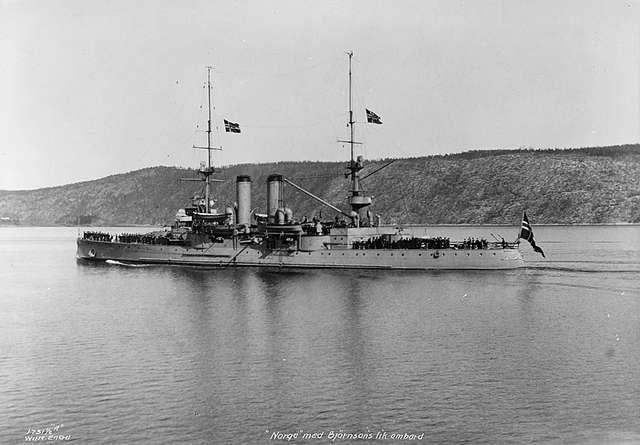
Coastal Battleship Norge (1900). 4 of such BS were in service, alongside two more of the older Haarfarge class. A powerful proposition for a coastguard.
 The Norwegian Navy in 1914
En 1905, the union between Norwegian and Swedish crown arrived to term, the former only possessing a rather small coastguard contingent of gunboats and TBs. Its limited industrial capabilities obliged the government to order its major units in UK, while Sweden was totally autonomous of foreign acquisitions. The Norwegian navy possessed a monitor, four coastal battleships, four gunboats, one destroyer and 12 Torpedo Boats in all, totalling 1000 active officers and sailors reinforced by 1000 conscripts. FY1914 Naval plan was more ambitious, aiming at a supplement of 3 destroyers, 3 TBs, 4 submersibles, and two more coastal battleships.
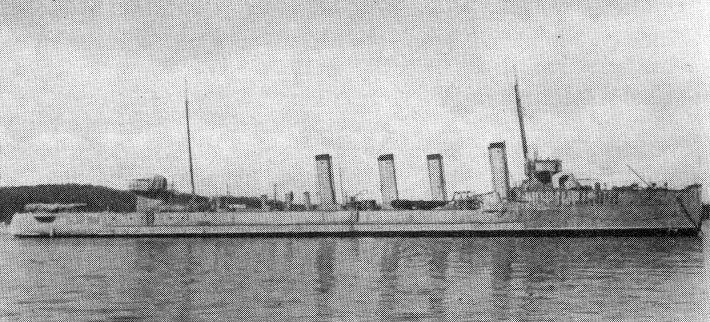
Draug class destroyers
Neutral for the duration of the war, Norway did not suffered of commerce disruption as much its freighter fleet was meager. Its most precious asset, iron, constituted the focal point of its neighbors. The Norwegian navy multiplied missions of minesweeping and coastal patrols. However, despite its well-known and well-shown neutrality, Norway leaned towards the allies. In 1916 indeed, she intercepted a precious German diplomatic suitcase, infected by germs destined to poison plasma bags en route for British casualties.
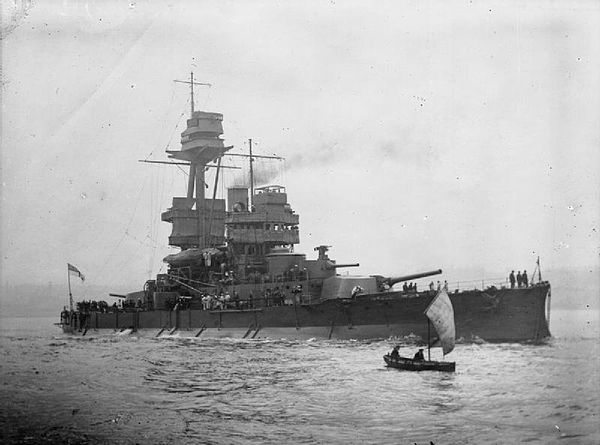
HMS Glatton: Formerly Nidaros class, ordered to UK in 1913 but requisitioned after the outbreak of war.
The British admiralty also tried in 1918 to drag more actively Norway into chasing U-boats, giving their precious latest acoustic equipment in exchange, but such proposal was rejected.
So here was the Norwegian naval strength in 1914:
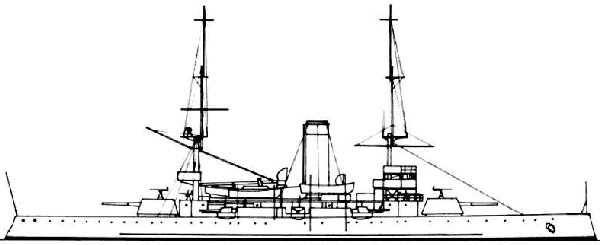
Tordenskjold profile
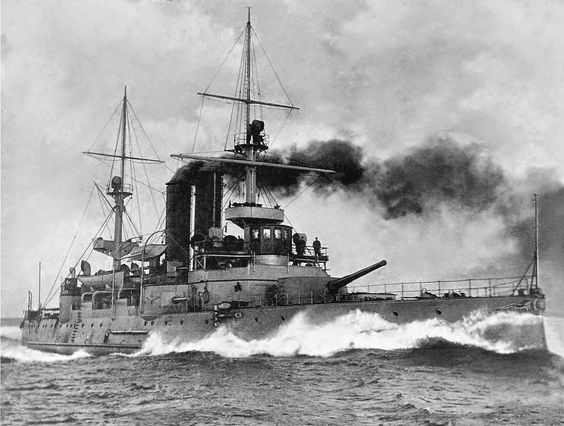
Norge class coastal battleships
-2 Cruisers: Frithjof (1895), Viking (1891). These two small tonnage ships has been rebuilt and rearmed in 1904-1908. Frithjof served as schoolship.
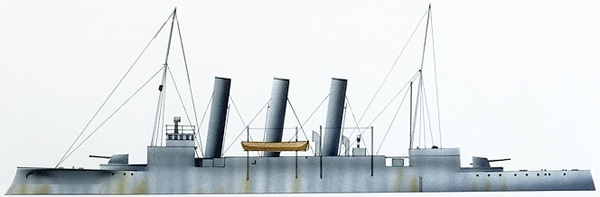
Frithjof cruiser profile (1895)
-4 Destroyers: 3 Draug (1908-13), single Valkyrjen (1896).
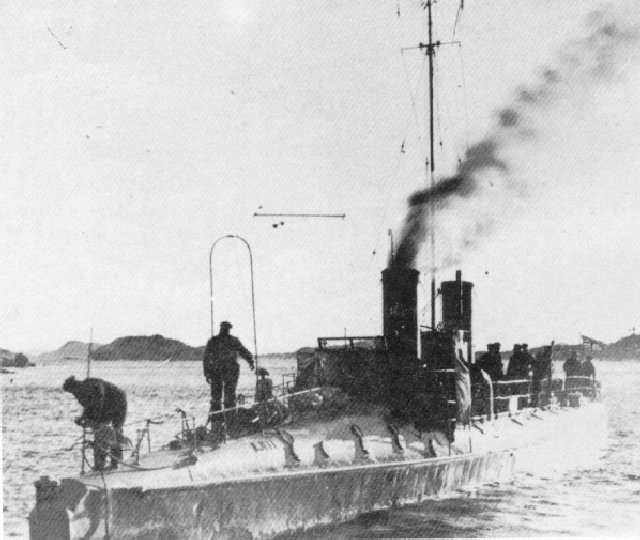
Kjell of 2nd class TBs
-40 Torpedo Boats:
1st class: 3 Teist (1906), 10 Hval (1896-1901).
2nd class: 5 Ravn (1903), 4 Hvas (1900), 8 Varg (1894), 3 Snar (1888), 4 Od (1882).
3rd class: Rap (1872), Ulven (1878), Myg (1899).
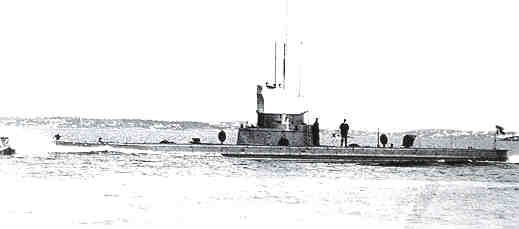
A4 class submarines
-4 Submersibles: Köbben (1909), three A2 class (1913), all built in Germany.
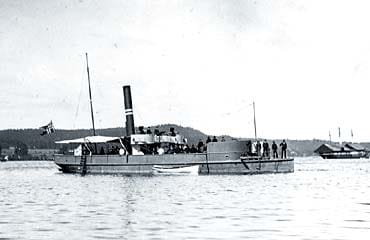
-11 Miscellaneous: Gunboat Aeger (1893), Ellida (1880), two Gor class (1884), five Vale class (1874), 2 Rjukan class (1860).
Until 1918, the Norwegian navy built Three Trygg class TBs, only achieved postwar, in 1919-21; gunboat Orkla (1917), minelayer Fröya (1916), and two Glommen class (1917).
Vale class gunboats
The Swedish Navy
The end of Kalmar union between the Crowns of Norway and Sweden, was the result of count Bernadotte 1814’s active lobbying, recently ended in 1905. Sweden was left to control the Skattegat strait towards the Baltic, the eastern coast being controlled by the old rival from St Petersburg, the Russian Empire. Sweden however had the double chance to have a powerful industrial basis, and resources to go with these assets. Its story was comparable to the US Navy, althought on the smaller scale. The diet (Parliament) approved many coastal battleships recently that dwarved any comparable ships and were worthy of “pocket dreadnoughts”.
Already by far the most prominent Scandinavian naval power, Sweden was however still way below its European neighbours both in quantity and quality, making it only a regional naval power. Sweden innovated with submarines, noticeably those of Nordenfelt, produced by Bolinders Mekanika Verkstad and Nordenfelt, Karlsvik in Stockholm. In 1885 these submersibles made such an impression at an international naval exhibition that UK, Greece, Turkey and Russia bought some. They predated Holland and Laubeuf submarines by nearly 10 years.
This tradition endured and Sweden aligned a rather powerful fleet of submarines in 1914. Naval bases were located at Karlskrona (the main naval fortress, fortified in the Vauban style), plus six large drydocks for submersibles at Stockholm, forts and coastal batteries, three drydocks, a TB base at Göteborg. Two other bases were located at Farösund, Gotland and Hemsö Bothnia gulf. The navy was commanded by an admiral, split between the coastal force and the fleet, divided into squadrons. Coastal defense wasn’t limited to forts but also comprised numerous batteries well hidden into granit-built blockhaus, rail batteries, and minelayers.
(Other informations to come)
 Latest Facebook Entry -
  X(Tweeter) Naval Encyclopedia's deck archive
 Instagram (@navalencyc)


 French Navy
 Royal Navy
 Russian Navy
 Armada Espanola
 Austrian Navy
 K.u.K. Kriegsmarine
 Dansk Marine
 Nautiko Hellenon
 Koninklije Marine 1870
 Marinha do Brasil
 Osmanlı Donanması
 Marina Do Peru
 Marinha do Portugal
 Regia Marina 1870
 Nihhon Kaigun 1870
 Preußische Marine 1870
 Russkiy Flot 1870
 Svenska marinen
 Søværnet
 Union Navy
 Confederate Navy
 Armada de Argentina
 Imperial Chinese Navy
 Marine Haitienne
 Marinha do Portugal
 Mexico
 Kaiserliche Marine
 1898 US Navy
 Argentina
 Brazil
 Chile
Chile Cuba
Cuba Peru
Peru Bulgaria
 Denmark
 Greece
 Netherlands
 Norway
 Portugal
 Romania
 Sweden
 China
China Thailand
 Sovietskiy Flot
 Royal Canadian Navy
 Royal Australian Navy
 RNZN Fleet
 RIN Fleet
 Chinese Navy 1937
 Kriegsmarine
 Chilean Navy
 Danish Navy
 Finnish Navy
 Hellenic Navy
 Polish Navy
 Romanian Navy
 Turkish Navy
 Royal Yugoslav Navy
 Royal Thai Navy
 Minor Navies
 Albania
 Austria
 Belgium
 Columbia
 Costa Rica
 Cuba
Cuba Czechoslovakia
 Dominican Republic
 Haiti
Haiti Hungary
 Honduras
 Estonia
 Iceland
 Eire
Eire Equador
 Iran
Iran Iraq
Iraq Latvia
 Liberia
 Lithuania
 Mandchukuo
 Morocco
 Nicaragua
 Persia
 San Salvador
 Sarawak
 Uruguay
 Venezuela
 Zanzibar
 Warsaw Pact Navies
 Bulgaria
 Hungary

 Bundesmarine
 Dutch Navy
 Marina Militare
 Yugoslav Navy
 Chinese Navy
 Indian Navy
 Indonesian Navy
 JMSDF
JMSDF North Korean Navy
 Pakistani Navy
 Philippines Navy
 ROKN
ROKN Rep. of Singapore Navy
 Taiwanese Navy
 Vietnam People’s Navy
 IDF Navy
 Saudi Navy
 Royal New Zealand Navy
 Egyptian Navy
 South African Navy


 Ukrainian Navy