
 United Kingdom (1911)
Iron Duke, Marlborough, Benbow, Emperor of India
The last prewar dreadnought class
Last dreadnoughts before the revolutionary Queen Elisabeth class largely completed during the war, the Iron Dukes were the last of a lineage started with the HMS Dreadnought a few years ago. The class consisted in four ships which design was in straight line with the previous King Georges V and Orion. The main battery of twin 13.5 in turrets (343 mm) were centerline, with a central turret encased between the rear funnel and rear blockhaus.
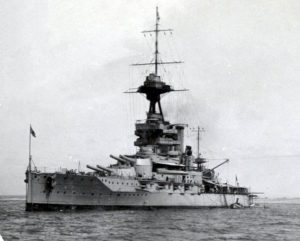
The four battleships of this class (Iron Duke, Marlborough, Benbow and Delhi – later renamed Emperor of India) were laid down in Portsmouth, Devonport, Beardmore and Vickers in 1912 (two in January and two in May). They were not the idea of Sir John Fisher, who left his post as lord of the sea in 1910, but of the Admiralty under the pressure of those practicing naval exercises, wishing for a less dogmatic approach than partisans of “speed and heavy artillery only” school. Importantly enough, 6 in (152 mm) cannons were reintroduced into the secondary battery, as 5 in (102 mm) were considered too weak, and the 533 mm torpedo tubes were adopted as a new standard.
For the rest, these battleships were inspired by the King Georges V but reached out a level close to 30,000 tons, with a speed slightly higher than 21 knots. HMS Benbow and Emperor of India may not have been the best known of British prewar battleships, but they undoubtedly closed an important chapter in British battleship design, stretching from 1910 with a total of 18 dreadnoughts of relatively similar design. Only HMS Duke of York made it into WW2, leaving much for speculation towards Washington treaty’s limitations and possible wartime modernization (see later).
Design
Iron Duke’s design was slightly enlarged, 25ft longer, a bit beamier and deeper. That increase was related to the new secondary artillery, much heavier, in order to preserve buoyancy forward and aft. This secondary battery was also moved further aft to reduce interference in bad weather. The configuration of their secondary batteries meant that all but two of the guns pointed at the front, and the two rear ones were soon considered too low and inefficient in heavy weather. They were removed during the war and carried over to the Upper, firing forward.
The firing station was much reinforced, as an even more essential organ of control, enlarged and supported by a solid tripod. The Iron Dukes were also the first battleships equipped with anti-aircraft guns, the “12-pounders” (76 mm). Very long in caliber, these anti-aircraft Mk.1 20cwt pieces were meant to shoot down no less than Zeppelins.
The HMS Iron Duke tested a new model of anti-torpedo nets, quickly removed and never adopted by other ships in its class. As for protection, barbettes had a new type of reinforced integral shield that was also adopted on the HMS Tiger and later battleships of the Queen Elisabeth class. They saw also reinforced their light armor after the Battle of Jutland, around the searchlights, the deck and ammunition bunkers. In 1918 their shooting range was considerably enhanced and their mast shortened while airplane platforms were placed on the central and second front turrets for advanced reconnaissance.
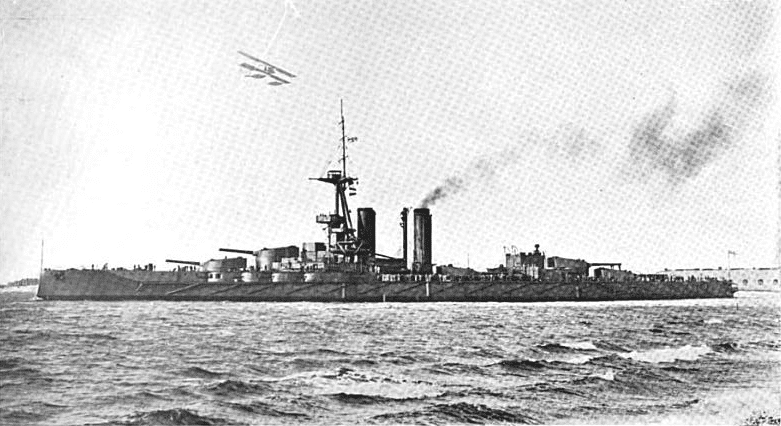
The Iron Dukes in service
These four ships spent nearly all their career within the Grand Fleet at Scapa Flow. Their completion was achieved at the eve of the war (March and June 1914 for the first two, October and November 1914 for the last two). As a result, their crews were not yet well trained at the beginning of the war, but nevertheless these powerful ships became the spearhead Of the Royal Navy. HMS Iron Duke was the general flagship of the Great Fleet until November 1916. The Iron Duke served the longest, being converted as a training ship in 1930, then depot from 1939, and retired in 1946. The three others also served in Jutland. The Marlborough was torpedoed and repaired in three months while serving in the Atlantic, and was sent to the Mediterranean after the war. These ships were reformed in 1929-32.
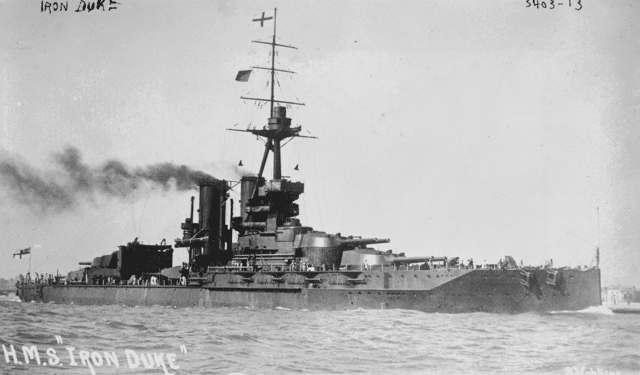
HMS Iron Duke under way
HMS Iron Duke
HMS Iron Duke fought in Jutland with the 2nd battle squadron, and after the war, sent to the Mediterranean in 1919, reaching the Black Sea to support the White Russians until 1920. She then served in the North Atlantic squadron until 1929 before being reformed, following the limitations of the Washington Treaty, and converted the next year as a training ship. She was partially disarmed, cleared of its armor, and its powerplant flanged for an effective speed of 18 knots, conditions required by the treaty for such category of ship.
In this second chapter of her life, she served as the main advanced training battleship of the Royal Navy until 1939. Based at Scapa Flow, she then served as pontoon, totally disarmed. On 17 October 1939 she suffered a German air attack and was damaged. Summarily repaired but beached, at anchor, she was eventually stricken out and sent to the breaking yard as scrap metal value in 1946. The Iron Duke’s bell is on display at Winchester Cathedral.
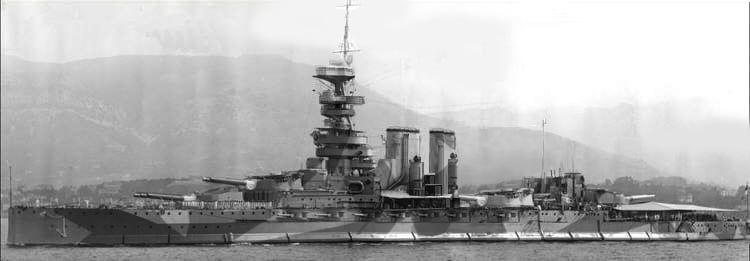
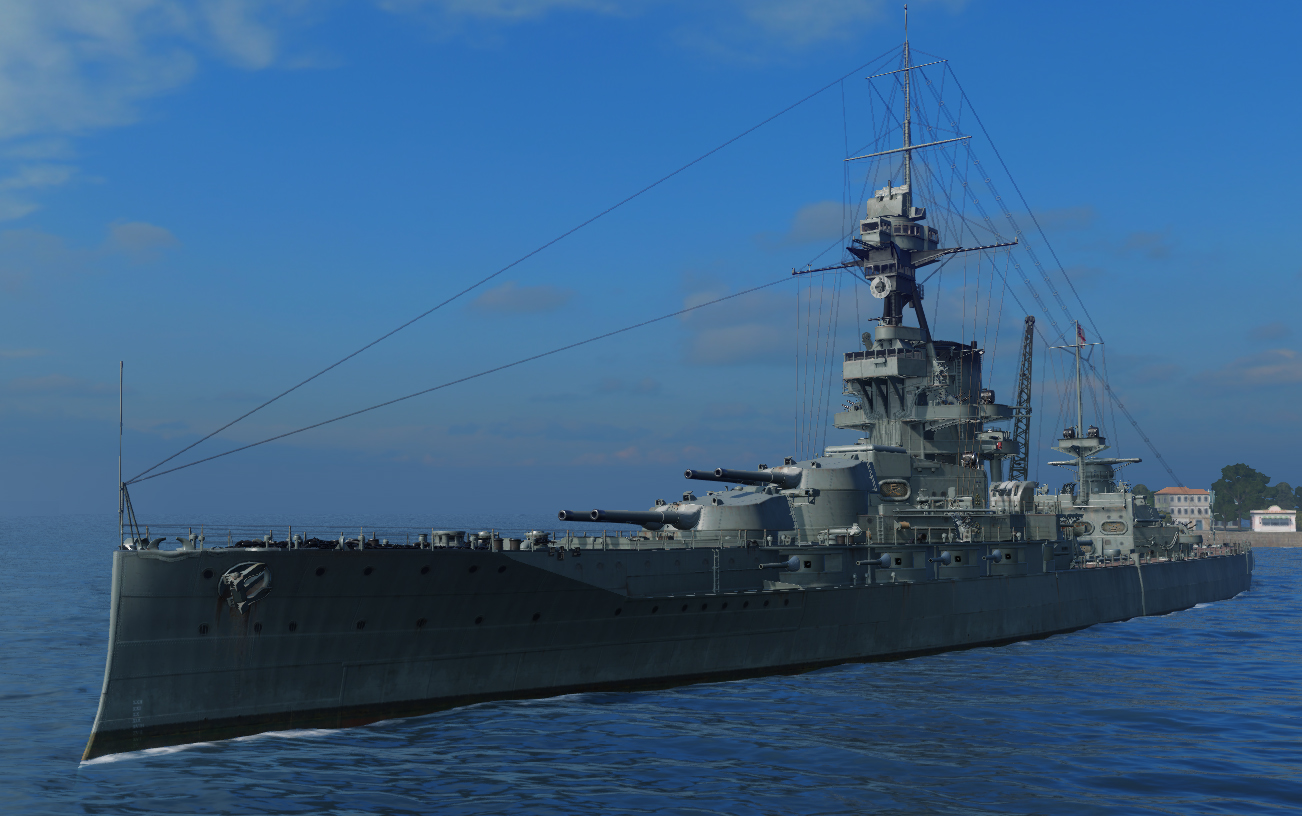
What-if photoshop of the Iron Duke rearmed and used in WW2 (here on the Mediterranean theater).
HMS Benbow
She teamed with HMS Emperor of India at the 4th Battle Squadron in December 1914, shortly after completion. Her rearmost 6-inch guns were removed and the casemates sealed off. She replaced HMS Dreadnought as the flagship of the 4th Squadron, then took part in various naval drills in 1915 without noticeable incident off the Orkneys and Shetlands and along the North Sea. The routine of gunnery drills restarted in 1916, but on the night of 25 March, Benbow and the rest of the fleet sailed from Scapa Flow to support the Battlecruiser Fleet and other ships raiding the German zeppelin base at Tondern. However as she approached the area on 26 March, opposite forces had already disengaged, and a severe gale prevented any further action. The Benbow also took part in the diversion action off Horns Reef on 21 April. Another similar action will take place in early May.
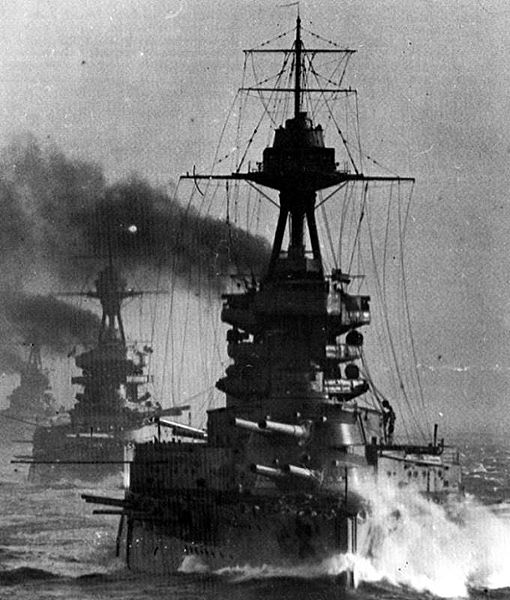
HMS Benbow in the battle line
On May, 31, 1916 she took part in the battle of Jutland, as the flagship of Vice Admiral Doveton Sturdee, stationed toward the center of the British line. Benbow’s gunners however did not scored any hit because of poor visibility at first. Gunners later claimed incorrectly some hits on the SMS Derfflinger. But she engaged successfully German TBs with her secondary battery, repelling these before any efficient torpedo launch. In the course of the battle, Benbow fired forty 13.5-inch armour-piercing, capped shells and sixty 6-inch rounds.
After the battle, the routine of drills restarted, as the German Fleet never ventured in force again in the North Sea. She was at Scapa Flow to see the Hochseeflotte being interned, escorted by 320 ships of an international coalition, following the Versailles treaty conditions.
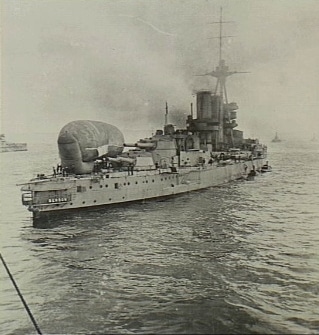
HMS Benbow exeprimenting with an observation kite balloon in 1916
By 1919, she was stationed with the 4th Squadron of the Mediterranean fleet, and served until 1926, supporting the White Russians in the Black sea, then as an observer in the Greek-Turkish war of 1920. Prior to her departure she received like her sister-ships flying off ramps on B and Q turrets, rangefinder baffles, funnel caps, additional searchlights and armour.
On July 1920 however she landed a force at Gemlik to secure the harbor for the Greeks to take over. She trained in the sea of Marmara in 1921 and in September and October took part in further operations against Turkish forces. Her unit, renamed 3rd Squadron was transferred to the Atlantic in 1926. In 1929 she was paid off and broken up in 1931 as part of the tonnage limitation of the Washington Treaty.
HMS Marlborough
Marlborough was assigned as the flagship of the 1st Battle Squadron, for all the war. In December she was second-in-command flagship for the Grand Fleet. She took part in gunnery drills during 10–13 January 1915 and later sailed in support of Beatty’s Battlecruiser Fleet (battle of Dogger Bank). She spent the rest of the year and the next performing drilling exercises. She supported the raid Trondern and sortied for a demonstration off Horns Reef in favor of Russian fleet efforts in the Baltic.
However in May 1916 she took part in the battle of Jutland, scoring three hits on the König-class battleship’s SMS Grosser Kurfürst during the battle.
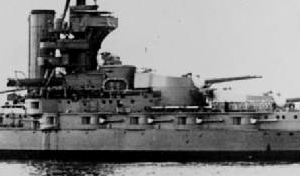
HMS Marlborough secondary artillery
This was on the second part of the battle. During the action however she was engaged by the SMS Wiesbaden a torpedo hit around the starboard diesel generator room. She engaged her twice, firing salvos at ranges of 9,500 to 9,800 yards (8,700 to 9,000 m). She also fired two torpedoes that missed their targets. However she listed the torpedo hit damaging forty watertight compartments, thought the torpedo bulkhead resisted.
Evasing action took her out of harm from other German TBs as she avoided several more hits. On its way back however the whole 6th Division was slowed down by Marlborough, at 15 knots. She proceeded to the Humber for temporary repairs, and later departed for Cromarty where she was repaired but also received an extra 100 tons of deck armour.
By February 1917 she was relegated as second command flagship. In 1918 she received flying-off platforms on her “B” and “Q” turrets for reconnaissance aircrafts. In March 1919, she was recommissioned at Devonport and assigned to the Mediterranean Fleet, 4th Battle Squadron where she served until 1926.
She also took part in the support to the Whites against the Red Bolsheviks in the Black sea. Sailing to Yalta she took Dowager Empress Maria Feodorovna and other members of the deposed Russian Imperial Family including Grand Duke Nicholas and Prince Felix Yusupov and later anchored off Halki Island, near Constantinople. Part of her guests then boarded HMS Lord Nelson destined for Genoa.
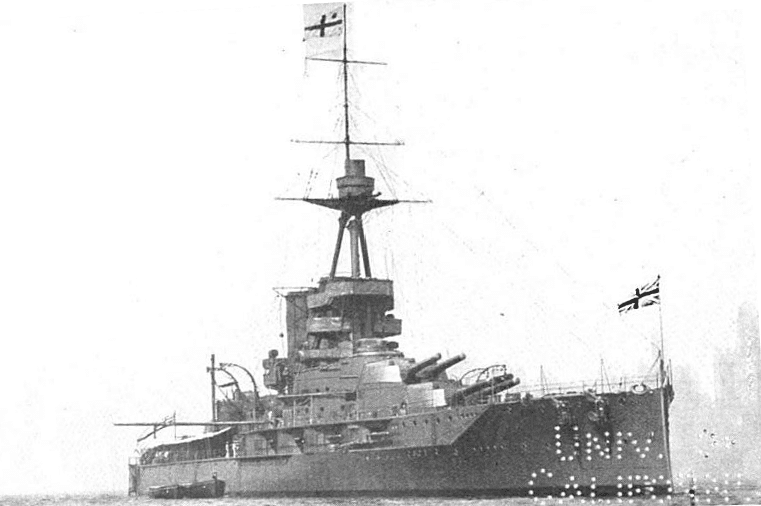
HMS Marlborough
She later took part in high-explosive 6-inch shells trials off the Kerch Peninsula, and operated a kite balloon. She was also an observer in the 1920 Greco-Turkish War. She departed for Devonport in 1920, received some modifications, then returned to the Mediterranean, and in March 1926, her unit renamed the 3rd Battle Squadron was relocated in the Atlantic.
In 1930, however, according to the Washington Treaty she was disarmed, then used as a target in the summer of 1931, before being disposed of in 1932 and broken up the same year by the Alloa Shipbreaking Co.
HMS Emperor of India
She served with the 4th Battle Squadron as the second division flagship, for the first two years of the war. By December 1915, her rearmost 6-inch guns were removed (like for the four Iron Duke-class ships) and casemates sealed off. These had been a liability in bad weather as water regularly gushed in.
She served with 4th and 2nd Squadrons, conducting drills west of the Orkneys and Shetlands, supported the squadron engaged at the first battle of Dogger bank. Other exercises in the north sea followed in March and April, May, and up to the fall of the year.
In January 1916 Jellicoe had intended to use the Harwich Force to sweep the Heligoland Bight, but bad weather prevented operations in the area. Later on the battleship supported the action of the battlecruiser fleet that raided the German zeppelin base at Tondern.
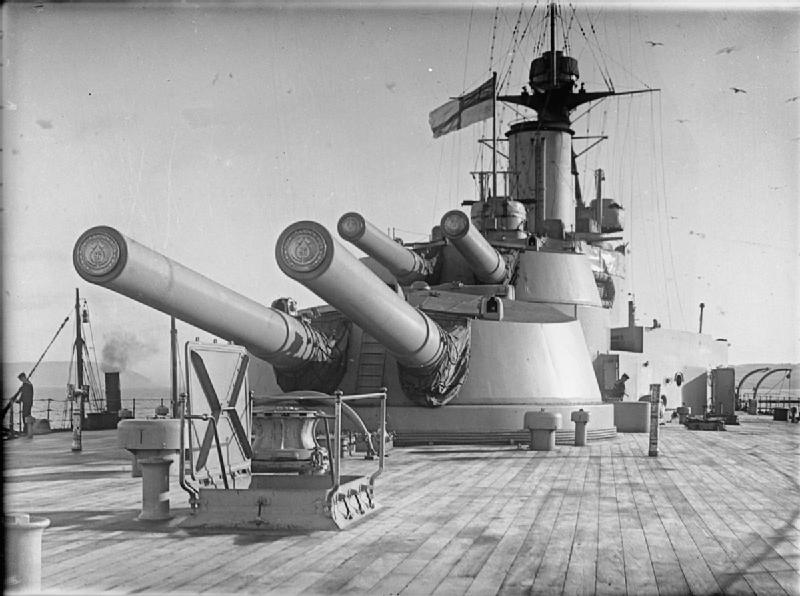
HMS Emperor of India aft 13.5 in gun turrets
In April 21, 1916, she took part of a demonstration off Horns Reef to distract the Germans while the Russian Navy relaid its defensive minefields in the Baltic Sea. In May missed however the battle of Jutland, refitting in drydock.
She was transferred to the 1st Battle Squadron, and in August was equipped to handle a kite balloon, for spotting mines and U-boats. She also received an additional 100 t (98 long tons; 110 short tons) of armour over the magazines between October and December 1916. Next years she was given larger, additional searchlights, funnel caps, rangefinder baffles (later removed).
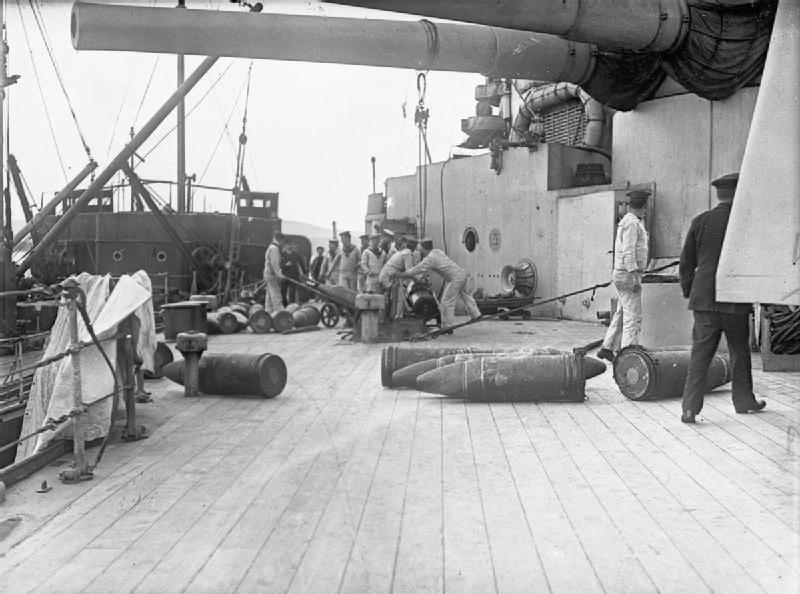
Ammunitions loaded onboard HMS Emperor of India
She was assigned in 1919 to the Mediterranean 4th Battle Squadron and served in the Black Sea, supporting the white Russians, bombarding Bolshevik troops on 5 May 1919 outside Theodosia, and later at Novorossiysk, even duelling with an armoured train ! She was also an observer in the Greco-Turkish War of 1919–22.
After a refit in 1922 (long-base rangefinders installed on “X” turret), she served in the Mediterranean until 1926, had a refit the next year in Devonport, served as squadron flagship from until January 1931, and was disarmed following the Washington Treaty, then Broken up in 1932.
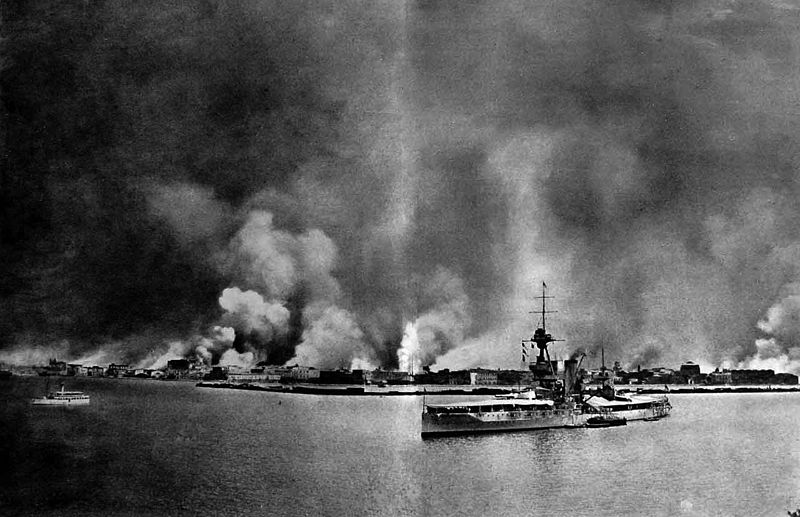
The burning of Smyrna (Gerco-Turkish war of 1920) as seen from the King Georges V. The Iron Duke is on the foreground.
More about the iron Duke class – src
The Dreadnought on wikipedia
On the dreadnought project
Specs ww1.co.uk
Article by Steve Woodward
On Royal Navy’s portal
Another article on the Iron Duke
Specs Conway’s all the world fighting ships 1906-1921.
Specifications |
|
| Dimensions | 189,9 x 27.4 x 9 m (622’9” x 90′ x 29’6”) |
| Displacement | 25 000t, 29 560t FL |
| Crew | 995 to 1022 (wartime) |
| Propulsion | 4 screws, 4 Parsons turbines, 18 Babcock & Wilcox boilers 29,000 hp |
| Speed | 21.5 knots (39 km/h; 24.7 mph) |
| Range | 7780 nmi @10 knots (18.5 km, 11.5 mi) |
| Armament | 10 x 13.5 in/45 cal Mk V (343 mm) (5×2), 12 x 6 in/45 cal (152 mm) BL Mk VII, 2 x 4 in (76 mm) Mk I AA, 4 x 3pdr (47 mm), 5 TT 21 in (553 mm) (sub) |
| Armor (max figures) | Belt 12 in (300 mm), Bulkheads 8 in (200 mm), Barbettes 10 in (250 mm), turrets 11 in (280 mm -face) as the conning tower, deck 4 in (76 mm) |
Video
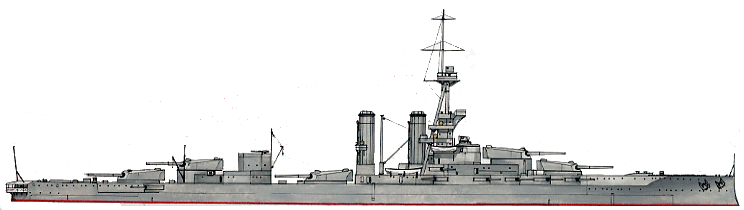
Illustration of the Iron Duke
 Latest Facebook Entry -
  X(Tweeter) Naval Encyclopedia's deck archive
 Instagram (@navalencyc)


 French Navy
 Royal Navy
 Russian Navy
 Armada Espanola
 Austrian Navy
 K.u.K. Kriegsmarine
 Dansk Marine
 Nautiko Hellenon
 Koninklije Marine 1870
 Marinha do Brasil
 Osmanlı Donanması
 Marina Do Peru
 Marinha do Portugal
 Regia Marina 1870
 Nihhon Kaigun 1870
 Preußische Marine 1870
 Russkiy Flot 1870
 Svenska marinen
 Søværnet
 Union Navy
 Confederate Navy
 Armada de Argentina
 Imperial Chinese Navy
 Marine Haitienne
 Marinha do Portugal
 Mexico
 Kaiserliche Marine
 1898 US Navy
 Argentina
 Brazil
 Chile
Chile Cuba
Cuba Peru
Peru Bulgaria
 Denmark
 Greece
 Netherlands
 Norway
 Portugal
 Romania
 Sweden
 China
China Thailand
 Sovietskiy Flot
 Royal Canadian Navy
 Royal Australian Navy
 RNZN Fleet
 RIN Fleet
 Chinese Navy 1937
 Kriegsmarine
 Chilean Navy
 Danish Navy
 Finnish Navy
 Hellenic Navy
 Polish Navy
 Romanian Navy
 Turkish Navy
 Royal Yugoslav Navy
 Royal Thai Navy
 Minor Navies
 Albania
 Austria
 Belgium
 Columbia
 Costa Rica
 Cuba
Cuba Czechoslovakia
 Dominican Republic
 Haiti
Haiti Hungary
 Honduras
 Estonia
 Iceland
 Eire
Eire Equador
 Iran
Iran Iraq
Iraq Latvia
 Liberia
 Lithuania
 Mandchukuo
 Morocco
 Nicaragua
 Persia
 San Salvador
 Sarawak
 Uruguay
 Venezuela
 Zanzibar
 Warsaw Pact Navies
 Bulgaria
 Hungary

 Bundesmarine
 Dutch Navy
 Marina Militare
 Yugoslav Navy
 Chinese Navy
 Indian Navy
 Indonesian Navy
 JMSDF
JMSDF North Korean Navy
 Pakistani Navy
 Philippines Navy
 ROKN
ROKN Rep. of Singapore Navy
 Taiwanese Navy
 Vietnam People’s Navy
 IDF Navy
 Saudi Navy
 Royal New Zealand Navy
 Egyptian Navy
 South African Navy


 Ukrainian Navy