
 United Kingdom (1897)
Canopus, Albion, Glory, Goliath, Ocean, Vengeance
Successors of the Majestic
Five ships of a new class of battleships were ordered on the 1896 plan. A sixth was on the 1897 plan. They were defined as faster versions of the Majestic, and at the same time to operate in the Far East to counterpoise especially the growing weight of the Nippon Navy. A real quadrature of the circle was also made, by reducing the thickness of the armor and the total weight of 2000 tons, by using Krupp steel rather than Harvey. Their armor and their artillery disposition remained modeled on those of the Majestic. Their “turrets” were actually relatively light barbettes, made of Krupp steel plates. The loading system was also new and allowed to operate it with parts inclined at all angles. These were also the first British battleships to have water tube boilers. The latter, Belleville, were scarcely heavier than the old ones and they put pressure on 300 bars, as against 155 on the old ones.
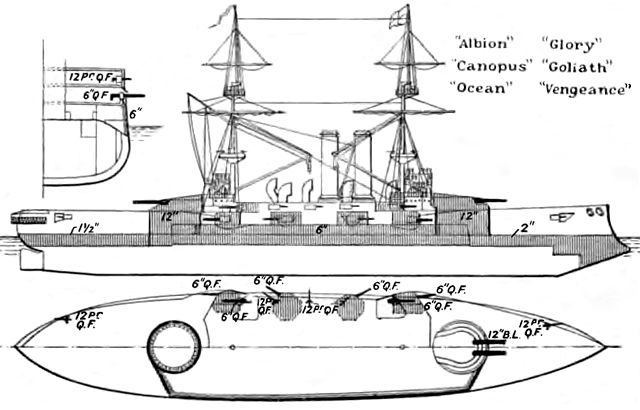
Brassey’s diagram of the class
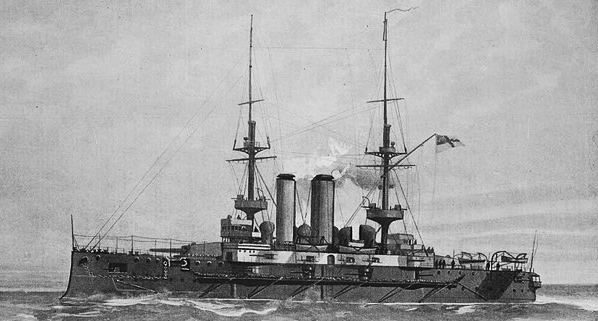
Canopus drawing by Alfred T. janes
The arrangement of these new boilers also made that their funnels were found in tandem and not side by side, provision kept thereafter for the future battleships. Test power reached 13,500 hp and reached speed of 18.5 knots. As expected, their career began with a long stay in the Far East squadron, which culminated after the Japanese victory against Russia in 1905 by a cautious military alliance with the Japanese Empire. As a result of this threat, the British repatriated a number of ships including these battleships into the Home Fleet, to ward off the growing threat of the Hochseeflotte.
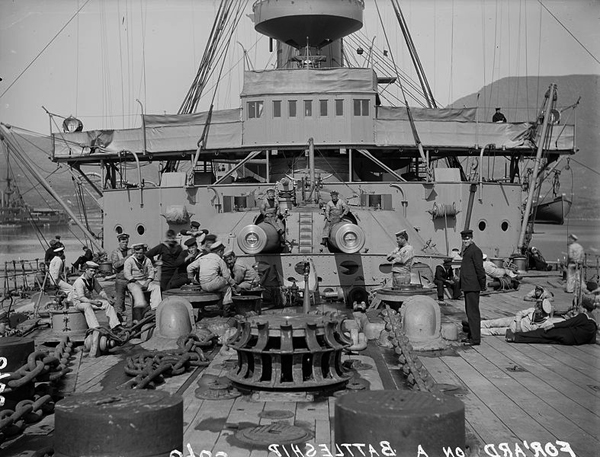
HMS canopus front artillery
HMS Albion
HMS Albion was in the 1906 Sailing Squadron before reemerging in Chatham in 1907. He was posted to the Home Fleet in Portsmouth and then to the Fleet. Atlantic. During the Great War he was sent to South Africa. Then he was assigned to the Mediterranean, bombing the strong Turks at the Dardanelles. He was touched seriously. After repairs, he sent troops to Salonica. Finally, he was stationed as coastguard of the Southeast fleet from the end of 1915 until 1918. He was assigned to Devonport, disarmed and used as a utility pontoon until 1922.
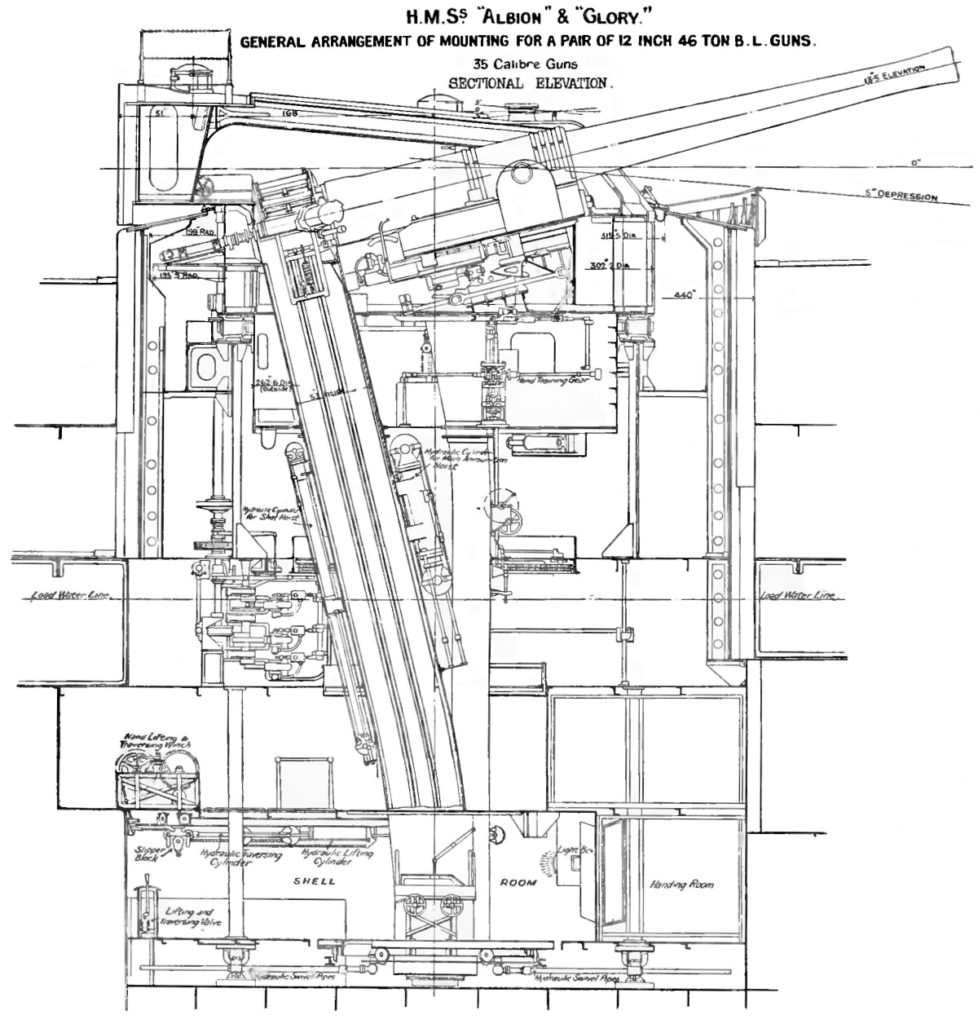
12 inches gun right elevation
HMS Canopus
The HMS Canopus served in the Channel, then in the Mediterranean, and returned to the metropolis, before being assigned to Port Stanley in the Falklands at the end of 1914. He could not take part in the fleet of Cradock which was defeated by the Von Spee squadron, but his guns fired a few later against German cruisers without results. He then rallied to the Dardanelles, then blockaded Smyrna, and returned in 1916 to Chatham, set aside, and sold in 1920.
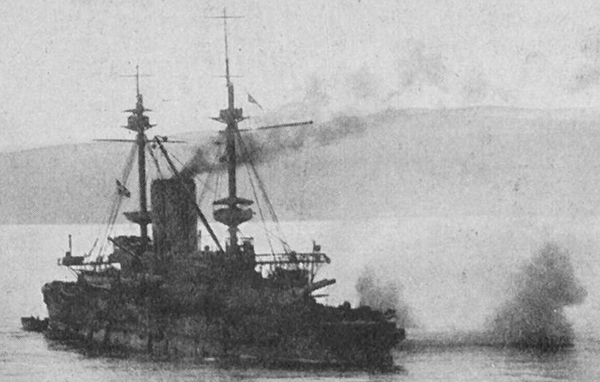
HMS Albion shelling Turkish forts of the Dardanelles
HMS Glory
HMS Glory was sent during the war to North America and then to the East Indies as flagship. He then worked in the Red Sea, then in the Mediterranean, defending the Suez Canal. He then joined Archangel and remained there as a coast guard until 1919 before the sale and demolition.
HMS Goliath
HMS Goliath served in the Channel, then in Scotland in 1914. He covered troop landings in Belgium (Ostend), and in the East Indies, and in November he was on the Rufiji River in Africa, firing the Königsberg. He was sent to the Dardanelles in 1915, to support the operations at Cape Helles, and twice touched. Finally, on the night of May 13, it was torpedoed and sunk by the Turkish submarine Muavenet, sinking in a few moments carrying 570 men.
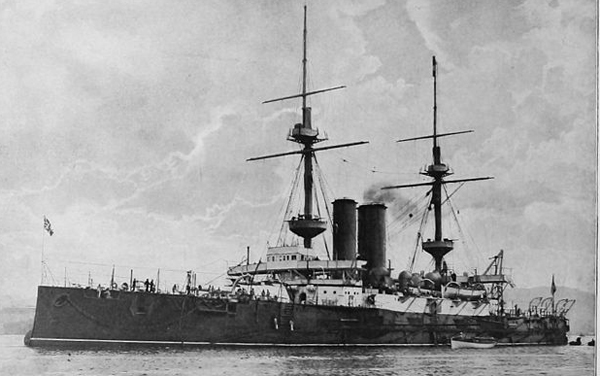
HMS Ocean in 1900
HMS Ocean
HMS Ocean was based in the Mediterranean, then in the Home Fleet and in the war in Pembroke. At the beginning of the war, he was sent to Queenstown in Jamaica, then to the East Indies. In November, he was in the Persian Gulf, then served in the Mediterranean, and fought the Dardanelles from February to March 1915. On the 18th, he struck a mine, after having wandered, hit by large Turkish caliber. It sank in three hours, leaving almost all of its surviving crew to evacuate.
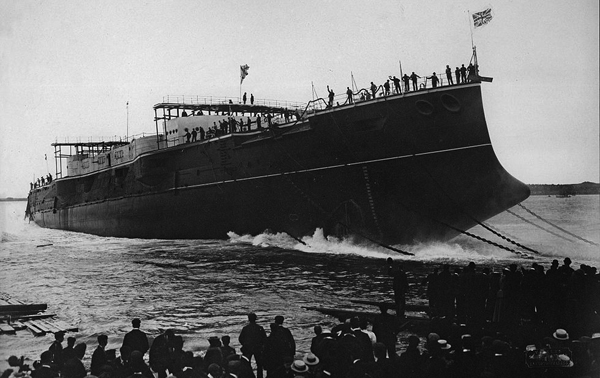
Launching of HMS Vengeance
HMS Vengeance
HMS Vengeance served in Channel, then in Home Fleet. Unhappy in his career, he hit a freighter, then ran aground in the Thames, and hit the destroyer Biter in 1910. In 1914 they still served as a training ship for gunners. He served then in the Atlantic with the 8th squadron of line, and in November 1914, operated against Cameroon, German colony. He was then detached to Egypt, then to Cape Verde. He was Admiral De Robeck’s flagship in Gibraltar, before joining the Dardanelles. He fired the forts of Cape Helles, covered the landings, before returning to Egypt. He then rallied to the East Indies, then returned to Egypt, opera again on the East African coast, and then in South Africa. He returned to Devonport in 1917 and was rearmed and kept as a ship-prescription. It was dropped from the lists in 1919, and demolished in 1921.

Artist’s Rendition of HMS Canopus
Neptune specifications |
|
| Dimensions | 128,47 x 22,56 x 7,98 m (ft) |
| Displacement | 13,150t, 14,300 Tons FL |
| Crew | 682 Peacetime |
| Propulsion | 2 shafts, 3 TE engines, 20 Belleville boilers, 13,500cv. |
| Speed | 18 knots () |
| Range | 6,330 nautical miles (11,720 km; 7,280 mi) at 10 knots (19 km/h) |
| Armament | 4 x 305, 12 x 152, 10 x 76, 6 x 47, 4 x 457 mm TT (sub). |
| Armor | Belt 152, Battery 254, Barbettes 305, turrets 203, blockhaus 152, decks 51 mm. |
Sources/Read More
Friedman, Norman (2011). Naval Weapons of World War One. Barnsley: Seaforth
Burt, R. A. (2013) [1988]. British Battleships 1889–1904. Barnsley: Seaforth Publishing
Gardiner, Robert, ed. (1979). Conway’s All the World’s Fighting Ships: 1860–1905. London: Conway Maritime Press
Canopus-class on Wikipedia
 Latest Facebook Entry -
  X(Tweeter) Naval Encyclopedia's deck archive
 Instagram (@navalencyc)


 French Navy
 Royal Navy
 Russian Navy
 Armada Espanola
 Austrian Navy
 K.u.K. Kriegsmarine
 Dansk Marine
 Nautiko Hellenon
 Koninklije Marine 1870
 Marinha do Brasil
 Osmanlı Donanması
 Marina Do Peru
 Marinha do Portugal
 Regia Marina 1870
 Nihhon Kaigun 1870
 Preußische Marine 1870
 Russkiy Flot 1870
 Svenska marinen
 Søværnet
 Union Navy
 Confederate Navy
 Armada de Argentina
 Imperial Chinese Navy
 Marine Haitienne
 Marinha do Portugal
 Mexico
 Kaiserliche Marine
 1898 US Navy
 Argentina
 Brazil
 Chile
Chile Cuba
Cuba Peru
Peru Bulgaria
 Denmark
 Greece
 Netherlands
 Norway
 Portugal
 Romania
 Sweden
 China
China Thailand
 Sovietskiy Flot
 Royal Canadian Navy
 Royal Australian Navy
 RNZN Fleet
 RIN Fleet
 Chinese Navy 1937
 Kriegsmarine
 Chilean Navy
 Danish Navy
 Finnish Navy
 Hellenic Navy
 Polish Navy
 Romanian Navy
 Turkish Navy
 Royal Yugoslav Navy
 Royal Thai Navy
 Minor Navies
 Albania
 Austria
 Belgium
 Columbia
 Costa Rica
 Cuba
Cuba Czechoslovakia
 Dominican Republic
 Haiti
Haiti Hungary
 Honduras
 Estonia
 Iceland
 Eire
Eire Equador
 Iran
Iran Iraq
Iraq Latvia
 Liberia
 Lithuania
 Mandchukuo
 Morocco
 Nicaragua
 Persia
 San Salvador
 Sarawak
 Uruguay
 Venezuela
 Zanzibar
 Warsaw Pact Navies
 Bulgaria
 Hungary

 Bundesmarine
 Dutch Navy
 Marina Militare
 Yugoslav Navy
 Chinese Navy
 Indian Navy
 Indonesian Navy
 JMSDF
JMSDF North Korean Navy
 Pakistani Navy
 Philippines Navy
 ROKN
ROKN Rep. of Singapore Navy
 Taiwanese Navy
 Vietnam People’s Navy
 IDF Navy
 Saudi Navy
 Royal New Zealand Navy
 Egyptian Navy
 South African Navy


 Ukrainian Navy
Boiler pressure should be 300 p.s.i., not Bar (4500 p.s.i.!)
Awesome typo, thanks for spotting it !
-the webaster
They are and always have been the Falkland Islands whilst under British rule NOT the Malvinas , deal in Facts not political correctness .
Too many good men died to keep them known as such , you dishonour thier sacrifice .
I don’t even know why it was called the “malvinas”, must be a translation bug. Fixed. There is no political agenda behind this site.
Rule Britannia.