

 Austro-Hungarian Navy
14 August 1914
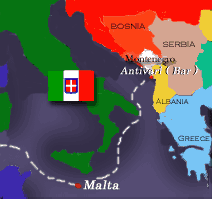 A visual of the area and route taken by the Allied ships. Although this engagement was all but fair (a recent dreadnought against an old cruiser) the ultimate result was almost a year round of inactivity for the Austro-Hungarian Navy (K.u.K Kriegsmarine) in the Adriatic
The Austro-Hungarians at war
The war broke out because of the Balkans, the assassination of Archduke Franz-Ferdinand was followed by a rejected inquiry by Austro-Hungarian authorities to Serbia, followed by a rejected ultimatum and war. By the alliances game, Serbia had the support of its natural ally Russia, which in turn could count on France. In response, Austria-Hungary was able to count on the German Empire for backup. But the first engagements of the Austro-Hungarian Army against Serbia, despite clear advantages, was nothing of a promenade. The Serbs managed to block and even repel the initial attacks with massive payback.
Situation in the Adriatic
On the naval front however it was expected from the K.u.K Kriegsmarine to take advantage of a clear cut superiority in the Adriatic. At that stage, the Austro-Hungarian Navy was not to be taken lightly with three brand new dreadnoughts (a fourth in achievement), 12 pre-dreadnought battleships, 13 cruisers, 27 destroyers and 79 torpedo-boats, as well as 7 submarines and many monitors and auxiliary ships of all sizes and tonnage. It was based mostly in Pola harbour and could easily defeat a very weak Montenegrin navy (perhaps a single gunboat, no info could be found) whereas the Serbian “navy” only counted a single patrol boat Jadar, based on the Danube in 1915. Since Italy was neutral, and perhaps then more inclined to join the central powers, Austro-Hungary has free hands in this “private lake” bordering the Balkans. In the Mediterranean however, this was another matter.
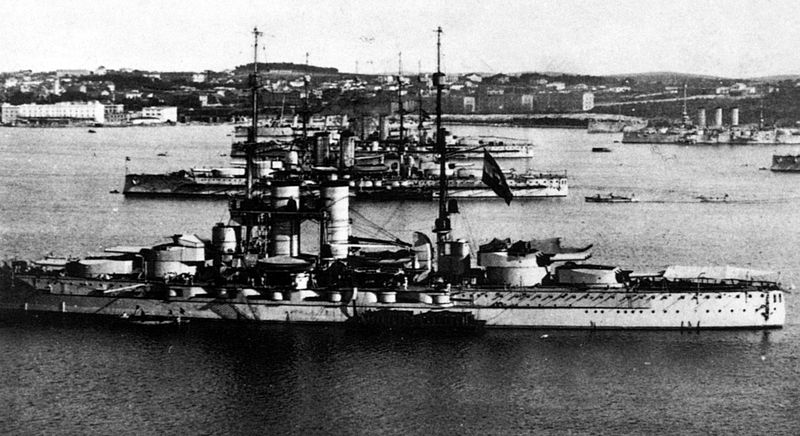
Austro-Hungarian Dreadnoughts and the fleet anchored at Pola. Despite real assets, from 1915, it was dwarfed by the combined might of the French, British and Italian navies and mostly condemned to inaction, trapped in the Adriatic.
At that time, since June 6, the proportion of the French fleet in the Mediterranean was such that the British thought fair to let the supreme naval command in the area to the French, the British naturally receiving supreme command of the Allied naval forces for the north sea. Thus, by treaty on June 6, the Royal Navy there was reduced to two armored cruisers (Defence and Warrior) and some light cruisers after by massive transfers to the North Sea,theoretically under the orders of Admiral Boué Lapeyrière. The latter, from the outset of the declaration of war, rallied Malta with the combined forces, then joined the Adriatic by executing an ostensible “naval review” in full strength and regalia to impress still undecided Italians.
The battle
On August, 14 the French fleet enters the Adriatic included 15 battleships (2 Courbet, 6 Danton and 5 Vérité), 6 armored cruisers (3 Léon Gambetta, Quinet, Renan, Michelet) and smaller cruisers. It was followed by British-armored cruisers from Gibraltar, the squadron of Admiral Troubridge. Alerted, the Austro-Hungarian fleet scrambled to rally in emergency the safe harbor of Pola. But Zenta had not been informed, and was still conducting operations of shelling of the small Antivari harbour.
She was safeguarded by destroyer Uhlan and 2 others. None did noticed the Courbet, a recently built dreadnought which opened fired at 20 000 m range. Soon 305 mm plumes squared the Zenta, which had no artillery capable of replicate at such distance. In very little time, the Zenta was severely hit, immobilized, and rendered all but helpless and burning. Her crew evacuated the soon-to-be hulk on rafts. The Destroyer Uhlan and two destroyers managed to flee thanks to their speed. The Zenta sank in a short time, but most of its crew safely joined the coast.
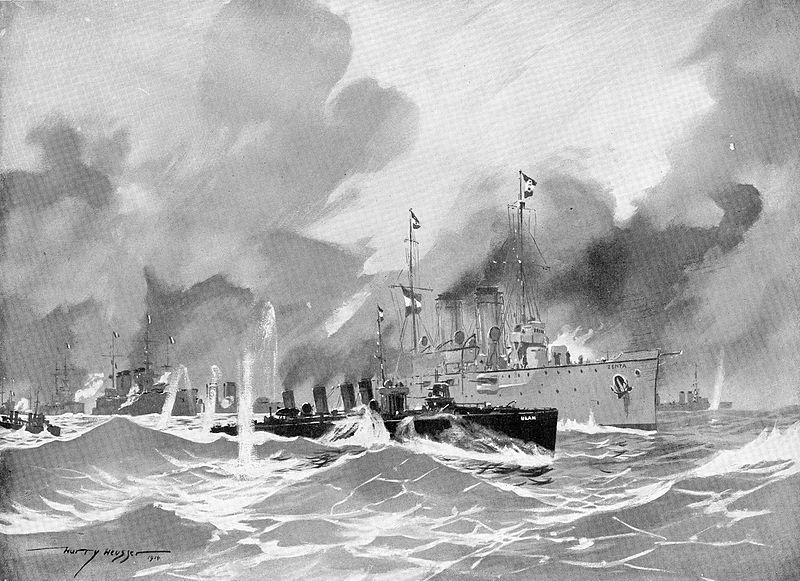
A painting of the battle of Antivari, by Harry Heusser, 1914.
Aftermath
This modest setback meant that the allies could now roam at will the Adriatic, blocking all the Austro-Hungarian initiatives. Initially at least, French presence dissuaded the naval forces stationed at Pola to start new coastal raids. But soon the allied forces departed and would be fully absorbed by operations in the Dardanelles. The Austro-Hungarian was then again free and ready for any action but only for a short time: Italy entered the war at about the same time. We will return on this chapter of the adriatic naval campaign soon. The “inaction” ended with a first major action Battle in Decemlber 1915, the battle of Durazzo, followed by by the Battle of the Strait of Otranto in 14-15 may 1917.
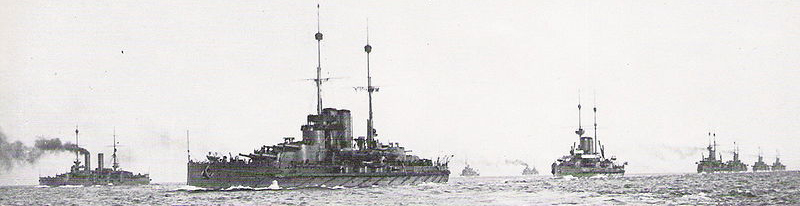
The Austro-Hungarian fleet
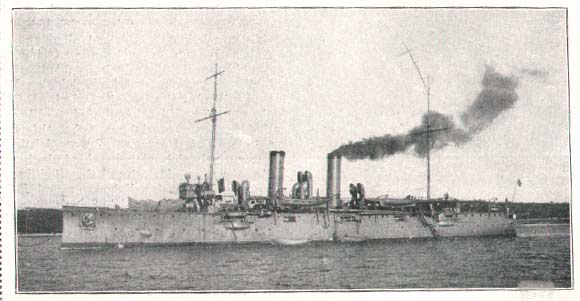
The cruiser Zenta in 1914.
 Latest Facebook Entry -
  X(Tweeter) Naval Encyclopedia's deck archive
 Instagram (@navalencyc)


 French Navy
 Royal Navy
 Russian Navy
 Armada Espanola
 Austrian Navy
 K.u.K. Kriegsmarine
 Dansk Marine
 Nautiko Hellenon
 Koninklije Marine 1870
 Marinha do Brasil
 Osmanlı Donanması
 Marina Do Peru
 Marinha do Portugal
 Regia Marina 1870
 Nihhon Kaigun 1870
 Preußische Marine 1870
 Russkiy Flot 1870
 Svenska marinen
 Søværnet
 Union Navy
 Confederate Navy
 Armada de Argentina
 Imperial Chinese Navy
 Marine Haitienne
 Marinha do Portugal
 Mexico
 Kaiserliche Marine
 1898 US Navy
 Argentina
 Brazil
 Chile
Chile Cuba
Cuba Peru
Peru Bulgaria
 Denmark
 Greece
 Netherlands
 Norway
 Portugal
 Romania
 Sweden
 China
China Thailand
 Sovietskiy Flot
 Royal Canadian Navy
 Royal Australian Navy
 RNZN Fleet
 RIN Fleet
 Chinese Navy 1937
 Kriegsmarine
 Chilean Navy
 Danish Navy
 Finnish Navy
 Hellenic Navy
 Polish Navy
 Romanian Navy
 Turkish Navy
 Royal Yugoslav Navy
 Royal Thai Navy
 Minor Navies
 Albania
 Austria
 Belgium
 Columbia
 Costa Rica
 Cuba
Cuba Czechoslovakia
 Dominican Republic
 Haiti
Haiti Hungary
 Honduras
 Estonia
 Iceland
 Eire
Eire Equador
 Iran
Iran Iraq
Iraq Latvia
 Liberia
 Lithuania
 Mandchukuo
 Morocco
 Nicaragua
 Persia
 San Salvador
 Sarawak
 Uruguay
 Venezuela
 Zanzibar
 Warsaw Pact Navies
 Bulgaria
 Hungary

 Bundesmarine
 Dutch Navy
 Marina Militare
 Yugoslav Navy
 Chinese Navy
 Indian Navy
 Indonesian Navy
 JMSDF
JMSDF North Korean Navy
 Pakistani Navy
 Philippines Navy
 ROKN
ROKN Rep. of Singapore Navy
 Taiwanese Navy
 Vietnam People’s Navy
 IDF Navy
 Saudi Navy
 Royal New Zealand Navy
 Egyptian Navy
 South African Navy


 Ukrainian Navy