
 The Japanese Marine Self Defence Force: All ships, submarines, assets and organization
The Japanese Marine Self Defence Force was the name of the cold war Japanese Navy. The current navy was rebuilt thanks to US transfers, and the local industry’s reconstruction. From a provisional coastal navy framed by article 9 of the 1947 constitution, it was rebranded as a self defence force but integrated nevertheless in the US naval policy towards the threat of the Soviet Pacific Fleet: The new JMSDF was indeed tailored for Anti-Submarine Warfare and grew until the 1980s as a considerable naval force, now a heavyweight with more integration with the USN and multilateralism than ever, facing the rapid rise of the Chinese PLAN.
The Japanese Navy in 1945:
Of the immense fleet of the Second World War, the third largest in the world, only minor units remained. The steamer of the US Navy had rolled its manpower whose last units were deprived of fuel and immobilized. It was these last ships that survived the air raids that formed the basis of the new Japanese self-defense force under the authority of Douglas MacArthur, with a focus on the major geostrategic issue of the Soviet Pacific fleet.
As a result, far from being a modest fleet of coast guards and fishery guardships, the new JMSDF eventually had an impressive potential. Currently, it ranks just behind the USN and Chinese PLAN fleet, in front of the Russian and British fleet yet still a “self-defense” force…
Of the huge fleet of 1941, there were no longer any ships of the line, nor cruiser, and only three destroyers, class Akizuki, and two carriers, the old Hosho (1922), demobilized, and the Katsuragi, well more recent (1944). These five units were taken into account by the new Ministry of the Navy, the second ministry of demobilization.
These ships for a few years skimmed Pacific islands to bring home isolated Japanese garrisons. They were later retired in 1947 and BU. The remainder of these surviving vessels consisted of coastal and light units, 53 minesweepers, former wooden-built submarine hunters (Cha type), and 12 light patrol boats, designed to serve as post-war trawlers.
They were assisted by high-sea patrol boats (Ukuru class) serving as supply vessels. The main role they were given was to clear Japanese waters of the 100,000 mines originally intended to block a US landing in January 1946. This force was incorporated into what was then known as the Maritime Safety Agency with two sections and to their heads, Admiral Yashio Yamamoto and Captain Tamura.
Under Article 9 of the new constitution, no military intervention force could be mobilized and the right to armed action to settle a different international could not be tolerated. However, from that time this principle was amended, if it were not to allow Japan, a maritime power, to guard its territorial waters and exercise a police role of traffic and fishing area protection, but also later to face the Soviet threat.
By the time the Japanese shipyards, largely bombed and devastated, were again operational, the US Navy transferred some vessels to the JMSDF (Japanese Maritime Self Defense Force), which was founded in 1954. The maritime security agency became the main force. of Japanese Coast Guard, modeled on the US Coast Guard. From this date, the reorganized shipyards would be able to build a fleet of larger units.
For Context: Japan in the Cold War
Japan came out of WWII disarmed and occupied (1945–52), with a constitution (Article 9, 1947) renouncing war and, on its text, the maintenance of “war potential.” That legal straitjacket shaped everything that followed. When the Korean War broke out in 1950, Washington pushed Tokyo to create the National Police Reserve, which evolved into the Self-Defense Forces in 1954 — technically not a “military” in constitutional terms, a fiction that mattered a lot for how the JMSDF was built and justified.
The Yoshida Doctrine
 The core strategic choice was the Yoshida Doctrine: rely on the US-Japan Security Treaty (1951, revised 1960) for hard security guarantees, keep defense spending minimal, and pour national energy into economic reconstruction. This gave Japan cheap security but also permanent political friction — the 1960 Anpo protests over the revised treaty were some of the largest in postwar Japanese history, and the relationship remained a live domestic political issue (Okinawa basing especially) through the whole Cold War.
Geographic Challenges
Geographically Japan sat directly on the front line: Soviet forces in the Kurils and Sakhalin, a large Soviet Pacific Fleet based at Vladivostok, contested territorial claims over the “Northern Territories,” and later Soviet Backfire bombers and submarines routinely transiting the straits around the home islands (Tsugaru, Soya, Tsushima) to reach the open Pacific. This is precisely why those straits and Japan’s sea lane defense mission became the JMSDF’s defining Cold War role — the “shiplifting/sea lane defense to 1000nm” commitment of the late 1970s/80s makes much more sense once you see the geography and the Soviet fleet posture.
There was also a self-imposed policy architecture limiting what forces could look like: the Three Non-Nuclear Principles (1967), the exclusively defense-oriented policy (senshu bōei), the 1% of GNP cap on defense spending (1976, later loosened), and the Three Principles on Arms Exports (1967) banning arms sales — all of which constrained naval shipbuilding, procurement choices, and industrial strategy in ways that Western navies didn’t face.
Economic and industrial context
Japan’s economic trajectory is the other half of the story:
1950s–1973: the “high-speed growth” era, GNP growth often above 10%/year, driven by steel, shipbuilding, chemicals, and later electronics and autos. Japan became the world’s largest shipbuilder by the 1960s — directly relevant, since this civilian shipbuilding base (Mitsubishi Heavy Industries, IHI, Kawasaki) is what the JMSDF’s warship construction rode on top of.
Oil shocks of 1973 and 1979 forced a shift away from heavy/energy-intensive industry toward higher-value manufacturing and electronics — again with knock-on effects for naval sensors, sonar, and combat systems development.
By the 1980s Japan was the world’s second-largest economy, running large trade surpluses with the US, which created friction (textiles, autos, semiconductors) that spilled into the security relationship — Washington increasingly pressed Tokyo to “share the burden” more on defense given its wealth.
Industrial/defense-specific challenges
No exportable defense industry (arms export ban), so the domestic defense-industrial base survived almost entirely on JMSDF/JGSDF/JASDF procurement — small production runs, high unit costs, license-built or domestically-adapted US designs.
Heavy dependence on US technology transfer and licensing (sonar, missiles, aircraft engines) even as Japan built hulls domestically — a “indigenize what we can, license what we can’t” pattern.
The 1% GNP ceiling combined with a shrinking window of political tolerance for “remilitarization” meant naval planners had to make a small, high-quality force do a large strategic job — which is a big part of why the JMSDF became known for very capable, well-maintained but numerically modest surface and ASW forces rather than mass.
Japanese Legacy warships used Postwar
Phase 1: Repatriation duty (1945–47)
At war’s end there were roughly seven million Japanese soldiers and civilians stranded across Asia and the Pacific, with almost no shipping left to bring them homeAllied forces devastated Japanese shipping during the war, leaving few transports, and it was recognized that countries occupied by Japan should be relieved of the burden of housing stranded Japanese troops. The solution was to press surviving IJN warships into service as makeshift troopships under SCAJAP (Shipping Control Authority for the Japanese Merchant Marine).
The process was standardized: each former IJN ship first had to be demilitarized — guns removed or barrels severed on larger ships, ammunition landed, and radar and catapults stripped where fitted. Since most IJN vessels weren’t designed for carrying personnel, they were fitted with temporary berthing, latrines, and galleys — with this conversion, even aircraft carriers and cruisers were turned into repatriation ships.
Notable examples:
Hosho and Katsuragi — Japan’s two surviving carriers were used to ferry home isolated garrisons from Pacific islands before being scrapped in 1947.
Myoko and other cruisers/destroyers earmarked for reparations still carried out some repatriation work first — Myoko, for instance, provided accommodation and power generation for other ships and had 653 of 830 personnel aboard being repatriated as of July 1946, before being handed to the British and broken up in Malaya in 1946.
Japan Center for Asian Historical Records
Civilian liner Hikawamaru — sent to Mile and Mereyon islands where starving Japanese troops were stranded, and went on to carry roughly 28,000 sick and starving soldiers and civilians home from places like Wake, Rabaul, Manila, and Shanghai.
At the operation’s peak, 172 Japanese naval vessels, 55 non-military Japanese ships, and 192 US vessels were engaged simultaneously. Crucially, the IJN personnel who crewed these ships were kept out of full demobilization specifically so they could operate them, and were only demobilized once repatriation work was complete — unlike the minesweeper crews (below), who never went through demobilization at all and became the direct ancestors of the JMSDF.
Phase 2: Reparations (1945–47)
Some of the more prestigious survivors went the other way — handed over to the Allies as war reparations rather than kept in Japanese hands: the battleship Nagato (expended at Bikini Atoll in the 1946 nuclear tests), destroyers Yukikaze and Hibiki (to the ROC and USSR respectively), and the giant submarine I-400 (to the US Navy, later scuttled). These are the famous “Big Five” reparations cases.
Phase 3: Minesweeping and the birth of the Coast Guard lineage (1945–52)
This is really the pivotal thread for your JMSDF research. Japan had heavily mined its own coastal waters during the war (plus extensive American aerial mining under Operation Starvation), and the Allies needed that cleared before shipping could resume safely.
The Navy Ministry delayed demobilizing thousands of IJN personnel specifically to staff minesweeping duty, and these sailors — unlike the repatriation crews — never underwent proper demobilization at all, becoming the nucleus of the future MSDF. This force eventually comprised six regional commands overseeing 10,000 former IJN sailors and 385 minesweeping vessels, commanded by mine warfare specialist Captain Tamura Kyūzō and 713 other IJN officers who were granted special exemption from the Occupation’s purge of military officers — meaning the minesweeping bureau became a rare institutional refuge for IJN officers at a time when everyone else in uniform was being purged from public life.
On 1 May 1948 the Maritime Safety Board (soon renamed Agency) was created under the Ministry of Transportation, built around this minesweeping force plus a small patrol and rescue element. This is the direct ancestor of today’s Japan Coast Guard, and its DNA is pure ex-IJN.
Custom-built patrol/fishery vessels from IJN hulls: individual ship histories show the pattern clearly. The submarine chaser Cha-203, for example, was decommissioned in November 1945, mobilized by Allied occupation forces, transferred to the Ministry of Transportation in August 1947, then assigned to the Maritime Safety Agency in May 1948 and renamed Patrol Vessel Hiyodori — later redesignated Minesweeper Hiyodori in December 1951, before passing to the Coastal Safety Force in August 1952 and finally the JMSDF in July 1954. That one hull’s paperwork trail is basically a microcosm of the whole IJN → MSA → Coastal Safety Force → JMSDF pipeline. Similarly, several No. 1-class auxiliary patrol boats (wartime picket/fishing-boat conversions) were transferred to the Maritime Safety Agency and renamed with MS pennant numbers on 1 May 1948, doing fishery patrol and coastal security work.
Phase 4: The Korean War — minesweepers go operational again
This is the dramatic and lesser-known episode. In October 1950, MSA minesweeping units were deployed on SCAP’s orders to sweep North Korean waters off Wonsan of Soviet-supplied mines — meaning Japanese crews, technically civilians, secretly conducted combat-adjacent operations in a live war zone only five years after Japan’s surrender. It was not risk-free: the Wonsan deployment cost Japanese lives to enemy action, the only known case of Japanese government personnel dying in a war zone in the postwar era.
Phase 5: Coastal Safety Force Towards the JMSDF (1952–54)
The Safety Security Force (Coastal Security Force), under the National Safety Agency, existed from August 1952 to June 1954 as the direct military-flavored successor to the MSA’s minesweeping element, before being folded into the newly created JMSDF on 1 July 1954. By this point Japan had also started receiving ex-US Navy ships (destroyer escorts, frigates) under MDAP, so the “pure ex-IJN fleet” era was ending — but the institutional core, doctrine, and a good share of the officer corps were the direct legacy of that 1945–52 minesweeper/patrol pipeline.
Japanese Naval Industry in the Cold War
During the Cold War Japan rebuilt one of the world’s largest and most technologically advanced shipbuilding industries. Although constrained by its post-war constitution, the country’s commercial shipbuilding sector provided an industrial base that enabled the Japan Maritime Self-Defense Force (JMSDF) to modernize steadily with domestically designed and built warships.
After World War II, Japan’s shipbuilding industry was initially restricted by the Allied occupation and all concerned military yards had been mercilessly bombed by both USAAF bombers like the B29 and the US Navy’s TF 38 of fast carrier force. Following the end of the occupation in 1952, shipyards rapidly recovered with some US help, driven primarily by commercial shipbuilding.
By the late 1960s and 1970s, Japan had become the world’s largest shipbuilder before the crown was taken by Korea and China in more recent years.
Civilian production of tankers, cargo ships, and container ships financed investments in modern facilities. Naval construction remained modest in scale but benefited directly from the advanced industrial base.
Unlike the Soviet Union or the United States, Japan did not maintain separate state-owned naval shipyards. Instead, private companies built nearly all JMSDF vessels.
Major shipbuilders:

Kobe shipyard in 1957
Mitsubishi Heavy Industries (MHI), Japan’s premier naval shipbuilder.
Facilities at Nagasaki and Kobe. Capable of making all types operated by the IDS, Guided missile destroyers, Helicopter destroyers, Submarines, and Fleet auxiliaries.
The company also manufactured naval gas turbines, electronics, and many ship systems.
Ishikawajima-Harima Heavy Industries (IHI)
Major facilities are at Tokyo and Yokohama. They are specialized in Destroyers, Support ships, Marine engines, Propulsion systems. IHI became one of the JMSDF’s principal destroyer builders.
Kawasaki Heavy Industries (KHI)
Main naval yard is at Kobe. It produced Destroyers, Diesel-electric submarines, Fast attack craft, Machinery and propulsion equipment.
Kawasaki shared submarine production with Mitsubishi, establishing a practice that continues today.
Mitsui Engineering & Shipbuilding
Important naval yard at Tamano, Constructing Minesweepers, Auxiliary ships, Smaller combatants, Logistic support vessels. The company was also a major commercial shipbuilder.
Others count in Steel production, Marine engines, Radar, Sonar, Electronics, and Missiles: Japan Steel Works, NEC, Toshiba, Fujitsu, Mitsubishi Electric.
Naval production during the Cold War
Japan followed a policy of continuous, incremental modernization rather than rapid expansion. Major vessel types included Destroyers, Anti-submarine or Guided missile types and General-purpose escorts. Its Submarines are built almost entirely domestically. Successive classes emphasized quieter operation and improved sonar. In mine warfare Japan maintained one of the world’s most capable mine countermeasure forces because securing its sea lanes was considered essential.
The Japanese naval industry differed from those of many other major powers by its Commercial-first model as Shipyards earned most of their revenue from merchant ships, with naval construction representing a smaller but technologically demanding workload. They are known for high-quality manufacturing: Emphasis was placed on precision engineering, reliability, and efficient production rather than mass output.
Domestic self-sufficiency: Hulls, machinery, sensors, and many combat systems were produced within Japan, although some technologies—such as Aegis systems later in the Cold War—were developed in close cooperation with the United States. Also they were and are still famous for their steady production: Rather than building ships in large batches, Japan typically ordered a small number of new vessels each year, ensuring that shipyards retained skilled workers and that the fleet remained modern.
Throughout the Cold War, Japan’s naval industry was geared toward supporting a maritime strategy focused on protecting the sea lines of communication (SLOCs) around the Japanese archipelago, detecting and tracking Soviet submarines in the western Pacific, defending the approaches to Japan alongside the U.S. Navy and maintaining a technologically advanced fleet without pursuing offensive power projection.
Japanese Trade and Fishery Fleets
Two rather different fleets, but both deeply tied to the Cold War security picture and worth treating together since they explain why Japan needed a navy of any kind at all beyond pure territorial defense.
Merchant marine and shipbuilding, 1947–91
Reconstruction phase (1947–56)
 Japan’s merchant fleet was essentially wiped out by 1945. Recovery started almost immediately: in 1947 the government created the “Programmed Shipbuilding Scheme,” under which the state decided what ships to build and funded them with low-cost loans to Japanese shipowners — a scheme that ran into the 1980s and drove most new tonnage in the early postwar years. Crucially, US occupation policy shifted from restricting Japanese shipping to actively encouraging it, once Washington recognized that a crippled Japanese merchant fleet would leave the country permanently dependent on US support, and that a strong Japan would be a useful Cold War ally against the Soviet Union.
World leadership (1956–73)

Deck Plans for a proposed (unbuilt) Japanese Nuclear-powered ocean liner, with 20,100 GRT, and a capacity for 2500 passengers (40 Cabin Class, 160 Tourist and 2300 Third Class), 1960.
Japan became the world’s largest shipbuilder in 1956, overtaking Britain, and the industry kept expanding through the 1960s as a driver of the broader economic miracle. By the mid-60s Japan was the world’s lowest-cost shipbuilder, launching close to half of all new shipping tonnage worldwide, helped by cheap steel and labor plus heavy government support. This wasn’t incidental to Japan’s growth model — it fed it directly: Japan’s booming manufacturing sector needed shipping to import the great bulk of its raw materials and export finished goods, and by the late 1960s Japanese demand accounted for roughly 75% of world coal transport, 60% of iron ore transport, and 20% of grain transport. Physically, this fleet rode on former IJN infrastructure — the giant dry dock at Kure that built the battleship Yamato was capable of handling ships up to 150,000 tons and gave Japan an early lead in building supertankers, and Sasebo’s naval dry dock similarly went on to build 130,000-ton tankers in the 1960s.
Oil shock and restructuring (1973–91)

M/T ‘Berge Captain’ (b.1983, Mitsubishi Heavy Industries Ltd., Nagasaki) pinterest.
The 1973–74 oil crisis hit Japanese shipbuilding especially hard because the industry was launching roughly half the world’s new tonnage at the time, mostly tankers, and had to absorb a sudden worldwide collapse in demand. The government ran the industry through a long adjustment; by the late 80s it was still enormous — Japanese yards took orders for 4.8 million gross tons in 1988, rising to 7.1 million in 1989 — but South Korea was already emerging as a serious rival, foreshadowing the loss of the #1 spot after 2000.
Fishery fleets, 1947–91
Japan’s fishing industry operated on three tiers — coastal, offshore, and distant-water — and it’s the distant-water fleet that intersects most with Cold War geopolitics.
Postwar explosion (1945–52)
Food scarcity drove an immediate scramble back to sea. Under SCAP the fleet was initially confined by the “MacArthur Line,” a boundary restricting how far Japanese boats could operate — removed only with the 1951 peace treaty, after which distant-water fishing expanded rapidly into the Pacific, Indian Ocean, and eventually worldwide.
Whaling as a special case. Whaling was central to the postwar protein crisis and heavily politically supervised from the start: SCAP authorized the resumption of Antarctic whaling in August 1946 under tight conditions — fleets limited to two factory ships, 12 whale catchers, and 7 carriers, with vessels required to leave and return to Japan between November and April. The fleet then grew steadily: from two factory ships per season through 1953/54, Japan expanded to three ships by 1954–56, five by 1956/57, and seven ships a season from 1960/61 through 1964/65.

Coastal small-boat whaling saw the opposite trend — 70 registered small whaling vessels in 1947 had shrunk to just seven by 1976 as the industry consolidated around the big pelagic factory-ship operations. Japan joined the International Whaling Commission in 1951, having had five unregulated seasons beforehand, and Japan repeatedly voted against moratorium proposals through the 1970s and early 1980s before the 1982 moratorium finally passed and took effect for the 1985/86 season — Japan withdrew its formal objection to the moratorium in 1985 under US pressure and ended commercial whaling at the end of 1987, pivoting into “scientific” whaling that continued for decades after.
Distant-water fishing boom and the 200-mile crisis
 The distant-water fishery saw striking postwar growth, extending Japanese operations to fishing grounds across the globe — an expansion that only stopped in the mid-1970s when many states began extending fishery jurisdiction out to 200 nautical miles. This is a major rupture point: Japan’s pelagic catch peaked at 3.99 million tons in 1973 (41% of its total marine catch), then was hit first by the 1973 oil price shock and then by the near-universal adoption of 200-mile EEZs in 1977. Japan responded defensively rather than by accepting the norm outright — in 1977 Japan enacted its own Fishery Zone Temporary Measures Act imposing a 200-nautical-mile fishery zone, but pointedly applied it only against the Soviet Union and Soviet vessels, reflecting the ongoing Northern Territories dispute rather than a general embrace of the EEZ concept (Japan didn’t adopt a full, general EEZ regime until 1996).
The Soviet fisheries flashpoint
This is where fishing and naval/territorial tension were most tightly linked. When the USSR declared its own 200-mile zone, Japan refused to recognize Soviet fishing jurisdiction over waters surrounding the disputed Northern Territories, forcing a negotiated arrangement to preserve traditional Japanese fishing access there. Soviet seizures and detentions of Japanese fishing boats operating near the disputed islands were a recurring Cold War irritant that regularly made the JMSDF/JCG’s patrol and surveillance missions in that specific area politically loaded, not just operationally routine.
Net effect by 1991: a fishing industry that had grown into a genuinely global distant-water fleet by the early 1970s was substantially forced back toward coastal/offshore operations and negotiated foreign-EEZ access agreements by the 1980s — bilateral agreements after 1977 prevented a sudden catch collapse and kept Japanese vessels employed, though allocations to Japanese boats were repeatedly cut after 1984.
JMSDF Organization

The Japan Maritime Self-Defense Force (JMSDF) is organized to defend Japan’s territorial waters, secure vital sea lanes, conduct anti-submarine warfare, and support allied operations. Although relatively compact compared to the U.S. Navy, it is highly professional and organized for rapid response and continuous readiness.
Overall Command Structure
The JMSDF is one of the three branches of the Japan Self-Defense Forces.
Chain of command: Prime Minister, Minister of Defense, Chief of Staff, Joint Staff, Chief of Staff, Maritime Self-Defense Force.
Major operational and support commands
The Chief of Staff, JMSDF is the service’s senior naval officer and is responsible for personnel, training, logistics, and force development.
Self Defense Fleet (Jieitai Kantai)
The Self Defense Fleet is the JMSDF’s principal operational command, equivalent to a fleet headquarters.
It commands nearly all combat units, including the Surface forces, Submarine forces, Fleet Air Force, Mine warfare units, Amphibious support forces, Fleet logistics
Major Components
1. Escort Fleet: Largest combat formation for Air defense, Anti-submarine warfare, Surface warfare, Fleet escort, Ballistic missile defense.
Organization: Four Escort Flotillas.
Each Escort Flotilla contains one helicopter destroyer (or large destroyer), two anti-air destroyers, 5–6 ASW (later general-purpose) destroyers. This changed over time.
2. Submarine Fleet, responsible for, Intelligence gathering, Sea denial, Anti-ship warfare, Anti-submarine warfare, and Strategic surveillance.
Usually organized into Two submarine flotillas and Several submarine squadrons, with major bases at Yokosuka and Kure.
3. Fleet Air Force
It provides Maritime patrol, Anti-submarine warfare, Airborne surveillance, Search and rescue, Helicopter support
4. Mine Warfare Force
Japan operates one of the world’s most capable mine warfare organizations. Its responsibilities include Mine hunting, Mine sweeping, Port clearance, and Amphibious route clearance
This force is especially important because Japan depends heavily on maritime trade and vulnerable sea lanes.
5. Fleet Intelligence and Ocean Surveillance
This component operates Oceanographic survey vessels, Electronic intelligence ships, Hydrographic vessels and Surveillance systems
Its mission is to monitor submarine activity, map the seabed, and support navigation and undersea warfare.
6. Fleet Replenishment Force
Responsible for Underway replenishment, Fuel, Ammunition, Logistics support.
Regional District Commands
The JMSDF also maintains five Regional District Commands responsible for local defense, training, logistics, and base operations:
Yokosuka: Eastern Japan and Pacific approaches
Kure: Inland Sea and western Japan
Sasebo: East China Sea and southwest islands
Maizuru: Sea of Japan coast
Ominato Mutsu (Ōminato): Northern Honshu and approaches to Hokkaido
Each district controls local Patrol craft, Mine countermeasure units and is in charge of Port security, Logistics, Training facilities, Shore support, Education and Training.
The JMSDF maintains several educational institutions, including the National Defense Academy of Japan (officer education), Japan Maritime Officer Candidate School, and Specialized schools for submarine operations, aviation, engineering, communications, and logistics.
Ships Covered
[catlist name=”cw-jmsdf” numberposts=100 orderby=”title” order=”ASC”]
In this Page (Anchors)
Harukaze class Destroyers
Ayanami class Destroyers
Murasame class Destroyers
Akizuki class Destroyers
Amatukaze missile destroyer ↗
Yamagumo class escort destroyers
Takatsuki class destroyers
Minegumo class escort destroyers
Haruna class helicoper destroyers
Tachikaze class missile destroyers
Shirane class helicopter destroyers
Hatsuyuki class missile destroyers
Hatakaze class missile destroyers
Asigiri class missile destroyers
Kongo class missile destroyers (started 1990)
Murasame class missile destroyers (started 1993)
Akebono/Ikazuchi class frigates
Kusu class frigates
Oyashio class Submarines
Ajisai class Landing Ships
Awaji class Patrol boats
Redburn class Patrol boats
Chifuri class patrol boats
Yahagi class patrol boats
Ukishima class Minesweepers
Yuhibari class Minesweepers
Ukuru class Minesweepers
Yashiro/Atada class Minesweepers
Type 1 class MTBs
Muroto class Coast Guards
Conventional JMSDF ships, early cold war (1947-60)
-19 Destroyers:
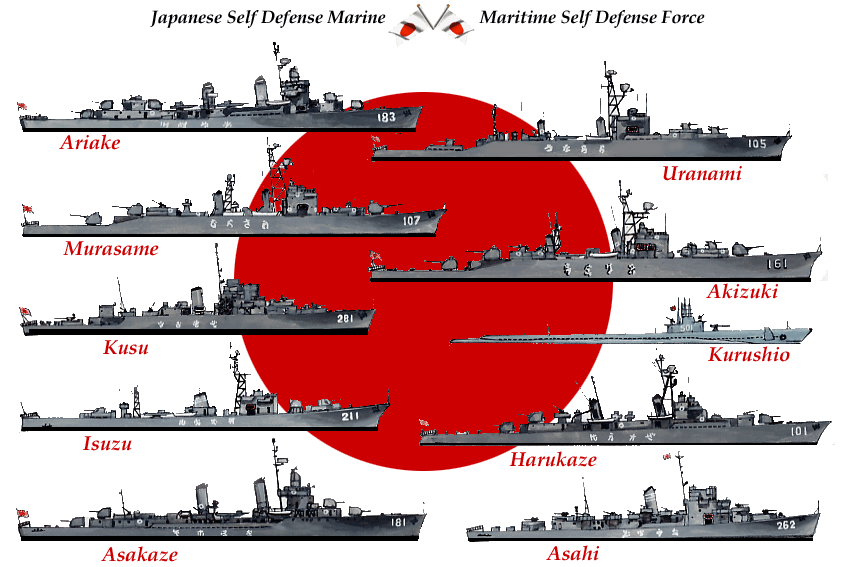
The big Akizuki (1941) having been scrapped there was only the only Wakaba, ex-Nashi, an escort destroyer of the class Tachibana (1945). It remained in service until 1972. Soon the US Navy transferred two Benson / Gleaves class destroyers in 1954 (Asakaze and Hatakaze) and two others of the Fletcher class (Ariake and Yugure). They remained in operation until 1969 and 1974 respectively. The shipyards then issued the first class of Japanese post-war destroyers, the Harukaze. To these two ships succeeded the 7 Ayanami, heavier, then the 3 Murasame and the two Akizuki. All were in service in 1960. They were classic buildings with artillery.
-23 Frigates:
The first were two acquisitions of the US Navy (Type GMT or Cannon class), the Asahi and Hatsuhi. They were operational from 1855 to 1975, soon joined by the first “escorts”, the Akebono, turbine and the two diesel Ikazuchi. But it was mostly the 18 class Tacoma frigates (Kusu) transferred in 1953 and operational until 1970-73.
-50 Assault ships:
These were 49 ex-US LSSLs, which had their rocket launchers removed from fire support and were using their light support artillery (Ajisai class). They were retired for many, and all in 1961. There was also the Yorikutei type LSM, an old ship that served first under the French flag in Indochina.
-2 Submarines:
After the transfer of the USS Mingo (Gato class) in 1955, under the name of Kuroshio, Japan launched its first classic attack submarine, the Oyashio in 1959.
-66 Patrollers/minesweepers:
Classes Awaji, Reburn, Chifuri, and Yahagi, built from 1951. There were also the 12 Ukishima, dating from 1945 and partially rebuilt, and the small Yuhibari, former auxiliary SM hunters of 1945, with 26 units survivors in 1960 (about to retire after their long demining work).
-17 Minesweepers:
There were the Ukuru, 5 former 1944 high-sea patrol ships reused as tankers and minesweepers. They were scrapped in 1963-66. From 1955, the USN delivered 9 YMS (Etajima class), 4 AMS/MSC (Yashima class) and Yashiro delivered the Yashiro in 1956, and the two Atada, larger ones. In addition, the Erimo, a deep sea minesweeper was transferred in 1955 and Tsugaru, a cable layer in 1955.
-10 Sub hunters:
They were the 7 Kamome class, inspired by the 1955-56 PC-Boats, the 1957 Great Hayabusa and the 1959 Umitaka.
-9 MTBs:
Type 1 and No. 7 and 8 (type 7) and No. 9 of British origin.
-20 Coastguards:
18 patrol boats of the 18 foot type were transferred in 1955, followed by the construction of the two Muroto class coastguard patrol boats (within the ASM – Maritime Safety Agency or MSA).
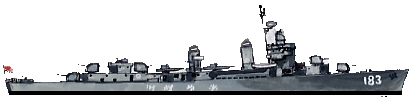
 ARIAKE class DDs
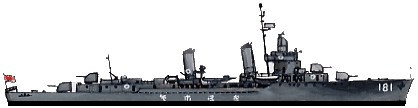
Ariake and Yugure (ex. Heywood L. Edwards and Richard P. Leary) had been launched 6 October 1943 at Boston NyD, towed to Japan in 1959 to be transferred to the new fledgling navy. In 1936 both undergone reconstruction: Improved bridges, larger CiC, new radars, tripod mast. The number 3 5-in gun was discarded for weight saving. On Ariake, number 2 5-in gun was replaced by a weapon Alfa. Both ships were deleted in 1974.
ASAKAZE class DDs
Both ships were Gleaves class destroyers, launched at Federal, Kearny (USS Ellyson) and Barth Iron Works(USS Malcomb), in 1941 and acquired 19.10.54. They were transferred under MDAP program, as the first Japanese postwar destroyers. New electronics were fitted, and the superfiring 5-in gun was discarded to make place for additional torpedo tubes. Both were returned to the USA in 1969; but then transferred again to Taiwan.
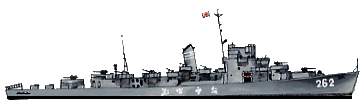
ASHAHI class Frigates: These were ex-Cannon class (DER) escort destroyers, launched in 1943 at Federal, Newark. Transferred 14.6.1955, under MDAP and returned to the US Navy in 1975.
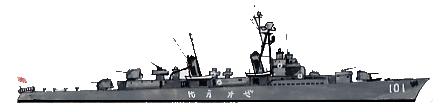
HARUKAZE class DDs (1955):
The first Japanese-built destroyers of the MSDF. Both were laid down at Mitsubishi Zosen, Nagasaki (Harukaze) and Shin Mistubishi HI Kobe (Yukikaze). They were designed and tailored for anti-submarine warfare. The majority of equipment was US-built, following Japan’s Mutual Defense Assistance Agreement. Sensor systems was also US standard like the AN/SPS-6 air-search radar, AN/SPS-5 surface-search radar, QHB search sonar, and QDA attack sonar.
They were armed with three 5-in/38 Mark 12 guns on Mark 30 single mounts of US manufacture, controlled by a Mark 51 director. But the JMSDF replaced the director by the Swedish-built modern GFCS developed by Contraves. On the Yukikaze, this was an American Mark 57 director. Other changes included K-guns and depth charge racks halved and later replaced by Mark 32 torpedoes. Two Mark 2 side launchers were also fitted.
Specs
Displacement: 1700- 2340 t FL
Dimensions 106 x 10.5 x 3.4 m
Machinery: 2 shafts Mitsubishi/Escher Weiss geared turbines or Westinghouse, 2 combustion engineering boilers or Hitachi/Babcock boilers, 30,000 bhp. 30 knots 6000 nm
Sensors: Radar SPS-5, SPS-6, Sonar SQS-29
Armament: 3x 5in/38, 8x 40 mm AA, 2 Hedgehod, DC rack, K-gun
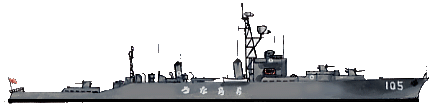
URANAMI class DDs (1957):
This second class comprised no less than seven ships, Ayanami, Isonami, Uranami, Shikinami, Takanami, Onami and Makinami. They were laid down between 20.11.1956 and 20.3.1959, launched 1957-1960 and completed 1958-60. Builders were Mitsubishi Zosen Nagasaki, Shin-Mitsubishi on Kobe, Kawasaki from Tokyo, Mitsui Zosen from Tamano, Oshikawajima from Kobe and Ino HI from Maizuru.
They were quite different in their approach compared to the Harukaze, with a smaller artillery, more emphasis in ASW warfare, better electronics and speed. The 3-in guns were American Mk33 models, under Japanese masks. The hull was not flush deck as there was a rear step down. During these times of nuclear fear, Ayanami tested eight wahs-down systems for removing irradiated dust. ECM was also a novelty, as well as air conditioning.
VDS was mounted on three ships, their TT banks removed and replaced by Mk8 “Poor Boy” launcher. Two units at the end of their active life were converted as training ships, without their 21 in TT mount to make room for a deckhouse. Electronics were Japanese-built, although based on US designs. All has been converted as training ships, starting in 1975 up to 1985 and deleted from 1986 to 1990.
Specs
Displacement: 1720- 2500 t FL
Dimensions 109 x 10.7 x 3.7 m
Machinery: 2 shafts Mitsubishi/Escher Weiss geared turbines or Westinghouse, 2 Mitsubishi -Nagasaki CE boilers, 35,000 bhp. 32 knots 6000 nm
Sensors: Radars OPS1, 15, Sonar SQS-12/14
Armament: 3x 3in, 1x 4 21in TTs, 2 torpedo racks, 2 hedgehog, 2 y-guns
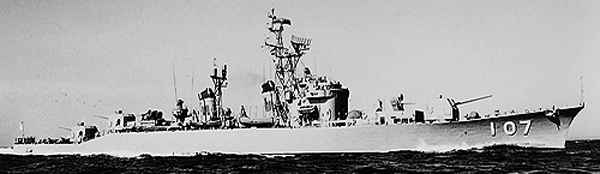
MURASAME class DDs (1958):
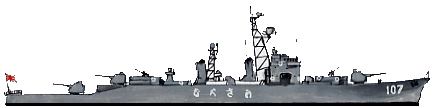
These AAW destroyers which came back to a better armed solution, with new 5-in/54 guns in semi-automated Mk.39 turrets that went from the USS Midway, entirely rebuilt. However their poor rate of fire made them unsuitable as AA guns and needed large handling rooms and magazines to operate, so the hull was crowded and living conditions less than ideal.
They were also heavier than previous design, although the hull very much derived from the previous “-Nami” class. Mk 32 TTs made their apparition on two ships, Murasame and Harusame, the latter tested new systems as ASU 7006 in 1984 and latter a depot ship. All three had been built at Nagasaki (Murasame), Tokyo (Yudachi) and Yokosuka (Harusame), auxiliary in 1984 and deleted in 1984-89.
Specs
Displacement: 1838- 1840 t FL
Dimensions 110 x 11 x 3.7 m
Machinery: 2 shafts Ishikawajima geared turbines and boilers, 35,000 bhp. 32 knots, 6000 nm
Sensors: Radars OPS1, 15, Sonar SQS-29
Armament: 3x 5/54in, 3x 3in/50 AA, 2 ASW torpedo racks, 1 hedgehog, 2 y-guns, DC rack
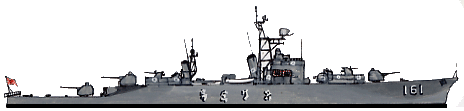
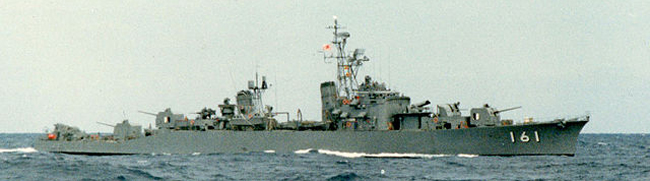
AKIZUKI class DDs (1959):
Last units of the “old design”, the two Akizuki and Teruzuki (Nagasaki and obe, launched june 1959, completed Feb. 1960, were built under the 1954 US Military aid, and carried the same 5-in/54 guns of the Murasame. They were however much larger, with a displacement of 23800/2890 tonnes FL, one more meter in beam and five meters overall lenght.
This was to make room for the particular sub-systems of the main guns. The forecastle hull in particular was lengthened to make room for additional command facilities as they were designed as flotilla leaders. They tested the infamous ASW mortar weapon Alfa, which was a failure.
Their sensors were modernized in 1977-78, and a 375 mm Bofors ASW mortar was adopted. Six 12.75 in Mark 32 ASW TTs were also adopted. VDS was installed and a SQS-23 sonar. They became auxiliaries in 1984-85 and were deleted in 1993.
Specs
Displacement: 2380- 2890 t FL
Dimensions 118 x 12 x 4 m
Machinery: 2 shafts Mitsubishi Escher Weiss geared turbines, 4 Mitsubishi CE boilers, 45,000 bhp. 32 knots, 6000 nm
Sensors: Radars OPS-1, 15, Sonar SQS-23, OQA-1 VDS
Armament: 3x 5/54in, 3x 3in/50 AA (2×2), 1 Weapon Alfa, 2 hedgehogs, 2 y-guns, 2×4 21-in TTs, DC rack
Kusu class frigates (1953)
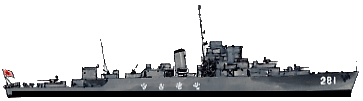
These were eighteen 1943 Frigates of the US Tacoma class, declared surplus and acquired under on loan in 1953. They were named aft trees, like an IJN DD serie. There were basically unchanged but with some exceptions: Keyaki had an additional deckhouse added abat the mainmast to act as flotilla flagship and Kaeded received the same modifications. They were all technically returned in 1962, after the ten year loan, but in reality retransferred to the Japanese government the same day and ecquired definitively. They were decommissioned in the early 1970s (1970-73), however:
Kusu, Nara, Kashi and Momi were deleted in 1972, and Kahi was a moored training ship from 1965. Sugi was decomm. in 1970, Matsu deleted in 1942, as Kaya, Ume, Sakura, Nire and Shii were returned in 1970. Kiri was decomm. in 1970, as Keyaki, buna, Tochi, Tsuge and Kaede HS in 1968.
Asahi class Frigates (1955)
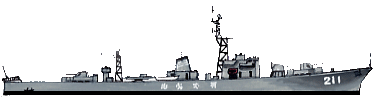
Two Cannon class escort destroyers were transferred on 14.6.1955 under MDAP. Both were the returned to the US in 1975 and scrapped.
Kurushio – Gato class Submarine USS

Contrary to many NATO countries, Japan only operated a single GATO class submarine, the IJ Kurushio. This was the ex-USS Mingo, launched 1942 at Electric boat, transferre dunder MDAP in August 1955. SS 501 was still in her vintage appearance. She was not modernized along the GUPPY program. She basically served as a training boat, waiting for the first postwar Japanese submarine class to be ready: The Oyashio class (started two years later in 1957).
Organization, personal and structure of the JMSDF
Japan’s 1947 Constitution’s famous Article 9 stated “The Japanese people forever renounce war as a sovereign right of the nation and the threat or use of force as a means of settling international disputes.” Hence not only the name and general perception but structure and organization of the Japanese Forces on all three branches, to be focused on self-defense. Due to Cold War pressures however it was scaled up to the size appreciated by the United States to provide its own defense, and free local US forces, giving the latter more leeway into the deployment of the pacific fleet.
Constitution of the JMSDF (1 July 1954)
Between 1945 and 1954, about ten years of American occupation, Japan started with little resources barely sufficient to protect fishing areas. Dissolved by the Potsdam Declaration acceptance, the fleet was reduced to a collection of disarmed ships, some taken away as war reparation (to be blasted in nuclear tests in the American case). Others provided means for the repatriation of Japanese soldiers throughout the whole asia-pacific, plus minesweeping the home waters. This dagerous and tiedous task was given to the supervision of the Second Bureau of the Demobilization Ministry. The minesweers were transferred afterwards to the newly formed Maritime Safety Agency, maintaining resources adnd skills for the navy.
Japan’s 1947 Constitution Article 9 in particular stated “The Japanese people forever renounce war as a sovereign right of the nation and the threat or use of force as a means of settling international disputes.” This was interpreted as to allow only a self-defense force. But under Cold War pressures and forced United States alliance, Japan had to bring its own maritme assets to the local defence rather than relying only on the US Navy.
At last in 1952, the Coastal Safety Force was created, as part of the Japanese Maritime Safety Agency. It included the minesweeping fleet and auxiliary vessels including American transferred destroyers. Two years later, this Force was separated to become the core of the JMSDF, a simple branch of the Japanese Self-Defense Force (JSDF), fixated by a law.
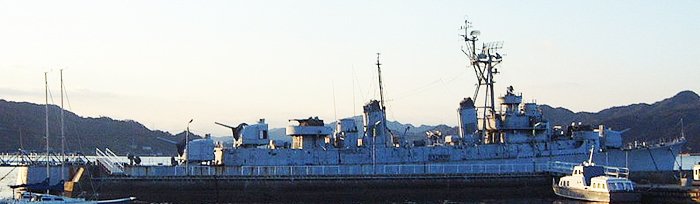
Harukaze, the earliest Japanese cold war destroyer, as preserved.
In 1956, the JMSDF at last commissioned its first domestically produced destroyer, Harukaze. As the Cold War intensified, the JMSDF main task became the anti-submarine role. Both destroyers and frigates developed for the JMSDF were tailored for ASW warfare in priority. By 1970, this navy was sufficient in this frame to nor depend of the US Navy, which kept a permanent task force centered around a nuclear aircraft carrier. With Japan’s economy booming, the Navy also gradually benefited from constant increased in budget and by 1991 had achieved by tonnage an historical peak, both in quantity and quality of ships. They were perfectly able to take head on the Soviet Pacific fleet.
Composition of the Cold War JMSDF
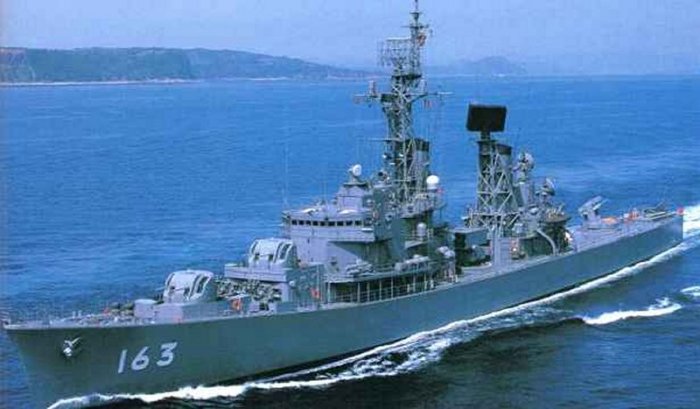
Amatsukaze, the earliest modern Japanese missile destroyer, 1963.
This chapter has been already thoroughly examined in the cold war page, but in the space of 40 years, the fleet scrapped her US-built or supplied ships and restarted naval construction with its own industrial giants, like Mitsubishi, already responsible for Japan’s tanks and some of her planes. The main doctrine that dominated Japanese cold war thinking was its role of a shield against any infiltration of the Soviet Pacific fleet submarines, in particular SNA and SSBNs.
In 1952, the Safety Security Force were created indeed as part of the Maritime Safety Agency, to create a minesweeping fleet and destroyers trsnaferred by the United States until one year later the JMSDF was formally created (1954 Self-Defense Forces Law). But soon it was integrated into the local USN policy and specialized on the ASW role to counter the Soviet’s powerful submarine fleet. This really was instrumental to understand the development of the shipbuilding industry through three main models, developed from 1958 and tailored for this role:
1-ASW destroyers, bearing names of former sunken WW2 IJN destroyers, which were the most numerous and indeed specialized, still with US-derived guns, radars, sonars, and weaponty such as ASROC and acoustic torpedoes.
2-Multirole destroyers, organic to ASW flotilla to ensure their protection against aerial and surface threats.
3-Helicopter destroyers, called for extra ASW capabilities
Alongside was developed a fleet of ASW corvettes, minesweepers, auxiliaries, and submarines, also to patrol Japanese waters, and later to patrol the Pacific, outside the extended Japanese EEZ, and specialized again in a submarine hunter role, despite their conventional propulsion.
Early japanese DDs were clearly tailored for ASW warfare, a role that was pushed forward as a condition to benefit from the MDAP program. Japan therefore accessed in the 1950s to the latest in weapons and sensors tech. The strenght of the Japanese cold war navy entirely rested on submarine warfare vessels, that gradually counted flotilla with one helicopter destroyer, generally two multirole, and more specialized ASW destroyers which made its strenght.
While the Harukaze, Ayanami, Murasame of the 1950s has been retired in 1990, the oldest Japanese DDs still active were the 1959 Akizuki class, of this early design (discarded 1993), and sole Amatsukaze (1963) that introduced a brand new Japanese DD design (discarded 1995). It was followed by the first class of ASW “escort destroyers”, the six Yamagumo class (1965-77). Moderately slow with their diesels, they were still capable of 27 knots and heavily armed for ASW warfare. Two became training ships in 1991, one an auxiliary, the others were still in service in the early 2000s.
The late 1960s will saw again a double class of four standard and three escort destroyers, the Takatsuki (1966-69) and Minegumo (1967-69). The first displaced 3100 tons, the second 2100 tons, 32 knots versus 27 knots. The first were heavily armed, but with slightly better antiship capabilities and more powerful electronics. The Minegumo were again ASW destroyers made for long range patrols. All were in service by 1990.
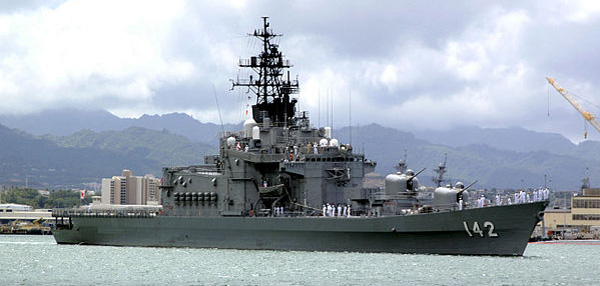
Helicopter Destroyer Hiei
1971 saw the arrival of the first Japanese Helicopter destroyer, Hiei. With on-board electronics being refined, airborne ASW warfare seemed a better solution and authorized the test of two massive destroyers, the largest postwar Japanese ships so far, bearing famous names also (used by former battleships): Hiei and Haruna. At 4700 tons standard, 6300 fully loaded, they were the largest and most powerful DDs in asia, capable of operating three large ASW HSS-2 heavy-duty long range helicopters.
JMSDF ships of the Late cold war (1960-90)
These thirty years are the most interesting, seeing a real departure over previous design to larger, more powerful more US-inspired and often hybrid helicopter vessels. The transition went on for the next post-1990 decade were even more vigor, unlike western powers making massive budget cuts after the fall of USSR. It was due to the rise of the Chinese Navy, already the dominant naval power in the 2010s in the region, and now believed to be the first worldwide in tonnage. Since Shinzo Abe presidency, the JMSDF underwent reform and became the world’s fourth largest navy by total tonnage by 2000. Old, symbolic names from the days of the IJN had been revived with Aegis destroyers and aircraft carriers under disguise, since they are still officially “helicopter destroyers”. Budget expenditures are rising and next naval plans for the 2020-2030s are extremely ambitious, hardly compatible with a “self defence” force.
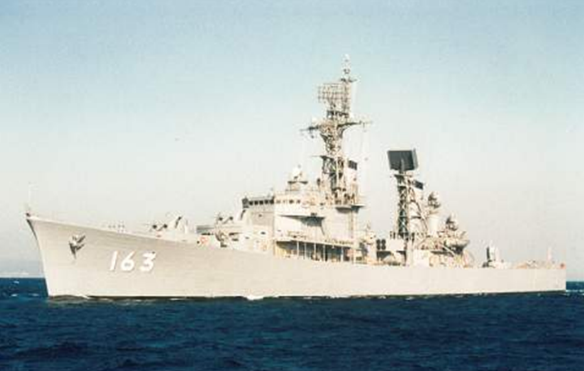
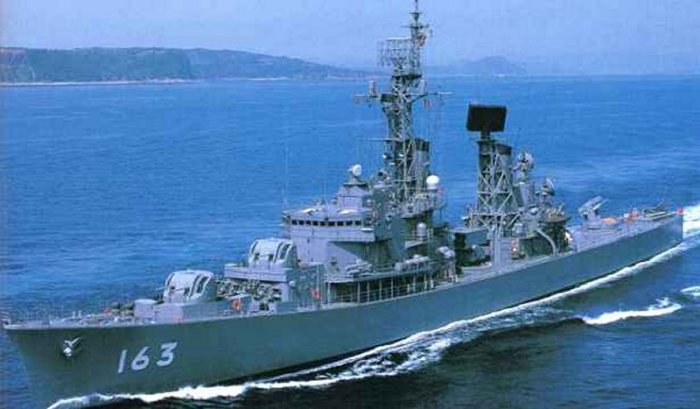
DDG 163 Amatsukaze was the first Japanese missile destroyer. Due to her limited size instead of a Terrier or Talos she was given the US Tartar missile system. Whe modernized in the 1980s, the Standard missile system, but also the RUR-5 ASROC system with Mk.112 octuple launcher afetr 1967. She was also the largest surface ship ever built in Japan since WW2, with almost double the displacement of 1950s destroyers. She was designed for AAW/ASW before the JMSDF alternate between AAW destroyers, ASW escorts and the much larger ASW destroyers. The Hatsusuki class (1980) was the first fitted with harpoon missiles.
Amatsukaze derived from the Akizuki class, and the Tartar system as its control system. Later she eaned an extended hull plus shelter cover design, improved steam turbines and SM-1.
She had an electronic suite and larger superstructure plus flush deck hull. She had no hangar but helipad. Later she had the AN/SPS-52, FCS-2-21D, AN/SPS-52 active and AN/SQS-23 passve sonars and NOLR-6B radar, OLR-9B missile warning system, OLT-3 jammer to stay active after the end of the cod war. Laid down on 29.11.1962, launched 5.10.1963 in Nagazaki, she was completed on 15.02.1965, discarded in 1995.
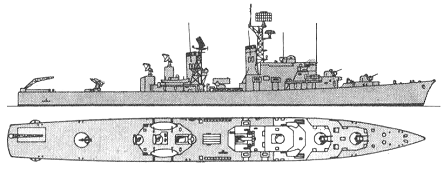
Amatsukaze, 2 views (src navypedia)
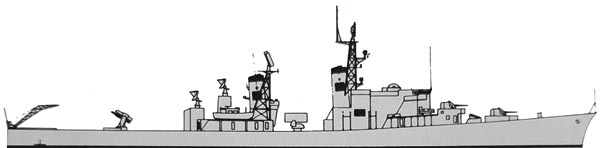
Amatsukaze, Conways
Specs
Displacement: 3050 tonnes standard, 4000 tonnes FL
Dimensions: 131 x 13.4 x 4.2 m
Machinery: 2 shafts Ishikawajima/GE geared turbines, 2 Ishikawajima/Foster-Wheeler boilers, 60,000 bhp. 33 knots, range 7000 nm
Sensors: Radars OPS-17, SPS-29, SPS-52, SPG-51, SPG-34, Sonar SQS-34, SQS-23
Armament: Mk13 launcher standard SAM (10 MR-1), 4x 3in/50 AA (2×2), 1×8 ASROC, 2 hedgehogs, 2 y-guns, 2×3 324mm Mk32 ASW TTs
Crew: 290
Yamagumo class escort destroyers (1965)
Yamagumo, Makigumo, Asagumo, Aokumo, Akigumo, Yūgumo
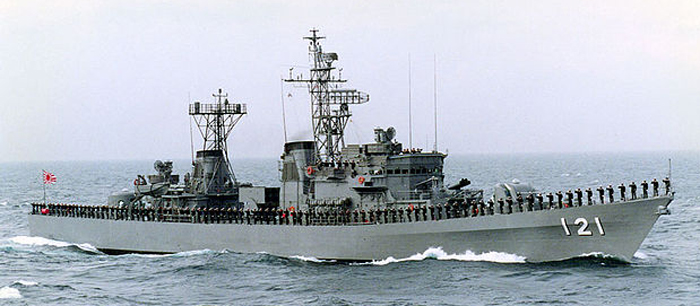
The Yamagumo class are vessels of the Japanese Maritime Self-Defense Force, usually classified as a destroyer, but due to their relatively light displacement, in other sources as a destroyer escort. This class is the successor of the Akizuki class.
This class was planned to become the new generation workhorse of the fleet of the JMSDF. In support of this objective, it was equipped with some new generation weapon and sensor systems such as the ASROC anti-submarine rocket and the OPS-11 early warning radar (Japanese equivalent of the American AN/SPS-40 radar).
The Minegumo-class destroyer derived from this class as the new DASH equipped version, but after the QH-50D DASH was scrapped, the JMSDF decided on resuming the construction of this class. The latter batch sometimes called as the Aokumo class, and there are some improvements, mainly in their electronics such as the OQS-3 hull-sonar (Japanese variant of the American AN/SQS-23) and the AN/SQS-35 variable depth sonar system.
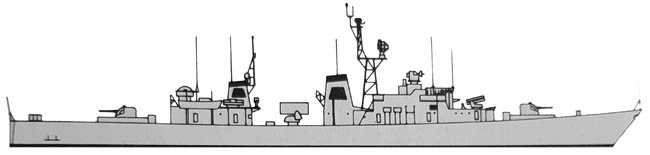
Yamagumo profile, Conways
Specs
Displacement: 2,050-2,200 long tons standard
Dimensions: 114-115.2 m (374ft) oa x 11.8 m (38 ft 9 in) x 3.9 m (12 ft 10 in)
Machinery: 2 shafts 4+2 × Mitsui 1228/1928 V3 BU-38V, 6 × Mitsubishi 12 UEV 30/40 diesels, 26,000 bhp
Performances: 27-28 knots (32 mph; 52 km/h), range 6,000 nmi (11,000 km)
Sensors: Radars AN/SQS-23, Mark 56/63 FCS OQS-3 sonar, VDS AN/SQS-35(J), OPS-11B, OPS-17 NOLR-1B/6
Armament: 4 × Mk.33 3″/50, ASROC, Bofors 375 mm (15 in) ASWRL, 2 × HOS-301 324 mm (12.8 in) TTs
Crew: 210-220
Takatsuki class missile destroyers (1966)
Takatsuki, Kikuzuki, Mochizuki, Nagatsuki
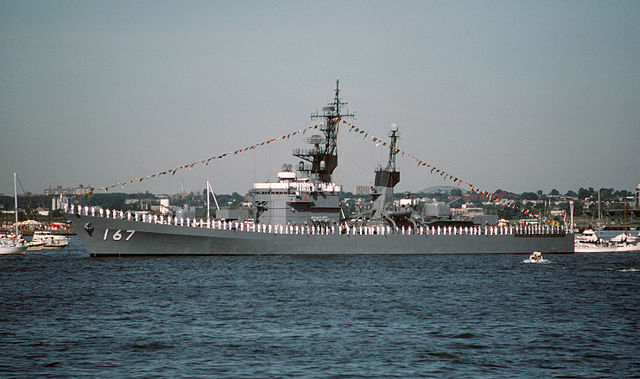
The Takatsuki class destroyers were designed mainly for anti-submarine warfare. They were laid down in 1964-68, launched 1966-69 and completed 1967-70.
They were powered by a mixed machinery like the previous class, with for the Takatsuki and Nagatsuki two Mitsubishi/WH reaction/impulse steam turbines and two Mitsubishi CE water tube boilers. Kikuzuki differed with her two Mitsubishi/EW impulse steam turbines and Mochizuki her Kawasaki Model NH-300 impulse steam turbines coupled with Model BD-120-1 water tube boilers. These all provided 60,000 shp (45 MW) on 2 shafts for 32 knots (37 mph; 59 km/h) and a range of around 6,000 nmi (11,000 km) at 16 knots.
Sensor-wise, they carried the OPS-11B EWR, OPS-17 SSR, AN/SQS-23, AN/SQS-35(J) suite as completed, with Mark 56 fire-control system. In the 1986 refits, they obtained the OPS-11C EWR radar and the NOLR-1B, NOLQ-1 chaff/ECM systems.
The armament also changed over time. When completed, these four 3,000 tonnes destroyers carried two Mk.42 5 in (127 mm) guns, one ASROC, a quad Bofors 375 mm (15 in) ASW Rocket Launcher (ASWRL), two triple Mk.32 ASW torpedo tubes and two QH-50D DASH anti-submarine drone helicopter.
After their 1986, they had one Mk.42 5 in (127 mm) gun removed aft, two quad RGM-84 Harpoon canister SSM added, and in place of the aft gun, a octuple 8 Mk.29 Sea Sparrow. For antimissile defence they earned a single Mk.15 CIWS, and kept the ASROC, Bofors ASWRL and TTs. However this 1985-1988 refit concerned Takatsuki and Kikuzuki (Sea Sparrow Harpoon). Phalanx CIWS systems were installed on Kikuzuki only. They also gained a new fire control system/radar, FCS-2-12 and TASS. Mochizuki and Nagatsuki were not upgraded. They were all retired post-1995, the first two retired in 2003-2008. Despite their greater armament, modernization implied better automation and they came from 270 to a 260 strong crew.
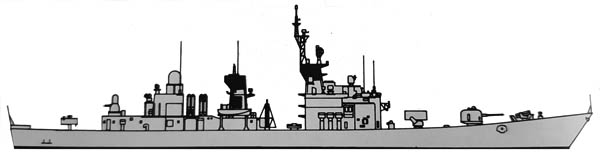
Takatsuki profile, Conways
Specs
Displacement: 3,100 t standard, 4,500 t full load
Dimensions: 136 x 13.4 x 4.4m (446 ft 2 in x 44 ft x 14 ft 5 in)
Machinery: 2 shafts Kawasaki steam turbines, 2 watertube boilers, 60,000 bhp. 32 knots, range 6,000 nm
Sensors: Radars OPS-11B EWR, OPS-17 SSR, AN/SQS-23, AN/SQS-35(J)
Armament: 2x 5in guns, ASROC, 1 ASWR, 2×3 324mm Mk32 ASW TTs, 2 DASH drones
Crew: 270
Minegumo class escort destroyers (1967)
Minegumo, Natsugumo, Murakumo
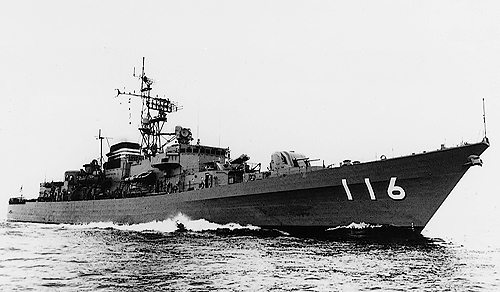
The Minegumo class represented a new, smaller and cheaper destroyer concept, as successor of the Yamagumo class, derived from it but fitted with the QH-50D DASH ASW drone instead of her ASROC system. Her main task was also Anti-submarine warfare. In 1969 Production of the QH-50D system was terminated and thus the class was cut after the third ship.
The JMSDF considered the creation of large helipad for a Kaman SH-2 Seasprite helicopter, but this plan was abandoned on budget cost issues. Nevertheless, DASH and its facilities were removed in 1979-82, replaced back by the Mk.16 GMLS/ASROC instead. Murakumo was refitted in 1978 and tailored to be used as gunnery trials vessel with her aft Mk.33 gun removed, replaced by the Italian OTO Melara 76 mm gun to be tested.
All three were decommissioned in 1999 and 2000.
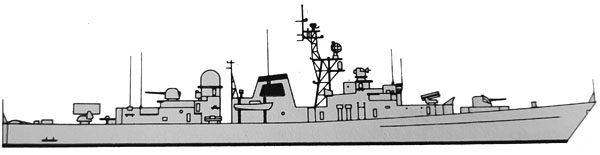
Minegumo profile, Conways
Specs
Displacement: 2,100 tonnes standard, 2,750-2,794 tonnes FL
Dimensions: 115 x 11.8 x 3.8 m (377 x 38 x 12 ft)
Machinery: 2 shafts Ishikawajima geared turbines, 2 Ishikawajima boilers, 50,000 bhp. 32 knots, range 7,000 nm
Sensors: Radars OPS-11B EWR, OPS-17, sonars OQS-3, SQS-35, Mark 56 FCS, NOLR-1B EW
Armament: 2 × Mk.33 twin 3″/50 guns, Bofors 375 mm (15 in) ASWRL, 2 × HOS-301 324 mm TTs, 2 × QH-50D DASH
Crew: 210
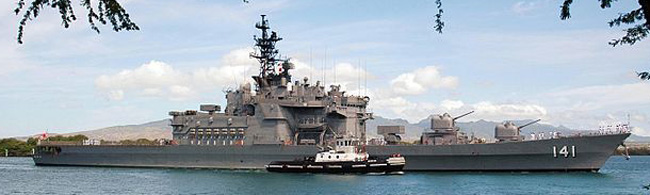
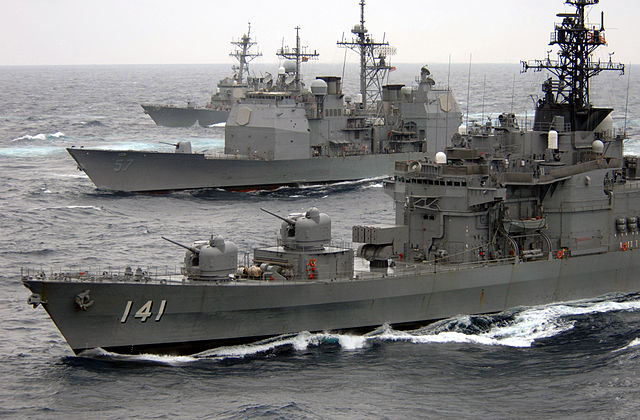
JDS Haruna (DDH-141) passes Hospital Point in Pearl Harbor, Hawaii
The Haruna-class destroyer were a first for Japan, and required an authorization for their unusual tonnage. Japan was forbidden to built aicrarft carriers and ships beyond 5,000 tonnes (standard) as defined in 1946. But the need of better ASW solutions to deal with the Soviet Submarine problem forced the Japan Maritime Self-Defense Force (JMSDF) to lift these limits, and plan for its first “helicopter destroyer” in the early 1970s. There had been helicopter carrying destroyers in the past, but they often had a simple helipad or at bast a small hangar. They were more common on cruisers. Hybrid helicopter crisers like the Soviet Moskva class however showed the way. For it to better pass budget approval, these vessels, sized like cruisers (they were larger than the Italian helicopter cruisers Andrea Doria !) were designated DDH. They were also very peculiar, built around a large central hangar housing up to three large helicopters. These were no longer the Kaman type bu licence-built Seawhawk, SH-60J(K) anti-submarine helicopters, with far better range and weapons, sensors array.
Originally, the JMSDF intended in 1960 to plan through the Defense Agency a single, experimental helicopter carrier (CVH) with the Second Defense Build-up Plan. It was later cancelled as fleet aviation was spread among destroyers instead. The Japanese DDH was completely recast as a simple “extended Takatsuki” with her weaponry concentrated forward (two 5-inch/54 cal. Mark 42, a Type 74 octuple missile launcher, and a large hangar and 50 m flight deck, complete with three spots. The Japanes FRAM program of 1983-1984 changed the armament to Sea Sparrow launchers, Phalanx CIWS, chaff launchers and better ECM/EEW systems as well as the Naval Tactical Data System (NTDS) coupled with the OYQ-6/7 combat direction system. As for their powerplant, they had new boilers working at 850 psi (60 kg/cm², 5.9 MPa), 430 °C for a total of 60,000 hp (45,000 kW).
Eventually the planned prototype became a class: DDH-141 Haruna started on 19 March 1970, launched 1 February 1972 and completed on 22 February 1973 in Maizuru and DDH-142 Hiei, laid down 8 March 1972, launched 13 August 1973, completed 27 November 1974, in Kure. The first was discarded and BU on 18 March 2009 and the second on 16 March 2011. The formula was considered a success, leading to the construction of the larger 1978 Shinane class and in the 2000s to a brand new replacement generation looking like conventional CVH: The Hyuga and Izumo class.
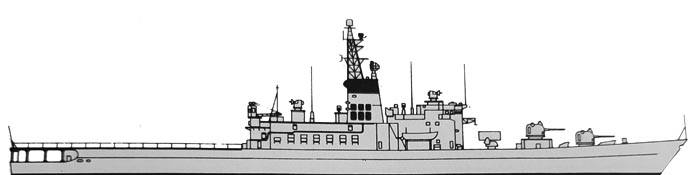
Haruna profile, Conways
Specs
Displacement: 4,950 t standard, 6,900 t full load
Dimensions: 153.1 x 17.5 x 5.2m (502 x 57 x 17 ft)
Machinery: 2 shafts Ishikawajima geared turbines, 2 Ishikawajima boilers, 60,000 bhp. 32 knots
Sensors: Radars OPS-11, OPS-17 (later 28), Sonar QQS 3.
Armament: 1×8 Sea Sparrow Mk.29 SAM, ASROC, 2× 5″/54 Mk.42 guns, 2 Phalanx CIW, 2 Mark 32 TTs
Aircraft carried: 3x SH-60J(K) ASW helicopters
Crew: 360
Tachikaze class missile destroyers (1974)
Tachikaze, Asakaze, Sawakaze
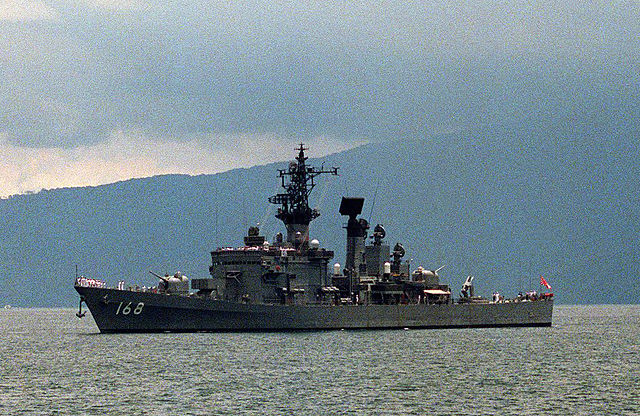
The Tachikaze-class destroyers were a new generation of versatile guided missile destroyer class, succeeding Amatsukaze, ten years prior. They benefited from successive improvements after completion and notably their C4I systems. Specialized in air-defense to ensure protection of ASW groups, they were succeeded by the Hatakaze class. Like those before and after, all were named after WW2 destroyers lost in action.
The Tachikaze class received the US Tartar-D system, and Standard-1 MR missile integrated with the Naval Tactical Data System (NTDS), for the first time on a warship in Japan. It wasq coupled with the OYQ-1 Weapon Entry System (WES) tested on JDS Tachikaze. The OYQ-1 WES derived from Takatsuki’s NYYA-1 but for the first time coupled with C4I system with NTDS. Asakaze had an improved OYQ-2 Target Designation System (TDS) and Sawakaze the new OYQ-4. Apart the Standard-1 MR and its Mk 13 launcher they received the Type 74 Mark 16 GMLS ASROC, two quad canister of Harpoon SSM, two Phalanx CIWS, two Type 68 324 mm TTs, and as usual two 5-inch/54 cal. Mark 42 main guns.
In 1998, Tachikaze became a flagship with her aft 5-inch gun replaced by a new blockhouse fitted for fleet command. Tachikaze was discarded in 2007, Sawakaze vecoming the new flagship, and was decomm. in 2010, Asakze in 2008.
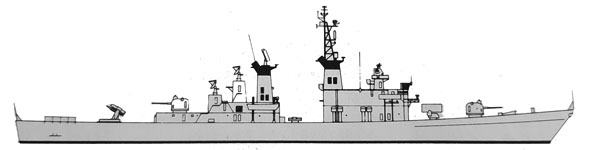
Tachikaze profile, Conways
Specs
Displacement: 3,850 t standard, 3,950 t FL
Dimensions: 143 x 14.3 x 4.6-4.7m (469 x 46 x 15 ft)
Machinery: 2 shafts Mitsubishi geared turbines, 2 Ishikawajima boilers, 60,000 bhp. 32 knots, range 5,000? nm
Sensors: Radars OPS-11, OPS-17 (later 28), Sonar QQS 3.
Armament: 2x 5-in/54 Mk42, 2x CIWS, 1x Mk13 SAM (MR-1), 2×4 Harpoon SSM, Type 74 ASROC, 2×3 HOS-301 324mm ASW TTs
Crew: 250-255
Shirane class helicopter destroyers (1978)
Shirane, Kurama
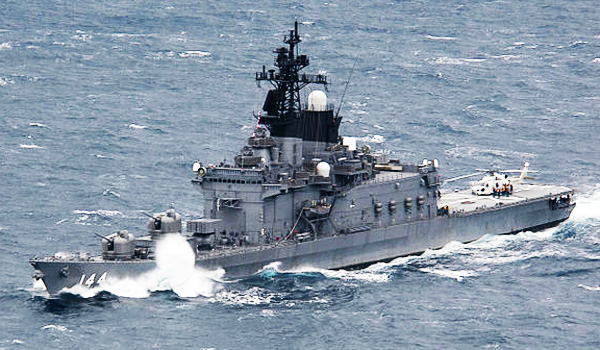
The Shirane were a repeat, but much improved version of the Haruna-class destroyers. The propulsion was upgraded due to the scale of the new ships to an output of 70.000 hp for 32 knots (she had new IHI boilers working at 850 psi (60 kg/cm², 5.9 MPa), 430 °C) for a displacement of 7,200 tonnes at Full Load. Also at 160 m long they were the largest warships ever built in postwar Japan, delivered by Yokosuka and Sasebo.
The Shirane class kept the same hybrid design, with the armament concentrated forward, and a large deck aft plus hangars to operate all sorts of medoum to heavy helicopters. Initially these were “only” three SH-60J(K) anti-submarine helicopters like their precedessors. More could be stored on deck spots.
The armament included two Mk.42 127mm guns, 20-mm Phalanx CIWS (close-in weapon systems) a single RIM-7 Sea Sparrow SAM, same triple torpedo banks and ASW rockets. Their elecronics suite was modernized and they gained a NOLQ-1 integrated suite with OLR-9B RWR and Mark 36 SRBOC. They were completed in 1980-81 and served until replaced by the new, very large Izumo-class helicopter destroyers, discarded in 2015 and 2018 respectively.
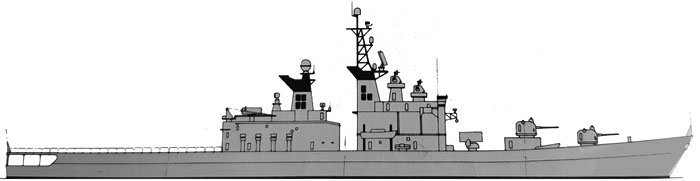
Shirane profile, Conways
Specs
Displacement: 5200 tonnes standard, 7500 tonnes FL
Dimensions: 159 x 17.5 x 5.3 m (522 x 57 x 17 ft)
Machinery: 2 shafts Ishikawajima geared turbines, 2 IHI boilers, 70,000 bhp. 32 knots, range ?
Sensors: Radars OPS-12 3D, OPS-28, sonars OQS-101 bow, SQS-35/SQR-18 VDS-TASS
Armament: Sea Sparrow SAM, ASROC Mk 112, 2 × FMC 5″/54 Mark 42, 2× CIWS, 2 × Mark 32 TTs, 3 Helicopters
Crew: 350-360
Hatsuyuki class missile destroyers (1980)
Hatsuyuki, Shirayuki, Mineyuki, Sawayuki, Hamayuki, Isoyuki, Haruyuki, Yamayuki, Matsuyuki, Setoyuki, Asayuki, Shimayuki
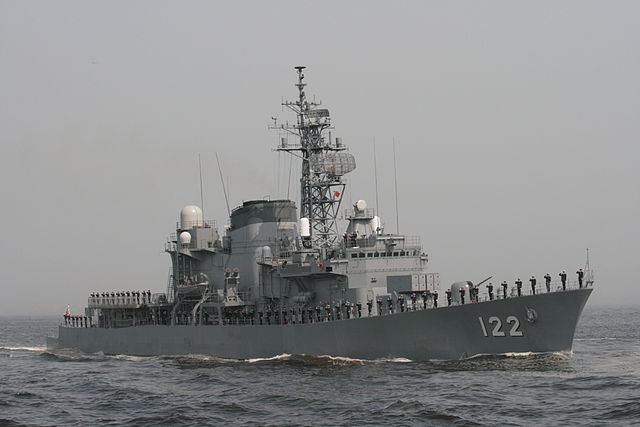
This was the largest post-war destroyer progral in Japan. The goal was to replace the entire 1950s generation of early ASW destroyers. This twelve ships were built at Simitomo, Hitachi, Mitsubishi, IHI, and Mitsui, yards usually not accustomed to military vessels, unless Yokosuka, Kure, Sasebo or Maizuru. Laid down in 1979-84 and completed in 1982-87, so close to the end of the cold war. Between anti-aircraft gunfire-oriented destroyers (DDA) and ASW destroyers (DDK) they were also the result of the 1970s reorganizaiton of squadrons dur to the gorwing threat of Soviet nuclear submarines. The concept adopted was a group of eight ships for eight helicopters, any flotilla being composed of a single helicopter destroyer (DDH), five general-purpose destroyers (DD), and two guided-missile destroyers (DDG).
The Hatsuyuki were the first of these new generation General-purpose destroyers (Hanyou-goei-kan) combining both AA and ASW capabilities as well as helicopters. The core was the new the OYQ-5 Tactical Data Processing System (TDPS) comprising the AN/UYK-20 computer, five OJ-194B workstations with datalink 14 (STANAG 5514). They were also the first to drop the traditional gear turbines and steam boilers for four gas turbines, two for cruising and two for speed. They also received later a full ECM suite, with the NOLR-6C intercept array, OLT-3 jammer, and Mark 36 SRBOC chaff launcher plus towed torpedo decoys. They also carried either a HSS-2B or a SH-60J helicopter and the crew was just 200 strong thanks to greater automation.
Four ships were later repurposed for training in 19999-2016: JS Shimayuki), Shirayuki, Setoyuki and Yamayuki. They were decommissioned in 2016-2022 (this year).
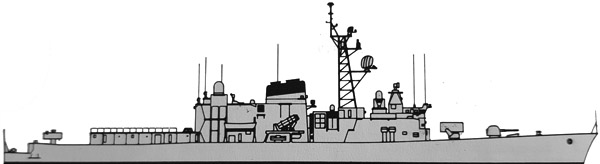
Hatsuyuki profile, Conways
Specs
Displacement: 2,950 tonnes standard, 4,000 tonnes FL
Dimensions: 130 x 13.6 x 4.2 m (430 x 45 x 14 ft)
Machinery: 2 shafts, 2 KHI-RR TM3B + 2 gas turbines, KHI-RR RM1C, 45,000 + 9,900 bhp. 30 knots
Sensors: Radars OPS-17, SPS-29, SPS-52, SPG-51, SPG-34, Sonar SQS-34, SQS-23
Armament: 1× OTO Melara 76 mm, 2 CIWS, 2×4 Harpoon SSM, 1×8 Sea Sparrow SAM, ASROC, 2×3 324 mm TTs, 1 Helicopter.
Crew: 200
Hatakaze class missile destroyers (1984)
Hatakaze, Shimakaze
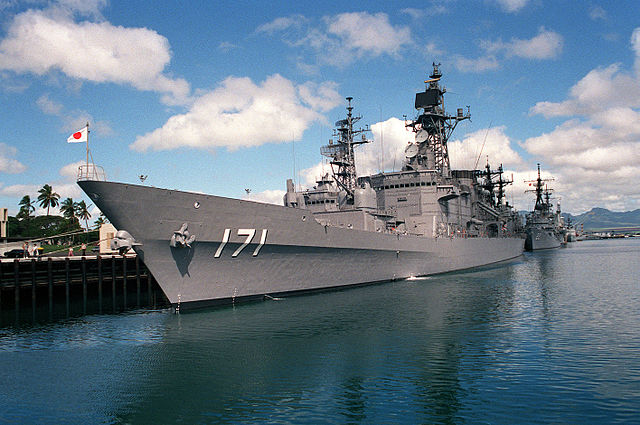
The Hatakaze class were large guided-missile destroyers, the third generation built for the JMSDF and like the previous class, the first to have gas-turbine propulsion. They had the same ecomputer and datalink as the previous Tachikaze class, but improves since they were both intended to be used as group flagship, being roomier than the Tachikaze. They were meant to function as command ships. They operated the OYQ-4-1 tactical control system with the Standard SAM, ASROC, RGM-84 Harpoon, Mark CIWS, triple ASW TTs but instead of the light 3-in OTO Melara pf their predecessors they still relied on the much larger 5 inch/54 caliber Mark 42. With automation despite their size their crew in standard condition was down to 260.
Laid down in 1983 and 1985 at Yokosuka and Sasebo they were commissioned in 1989-88. Both had been converted as training vessel in 2020 and 2021 respectiovely for the new generation of guided missile destroyers of the Kongo lineage. They were also the largest JMSDF vessels, even compared to the Shirane class. They are still in service today, planned to stay active at least until 2025.
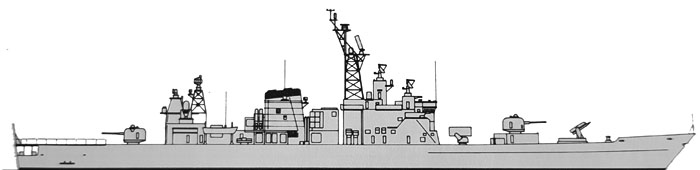
Hatakaze profile, Conways
Specs
Displacement: 4,600 tonnes standard, 6,000 tonnes FL
Dimensions: 150 x 16.4 x 4.8 m (492 x 53 x 16 ft)
Machinery: 2 shafts COGAG Kawasaki RR Spey SM1A, RR Olympus 72,000 hp, 30 knots
Sensors: Same as Tachikaze
Armament: 2×4 Harpoon SSM, Standard SAM, ASROC, 2× 5″/54 Mark 42, 2× CIWS, 2×3 Type 68 TTs
Crew: 260
Asagiri class missile destroyers (1986)
Asagiri, Yamagiri, Yūgiri, Amagiri, Hamagiri, Setogiri, Sawagiri, Umigiri
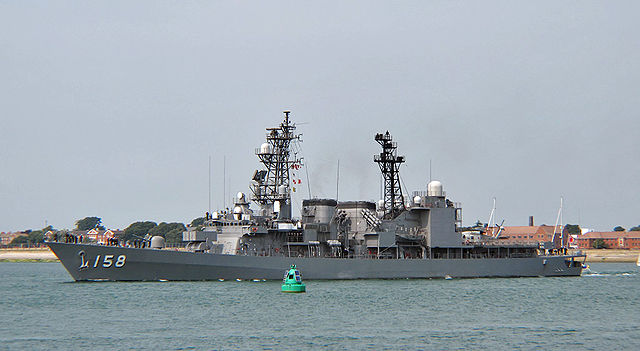
This was the second class of new multirpurpose destroyers. Improved version of the Hatsuyuki class, which due to budget constraints the design was compromised for C4I function, resistance, and durability. These FY1983 planned desotroers were built back in large or military yards and an evolved design with expanded hull, enhanced equipment.
They were not only enlarged Hatsuyuki class, with superstrcture made of steel, and instead of COGOG they had COGAG, combining four Kawasaki-Rolls-Royce Spey SM1A gas turbines, enabling 26 knots (48 km/h; 30 mph) on just two engines with much greater range to track nuclear submarines much longer. The alternated arrangement improved resistance and durability, recalling the good old steam turbines. They had at forst the OYQ-6 combat direction system (CDS) with the same AN/UYK-20 computer but expanded memories, and datalink-11, later upgraded to the OYQ-7 with the OYQ-101 ASW Direction System. For C4I they used the Superbird SHF-SATCOM.
They also had the new OPS-28 air-search radar, OPS-14C and later OPS-24 3D, while electronic warfare was uopgraded with NOLR-8. Armament however remained the same with a more modern FCS but they now operated a permanent SH-60J shipboard helicopter with a hangar large enough for two. Laid down In 1986-89, at the end of the cold war, they were completed in 1988-91 as it ended. Needless to dyay their are still in 2022, fully active, two early ships being converted as training vessels in 2011 and 2012. Decommission dates would be around 2030, and with the rise of the Chinese PLAN and recent demonstrations in the yallow sea, it is likely they would be kept active longer after intensive modernization.
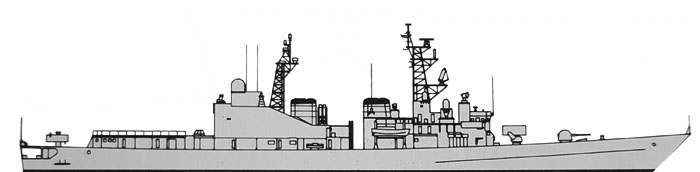
Asagiri profile, Conways
Specs
Displacement: 3,500 tonnes standard, 5,200 tonnes FL
Dimensions: 137 x 14.6 x 4.5 m (450 x 47 x 15 ft)
Machinery: 2 shafts COGAG, 4 Kawasaki RR Spey SM1A, 54,000 bhp. 26 knots, range 6,000 nm
Sensors: Radars OYQ-6/7 CDS, OPS-14/24, OPS-28, Sonars OQS-4A, OQR-1 TASS
EW: NOLR-8 intercept, OLT-3 jammer, Mark 36 SRBOC, AN/SLQ-25 torpedo decoys
Armament: As Hatsuyuki
Crew: 220
JMSDF Escorts

IJ Hatsushi, en ex-Cannon class DET, in service from 1955 to 1975.
This category started early on for basic marine policy around the vast expanses of Japanese territorial waters, especially in contested areas like the Sakhalin island but also those of the Okinawa prefecture, close to China and Taiwan. Aside the vessels of US provenance, a program to relaunch naval construction led to the design and construction of new ASW escort ships somewhat inspired in concept by WW2 US vessels but already leaning to the new early cold war US designs.
Akebono class escorts (1955)

Akebono was authorised under the 1953 Programme as one of three ‘B type’ escort vessels. She was built with geared turbines and her near-sisters, Ikazuchi and Inazuma with diesels. There were many differences between the two designs, the most noticeable being Akebono’s twin funnels in contrast to the one funnel of the near-sisters. All weapons and electronics were US produced. In March 1959 her original gun armament was removed and she was fitted with 2-3in quick-firing guns. Four K-guns and a DC rack were also removed.
Specs:
Displacement: 1,092 t standard, 1,372 t full load
Dimensions: 91.8 x 8.5 x 3.4 m (301 ft 2 i x 27 ft 11 in x 11 ft 2 in)
Propulsion: 2 shafts geared steam turbines, 2× boilers 18,000 shp (13,000 kW): 28 kn (52 km/h; 32 mph)
Complement: 193
Sensors: Mark 51 FCS, Mark 63 FCS (1959)
Armament: 2 × 3″/50, 4× 40 mm AA, Hedgehog, 8 K-guns, DCR.
Ikazuchi class escorts (1955)

Both units were authorised under the 1953 Programme as two further ‘B type’ escort vessels, powered by diesels. The Ikazuchi class had one funnel whereas Akebono had two, a prominent recognition difference. All weapons and electronics were US produced. The original 2 x 3-in guns and 140 mm gun were removed in 1959 and replaced by 2 x 3in quick-firing guns. Four K-guns and one DC rack were also removed. Due to projected vibrations from the diesels, steel plates were used for the hull and aluminium alloy in the superstructure.

Specs:
Displacement: 1,080 long tons standard
Dimensions: 87.5 x 8.7 x 3.01 m (287.1 x 28.5 x 9.9 ft)
Propulsion: 2 × diesels, 25 knots
Complement: 160
Sensors: OPS-2 ASR, OPS-3 SSR, QHB, QDA sonar, Mark 51 FCS
Armament: 2 × 3″/50 Mk.21, 2× Bofors 40 mm, Hedgehog, 8x K-gun, 1 DCR
Izuzu class escorts (1961)

Class: DE-211 Isuzu, DE-212 Mogami, DE-213 Kitakami, DE-214 Ōi
Two ships were constructed under the 1959 and two under the 1961 programme. Weapons and machinery varied considerably throughout these units Usuzu and Mogami had Weapon Alfa instead of a rocket launcher, and no DCT) and they served as test platforms. VDS was mounted on Mogami in 1966 and Kitakami in 1968. All had different machinery, but Isuzu had only two engines, and consequently a smaller funnel. On conversion to auxiliary/ training status TT (and VDS in DE 212 and 213) removed.
The earlier batch (DE-211, 212) had a Mk.108 ASW rocket launcher and two Mk.2 ASW torpedo racks. The latter batch (DE-213, 214) had a Bofors M/50 375 mm ASW rocket launcher and two Type 68 triple 324 mm torpedo tubes.

Specs:
Displacement: 1,490 long tons standard, 1,700 long tons full load
Dimensions: 94 x 10.2 x 3.5m (308 ft 5 in x 33 ft 6 in x 11 ft 6 in)
Propulsion: 2 shafts Diesel: 25 knots (46 km/h; 29 mph)
Complement: 183
Sensors: Mark 63 FCS.
Armament: 4× 3 in/50 Mk.22, Y-gun, DCR, 4 × 533 mm TTs, see notes.
Chikugo class escorts (1970)

Class: DE-215-225: Chikugo, Ayase, Mikuma, Tokachi, Iwase, Chitose, Niyodo, Teshio, Yoshino, Kumano, Noshiro built 1968-77.
Chikugo units are the smallest ships in the world to be armed with ASROC, and most units are equipped with VDS. Particular attention was given to reduce vibration and noise. Because of the large superstructure area for ships of this size, they were given greater beam to improve stability. Karly units are 1470t standard; from Teshio onwards they are 1530t. The Mitsui diesels are fitted to DE 216, DE 220, DE 222 and DE 224. Decommissioned 1996-2003

Specs:
Displacement 1,700–1,800 long tons full load
Dimensions: 93 x 10.8 x 3.5 (305.1 x 35 x 11 ft)
CODAD propulsion system: 2 shafts, 4 diesels 16,000 hp: 25 knots (46 km/h; 29 mph)
Range: 5,500 nmi (10,200 km) at 20 kn (37 km/h; 23 mph)
Complement: 165
Sensors: TDS-1, OPS-14 2D, OPS-17, FCS-1B FCS, OQS-3A bow sonar, SQS-35(J) VDS, SFCS-4 FCS NOLR-1/5 ESM
Armament: 2× 3″/50, 2× 40 mm AA, ASROC, 2×3 324 mm ASW Mk.24
Ishikari class escorts (1980)

Two units of the Ishikari class were originally authorised, one in 1977-78 and the second in 1979-80, but only one was built. As many as twenty were planned. This design is smaller and less sophisticated than the preceding Chikugo class, but too much seems to have been attempted on the displacement — hence the curtailment of the programme, and the evolution of the Yubari design (see below).

Specs:
Displacement: 1,290/1,450 tons FL
Dimensions: 278.8 x 35.4 x 11.8ft (85 x 10.8 x 3.6 m)
Propulsion: CODOG Kawaksaki/RR Olympus TM3B 24,700 hp+ Kawaksaki 6DRV diesel: 25 knots
Complement: 95
Armament: Otobreda 76 mm, 8× Boeing Harpoon SSM, Bofors 375 mm ASWRL, 2×3 HOS-301 324 mm TTs
Yubari class escorts (1982)

An improved and slightly enlarged Ishikan, with improved accommodation and increased fuel capacity. The second ship was ordered under the FY80-81 programme, but no further ships appeared. Phalanx CIWS was part of the original design, but has not as yet been fitted. DE-227 Yūbari was laid down on 9 February 1981, launched on 22 February 1982 comp. 18 March 1983 and DE-228 Yūbetsu launched on 25 Jan 1983, both based at Ominato, decommissioned on 25 June 2010.

Specs:
Dimensions: 1,470 tons standard, 1,690 tons full load
Dimensions: 91 x 10.8 x 3.6 m (298 ft 7 in x 35 ft 5 in x 11 ft 10 in)
Propulsion: as Ishikari
Complement: same
Armament: same.
Abukuma class escorts (1961)

Class: DE 229 ABUKUMA, DE 230 JINTSU, DE 231 OHYODO, DE 232 SENDAI, DE 233 CHUKUMA, DE 234 TONE.
A much larger and more capable escorts, comparable to the earlier smaller destroyers. Two ordered in successive estimates 1987-89.
Abukuma was laid down on 17 March 1988, launched 21 December 1988, comp. 12 December 1989 (HP Kure)
Jintsū was laid down on 14 April 1988, launched on 31 January 1989, comp. 28 February 1990 (HP Sasebo)
Ōyodo was laid down on 8 March 1989, launched on 19 December 1989, comp. 23 January 1991 (HP Ominato)
Sendai was laid down on 14 April 1989, launched on 26 January 1990, comp. 15 March 1991 (HP Maizuru)
Chikuma was laid down on 14 February 1991, launched on 25 January 1992, comp. 24 February 1993 (HP Ominato)
Tone was laid down on 8 February 1991, launched on 6 December 1991, comp. on 8 February 1993 (HP Kure)
They were a redical departure over previous designs and much larger, relfecting the US Knox and OH Perry. They were fitted for towed-array sonar from the start.
They innovated by some stealth tech, with angled hull surfaces, Naval Tactical Data System, OYQ-7 combat direction system and ECM capability with the OLT-3 jammer. They are still in service today.

Specs:
Dimensions: 357ft 7in x 44ft x 12ft 6in (109 x 13.4 x 3.8m)
Machinery: 2-shaft CODOG, 2 Rolls-Royce Spey SM1A gas turbines, 26,650shp = 27kts; 2 Mitsubishi diesels 6000bhp = 27kts
Sensors: Radar OPS-14C, OPS-28; sonar OQS-8
Armament: 8 Harpoon SSM (2 x 4), 1-76mm/62 OTO Melara, 1-20mm Phalanx CIWS, 1 ASROC ASW system, 6-12.75in Mk 32 ASW TT (2 x 3)
Complement: 115
Next: JMSDF Cold War Submarines
Oyashio (1959)
Ayashio class submarines (1961)
Natsushio class submarines (1962)
Oshio class submarines (1964)

Uzushio class submarines (1970)

Yushio class submarines (1979)

 Latest Facebook Entry -
  X(Tweeter) Naval Encyclopedia's deck archive
 Instagram (@navalencyc)


 French Navy
 Royal Navy
 Russian Navy
 Armada Espanola
 Austrian Navy
 K.u.K. Kriegsmarine
 Dansk Marine
 Nautiko Hellenon
 Koninklije Marine 1870
 Marinha do Brasil
 Osmanlı Donanması
 Marina Do Peru
 Marinha do Portugal
 Regia Marina 1870
 Nihhon Kaigun 1870
 Preußische Marine 1870
 Russkiy Flot 1870
 Svenska marinen
 Søværnet
 Union Navy
 Confederate Navy
 Armada de Argentina
 Imperial Chinese Navy
 Marine Haitienne
 Marinha do Portugal
 Mexico
 Kaiserliche Marine
 1898 US Navy
 Argentina
 Brazil
 Chile
Chile Cuba
Cuba Peru
Peru Bulgaria
 Denmark
 Greece
 Netherlands
 Norway
 Portugal
 Romania
 Sweden
 China
China Thailand
 Sovietskiy Flot
 Royal Canadian Navy
 Royal Australian Navy
 RNZN Fleet
 RIN Fleet
 Chinese Navy 1937
 Kriegsmarine
 Chilean Navy
 Danish Navy
 Finnish Navy
 Hellenic Navy
 Polish Navy
 Romanian Navy
 Turkish Navy
 Royal Yugoslav Navy
 Royal Thai Navy
 Minor Navies
 Albania
 Austria
 Belgium
 Columbia
 Costa Rica
 Cuba
Cuba Czechoslovakia
 Dominican Republic
 Haiti
Haiti Hungary
 Honduras
 Estonia
 Iceland
 Eire
Eire Equador
 Iran
Iran Iraq
Iraq Latvia
 Liberia
 Lithuania
 Mandchukuo
 Morocco
 Nicaragua
 Persia
 San Salvador
 Sarawak
 Uruguay
 Venezuela
 Zanzibar
 Warsaw Pact Navies
 Bulgaria
 Hungary

 Bundesmarine
 Dutch Navy
 Marina Militare
 Yugoslav Navy
 Chinese Navy
 Indian Navy
 Indonesian Navy
 JMSDF
JMSDF North Korean Navy
 Pakistani Navy
 Philippines Navy
 ROKN
ROKN Rep. of Singapore Navy
 Taiwanese Navy
 Vietnam People’s Navy
 IDF Navy
 Saudi Navy
 Royal New Zealand Navy
 Egyptian Navy
 South African Navy


 Ukrainian Navy