
United Kingdom vs. Germany
First naval action of the war
The very first action of the great war occurred on seas: The Staff of the Hochseeflotte had developed a comprehensive plan for years to come in the event of a war with Britain. It was firstly to undermine British ports and disrupt coastal shipping and traffic areas before any action being taken the Royal Navy, and secondly to make bombing raids of British coastal towns to attack population’s morale.
As part of the first action, the German naval command mobilized on August 04 in the morning, former ferry Königin Luise, requisitioned and converted for the Hochseeflotte as “hilfsminenkreuzer” (auxiliary cruiser minelayer). In this context the ship was quickly fitted out with mine rails, while two 37 mm guns taken from old stocks were installed at the stern. The night of 3-4 August, she was also provided with facilities to install two 88 mm, but the rush prevented this and she was to be to painted in a new livery and load 200 mines fastened to buoy ropes on board instead.
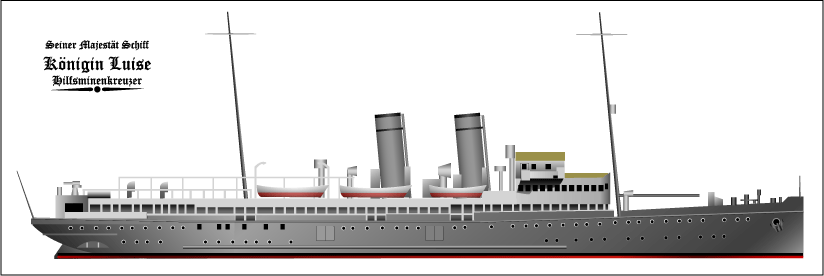
Centerpiece of this event, SMS Königin Luise, auxiliary cruiser/minelayer in august 1914.
Beginnings
August 5, in the morning, the ship left Cuxhaven unescorted and headed towards the Thames with a mission to establish there a minefield. The Thames was a deep and well dredged river and probably the most vital artery for the British trade towards the interior of Sussex and London in particular. The traffic there was so much that Königin Luise traveling at 16 knots was not even spotted when crossing an upcoming squadron of destroyers, thanks to her new, hastily painted livery that betrayed her identity, and went on her way unmolested to its objective.
There she spent the afternoon quietly and eventually laid her mines off the estuary, crossing rare ships without awakening suspicion. However in the British Admiralty, intelligence services report stated that German missions were underway, or warned of expected German mines being laid down. The SS Königin Luise is often mismatched with the much larger Barbarossa class liner (1897). More on this

The other SS Königin Luise was a recent steam ferry operated by the Hamburg America Line, laid down in AG Vulcan Stettin in 1913.
The British counterstroke
The squadron of the Thames, composed of Amphion, and two flotillas of destroyers (height in all) is eventually informed, and headed full speed ahead to the mouth of the Thames. The German ship was currently completing its mission and was preparing to return to Cuxhaven. At 11:40 p.m., HMS Amphion made eye contact with the ship, which then immediately leaved, and a hot pursuit ensured.
Faster, destroyers Lance and Landrail running at 29 knots were the first to catch the German ship (only capable of 21 knots). These made a few warning shots with their 102mm forward of the ship to order her stopping. Then both destroyers went parallel to KL, still firing warning shots at a distance, while HMS Amphion, slower, fired to the rear. The German ship could only answer with its 37 mm and had to prepare for torpedoes at close range. The duel was uneven and eventually SMS KL took many hits 102 mm from the destroyers cross-sides.
The end of the Königin Luise
Pounded at the rear in addition, the KL receives the final blows of Amphion, as dark fell at 0:00 at 51 ° 52 ‘north and 02 ° 30’ east. Survivors were rescued until dawn, and then the squadron set sail to its base. The Amphion will – ironically – be responsible for rescuing other sailors victims from the minefield laid by Königin Luise, and was struck at 18:00 by several of them, sinking in no time with great loss of life. So it was the most prized victim of the German ship. The destroyers, who strived to recover survivors were running slowly, watching cresting waves that indicate position of the mines, helping to spot and sweep these the day after, while many transport passing by were duly notified. Such event served as a lesson also to the Royal Navy, that, duly warned, from then on multiplied patrols, and was more suspicious about possible misidentified civilian ships.
 Latest Facebook Entry -
  X(Tweeter) Naval Encyclopedia's deck archive
 Instagram (@navalencyc)


 French Navy
 Royal Navy
 Russian Navy
 Armada Espanola
 Austrian Navy
 K.u.K. Kriegsmarine
 Dansk Marine
 Nautiko Hellenon
 Koninklije Marine 1870
 Marinha do Brasil
 Osmanlı Donanması
 Marina Do Peru
 Marinha do Portugal
 Regia Marina 1870
 Nihhon Kaigun 1870
 Preußische Marine 1870
 Russkiy Flot 1870
 Svenska marinen
 Søværnet
 Union Navy
 Confederate Navy
 Armada de Argentina
 Imperial Chinese Navy
 Marine Haitienne
 Marinha do Portugal
 Mexico
 Kaiserliche Marine
 1898 US Navy
 Argentina
 Brazil
 Chile
Chile Cuba
Cuba Peru
Peru Bulgaria
 Denmark
 Greece
 Netherlands
 Norway
 Portugal
 Romania
 Sweden
 China
China Thailand
 Sovietskiy Flot
 Royal Canadian Navy
 Royal Australian Navy
 RNZN Fleet
 RIN Fleet
 Chinese Navy 1937
 Kriegsmarine
 Chilean Navy
 Danish Navy
 Finnish Navy
 Hellenic Navy
 Polish Navy
 Romanian Navy
 Turkish Navy
 Royal Yugoslav Navy
 Royal Thai Navy
 Minor Navies
 Albania
 Austria
 Belgium
 Columbia
 Costa Rica
 Cuba
Cuba Czechoslovakia
 Dominican Republic
 Haiti
Haiti Hungary
 Honduras
 Estonia
 Iceland
 Eire
Eire Equador
 Iran
Iran Iraq
Iraq Latvia
 Liberia
 Lithuania
 Mandchukuo
 Morocco
 Nicaragua
 Persia
 San Salvador
 Sarawak
 Uruguay
 Venezuela
 Zanzibar
 Warsaw Pact Navies
 Bulgaria
 Hungary

 Bundesmarine
 Dutch Navy
 Marina Militare
 Yugoslav Navy
 Chinese Navy
 Indian Navy
 Indonesian Navy
 JMSDF
JMSDF North Korean Navy
 Pakistani Navy
 Philippines Navy
 ROKN
ROKN Rep. of Singapore Navy
 Taiwanese Navy
 Vietnam People’s Navy
 IDF Navy
 Saudi Navy
 Royal New Zealand Navy
 Egyptian Navy
 South African Navy


 Ukrainian Navy