
Braunschweig class battleships (1902)
 Germany (1906)
Battleships Braunschweig, Elsass, Hessen, Prussen, Lothringen
Improved pre-dreadnoughts with three funnels
The Braunschchweig were another group of five German pre-dreadnought battleships ordered as part of Tirpitz 1898 naval law. After the Kaisers and Wittlesbach, they proceeded in a straightforward fashion, improving all what they could compared to the previous design; In protection, speed, and armament, with secondary barbettes with 170 mm guns instead of 140, giving them much appreciated punch and range over standard 6-in guns used by the Royal Navy. Much like the other classes they remained mostly inactive during WW1and were eventually disarmed between 1916 and 1917, their guns recycled onto railways and being converted to minor duties, training or depot ships, surviving into the 1930s.
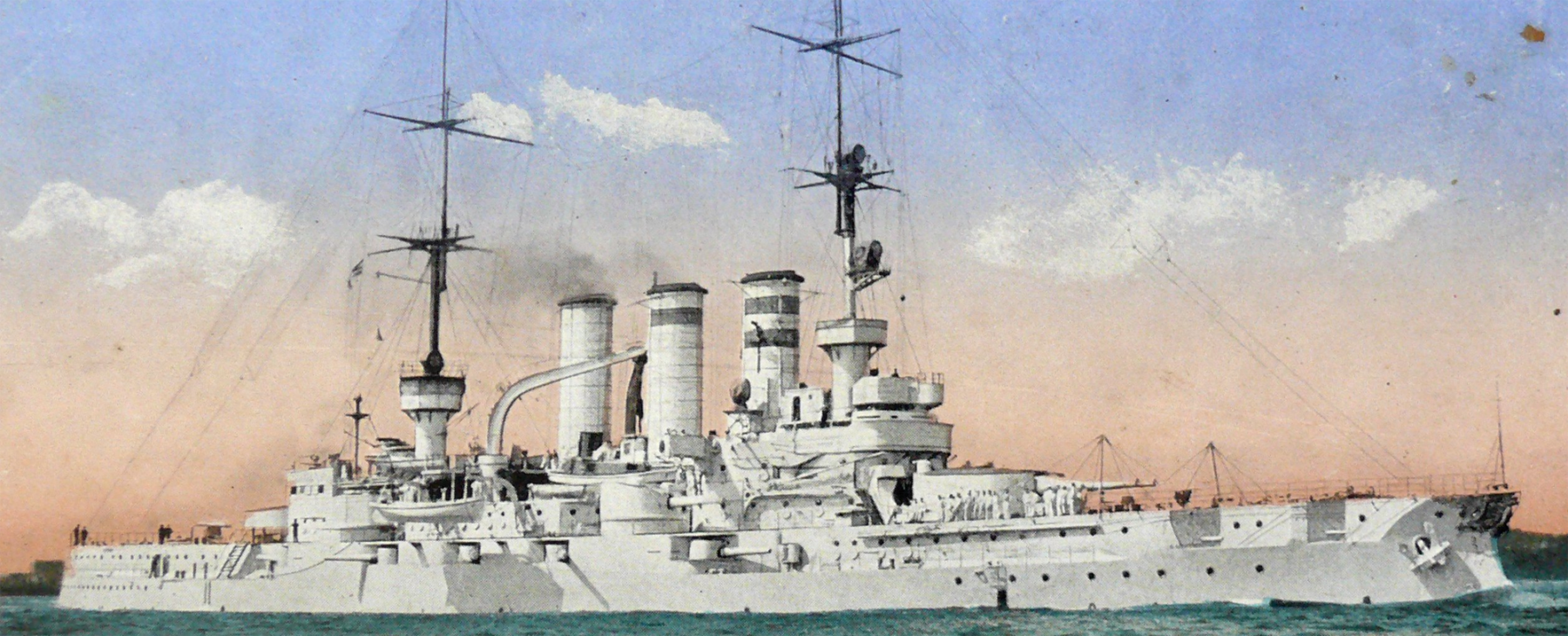
Era Postcard of the SMS Essen
Improved Battleships with a powerful secondary battery
The Braunschweig class were essentially heavier versions of the previous Wittelsbach, but with a more powerful armament, 280 mm instead of 240 mm for the main battery and for the secondary battery 170 mm instead of 150 mm. The idea was to compensate for the lighter caliber of the main artillery with a secondary one that can engage the enemy at an intermediary range, pummelling the superstructures. In any case it was a true leap forward and gradually closing to the British classes.
Design of the Braunschweig
This class of 5 battleships (second set of “regions”) included the Braunschweig, Elsass, Hessen, Preussen, and Lothringen. They were started in 1901-1902 in Schichau, Germaniawerft and Vulcan. Elsass and Lothringen carried a significant weight for the French, since they were German translation of former French border regions “Alsace” and “Lorraine” obtained after the war of 1870 and a constant hot point behind French motivations to war and revenge over Germany.
Armament
They drifted closely from the previous Wittlesbach, but their secondary artillery, partly in barbettes and partly in simple turrets, was changed to 170 mm caliber, which was unique at the time, and included some of the weakness of the 280 mm in range and to penetrating power lower than English 12-inch pieces.
Propulsion
They had a new boiler system, with the power and speed increasing, and this time they had three fireplaces. They reached 25.6 meters wide, and in fact remained fairly stable. Their front turret was returned to normal position.
Armor
As said above the Braunschweig drifted closely from the previous Wittlesbachs, but with a more potent main artillery, and a powerful secondary one partly in barbettes and partly in simple turrets, 170 mm caliber, quite unique at the time. This somewhat compensated for the weakness of the 280 mm in range and to penetrating power, always lower than the British 12-inch pieces.
Active service
By far the heaviest German pre-dreadnoughts, they remained relatively inactive at the beginning of the war. They formed the 4th squadron based in the Baltic and intended for the possible exits of the Russian fleet. Because of the lack of crews, they were partially put in reserve, being officially ranked as coastguard. In 1916, their secondary battery was removed and they kept only a few pieces of 88 mm.
In 1919, Preussen and Lothringen were converted into type F star-holders. The experiment was interrupted in 1938, and the Preussen was broken up, as were the other units of the class in 1931. Hessen, on the other hand, was radio-controlled target ship, survived the Second World War and was awarded war damage to the USSR in 1946 renamed Tsel.
Links/read more
en.wikipedia.org/wiki/Braunchsweig-class_battleship
https://www.fr.naval-encyclopedia.com/
https://www.naval-encyclopedia.com/ww1/pages/hochseeflotte/hochseeflotte.htm
https://www.kaiserliche-marine.de
https://www.sms-navy.com/
Specs Conway’s all the world fighting ships 1860-1905, 1906-1921.
Braunschweig specifications |
|
| Dimensions | 127,7 x 25,6 x 8.1 m |
| Displacement | 14 167 t FL |
| Crew | 743 |
| Propulsion | 3 shafts, 3 TE engines, 12 boilers, 17 000 hp |
| Speed | 18.5 knots ( km/h; mph) |
| Range | 5,000 nautical miles (9,300 km; 5,800 mi) @10 knots |
| Armament | 4 x 280mm (2×2), 18 x 170mm, 12 x 88 mm, 6 x 450 mm TTs |
| Armor | Belt 150mm, deck 65mm, CT 150mm, turrets 250mm |
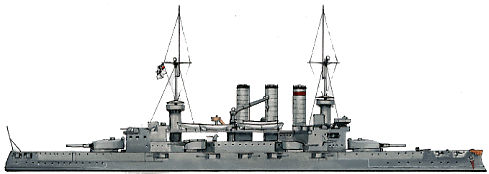
Author’s rendition of the Braunschweig class
 Latest Facebook Entry -
  X(Tweeter) Naval Encyclopedia's deck archive
 Instagram (@navalencyc)


 French Navy
 Royal Navy
 Russian Navy
 Armada Espanola
 Austrian Navy
 K.u.K. Kriegsmarine
 Dansk Marine
 Nautiko Hellenon
 Koninklije Marine 1870
 Marinha do Brasil
 Osmanlı Donanması
 Marina Do Peru
 Marinha do Portugal
 Regia Marina 1870
 Nihhon Kaigun 1870
 Preußische Marine 1870
 Russkiy Flot 1870
 Svenska marinen
 Søværnet
 Union Navy
 Confederate Navy
 Armada de Argentina
 Imperial Chinese Navy
 Marine Haitienne
 Marinha do Portugal
 Mexico
 Kaiserliche Marine
 1898 US Navy
 Argentina
 Brazil
 Chile
Chile Cuba
Cuba Peru
Peru Bulgaria
 Denmark
 Greece
 Netherlands
 Norway
 Portugal
 Romania
 Sweden
 China
China Thailand
 Sovietskiy Flot
 Royal Canadian Navy
 Royal Australian Navy
 RNZN Fleet
 RIN Fleet
 Chinese Navy 1937
 Kriegsmarine
 Chilean Navy
 Danish Navy
 Finnish Navy
 Hellenic Navy
 Polish Navy
 Romanian Navy
 Turkish Navy
 Royal Yugoslav Navy
 Royal Thai Navy
 Minor Navies
 Albania
 Austria
 Belgium
 Columbia
 Costa Rica
 Cuba
Cuba Czechoslovakia
 Dominican Republic
 Haiti
Haiti Hungary
 Honduras
 Estonia
 Iceland
 Eire
Eire Equador
 Iran
Iran Iraq
Iraq Latvia
 Liberia
 Lithuania
 Mandchukuo
 Morocco
 Nicaragua
 Persia
 San Salvador
 Sarawak
 Uruguay
 Venezuela
 Zanzibar
 Warsaw Pact Navies
 Bulgaria
 Hungary

 Bundesmarine
 Dutch Navy
 Marina Militare
 Yugoslav Navy
 Chinese Navy
 Indian Navy
 Indonesian Navy
 JMSDF
JMSDF North Korean Navy
 Pakistani Navy
 Philippines Navy
 ROKN
ROKN Rep. of Singapore Navy
 Taiwanese Navy
 Vietnam People’s Navy
 IDF Navy
 Saudi Navy
 Royal New Zealand Navy
 Egyptian Navy
 South African Navy


 Ukrainian Navy