
Zenta class cruisers (1897)
 Zenta, Aspern, Szigetvar
Three cruisers for a reverence: The Zenta class were obsolete by the time WW1 erupted. They had a short career, but despite of this, one ship eclipsed all others by feats of bravery rarely equalled in the Austro-Hungarian annals: Zenta duelled with French battleships for one hour before sinking, using speed as for a skirmisher mode, a delay allowing her own escort to escape safe to Pola.
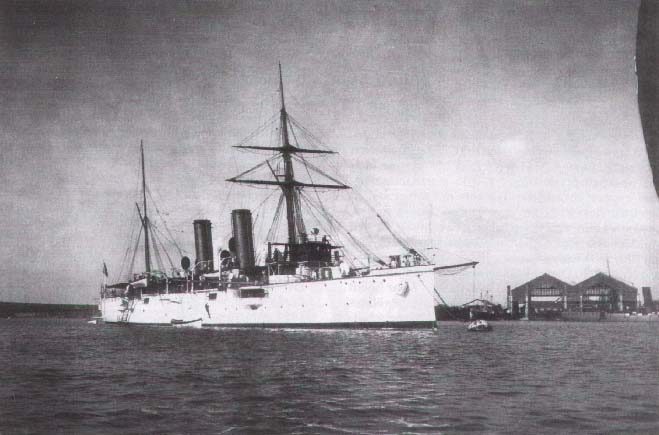
SMS Zenta in 1899 in colonial livery
This class, relatively classic in design -they could have been drawn by Vickers-Armstrong engineers- were three units of 2300 tonnes fully armed with 4.7 in (120 mm) guns and bristling with smaller quick-firing guns intended for enemy torpedo boats. Studied at Pola N Yd after a request of the admiralty for scout duties and squadron leaders, plans were drawn in 1895, and construction started at Pola, the keels being laid down in August 1896 (Zenta), October 1897 (Aspern) and May 1899 (Szigetvar). They were launched in 1897, 99 and 1900 respectively and completed in 1899, 1900 and 1901.
Design
Due to the gap between the launch of the next ships, corrections were added to the design, so the last was the most refined. All three diverged in dispacement: Szigtervar was heavier fully loaded than the Zenta at 2562 tonnes, but Aspern was the heaviest of them all, at 2625 tonnes. In general shape, they had a continuous bridge, two funnels and masts, two Conning towers, with the forward one topped by the bridge, and a telegraphy station at the rear, before the rear mast. They were protected by a double layer of 25 mm armour on the belt, the casemates were 35mm thick and the decks 20mm, while the forward conning tower was protected by a double layer of 25mm. Crew was 308, sailors and officers.
Main armament comprised eight Skoda 12 cm/40 (40 caliber) QF (quick firing) main guns all on single pivots, two on the deck aft and rear, shielded, and the others in the battery deck below, in side barbettes. The aft and rear pieces had a 120° traverse, which gave a chase and retreat firepower of three guns, while a broadside counted five guns.
Secondary armament comprised eight 47mm /44 Skoda guns, quick-firing protruding in barbettes from the main battery deck and on deck. There were also two 47mm/33 Hotchkiss guns which served as saluting pieces, two 8mm machine guns and two 450 mm torpedo tubes above waterline on the beam.
For propulsion, their machinery comprised two shafts and propellers, run by 4-cylinder VTE engines (Vertical Tubes) built by STT (Trieste) and fed by boilers delivering an output of 8160 ihp or a top speed of 20,8 knots, which was honourable for the time.
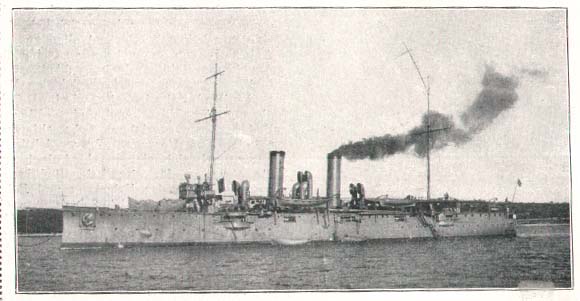
SMS Zenta during the war, in grey livery.
Career
The three Zenta were in fact the last light cruisers developed by the empire before the excellent Admiral Spaun.
SMS Zenta upon completion sailed for a long cruise to Asia, starting from Port Said, then through Suez, Aden, Colombo, Singapore and then to Hong Kong, Macau, and Shanghai. She left China to visit Japan, Nagasaki, Kagoshima and Sasebo. She was nearby when the Boxer Rebellion erupted, and therefore was soon able to bring support to the embattled garrison of Peking: She was able to assist in the evacuation of the embassy staff and Austro-Hungarian delegation.
Then she landed 75 men which took part in Admiral Admiral Seymour’s relied expedition to Tien’Tsin. Later these men also joined thos of cruiser SMS Kaiserin und Königin Maria Theresia to assist German troops into recapturing Taku forts. During this action, commander Kapitän Eduard Thomann Edler von Montalmar was KIO. Back home in 1901 she was back to Cape Town the next year, and from there joined South America, first Argentine ports Montevideo and Buenos Aires, then Rio de Janeiro, and then on her way back through the Mediterranean, she stopped at Funchal, Cadiz, Tangier, Málaga, Tunis, Corfu, before joining Trieste. The other two cruisers were put in reserve as early as 1917 and disarmed in 1918. The Aspern served as a pontoon in Pola and Szigetvàr as a training ship for torpedo boats, then later as a depot ship and target. Both were awarded to Great Britain for war reparations, but the latter had them broken up in Italy in 1920.
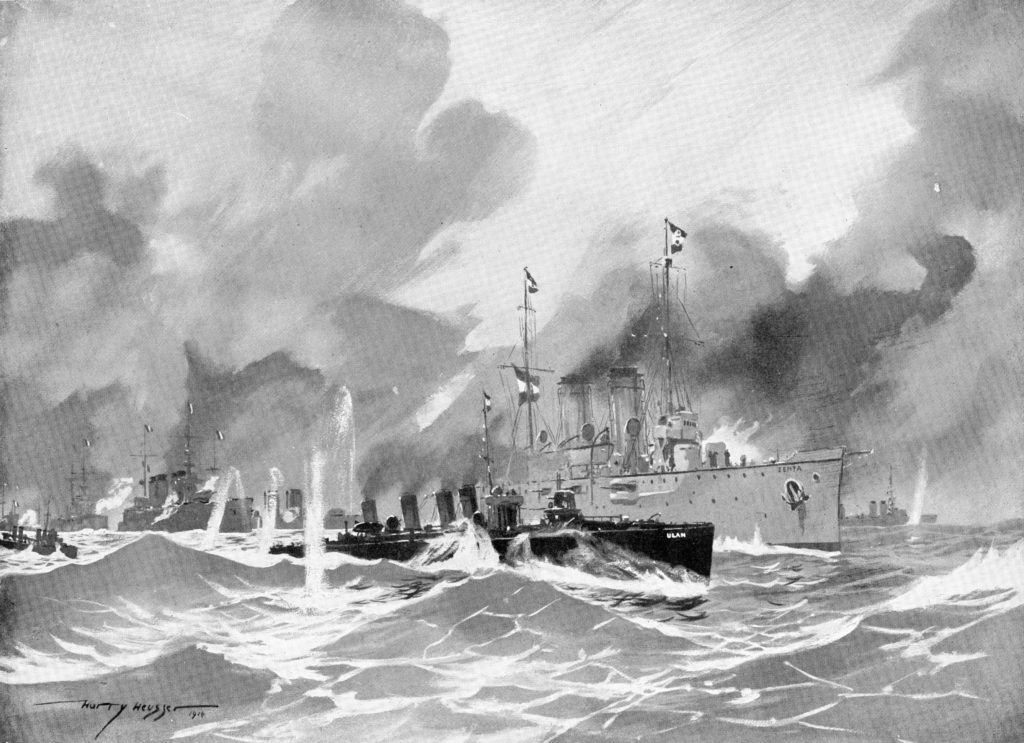
Depiction of the battle of Antivari by Harry Heusser in 1914
Zenta’s heroic last stand
The three cruisers formed the 5th reconnaissance Division in 1914. All three led a squadron of destroyers during the shelling of Montenegro in August 1914. The Zenta was however sunk by French battleships on August 18, 1914 at the battle of Antivari. The Anglo-French Fleet under Admiral Auguste Boué de Lapeyrère surged in the Adriatic to try to catch the Austrian ships off the coast of Montenegro. In fact, Zenta, escorted by the destroyer Ulan was precisely blockading the area, and became cutoff by a fleet of seventeen combined ships of all sizes, barring her way North. She covered the destroyer SMS Ulan to escape and Captain Pachner decided to bravely attempt to face the fleet.
This action of Antivari, off the coast of Bar was totally hopeless, as the ship was woefully outmatched and outranged. She could not even count on speed to carry at least some significant action. She faced no less than the Courbet, Jean Bart, and as a backup the pre-dreadnoughts of the 1st Battle squadron, Voltaire, Vergniaud, Diderot, Danton, Condorcet, Vérité, Justice, Démocratie, Patrie, and République and about four anglo-French armoured cruisers. She mostly duelled with the Courbet in all her engagement, a modern dreadnought capable of volleys of ten 305mm (12 in) shells. Crippled in 12 minutes, her armament and vitals gone, she nevertheless resisted for one hour before sinking. There were 173 dead, but 139 men managed to regain the coast at Podgorica by swimming ashore, where they were taken prisoner until 1916.
Specifications |
|||||||||||||
| Dimensions | 96.88 x 11.73 x 4.24 m (317 x 34 x 13 ft) | Displacement | 2313 long tons (2503 t) FL | Crew | 308 | Propulsion | 2 shafts, 4 cyl VTE steam engines, 8 boilers 8160 ihp | Speed | 20.8 kn (37 km/h; 23 mph) | Armament | 2 × 120mm, 8 × 47 mm Skoda QF, 2 x 17 mm Hotchkiss, 2 MG, 2 × 450 mm TTs | Armor | Decks 2×25 mm, gunshields 25 mm, Conning tower 2×25 mm |
Sources, read more
http://dawlishchronicles.blogspot.fr/2014/08/the-battle-of-antivari-1914-heroic-last.html
https://en.wikipedia.org/wiki/Battle_of_Antivari
Conway’s all the world’s fighting ship 1860-1905 and 1906-1921
 Latest Facebook Entry -
  X(Tweeter) Naval Encyclopedia's deck archive
 Instagram (@navalencyc)


 French Navy
 Royal Navy
 Russian Navy
 Armada Espanola
 Austrian Navy
 K.u.K. Kriegsmarine
 Dansk Marine
 Nautiko Hellenon
 Koninklije Marine 1870
 Marinha do Brasil
 Osmanlı Donanması
 Marina Do Peru
 Marinha do Portugal
 Regia Marina 1870
 Nihhon Kaigun 1870
 Preußische Marine 1870
 Russkiy Flot 1870
 Svenska marinen
 Søværnet
 Union Navy
 Confederate Navy
 Armada de Argentina
 Imperial Chinese Navy
 Marine Haitienne
 Marinha do Portugal
 Mexico
 Kaiserliche Marine
 1898 US Navy
 Argentina
 Brazil
 Chile
Chile Cuba
Cuba Peru
Peru Bulgaria
 Denmark
 Greece
 Netherlands
 Norway
 Portugal
 Romania
 Sweden
 China
China Thailand
 Sovietskiy Flot
 Royal Canadian Navy
 Royal Australian Navy
 RNZN Fleet
 RIN Fleet
 Chinese Navy 1937
 Kriegsmarine
 Chilean Navy
 Danish Navy
 Finnish Navy
 Hellenic Navy
 Polish Navy
 Romanian Navy
 Turkish Navy
 Royal Yugoslav Navy
 Royal Thai Navy
 Minor Navies
 Albania
 Austria
 Belgium
 Columbia
 Costa Rica
 Cuba
Cuba Czechoslovakia
 Dominican Republic
 Haiti
Haiti Hungary
 Honduras
 Estonia
 Iceland
 Eire
Eire Equador
 Iran
Iran Iraq
Iraq Latvia
 Liberia
 Lithuania
 Mandchukuo
 Morocco
 Nicaragua
 Persia
 San Salvador
 Sarawak
 Uruguay
 Venezuela
 Zanzibar
 Warsaw Pact Navies
 Bulgaria
 Hungary

 Bundesmarine
 Dutch Navy
 Marina Militare
 Yugoslav Navy
 Chinese Navy
 Indian Navy
 Indonesian Navy
 JMSDF
JMSDF North Korean Navy
 Pakistani Navy
 Philippines Navy
 ROKN
ROKN Rep. of Singapore Navy
 Taiwanese Navy
 Vietnam People’s Navy
 IDF Navy
 Saudi Navy
 Royal New Zealand Navy
 Egyptian Navy
 South African Navy


 Ukrainian Navy