
 German Navy
26 August 1914
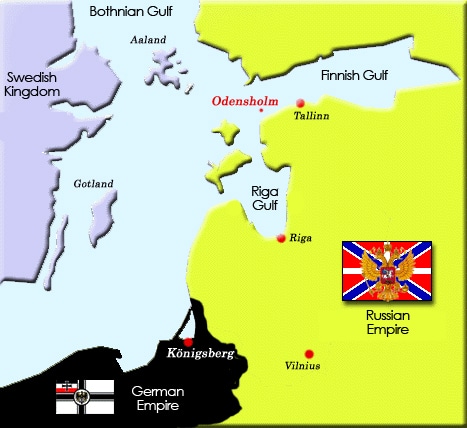
Mining the Gulf of Finland
Odensholm (currently Osmussaar, desolate island of 4.7 kilometers belonging to Estonia – where according to legend, Odin was burned at his funeral) was located 67 km southwest of Tallinn (59°17′30″N 23°23′30″E). By its strategic location, it closed the Gulf of Finland, gateway to the Baltic from St Petersburg. Upon declaration of war, it was entrusted to the care of the Hochseeflotte to lay mines at the entrance to the Gulf. On 25 August, were designated for this the cruisers Magdeburg and Augsburg. The first sailed from Königsberg (now Kaliningrad) and rallied the entrance to the Gulf during the night of August, 26.
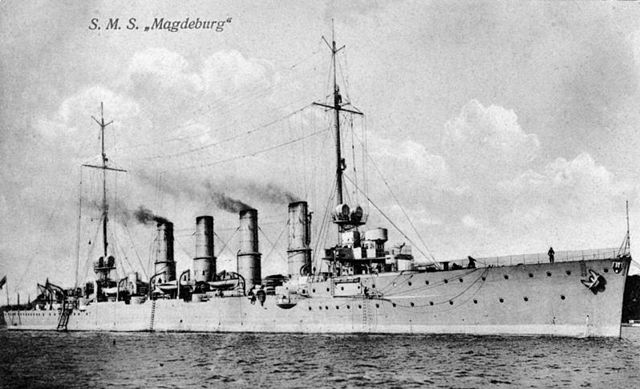
SMS Magdeburg, German light cruiser
Return of fate
Unfortunately the weather was foggy, and the Magdeburg ran aground on shoals north of the island of Odensholm, at only 200 m from the lighthouse at midnight past 38 minutes, when the starboard forward hit sand where water was only 2.5 meters deep. Escorting destroyer V26 tried to take her in tow for digging out, but in vain. However, from the nearby island Lighthouse, as the weather cleared up in the first lights, the Russian watchman gave the alarm to the headquarters of the Baltic Fleet. The naval base of Tallinn was only 50 miles away. Situation was now critical and Lieutenant Commander Habenitch orders the crew to evacuate the ship and prepare for scuttling.
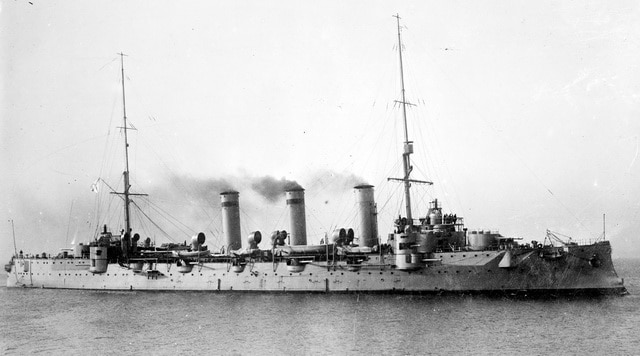
Russian cruiser Bogatyr
Engagement
Charges were laid, confidential archives are burned in a boiler. As the crew prepares to embark on the V26, a watchman signaled two Russians cruisers in sight. This was actually the Bogatyr, followed at a distance by the Pallada, that came through at 9.10 am. The V26 resumed abruptly boarding operations and left the area immediately, leaving the men left to their fate. The cruiser had not brought the colors yet, so the Russians cruisers opened fire in a blind spot: The German cruiser would not even have time or opportunity to replicate. After warning shots, seeing that the German cruiser failed to comply and bring the colors down, they shelled the ship at short range and quickly blown its superstructures up. A raging fire started, and the beginning of a panic seized the German crew. Moreover, charges at the front blown up at the same time, the back charges then being inactivated probably to left time to evacuate the ship. As a result, the ship essentially was left unscaved, as the Russians quickly stopped firing and sent a boarding party.
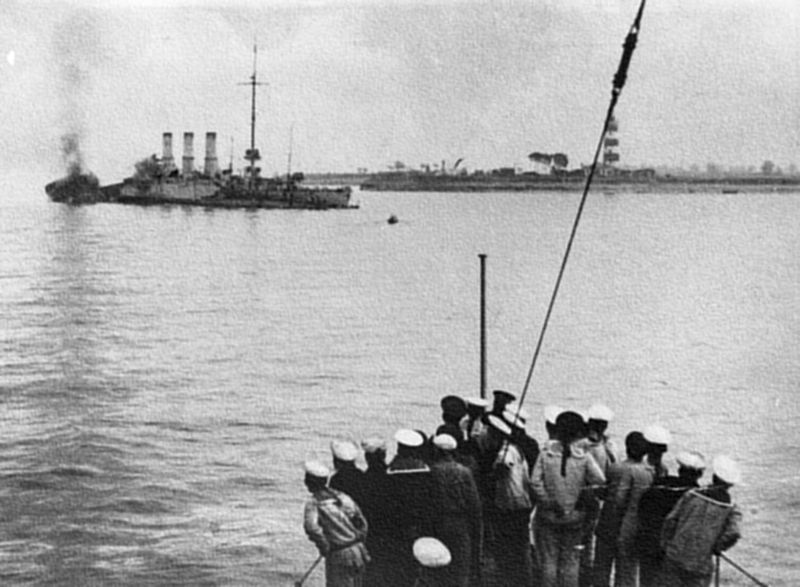
Stranded SMS Magdeburg being evacuated (seen probably from a Russian cruiser’s bridge), as the front part has been blown up. The lighthouse can be seen 200m in the background. (Bundesarchiv)
Aftermath
Ultimately, 56 sailors and Commander Richard Habenicht were captured, 17 dead, 21 wounded and 85 missing were declared. Captain Nepenin, chief of intelligence of the Baltic fleet sent a search team who to find a copy of the precious codes book of the Hochseeflotte, the Signalbuch der Kaiserlichen Marine (SKM), which was eventually discovered under a pile of clothes in the room of the commander. This document was indeed of paramount importance, giving precious intelligence to the allies.
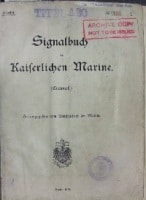 Moreover two others were also found with their decoding manuals attached: The around maps (containing coded squares). Two of these copied code books were sent to the fleet of the Baltic and the Black Sea, and the third one sent to London by captains Kedrov and Smirnof that delivered these personally to Winston Churchill, then 1st Lord of the Admiralty. Discovered also were the 4977.73 Marks, maps with the registered German minefields and corresponding secret codes.
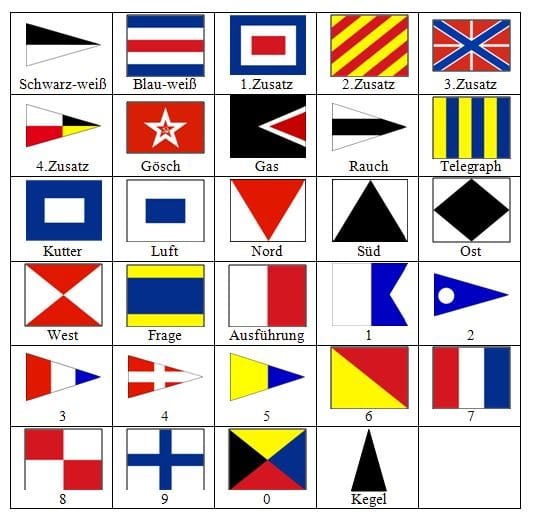
German signal flags.
These were immediately sent to the “Room 40” and intersected with other documents. From then on the Royal Navy and the Russian Navy will always have an edge over the Hochseeflotte. Indeed, the German staff ignored that the allies were now in possession of these ultra-secret documents, as the 56 men of the Magdeburg were held in Siberia until the capitulation. Moreover, in October 1914 the British also obtained the Imperial German Navy’s Handelsschiffsverkehrsbuch (HVB). This codebook was used by German naval warships, merchantmen, naval zeppelins and U-Boats. This case recalls another, which occur 19 years after: The seizing of enigma machines and breaking of the encryption code (which ultimately led to the invention of the computer).
Links & resources
Osmussar – Odensholm
German signal flags from 1815 (pdf)
The Code Bearers (Google book) By John Westwood
Das Ende von SMS Magdeburg
Room 40
 Latest Facebook Entry -
  X(Tweeter) Naval Encyclopedia's deck archive
 Instagram (@navalencyc)


 French Navy
 Royal Navy
 Russian Navy
 Armada Espanola
 Austrian Navy
 K.u.K. Kriegsmarine
 Dansk Marine
 Nautiko Hellenon
 Koninklije Marine 1870
 Marinha do Brasil
 Osmanlı Donanması
 Marina Do Peru
 Marinha do Portugal
 Regia Marina 1870
 Nihhon Kaigun 1870
 Preußische Marine 1870
 Russkiy Flot 1870
 Svenska marinen
 Søværnet
 Union Navy
 Confederate Navy
 Armada de Argentina
 Imperial Chinese Navy
 Marine Haitienne
 Marinha do Portugal
 Mexico
 Kaiserliche Marine
 1898 US Navy
 Argentina
 Brazil
 Chile
Chile Cuba
Cuba Peru
Peru Bulgaria
 Denmark
 Greece
 Netherlands
 Norway
 Portugal
 Romania
 Sweden
 China
China Thailand
 Sovietskiy Flot
 Royal Canadian Navy
 Royal Australian Navy
 RNZN Fleet
 RIN Fleet
 Chinese Navy 1937
 Kriegsmarine
 Chilean Navy
 Danish Navy
 Finnish Navy
 Hellenic Navy
 Polish Navy
 Romanian Navy
 Turkish Navy
 Royal Yugoslav Navy
 Royal Thai Navy
 Minor Navies
 Albania
 Austria
 Belgium
 Columbia
 Costa Rica
 Cuba
Cuba Czechoslovakia
 Dominican Republic
 Haiti
Haiti Hungary
 Honduras
 Estonia
 Iceland
 Eire
Eire Equador
 Iran
Iran Iraq
Iraq Latvia
 Liberia
 Lithuania
 Mandchukuo
 Morocco
 Nicaragua
 Persia
 San Salvador
 Sarawak
 Uruguay
 Venezuela
 Zanzibar
 Warsaw Pact Navies
 Bulgaria
 Hungary

 Bundesmarine
 Dutch Navy
 Marina Militare
 Yugoslav Navy
 Chinese Navy
 Indian Navy
 Indonesian Navy
 JMSDF
JMSDF North Korean Navy
 Pakistani Navy
 Philippines Navy
 ROKN
ROKN Rep. of Singapore Navy
 Taiwanese Navy
 Vietnam People’s Navy
 IDF Navy
 Saudi Navy
 Royal New Zealand Navy
 Egyptian Navy
 South African Navy


 Ukrainian Navy