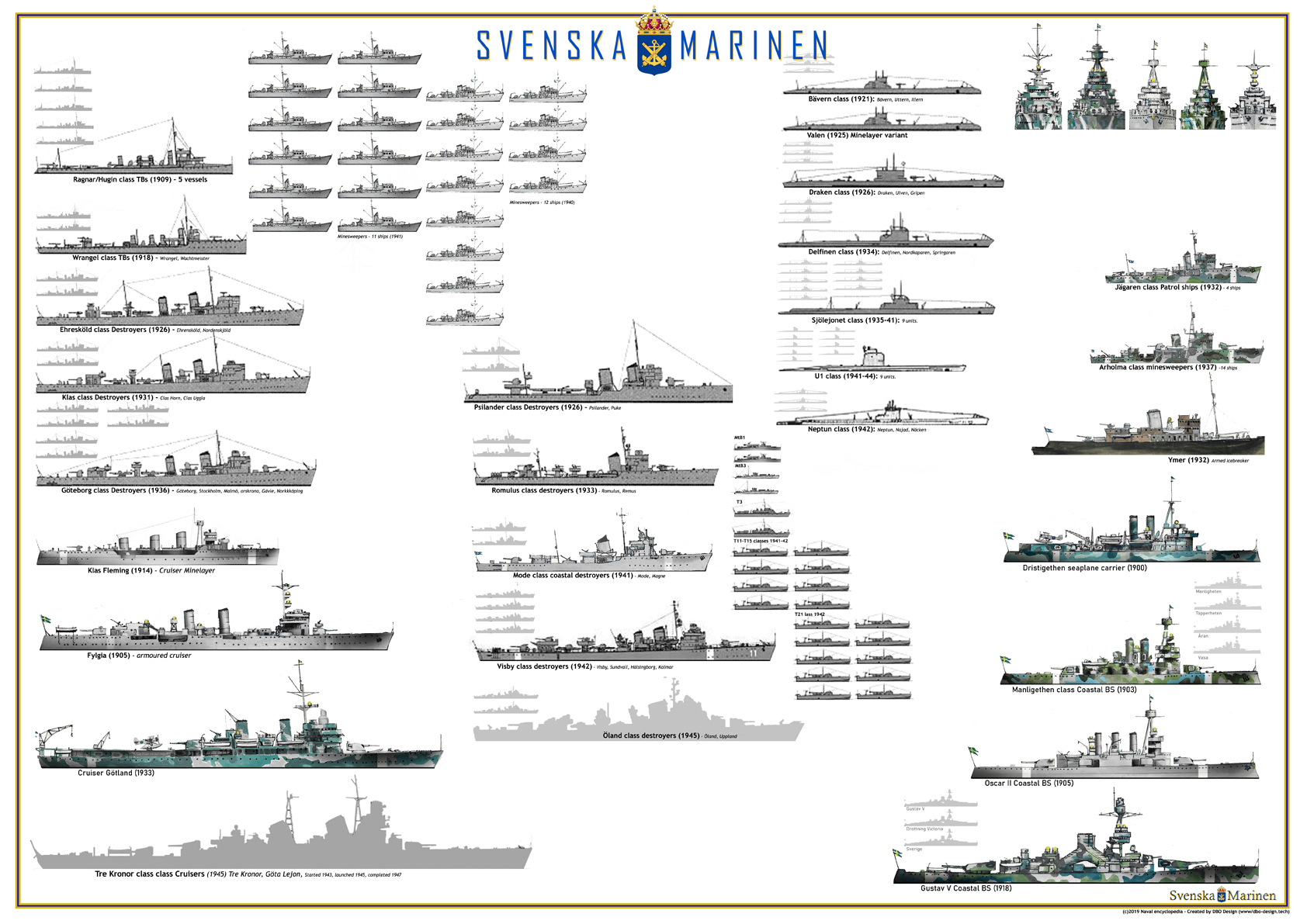
 c300 ships 1947-1991
 Sweden’s Fleet dominated the Baltic in 1947 and for some years after while her war-ravaged neighbours recovered. New ships and vessels, from heavily armed, very fast cruisers to small high speed MTBS were built, delivered and commissioned. New classes of destroyers, submarines, torpedo-boats and minesweepers joined the Royal Swedish Navy.
In 1990:
-12 submarines
-29 FACs
-2 missile Corvettes
-18 Patrol Boats
-3 Minelayers
-22 Minesweepers
-6 icebreakers
Uniquely, it acquired nuclear weapon proof bunkers carved out of cliffsides to shelter and hide submarines and ships up to destroyer size.
From 1958 the five year defence plans changed to the disadvantage of the navy – and later also of the army and the air force. The idea of a ‘light navy’, no longer including coastal battleships or cruisers as backbones of the three task forces, was followed by a theory of light task forces of only one or two destroyers with one or two squadrons of large torpedo boats and, of course, submarines, coast defence flotillas of small MTBS, minesweepers, etc.
Detailed articles list
- Tre Kronor class (1946)
- Öland class DDs (1945)
- Halland class DDs (1952)
- Ostergotland class DDs (1956)
- Spica III class Corvettes (1984)
- Goteborg class Corvettes (1989)
- U1 class subs (mod.1963)
- Hajen class subs (1954)
- Sjoormen class subs (1967)
- Nacken class subs (1978)
- Vastergotland class subs (1986)
- Gotland class subs (1995)
- T32 class MTBs (1951)
- T42 class MTBs (1955)
- Plejad class FACs (1951)
- Spica I class FACs (1966)
- Spica II class FACs (1972)
- Hugin class FACs (1973)
- Swedish Patrol Boats
- Swedish minesweepers
- Swedish Icebreakers
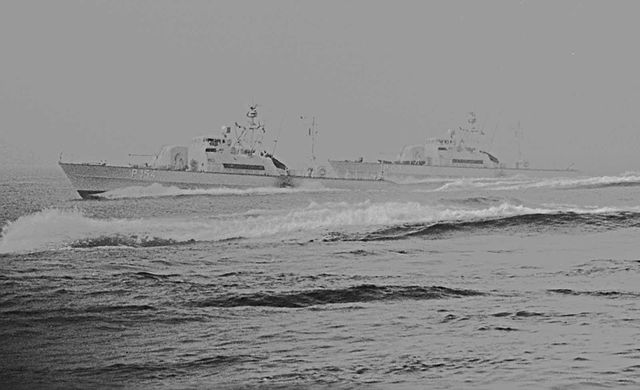
Early Swedish missile Fast Attack crafts: Mode and Magne in the 1960s.
However, this “lighter” navy could not be maintained. The last cruiser, Göta Lejon, was sold to Chile in 1971. Two missile destroyers and one ocean minelayer were cancelled. Destroyers were reclassified as frigates after or without being equipped with modern ASW weapons. The submarine force fell by half between 1975 and 1982.
During the Cold War, the Swedish Navy had to deal with almost constant intrusions into Swedish territorial waters, there being forty such incidents in 1982 alone. Despite heavy depth-charging and detonation of ground mines, all these intruders escaped. Combating this problem was an important task for the navy, and a mini-sub was built in the late 1980s as an ASW target, simulating the type of vessel believed to be involved.
By 1985 the two remaining destroyers had been disposed of, but numbers of light craft had increased, with torpedo boats being fitted with a new Saab SSM and new classes of submarine being commissioned. Uniquely, the Swedes persisted with work on air-dependent conventional propulsion systems for submarines, when the major navies had abandoned them for nuclear boats, and in 1996 the first operational class of submarines with such propulsion systems will enter service (the Götland class).
The Swedish submarine industry scored an export success in 1987 with the sale of the Collins class boats to the Royal Australian Navy, claimed to be the most sophisticated conventional submarines in the world. 2000s models included air-independent main engines and radical new hull forms.
In 1995, naval personnel totalled 9,150, plus 6000 reserves. Coastal Artillery Service had 3900 active personnel organised into five regiments and 3000 reservists, which operated both static and mobile coast-defence gun and SSM batteries, as well as a number of mine warfare and patrol vessels. Principal naval bases were at Karlskrona and Muskö. Although an even ‘lighter’ fleet than in 1947, the Swedish Navy has remained a capable and powerful force centred around submarines, missile combatants and mine warfare vessels.
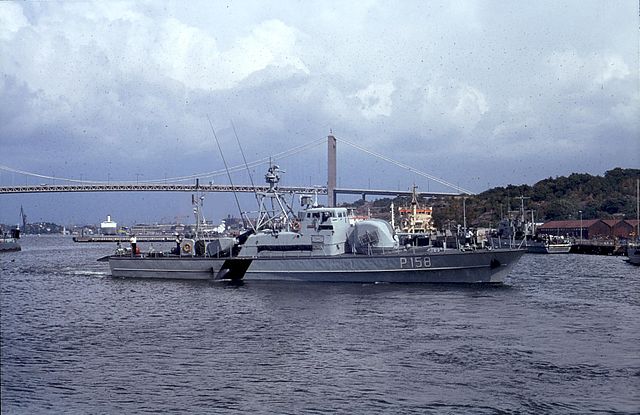
FAC(M) Mysing (P158)
Situation after the end of WW2
In 1945, Sweden became de facto the pre-eminent naval power in the Baltic after the comprehensive destructions of the Soviet Baltic fleet and Kriegsmarine.
On paper its force was indeed impressive:
Coastal Forces: Three Aran class Coastal Battleships (CB), three Sverige class, Oscar II.
Cruiser forces: Fylgia, Gotland, two Tre Kronor class in construction. So four cruisers in 1947.
Destroyer force: Three Sigurd class, Hugin, two Wrangel class, two Ehrenskold class, two Psilander class, Klas Horn, two Romulus class, six Göteborg class, four Magne class, four Visby class, two öland in completion: 29 in 1947.
Submarine force: Draken, Delfinen, Sjolejonet, Neptun, U1 classes: 26 in all, the last completed in 1946.
Misc. Vessels: Four Ane class Landing crafts (1943), the minelayers Clas Fleming (1912, 1735 tons), Alvsnabben (1943, 4250 tons), 4 MAS, 2 Vosper, 15 domestic-built MTBs, 50 minesweepers, about 70 patrol boats of the V and SVK type, 2 icebreakers.
See the complete WW2 Swedish Navy
Of course, the coastal battleships were obsolete designs dating back for some to 1890. Of all these, the last to go was HMS Gustav V, used from 1957 as a training ship. They were all stricken in 1947-57. The cruiser Fylgia was discarded in 1953 and the more modern Gotland in 1960. The ambitious Tre Kronor class, largest cruisers ever built in Sweden, were found irrelevant in the 1960s. The first, Tre Kronor, was stricken in 1964 and the second was resold to Chile in 1971. She served until 1984 as Almirante Latorre.

HMS Svea, imagined by WoW as an alternative to the tre Kronor class.
For destroyers, many were also discarded in 1947-58. The exceptions were the Ehrenskold class, converted as ASW frigates like British and US vessels. They stayed active until 1968 (see below).
The Italian-built vessels served until 1949-59.
The more recent Göteborg class served until the 1960-1970s, Gavle being converted as a nuclear floating test facility after 1969.
The Mode class were also discarded in the 1960s, but the four Visby class were converted as ASW frigates in 1965-68 and served until 1979-82.
The öland class were modern enough to be kept in service and upgraded until stricken in 1978.
Misc. ships were discarded at various dates, some stricken as early as 1946, but some soldiering on until the 1980s (like the minelayer Alvsnabben, in 1982) or the 1990s like the Ane class landing crafts.
Swedish Aircraft Carrier 1946
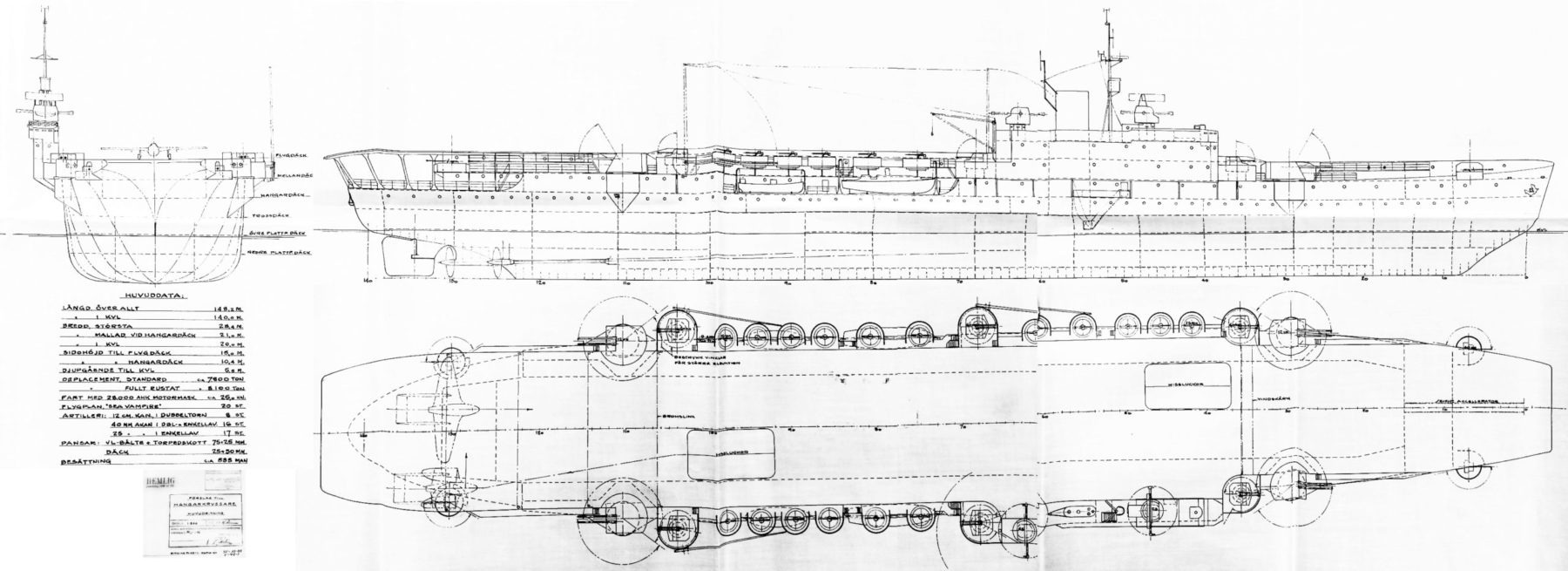
This project is only known through detailed sketches (but no blueprints). It was part of the ambitious naval plan of WW2 which saw a drastic increase in shipbuilding, notably with the Tre Kronor cruisers, new destroyers and submarines. This was a rather small carrier, displacing just 8,000 tonnes, well protected, armed, and still carrying a provision of twenty jet fighters. It was perhaps too ambitious as a design due to the limited size and displacement, forced upon by the limited size of Yards basins.
The general appearance resembled a British carrier, with a large bridge island, rounded fore an aft deck, two lifts in échelon in the middle of a straight deck which as shows in the upper view, only allowed folder wings planes to be stacked alongside, an little space available for the jets to take of in straight line from the back of the deck – There was however what could be a catapult forward (“even accelerator”) otherwise these jets would had to take off in about 130 meters. The project did not went very far from a proposal to the admiralty, there was no official name associated, and she was never ordered. Conways is totally silent about it as well. See the authority signing the sketch.
Specifications: As shown in the drawings
Dimensions: 140m wl/148.2 m oa x 20 m wl/28.4 m oa x 5.5 m
Displacement: 7,800 tonnes standard, 8,100 tonnes FL
Machinery: 28,000 shp: 25 knots max.
Aviation: 20 de Havilland Sea Vampire carried
Armament: 4×2 12 cm, 16x 40mm Bofors, 17 25mm
Armor: 3-in (75 mm) belt, 25 mm torpedo bulkheads, 25 + 50 mm deck
Crew: 535 men
Coastal defences and naval districts until 1948
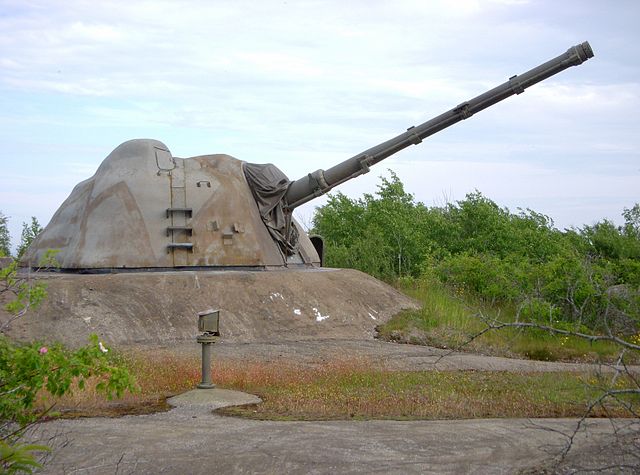
120 mm semi-auto DP battery (tornautomatpjäs m/70) installed Landsort. This weapons system called ERSTA (Ersättning Tungt Artilleri or “Replacement Heavy Artillery”) replaced all previous coastal artillery used in Sweden and became quite ubiquitous. These batteries were installed in nine locations, six in Sweden, at Söderarm, Landsort, Asunden (Gotland), Källesjö near Ystad, Gylle near Trelleborg and Holmögadd near Umeå. There were also three Norwegian installations, at Andfjorden near Harstad, Ofotfjorden outside Narvik and Kråkvågfjorden outside Trondheim.
The Swedish Navy’s Coast Artillery was formed on January 1, 1902 as part of the Navy. From January 1928 it was divided into six marine districts. There was a lack of clear commands and uniform management for the Swedish coastal areas in case of war however. The six naval districts played however an important role as regional commands. From 1936 decree by the Riksdag (parliament) these naval districts were under a single command from 1937. It had a centralized organization with staff, personnel, curatorial administration, medical management, a camera office, ship depot, naval depot, coastal detachment and fishery protection division. In 1948 a new decree reduced the number of marine districts by two, and introduced the concept of marine guard areas, subordinated to marine districts.
From 1948, the old coastal forts were still active for a time and were not modernized, in case of a possible Soviet attack in the Baltic. After a sturdy in the 1960s, as part of the STRIL 60 program which should have comprised Rb 08 anti-ship missile installations too. 10 locations were chosen and production of the first guns started in 1971.
These were developed to defend vital points from enemy landing ships and area control or antiship and fire in a nuclear context (they are NBC-proof).
However after budget cuts, Only six 12/70 batteries were maintained and EMP protection was no longer pursued. Also both the crew and support installation were reduced to the bare minimum. Each of these six batteries counted three fully independent gun emplacements with a command center, ranging stations and AA Bofors guns for close defense, plus mortar positions and troop shelters in case of an enemy landing. They were installed either in blasted holes or natural ones.
The gun was fully automatic, water-cooled vertical sliding wedge, electrically-driven for traverse but with manual elevation. Fully prepared for a nuclear war, the turret is hydraulically lowered and anchored to its foundation, the interior has a liner and both its muzzle and mount aperture are automatically sealed before the lowering. After a nuclear blast, it was assumed the crew, evacuated in the sealed vault behind the turret could reoccupy the latter soon after.
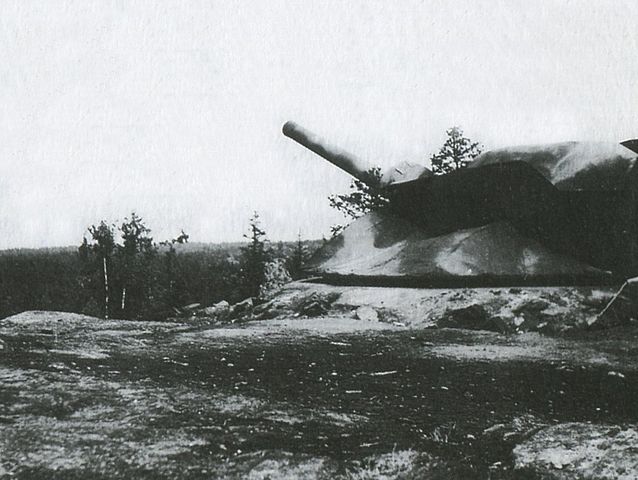
Batteri Järflotta (1942), which stayed in service for the whole cold war.
The remainder, older fortifications were equipped with guns dating back from WW1 from some. The modernized Boden Fortress for example was only deactivated in 1998. Sooner, this was the case of the Degerberget Fort, and the Fort Oscar II. However the Skåne Line (1941) was maintained until the late 1950s, whereas the Järflotta Fort (1942) stayed active also until the 1990s.
Reorganization of 1957
On October 1, 1957, naval districts were reorganized into naval commands. There was now a clear separation from coastal defense. In July 1, 1958, these had their own authority, whereas the coastal artillery command became a defense area command. The new Swedish Navy organization consisted of a staff management and an administration for coastal artillery brigade, ships and helicopters associated.
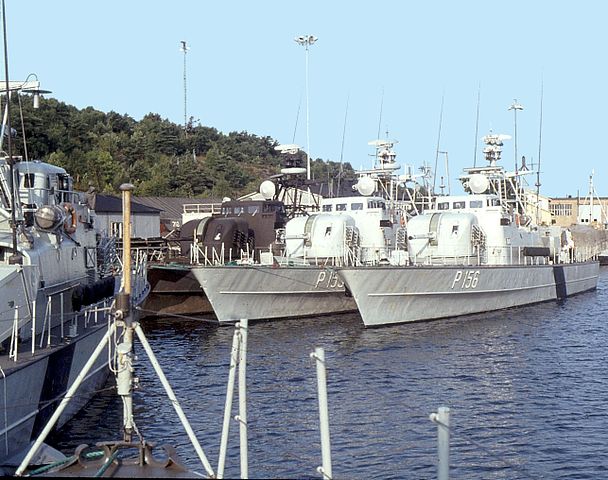
Two Hugin class FAC(M)
Sweden in the Cold war – General context

Sweden’s position in the Cold War was unusual, officially neutral, yet deeply connected to the Western world.This was due to its particular geopolitical context, missing geography, security concerns, domestic politics, and its relationship with both NATO and the Soviet Union.
The Strategic Context:
A critical position in Northern Europe, as Sweden sat across the Baltic Sea from the Soviet Union.
It controlled access routes between the North Atlantic and the Baltic, and bordered Norway, a NATO member. It was close to key Soviet military facilities around Leningrad (now Saint Petersburg). In a major NATO–Warsaw Pact conflict, Scandinavia would have been strategically important for naval and air operations. Sweden therefore could not simply ignore great-power competition.
Immediate postwar period (1945–1949): balancing uncertainty
After World War II, Sweden faced a transformed strategic landscape:
The Soviet Union dominated the Baltic region
Finland had been constrained by Soviet influence
Norway and Denmark leaned West
Sweden initially explored a Scandinavian defense union with Norway and Denmark as a way to avoid joining either bloc. This failed in 1949 when Norway and Denmark joined NATO.
That left Sweden isolated strategically, reinforcing neutrality as official doctrine.

Ledningscentralen “Vargen” i Huddinge, stötvågsbarriär. Swedish cold war underground facility and fallout shelter of the cold war, near Stockholm.
Early Cold War (1949–1955): neutrality, but West-leaning
Although publicly neutral, Sweden’s policy was not equidistant.
In practice:
Sweden built one of Europe’s strongest independent air forces
It developed a major domestic arms industry through companies like Saab AB
Swedish defense planning assumed the primary threat would come from the Soviet sphere
There was also quiet intelligence cooperation with Western powers, especially the United States and Britain, though this was not public.
Sweden’s neutrality was therefore:
Officially: non-alignment
Strategically: prepared for possible Soviet pressure
Operationally: discreetly connected to Western defense structures
The creation of the Warsaw Pact (1955)
The formation of the Warsaw Pact in 1955 after West Germany joined NATO sharpened Sweden’s concerns.
For Sweden, the pact meant:
Formal military consolidation of Soviet control over Eastern Europe
Increased military activity in the Baltic Sea region
Greater concern over airspace and naval security
Sweden responded by strengthening its Coastal defense, Air defense radar systems and Civil defense and mobilization planning.
The Baltic became one of Sweden’s most sensitive geopolitical frontiers.
Relations with Eastern Bloc states
Sweden maintained formal diplomatic and economic relations with Warsaw Pact countries, including: Poland, East Germany, Czechoslovakia and the Soviet Union. Sweden generally avoided direct confrontation, but tensions emerged over Soviet military pressure. Frequent Swedish concern over Soviet naval and air activity in the Baltic. Intelligence incidents include the 1952 Catalina affair, when the Soviet Union shot down a Swedish signals intelligence aircraft over the Baltic. This revealed that Sweden was conducting intelligence work relevant to NATO and Soviet suspicion of Swedish neutrality. This was a major turning point in Swedish security thinking.
Official Neutrality:
Since the early 19th century, Sweden had pursued a policy often summarized as non-alignment in peacetime, neutrality in wartime. The goal was straightforward:
Avoid being drawn into another European war. Maintain independence from both superpower blocs. Preserve freedom of action in foreign policy.
Unlike Norway and Denmark, Sweden never joined North Atlantic Treaty Organization. Unlike countries in Eastern Europe, it never joined the Warsaw Pact.
This allowed Sweden to present itself internationally as a mediator and advocate for disarmament.

Standard Swedish Fallout-shelter Ledningscentral Typ A
The Hidden Reality: Quiet Alignment with the West. Although neutral on paper, Sweden was not equidistant between East and West. Swedish leaders generally viewed the Soviet Union as the primary military threat. As a result: Sweden built extensive secret security cooperation with the United States and NATO. Swedish military planning often assumed support from Western powers if Sweden were attacked. Intelligence sharing occurred with Western countries. Swedish air defenses and military systems were designed with Soviet threats in mind.
Historians sometimes describe Sweden’s position as “armed neutrality” or “non-aligned but Western-oriented.”
Armed Neutrality
A key feature of Swedish policy was maintaining a powerful independent military. Sweden invested heavily in Universal male conscription, Domestic arms production, Advanced air power and Coastal defenses as well as Civilian defense infrastructure. More important even, all these developments were fully autonomous. Unlike most NATO countries, Sweden never depended on the good will of USA in terms of hardware for protection. Depsite having no deterrence, Sweden benefited of a dynamic defense industry, which started to reaps benefits with exports in the 1970s and that move had been growing ever since.
A bit like France, Sweden notably developed its own aviaton assets in an almost completely independent way, and for its own needs. Notable Swedish military systems included the Saab 35 Draken, Saab 37 Viggen, but the Navy was also concerns, with its own ships, guns, missiles and radars. Same for the ground forces to some extent. In the late 1970s started to adop the German Leopard MBT, but produced under licence on Sweden and modified, tailored to its own needs again. By Cold War standards, Sweden fielded one of the strongest militaries in Europe relative to its population. The idea was conventional deterrence: make invasion so costly that neither superpower would consider it worthwhile.
Relations with the Soviet Union

The Chief of the Air Force, Lieutenant General Stig Norén, tests a MiG-21 aircraft during the Royal Uppland Air Force Wing’s visit to the MiG-21 base at the Soviet Air Force on 16 May 1972. A Soviet officer display the aircraft. In the background are several Soviet soldiers.
Relations with Moscow were often tense more than cordial. Major issues included repeated Soviet Submarine Incidents:
In 1981, a Soviet submarine, the Soviet submarine S-363, ran aground deep inside Swedish territorial waters. The event became known as the “Whiskey on the Rocks” incident.
Many Swedes viewed it as evidence of Soviet military probing and espionage. Numerous suspected submarine incursions followed during the 1980s.
Baltic Security: The Baltic Sea was heavily militarized. Sweden monitored Soviet naval movements, Aircraft activity, Missile deployments.
The possibility of a surprise Soviet attack remained a central concern of Swedish defense planning.
 Swedish Foreign Policy and the “Third Way”: Sweden sought a distinctive international role. Under leaders such as Olof Palme, Sweden Criticized the Vietnam War, Opposed colonialism, supported development aid and advocated nuclear disarmament. Palme’s criticism of U.S. policy sometimes created friction with Washington. At the same time, Sweden was also critical of Soviet actions, including the suppression of reform movements in Eastern Europe. This gave Sweden a reputation as an independent voice rather than a formal ally of either bloc.

The “Catalinaaffären” or “Catalina affair”. On June 13, 1952, a Swedish Douglas DC-3 (Tp 79001 Hugin) was shot down by a MiG-15bis, with all crew of 8 lost. Then, three days later on the 16th, 1952, a Swedish PBY-5A Catalina (Tp 47002), sent to search for 79001, was shot down by two MiG-15bis planes, with all crew of 5 rescued.
The 1960s: activist diplomacy under Tage Erlander and Olof Palme
Sweden increasingly used neutrality as a platform for independent international criticism. It criticized U.S. actions in Vietnam War, but also Soviet repression, especially after the 1968 invasion of Czechoslovakia by Warsaw Pact forces during the Warsaw Pact invasion of Czechoslovakia. Sweden condemned that invasion strongly. This was significant because it demonstrated Sweden’s neutrality did not mean silence toward Eastern bloc coercion.
By 1970: Sweden’s strategic position
By 1970, Sweden had established a distinct Cold War posture: Externally it was a non-member of NATO, there was no alignment with Warsaw Pact and it was active in international diplomacy and the United Nations. Internally it had a Highly militarized neutrality, advanced defense industry and extensive civil defense. Toward the Warsaw Pact there was a diplomatic engagement, Economic contact and Deep strategic distrust, especially toward Soviet Baltic power.
The Nordic Balance:
Sweden’s neutrality was part of a broader Nordic security arrangement: Norway and Denmark were NATO members. Finland maintained neutrality under significant Soviet influence through the policy often called “Finlandization.” Sweden remained militarily non-aligned but strongly armed. This balance helped keep Northern Europe relatively stable throughout the Cold War.
This Strategy Worked: Several factors made it credible:
-A strong military capable of resisting invasion.
-A stable democratic political system.
-Economic prosperity.
-Geographic distance from the main Central European front.
-Quiet Western backing without formal alliance commitments.
The Soviet Union generally judged that forcing Sweden into its sphere would be costly and risky.
The end of the Cold War initially reduced Swedish defense spending. However, growing tensions with Russia—especially after the annexation of Crimea in 2014 and Russia’s full-scale invasion of Ukraine in 2022—led Sweden to rethink its traditional neutrality. In 2024, Sweden formally joined North Atlantic Treaty Organization, ending more than two centuries of military non-alignment.
In short, Cold War Sweden was neither truly East nor fully West: it maintained public neutrality while building a powerful military and quietly preparing to cooperate with the Western alliance in the event of a Soviet threat.
Naval Challenges
During the Cold War, Sweden’s navy faced one of the most difficult strategic situations in Europe: defending neutrality while operating in the confined, highly militarized waters of the Baltic Sea against the shadow of the Soviet Union and the broader Warsaw Pact. The challenge was not building a blue-water navy like the U.S. or Britain. It was surviving and fighting in a small, shallow, contested sea dominated by a superpower nearby.
Geography: defending a vulnerable coastline

The Soviet Baltic Fleet
The main threat was the powerful Soviet Baltic Fleet, based around ports such as Kaliningrad and bases near Leningrad (now St. Petersburg).
The Soviet advantage included numerical superiority, larger submarines, missile-equipped surface combatants, naval aviation, and generous amphibious assault capability. Sweden could not match this directly. Instead it planned asymmetric denial: Make Swedish waters too dangerous for Soviet forces.
Submarine warfare and anti-submarine defense
This became Sweden’s defining naval challenge. Swedish fears Soviet submarines infiltrating archipelagos, intelligence gathering near naval bases and preparation for sabotage or special-forces landings. So Sweden invested heavily in coastal sonar networks, fast anti-submarine patrol craft (Like the Spica class), mines, depth-charge systems and shallow-water detection tactics. The Baltic’s brackish water and unusual thermal layers made sonar difficult, making submarine detection especially hard. These problems would become famous later in incidents like the grounding of Soviet submarine S-363 in 1981, but the challenge existed throughout the Cold War.

For decades, the conventional Tre Kronor class cruisers were the only deterrent Sweden had (here Göta Lejon).
Building a navy for the archipelago
Sweden adapted with specialized vessels rather than large capital ships. Key platforms included Fast attack craft, Torpedo boats, Coastal submarines, Mine warfare vessels and Coastal artillery integrated with naval operations. Notable examples include vessels developed by Saab AB and Swedish naval shipyards and the recent ones emphasizing stealth, speed, and coastal maneuverability.
The goal was always to hit larger Soviet vessels quickly and disappear into coastal cover. This was an early form of what would later be called littoral warfare doctrine.
Neutrality and surveillance
A constant challenge was enforcing Swedish neutrality. The navy had to monitor Warsaw Pact movements, as well as NATO naval activity, potential air and sea boundary violations. Sweden frequently tracked foreign naval and air incursions. The 1952 Catalina affair highlighted how dangerous surveillance around the Baltic had become. Naval intelligence and signals collection became central missions.
Mobilization and readiness
Sweden assumed that in a major European war it could receive very little warning. Naval challenges included rapid reserve mobilization, protecting ports, securing shipping, keeping command systems functioning under attack. The navy was designed for quick wartime dispersal into hidden archipelago bases.
Technological constraints
Sweden wanted strategic independence. This meant developing domestic solutions for Radar, Missiles, Sonar, Fire control systems. This was expensive for a medium-sized state. Balancing technological sophistication against limited national resources was a constant Cold War pressure. In one sentence Sweden’s Cold War naval challenge was how to prevent a much larger Soviet fleet from controlling Swedish coastal waters without formally joining NATO. Its answer was a highly innovative coastal-defense navy built around stealth, speed, mines, submarines, and archipelago warfare.
Swedish Naval Aviation
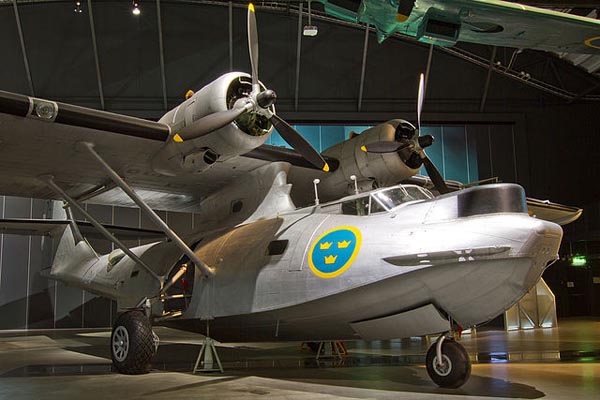
Swedish Naval Aviation was born even before the start of WWI, developed rapidly from foreign models licenced locally, and soon two branches were created, one for the Army and another for the Navy (Svenska Marinen), called the Marinens Flygväsende (MFV). This state remained until the unification of services under the creation in 1926 of the Flygvapnet. Procurement went on for the Navy however, mostly German and British models under local names and local production, especially with the creation of SAAB. This page is about the context, development, evolution; challenges and assets of the Swedish Naval Aviation from its beginning to the end of world war two in the broader geopolitical context.
During the Cold War, Swedish naval aviation (Marinflyget, or Navy Air Arm) was relatively small, but it played an important role in Sweden’s strategy of defending its long coastline and territorial waters against incursions—especially from the Soviet Union. Sweden remained officially neutral, but its military planning was heavily focused on countering a possible Soviet attack. Main missions were Anti-submarine warfare (ASW), especially after repeated submarine incidents in Swedish waters, like U-137 near Karlskrona in 1981. By the 1980s Sweden conducted extensive ASW operations against suspected foreign submarines (not just Soviet). It operated naval helicopters with dipping sonar and hydrophones, depth charges, lightweight torpedoes and surface-search radar on some variants. They could rapidly investigate sonar contacts and coordinate with surface ships and coastal defenses but relatively close to shore.

A HKP 4A variant with the Swedish Air Force
Major models included the HKP 1 (Vertol 44), HKP 2 (Alouette II) 13 purchased as well as the HKP 4 (Boeing Vertol 107/Kawasaki KV-107) whih became the backbone of Swedish naval helicopter operations from 1970 onward. It was equipped for serious ASW work. There was also the HKP 6 (Bell 206) with naval versions that could be armed with torpedoes and depth charges and participated in anti-submarine operations. Some even dropped live depth charges during real ASW incidents in the 1980s.

The Saab Lansen was one of these early Swedish jets, somewhat looking like a Hawker Hunter, but in reality inspired by the never built Messerschmitt’s P.1101, P.1110, P.1111 and P.1112 projects. There were two versions used in naval service from ground bases, the AC was developed for anti-ship missions, capable of launching the Rb 04C anti-ship missile, helped by its Ericsson mapping and navigation radar. It replaced the “Swedish Do 17”, the Saab B 18/S 18 previous used with torpedoes but tested also with Sweidsh first A/S missiles. The second variant was the J 32E used for ECM (14 J 32B modified) only retired in 1997 and using the jamming system G 24 against naval radars. image: Pinterest
Swedish naval aviation was organized into helicopter squadrons based on both the east and west coasts. Unlike many NATO navies, Sweden did not operate aircraft carriers or large shipborne air groups. Naval aviation was almost entirely helicopter-based and worked closely with Surface combatants, Submarines, Coastal artillery, Coastal Ranger units (Kustjägarna) for defending Sweden’s archipelagos and coastal waters rather than projecting power overseas. A notable feature of Swedish Cold War defense planning was the division of labor between the Navy and the Air Force. The Swedish Air Force handled most long-range maritime strike missions using aircraft such as the Saab Lansen and later the Saab 37 Viggen armed with anti-ship missiles. Naval aviation focused on coastal surveillance, submarine hunting, transport, and rescue…
Reorganization of 1966
On October 1, 1966, a new regional command was established whereas overall operational command was unified with a single military commander. Naval commands were reorganized into naval bases, subordinated to this new military commander, assimilated to the Navy chief of staff. Three commands were reorganized into naval bases:
-Marine Command Nord comprising the Norrland’s coastal artillery.
-East Coast War Base (ÖrlB O)
-Roslagen’s war base (Uppsala)
These war bases included staff and administration, plus a coastguard with affected ships and helicopters.
Integration of the Swedish Navy in other branches during the cold war
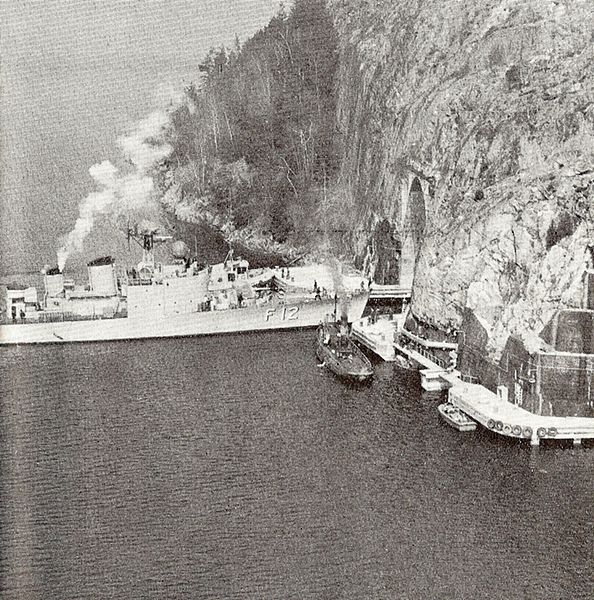
Muskö naval base, HSwMS Sundsvall entering a pen in the naval base. Built in several stages from 1950 to 1969 in Concrete, stone, steel, this was the largest “nuclear-proof” naval base of Sweden. This unique underground naval facility was based on the island of Muskö, south of Stockholm. It has three docks, large enough for two destroyers and two submarines. Kept highly secret during the cold war it was only fully unveiled to the public from 2004, when it was decided to concentrate efforts in Karlskrona Naval Base and the Berga Naval Base. The only raison d’être of the complex was indeed the nuclear threat posed by USSR.
Sweden, although neutral, was the first country past Finland, in the path of the mighty Soviet Army. Most scenarios of invasion from the latter involved the violation of Swedish territory. So
Sweden one of the most militarized countries in the area and despite a 7-8 million population was able to mobilize 800 000 conscripts. Its shining pride was its modern air force, made of ground-braking jets developed in total autonomy, compounded by the use of dispersed road bases making its destruction nearly impossible. The army was equally well equipped and also dispersed throughout the country in mobilization stores. For communication and storage, Sweden counted a network of well managed and adapted caves and mines. The possibility of nuclear warfare did not hampered the command and control functions at any level.
The extensive civil defense system provided a large array of bomb shelters, in fact there was enough room for each citizen. During the cold war, many citizens were granted the right to built their own NBC compound, in their garage, cave or in the garden. In addition, vast stores of food, medical supplies, fuel existed, in order to be consumed by the whole country and to last for a year.
The fleet in 1966:
-1 Cruiser: Gota Lejon
-8 destroyers (4 missile)
-8 ASW Frigates (4 in conversion 1966)
-19 submarines (+5 in construction)
-About 120 Landing crafts (LCU, LCA, Grim class)
-23 MTBs
-12 FACs (6 in construction)
-16 Patrol Boats
-1 minelayer
-44 minesweepers
-4 icebreakers
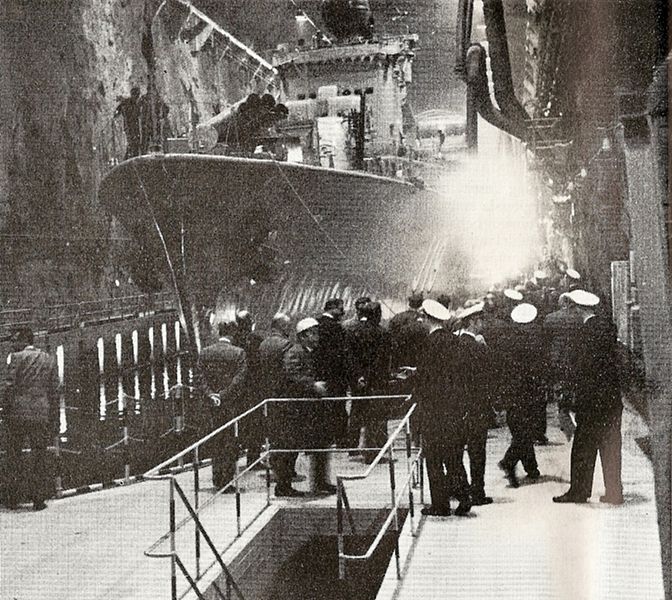
HSwMS Småland in one of the underground pens in Muskö naval base (1960). This could be used as a NBC-proof drydock as well.
The navy was however small in comparison but purposedly built to wage war in the archipelago of the coast line. In addition to cutting edge submarines, a fleet of MTB/FACs, and a comprehensive use of mines guaranteed extra protection, channelling enemy forces towards coastal battery range. In 2005, after a carrier was “sunk” in exercize by a Swedish sub, the US Navy borrowed one to test it versus nuclear submarines and found it way harder to hear them and this ended with a full time leasing for more practice.
Sweden innovated in this field, using Stirling engines for maximal discretion, as these theoretical engines generated no vibrations. Swedish missiles carried in its tubes are very capable too.
1982 Reorganization
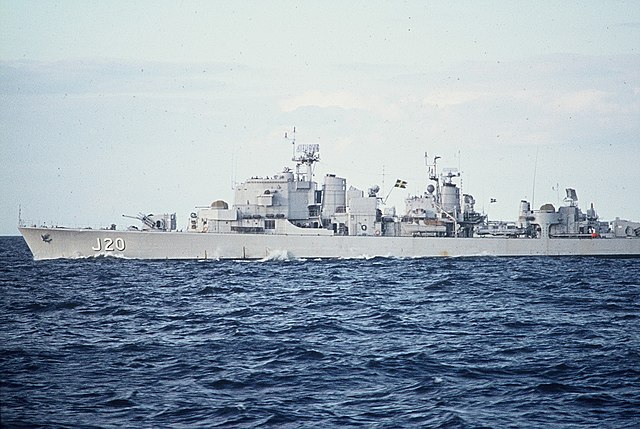
The destroyer Ostergotland
Prior to the Defense Decree of 1982, the Commander-in-Chief of the Navy proposed cost and staff reductions concerning the East Coast. Increased coordination and part fusion between the operations of the East Coast War Base and Berga War Schools.
Roslagen’s war base was relocated to Muskö that year, and merged into the East Coast’s base. Its Division was terminated on June 30 that year and assets relocated to the East Coast Base. Between 1986 and 1990, other reforms were carried out and ultimately all naval bases merged with the coastal artillery defenses unified into naval commands.
The cold war Swedish Navy in action: Incidents
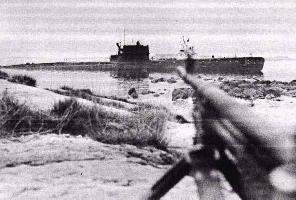 These were many submarine incidents during the cold war in Swedish waters. They mostly involved Soviet submarines and these were recognised by NATO as the “hottest” during the whole cold war, with those around North Korea.
In many of these incidents (around 20 listed), the intruders were simply driven off by depth charges, but in one occasion, the U 137 incident (1981), a soviet submarine was grounded, officially, because of navigation compass failure. The first incident was reported in 1962, followed by 1966, 1969 (20 days submarine hunt in Swedish waters), 1969 (sub-to sub encounter), 1974 (spotted, chased), 1976 (soviet sub found, chase), 1980, 1982, 1983 (as many as 5 violations), 1984, 86, 1987 (two incidents), 1988 and 1990 (West German sub). This went one after the cold war, with similar incidents in 1992, 2011, and 2014.
A controversy grew after the fall of the USSR, as many archives were being declassified and books were written. It happened that many of these violations for author Ola Tunander, seemed to have originated in NATO top secret operations. These submarines were on their way of spying the Russians, or were used in coordination with the Swedish Navy to play the role of the agressors. The 1980s incidents were so numerous that they spawned a famous novel in Sweden, a best seller called “The Troubled Man” (Den orolige mannen) by Henning Mankell.
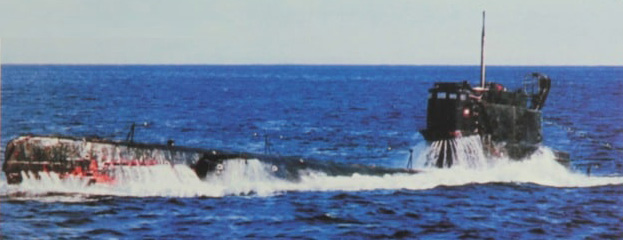
A NATO ‘Whiskey’ class submarine. In October 1981 S-366 was grounded off the Karlskrona underwater rocks, becoming for the international press the famous “Whiskey on the rocks”.
Svenska Marinen today:
post-cold war Reorganization
In FY 1995/96, the government proposed that basic training at Norrland naval command was terminated. Annual conscription in the Navy indeed has been reduced from 6,300 to 4,100 conscripts yearly. The Defense Decree 1992 made numerous budget cuts, taking in account the threat of USSR was no longer there. A commission found there was overcapacity in the navy’s training organization, and especially in the coastal artillery. Thus all training in the Norrland Coast naval command was to cease in 1997. The Härnösand Coast Artillery Regiment was dissolved a year later.
2001 reforms and bases
The government’s starting point was a report stating only two units were needed to meet the training of coastal artillery units. One was thus intended to be the main unit for coastal artillery (which of course included missiles). Prior to 2001 there were still three Coast Artillery Regiments in operations:
-Vaxholm Coast Artillery Regiment (The First Coast Artillery Brigade (KA 1)
-Karlskrona Coast Artillery Regiment (Second Coast Artillery Brigade (KA 2)
-Gothenburg Coast Artillery Regiment (KA 4)
-Gotland’s Coast Artillery Regiment (KA 3)
The Vaxholm Coastal artillery regiment was chosen to be the main unit. Indeed it had already extensive infrastructures and was close to the Stockholm archipelago. It also included training and shooting ranges and was well-dimensioned. It was also made important to maintain coordination with other units in the Stockholm area.

The ideal Swedish ship: Visby class Corvette
The support unit for Vaxholm was to be decided either for Karlskrona or Gothenburg. However it was also decided to invest more in Gothenburg and Karlskrona as they lacked practice fields before to be considered suitable as support units. Gothenburg was eventually chosen. The deciding factor what Gothenburg was Sweden’s second city and had a central location in Western Sweden, not too far away from Vaxholm. Eventually the Karlskrona Coast Artillery Regiment and Second Coast Artillery Brigade and Gotland’s Coast Artillery Regiment (KA 3) on Gotland were dissolved.

The main consequence was the practical dissolution of fixed coastal artillery. Remaining assets passed to the amphibious force. The two coastal artillery regiments became amphibious regiments, each comprising an amphibious brigade and three amphibian battalions. From June 30, 2000 all remaining forts were decommissioned, closed for overhaul, for most to be demilitarized and open to public as museums. The amphibious corps was formed in July with the Vaxholm amphibious regiment and Älvsborg’s amphibious regiment fed by the Amphibious Combat School.
The Coast Artillery Combat School was now part of Vaxholm’s amphibious regiment, it was renamed the Amphibious Combat School. This better reflected its activities.
The Riksdag was proposed by the Government that tactical organization was reduced by dismantling local defense area staffs, local naval commands and flight commands. A brand new naval and aerospace tactical command was co-located with the all-arms Swedish Operational Command. The proposal was adopted by the Riksdag, and resulted in much budget savings (and drastic personal reduction). On June 30, 2000, naval commands were dissolved, replaced by two new centralized units based on the two naval bases of Gothenburg and Vaxholm.
2004 and 2009 reforms
Prior to the 2004 decree, the government proposed to dissolve the two naval bases organization, with naval combat new tasks, and international changes, notably from NATO. The government proposed a single naval base, including a main base and a “backup base” if needed. However as it could lead to ambiguities of command and less rational organizations a single naval base was to be maintained, responsible for the entirety of Sweden’s naval defence.
A new framework was setup, which still enabled two additional locations. The new base organization should consist of shipbuilding resources for large ships maintenance and staff, plus infrastructure, quays and mooring facilities. In January 2005, this single naval base supervised several maritime information companies.
Training of amphibious units was needed and urged Vaxholm’s Amf 1 to be maintained. Älvsborg’s amphibious regiment (Amf 4) in Gothenburg had limited training facilities however and the Riksdag was proposed that the Amphibious Combat School should be discontinued, and staff and assets relocated to the Naval Combat School in Karlskrona.
The new naval program
Today’s Swedish Navy is headed by Marinchefen Rear Admiral Ewa Skoog Haslum, senior representative of the Swedish Royal Navy’s combat forces. There is no longer a vice admiral in the Navy.
This force is splitted between the:
-1st Submarine Flotilla (1. ubflj) Karlskrona
-3rd Naval Warfare Flotilla (3. sjöstridsflj) Karlskrona
-4th Naval Warfare Flotilla (4. sjöstridsflj) Berga, Muskö.
-1st Marine Regiment (Amf 1), Berga.
-Swedish Naval Warfare Centre (SSS) Karlskrona.
The current fleet counts 5 submarines of the Gotland and Södermanland classes, 7 corvettes (Göteborg and Visby classes), 9 minesweepers (Koster and Styrsö class), 13 Patrol Boats (Stockholm class and Tapper class), 147 Stridsbåt 90 (light “Combat Boats”), the long range patrol vessel HSwMS Carlskrona, the intelligence vessel HSwMS Orion, 100 G class Landing Crafts, 3 auxiliaries, 2 tugs, 1 Torpedo salvage vessel, 3 transports, 3 Griffon 2000TD Hovercrafts and 7 training vessels. In total 300 ships round, but most are of very low tonnage. The Svenska Marinen participated (marine troops mostly), to the War in Afghanistan (since 2002) and the fleet to the ongoing Operation Atalanta (since 2008) against piracy on the African horn.
Hot News:

Sweden just announced (May 19, 2026) placing an order for four FDI Luleå class Frigates to Naval Group in France, in a $4.2 billion deal over Navantia and the Babcock International proposals. The selection is the result of a “very high degree of delivery reliability” and an integrated and proven air-defense system, while sharing costs with FDI operators France and Greece. More to come. The first is expected to hit the water in 2030.
Nomenclature of Swedish ships in the cold war
This is listing the vessels built after 1945. Some which were moderrnized or completed past 1945 are also listed there.
Tre Kronor class cruiser (1946)
Class: Tre Kronor, Göta Lejon
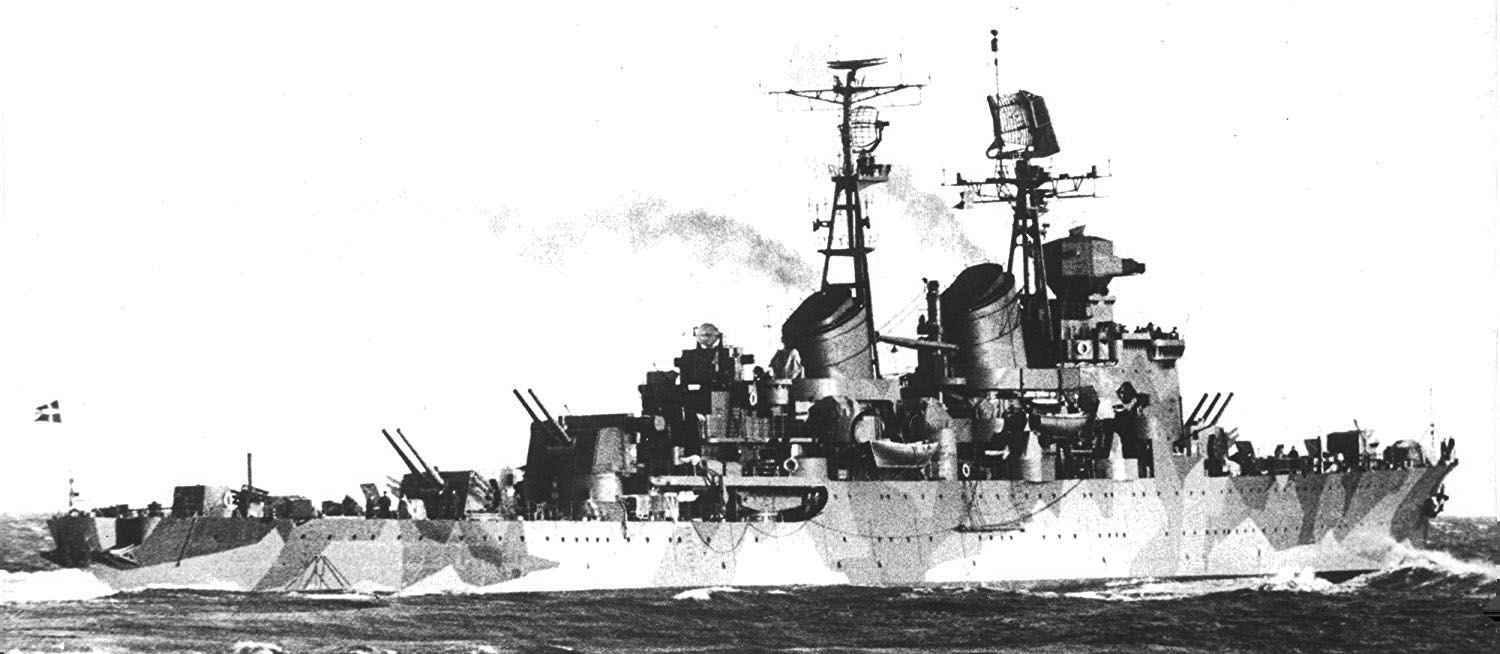
The “Three Crowns” class was the most ambitious naval program of Sweden during WW2. It was created out of necessity in case Sweden’s neutrality would end one way or another. Launched in 1943, however the first one was only completed in 1947. Undoubtedly the best Swedish cruisers ever produced (and the last) they missed WW2 but were ready for the cold war. They would have been classes as light cruiser under the Washington Treaty, with their 8,000 tonnes standard displacement and 6-in artillery. The armament was modified and the AA was exclusively composed of the 40 mm Bofors. By necessity to stay relevant, Göta lejon was modernized and rebuilt, served with the Swedish Navy until she was sold in Chile in 1971 and under her new flag she served until the end of the cold war while Tre Kronor was stricken in 1964. Two cruisers with very different fates and styles, which marked the Swedish Navy.

Characteristics (1980s)
Displacement: 8,000 t standard, 9,500 t FL
Dimensions: 182 x 16.45 x 5.94 m (597x 54x 19 ft)
Machinery: 2 shaft Geared turbines, 4×4 drum Boilers, 100,000 bhp, 33 knots, 5,000 nm at 15 knots
Armament: 7x152mm/50, 20x40mm/50, 7x25mm AA, 6x533mm TTs, 2 DCR, 2 ASWM, mines.
Armor: Belt: 70 mm, deck 30 mm, turrets 50–127 mm, CT 20–25 mm
Crew: 618
Swedish Cold War Destroyers
The list is restricted there as only two class, six ships, were built during this period, up to 1959 when the last was completed. Sweden from then reversed its attention to smaller ships, FACs, Submarines and coastal warfare. There were projects though, but none passed the vote at the Riksdag.
Öland class Destroyers (1945)
Class: Öland, Uppland
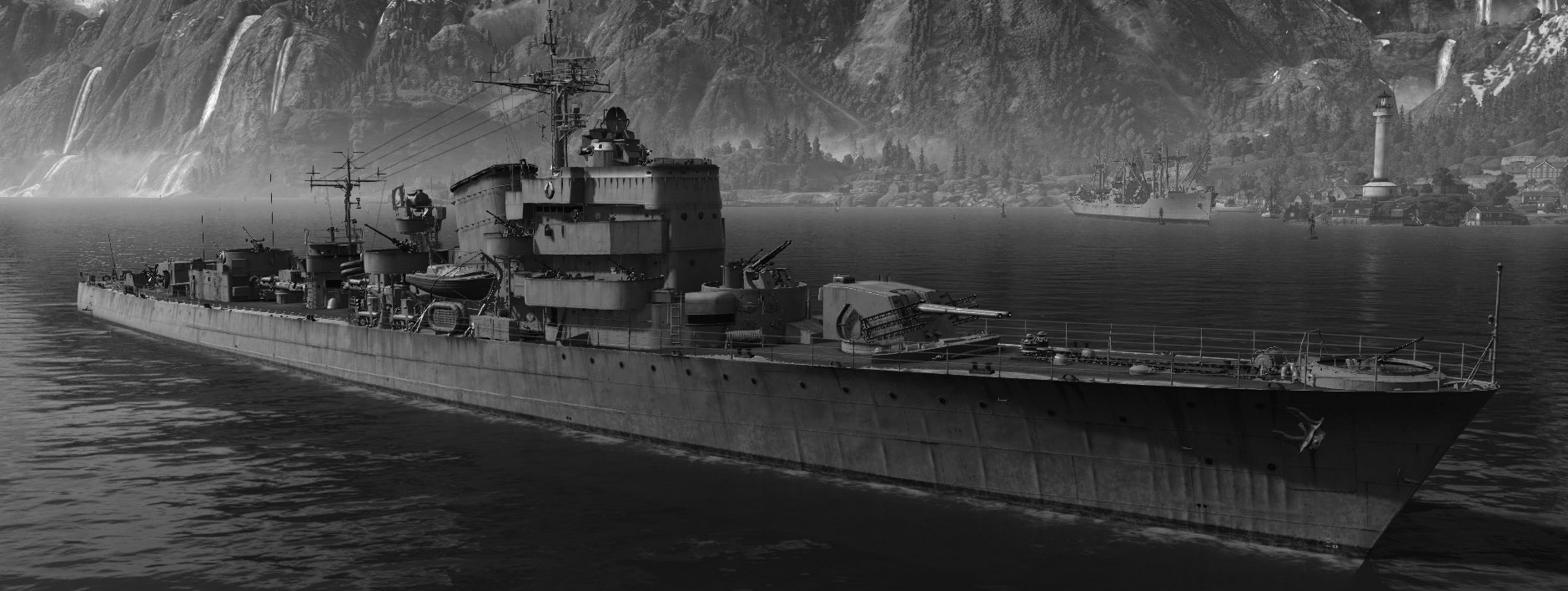
WoW’s rendition of the Öland class
Technically both destroyers has been completed in 1947 and entered service just when the cold war started in 1948, but both were wartime designs strongly influenced by US flush-deck destroyer design. Both destroyers were laid down at Kockums and Karlskrona respectively in 1943, launched respectively in December 1945 and November 1946 and completed on 5.12.1947 and 31.1.1948 respectively. They were small by USN standard, at just 1,800 tonnes. They were not supremely fast either at 35 knots but won in versatility. In addition to dual purpose semi-automated fast-firing dual purpose 120 mm guns (80° elevation) plus six torpedo tubes and reloads, and their AA was impressive with up to seven 40 mm Bofors (HMS Uppland), eight 25 mm guns. For ASW warfare, they had the usual DC and DCTs, plus a single 357 mm Bofors quadruple rocket launcher.
They could act as minelayer as well, carrying 60. Their radius of action was 2500 nm at 20 knots, carrying 300 tonnes of oil. Crew was 210. Their machinery was protected as well as vital parts in the superstructures by additional armor plating. They were modernized, for the first Öland in 1949, 1953, 1960 and 1969 and for the second, Uppland in 1953 and 1963. Bu by 1974 they were reclassed as frigates.
They were the largest destroyers built in Sweden, and its first and last missile destroyers. Designed first for anti-ship warfare, they possessed anti-ship missiles before any one else in Europe, at the exception of the Soviet fleet.
Specifications:
Tonnage: 1880 tonnes standard (2,500 FL)
Dimensions: 112 x 11.2 x 3.4 m
Propulsion: 2 shaft De Laval geared steam turbines, 2 Penhöet boilers for 44,000 shp.
Armament: 4x 120mm/45 (2×2), 6-7×40 mm Bofors AA, 8x 25 mm AA, 2×3 533 mm TTs, 375 mm ASWRL Bofors, 60 mines.
Halland class Destroyers (1952)
Class: Halland, Smaland (+ Lappland, Varmland)
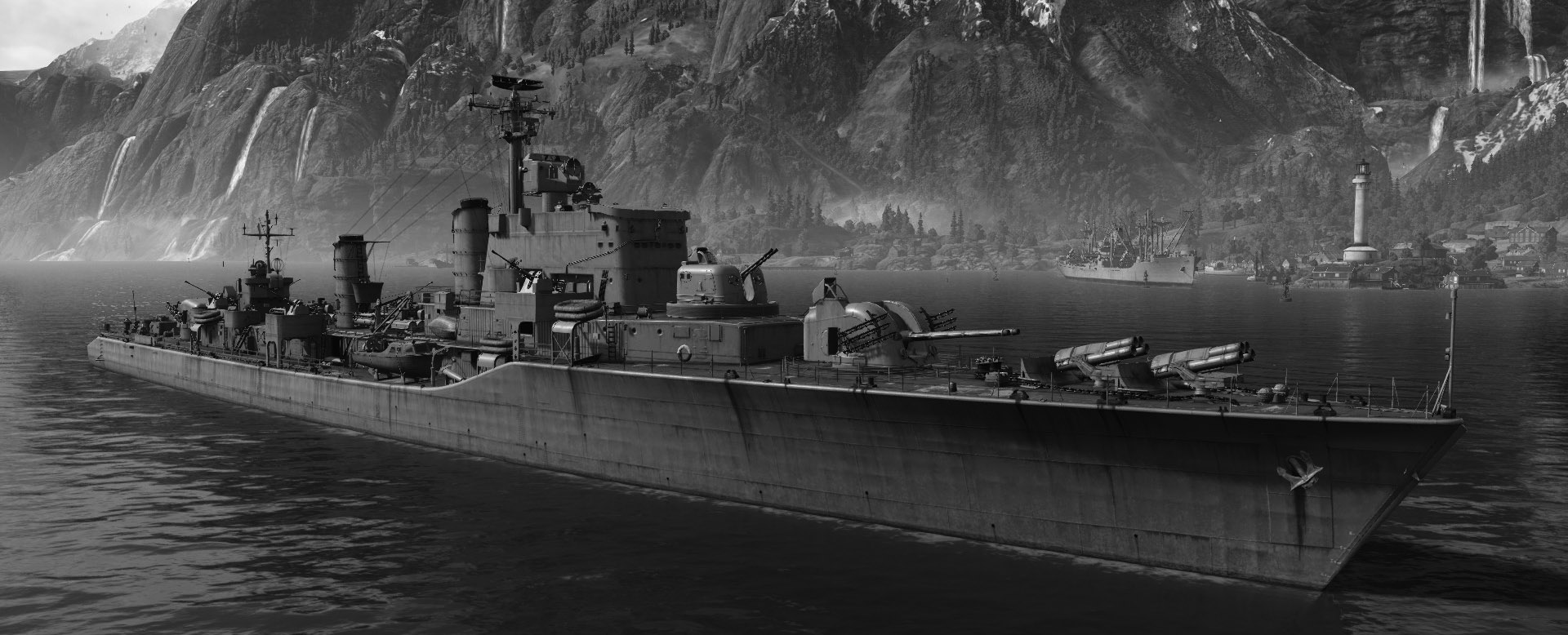
Wow’s rendition of Halland
Both destroyers were voted by the Riksdag in 1948, and later two more were voted in 1955 to be built in the same yards, cancelled in 1958. Design was completed in 1950 and construction was ordered at Götaverken and Eriksberg Yards in Göteborg in 1951. Both were launched in 1952 and completed in 1955 and 1956. They were arguably the very first European missile destroyers, aside the Soviet Navy. The first version fired the Rb315, later upgraded to the Rb08 and to the RB20. Both were modernized in 1962 and 1969 (Halland) and 1964 and 1967 (Smaland). Two more would be built for Columbia.
Their new caliber 50 Bofors guns, 120 mm were the same found in coastal fortifications later. Fully automated, they fired at 40 rpm at great angle, equally efficient against planes. The forward turrets were both fitted with three RFL or Rocket (Flare) launchers on either side. Sweden’s Bofors also developed a 57 mm variant of 60 caliber, close to what was developed in the Soviet Navy at that time. The AA panoply was completed by six Bofors 40 mm of the latest 70 caliber versions, automated. There were two TT banks, one quintuple just behind the forward funnel, and another triple behind the aft funnel, with the Saab missile launcher mounted on top.
Its magazine was below the aft superstructure. The missile was traversed by the TT bank.
The latter fired the wire-guided Torped 61, designed in Scandinavia and shared by Norway and Denmark as well.
For ASW warfare, they carried two quadruple Bofors 375 mm Rocket Launchers installed on the forward, near the prow. Originally they were fitted with the LW3 radar, later replaced by the PEAB 9LV 200 Mk2 radar, also replacing the Mk45 fire control sets.
These destroyers were heavily armed for their time, moreover on such a small package. They were discarded in 1985, about the same time as the Colombian ships in 1985-86.
Specifications:
Tonnage: 2630 tonnes standard (3,400 FL)
Dimensions: 121 x 12.6 x 5.5 m
Propulsion: 2 shaft De Laval geared steam turbines, 2 Penhöet boilers, 58,000 shp, 35 knots
Armament: Saab Rb08A SSM, 4x120mm/50, 2×57 mm AA, 6×40 mm Bofors AA, 8×533 mm TTs, 2×375 mm ASWRL Bofors, 6×103 mm RFL, 60 mines.
Sensors: Radar Scanter 009, Thomson-CSF Saturn, HSA Mk22, Sonars
Ostergotland class Destroyers (1956)
Class: Ostergotland, Sodermanland, Gastrikland, Halsingland
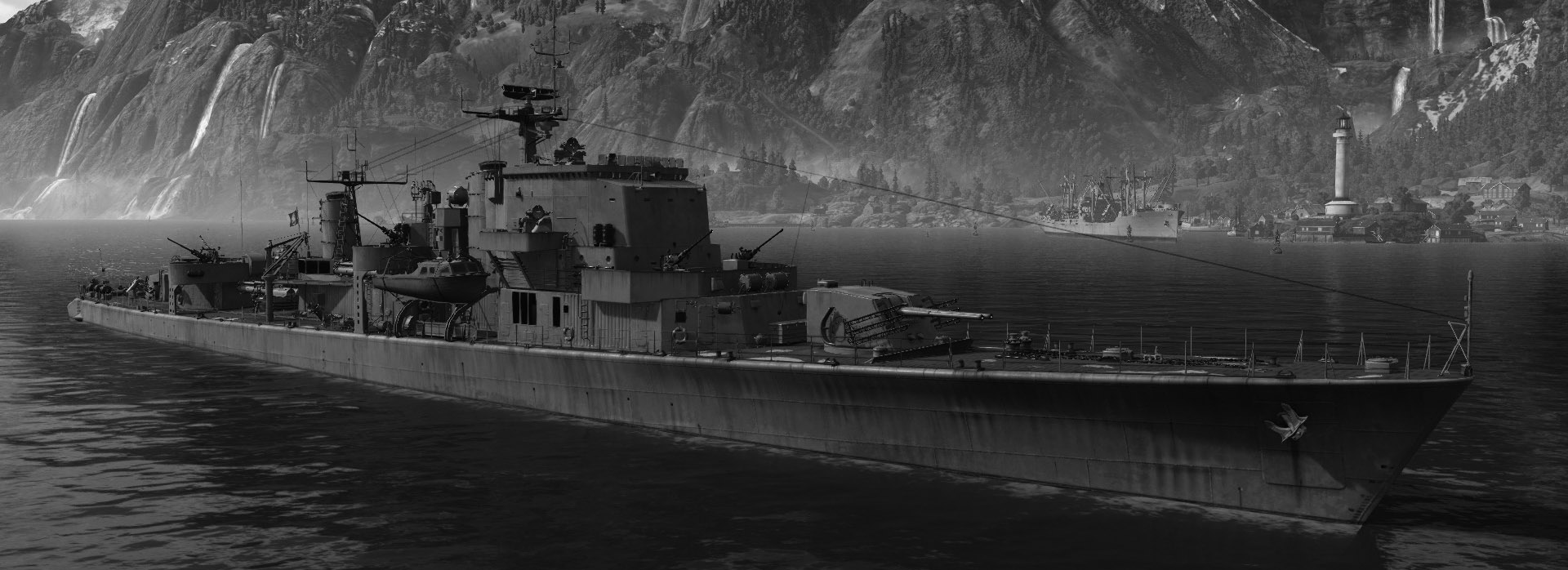
Wow’s rendition of the Ostergotland
All four ships were voted in 1953, they signalled a return to the smaller, cheaper and more conventional flush-deck Oland design, but with a modern squid ASW launch system. There was a single sextuple TT bank for the Torped 61, and 12 RFL (Flare launchers), installed on both turrets, no 57 mm AA and only 40 mm Bofors. Built in the same yards as the Halland vessels, they were launched in 1956-57 and completed in 1958-59. Modernized in the 1960s, their 40 mm Bofors were replaced by one British Seacat SAM system called Rb07. Pennant numbers J20-23, “J” standing for “Jagare”, “hunter” for destroyer. They were discarded in 1982-83, the last ever Swedish destroyers, now relics of the cold war.
Specifications:
Tonnage: 2150 tonnes standard (2,600 FL)
Dimensions: 112 x 11.2 x 3.7 m
Propulsion: 2 shaft De Laval geared steam turbines, 2 Babcock boilers, 47,000 shp, 35 knots
Armament: 4x 120mm/50 (2×2), 7×40 mm Bofors AA, 6×533 mm TTs, Squid ASWRL, 60 mines.
Sensors: Thomson-CSF Saturn, HSA Mk44-45, Sonars
Swedish Cold War Submarines
U1 class subs (modernized – 1963)
No known photo
This class dated back from 1940, with nine built until the end of the war, the last, U9, launched in May 1944. They decent but small, coastal 378 tonnes boats. Instead of being scrapped in 1960, they were taken in hands for a full modernization. When out of this process in 1964 they featured a streamlined single hull and fin, plus modern sonars and equipments, rebranded as hunter killers. Their displacement was not 388 tonnes. Their second career was short lived, as they were scrapped gradually in 1970-76 for the U-4 – U-9 modernized.
Many sources also states the true predecessors of the cold war submarines to be the Neptun class (Näcken, Najad, Neptun) commissioned in 1943, as larger than the U1. They were apparently however not modernized like the U1 and all decommissioned in 1966.
 Hajen class subs (1954)
 The Hajen class (or Hajen III class due to the name’s previous uses), was a series of submarines built by Kockums, which design was strongly influenced by the German Type XXI. A total of six were built 1954-1958, in service until 1980. After HSwMS Hajen in 1954, was HSwMS Sälen (1955), HSwMS Valen (1955), HSwMS Illern (1957), HSwMS Bävern (1958), and HSwMS Uttern (1958). They were the first cold war design of Sweden and almbeit classic diesel-electric, they combined outer streamlining lessons learned with the modernization of the U1 class and a powerful battery set for greater underwater speed. They displaced 720/900 tonnes for 65.8 x 5.1 x 5 m had two Pielstick Diesels 1,660 hp (1,240 kW)
combiend to two 2 ASEA electric motors for 16 kts/20 kts, had a crew of 44 and carried just four 533 mm TTs at the bow, with 4 in reserve.
Draken class submarines (1960)
 The Draken class were six coastal subs built from 1960 to 1962 and modernised in 1981–1982. Essentially a modified version of the Hajen class wti a single shaft but larger 5-bladed prop for improved underwater performance and reduced noise. Draken, Vargen, Nordkaparen and Springaren were ordered from Kockums, Gripen and Delfinen from Karlskrona. They were decommissioned 1988–1990 but HSwMS Nordkaparen was preserved and is displayed at Maritiman in Gothenburg. Specs: 770t/950t, 69.3 x 5.1 x 5.3 m, 2 Pielstick diesels 1,660 hp, 2 ASEA electric motors, 17/22 knots. Crew 36, 4× 533 mm bow TTs (12).
Sjöormen class subs (1967)
 Class: Sjöormen, Sjölejonet, Sjöbjörnen, Sjöhunden, Sjöhästen. The Sjöormen class (Sea serpent) were a brand new design, with a teardrop hull and able to dive to 150 metres (490 ft). When completed, they were regarded as the most advanced conventional attack submarine classes in the world, with novel features including such an x-rudder and anechoic tiles, and a great underwater endurance. They were retired in the early 1990s, purchased by the Republic of Singapore Navy (RSN) and modernized as the Challenger class, in service until 2024. Specs: 1,075t/1,400t, 51 x 6.1 x 5.8 m, 1 shafts 2× Pielstick diesel, 1× ASEA electric motor 15/20 knots, endurance 21 days (crew 23), FAS, 4x 533 mm, 2× 400 mm TTs and mines.
Nacken class subs (1978)
 Class: Näcken, Neptun, Najad. The Näcken-class (A14 type) were authorised in 1972 and completed 1980-1981 at Kockums, Karlskrona. New teardrop hull, diving 150 m. By 1987-1988, all were were cut in half for a new 8 m (26 ft) long hull section to be instered with a prototype Air-independent propulsion (AIP), Stirling engine between the aft battery/propulsion, control room and motor room, increasing patrols to 14 days and adopted in the next Swedish submarines.
They were decommissioned in the early 2000s after a White Paper with one leased to the Royal Danish Navy until 2005. Specs: 1,030 tonnes (sub), 49.5 x 5.7 x 5.5 m. 1 shafts, 2 MTU diesels, Jeumont-Schneider electric motor: 20/25 knots. Crew 19, FAS control, same armament as above.
Vastergotland class subs (1986)
 Class: Västergötland, Hälsingland, Södermanland, Östergötland. The Västergötland entered service in 1987 to replace the last Draken II class. Design was done in 1976, contract signed in April 1978, construction started on 8 December 1981 at Kockums AB, last delivered 1988. They all had comprehensive refits with a new AIP hull section, recommissioned 2003–2004 as the Södermanland class. Västergötland and Hälsingland were in reserve by 2005, then sold to the Republic of Singapore (Archer class), modernized 2009–2010. Östergötland was decommissioned in 2021, Södermanland is still in service as instruction boat. Their bow armament was reinforced to 6 533mm bow tubes and 3 400mm bow tubes all for a simultanoous fire of 6 heavy and 6 light wire-guided torpedoes at the same time on 6 different targets. Specs: 1,070/1,150t, 48.5 x 6.1 m x 5.6 m. 1 shaft, 2× Hedemora V12A/15 diesels, 1× Jeumont-Schneider electric motor 11/20 kn. Crew 18 officers+ 6 conscripts. FAS control, 6× 533mm, 3 × 400mm TTs and mines.
Gotland class subs (1995)
 Class: HSwMS Gotland, Uppland, Halland. The Gotland-class are modern submarines designed and built by Kockums (SAAB AB from 2014) and first submarines in the world to feature a twin Stirling engine AIP from the start instead of electric motors, extending underwater endurance to weeks. They capacity was extended to fire sub-missiles, COMINT, ELINT, special operations, in addition to mine-laying. Completed in 1996 they are all today active in the 1st Submarine Flotilla, but needs replacement. Specs: 1,494/1,599 tonnes, 60.4 x 6.2 x 5.6 m. 1 shafts, 2× MTU diesels, 2× Kockums v4-275R Stirling AIP units 11/20 knots on batteries, 5 kts on AIP. Crew 18–22 officers, 6–10 ratings. CSU 90-2 integrated sonar sensor suite, armed with 4× 533 mm, 2× 400 mm TTs, 48× Externally mounted naval mines.
Their successors are the Blekinge-class submarines, the 1900 tonnes, 2000s generation. Called A26 type, they were delayed several times, until the first was laid down at Kockums in 2015 as HSwMS Blekinge, with the second named HSwMS Skåne in 2016. Expected commissions were 2024 and 2025 but they are now pushed down to 2031 and 2033. Three more are planned for Poland. The project as of 2026 is wozefully 120% over budget and 8 years late. SAAB marketed these for export in three variants: The AIP has an endurance of 20 days. The “Oceanic” measures 65 meters and has an autonomy of more than 30 days. The third, called “Extended Range” is over 80 meters long and is capable of 10,000 nautical miles, perhaps 50 days+ plus at sea according to the constructor (navaltoday). However given the massive delays it’s not sure that the Polish orders will remain.
Early Swedish MTBs and FACs
Swedish Yards already had some experiences in MTBs, studying both Italian and British designs (Baglietto and Vosper) in the 1930′ and cranking up in 1941-43 a serie of 22.5-27 tonnes boats, from T15 to T30. The last were stricken in 1959. In betwee, Sweden purchased an American model, of the Higgins class, renamed T1 (1945, acquired 1950). She was tested and used until burnt by accident in 1957 and BU. Kockums received an order for ten modern MTBs, all-steel, with three Isotta-Fraschini engines for 4,500 hp. This allowed them to speed up to 45 knots.
In 1952, Fiskätra Varv Yard at Saltsjöbaden received an order fo an experimental unit called T201. It was an attempt of a small, 17 tonnes MTB armed with two 18-in TTs (later changed to the standard 21-in model (533 mm), capable of 44 knots tanks to three Isotta-Fraschini engines. She served mostly for testing a future mass-production until 1963 when strucken and used as an experimental station ship for missile FACs in 1980.
T32 class MTBs (1951)
A small serie of steel torpedo MTBs built from 1951 to 1952 (Serie T32-T41) at Kockums and Karlskrona Yards. The first were stricken in 1972 a,d the last in 1975. They weighted 38.5 tonnes standard, measured 23 x 5.6 x 1.4 m, had three shafts mated on Isotta-Fraschini 184C engines for a total output of 4500 bhp, top speed 44 knots. They carried two 533 mm TTs and one Bofors 40 mm gun. T41 was rebuilt in 1967 as the patrol vessel Viken. Crew: 16.
T42 class MTBs (1955)
Second serie of 15 MTBs also from Kockums and Karlskrona, also stall-hulled and heavier at 40-44 tonnes, their powerplant and armament remained the same, but the hull shape was revised. They were stricken from 1977 to 1991. Same specs as above but displacement 40 tonnes standard, 44.5 FL, 5.9 m wide.
Plejad class FACs (1951)
 Sweden was one of the very first country to create the concept of Fast Attack Craft. Far larger than MTBs, they were able to patrol long distances and were heavily armed, but slower than MTBs. The Plejad class was designed in the late 1940s, taking inspiration from the allied large Fairmile types. Their size allowed to fit inside MTU diesels, whereas Perseus was a prototype fitted with diesels and a Proteus gas turbine. She was capable of ramping up 4,500+5,000 hp, so 9,500 total. The regular Plejad boats were rated for 9,000 bhp. This was enough to reach a top speed of 37.5 knots, but cruise speed was 30 knot, still allowing them to cover 600 nautical miles.
There were two torpedo tubes forward, abaft the forward turret, and four in échelon rearwards, abaft the aft turret. They could be removed to install mine tracks. The rocket launcher was further aft as well as smoke projectors. Based on a German design they were built by Lürssen-Karlskrona in two batches, the first launched in 1950-54 and the second in 1956-57 and discarded from 1977 to 1981. Some were rebuilt in 1964 to 1965. The class comprised the Perseus (discarded 1967), Plejad, Polaris, Pollux, Regulus, Rigel, Aldebaran, Altair, Antares, Arcturus, Argo and Astraea.
Specifications:
Tonnage: 155 tonnes standard (170 FL)
Dimensions: 48 (45.2 PP) x 5.8 x 1.6 m
Propulsion: 3 shafts MTU 20V 672 diesels, 9,000 shp, 37.5 knots
Armament: 2x 40mm AA, 6x 533 mm TTs, 2×2 103 mm, 1×12 RFL.
Spica I class FACs (1966)
 Class: T121-126 Spica, Sirius, Capella, Castor, Vega, Virgo. The Spica class was a class of six fast torpedo boats built for the Swedish Navy in the 1960s, decommissioned in the late 1980s apart HSwMS Spica, preserved in Stockholm, Sweden. They were ordered in 1961 as part of a re-armament programme for the coastline and the UK, Norway and Germany took part in tenders. Lürssen offered the new Jaguar-class but the Swedes eventually ended up designing their own ship, which became arguably one of the most imprtant class of light ships in Cold War Sweden. They were still using six torpedo tubes at a time missiles became more common, rounded up by a Bofors 57 mm gun. Specs: 220/235 tons, 42.5 x 7.1 x 1.6 m. 3 shaft Bristol Proteus gas turbines 12,750 hp (9,510 kW) with controllable pitch propellers for 40 knots. Crew 30, Scanter 009, HSA M22 radars, Bofors 57 mm gun, 6× 533 mm wire-guided torpedoes TTs, 2× 7.62mm GMPG, Flare and chaff rockets, mines/depth charges.
Spica II class FACs (1972)
 Class: T131-142 Norrköping, Nynäshamn, Varberg, Västerås, Västervik, Umeå, Piteå, Luleå, Halmstad, Strömstad, Ystad. These twelve FAC built for the Swedish Navy in the 1970s (last decommissioned 2005) were aletrnativel name the Norrköping class, named after Swedish cities as an improved Spica-class. Same power train, same Bofors 57 mm and six 533 mm (21 in) TTs, but after refit in 1982–1985, four launchers for RBS-15 SSMs were installed instead, alternative to mines as well as installation of the Sea Giraffe radar and the Maris 880 weapons constrol system. They were modernised between 1996 and 2000. A version was also built for the Royal Malaysian Navy (Handalan class). Specs: 220/255 tons, 43.6 x 7.1 x 1.6 m, 12,750 hp for 41 knots, crew 30. Sensors Scanter 009, PEAB 9LV 200 mk1, later Sea Giraffe 50HC, MARIS 880. Same armament but 8x RBS-15 1982–1985.
Jägaren (1972)
 Single ship similar to Norwegian Snögg class, named P151, P150, and from 2008- V150. She was built at Bergens MV, Bergen, Norway as a small FAC for missiles, launched 8.6.1972 and completed 24.11.1972. Stricken 2002, re-instated 2008, preserved 4.2016. Specs: 120/150t, 36.6 x 6.30 x 1.70, 2 shafts MTU 20V672 TB90 diesels 7200 hp for 35 kts, range 550 nm at 35 kts. 6x 1 RB-11 SSM (6 Penguin Mk 1) or (2x RB-11 SSM (2 Penguin Mk 1) or 24 mines. Also tested with 2x RB-11 SSM (2 Penguin Mk 1), 2 DCR. She also had a Bofors 57mm/70 SAK57 Mk 1, sensors were the Scanter 009, 9LV200 Mk 2 radars, SQ3D/SF sonar and she had a crew of 22.
Hugin class FACs (1973)
 Class: P151-165. Hugin, Munin, Magne, Mode, Vale, Vidar, Mjölner, Mysing, Kaparen, Väktaren, Snapphanen, Spejaren, Styrbjörn, Starkodder, Tordön, Tirfing. Partly built at Bergens MV, Bergen, and Westermoen, Mandal, Norway from 1977 to 1982, derived from the successful Jägaren and similar to Norwegian Snögg class but with diesels taken from retired Spica class craft. Specs: Same as above.
Modernizations: In the late 1980s, all received the EWS-905 ECM suite. In 1992-1994, Kaparen, Väktaren, Snapphanen, Spejaren, Styrbjörn, Starkodder, Tordön, Tirfing had 2 MTU 16V396 TB94 (6400hp, 32kts, 550(32)kts) unstalled and theu gained four 9 ELMA ASWRL, the 9GR600 radar, SA-950, and ST-570 sonars. Stricken 1995 to 2008.
Swedish missile corvettes

Stockholm (Spica III) class Corvettes (1984)
 Class: Stockholm, Malmö, bith built at Karlskronavarvet, Karlskrona, 1982-85, in service. Essentially a development of Norrköping class (SPICA II) with half SSMs, and hafl TTs or all TTs or SSMs alternatively. Note that the torpedoes could be used for ASW, wire-guided. Specs: 300/372t, 50 x 7.50 x 3.30m, 3 shafts CODAG, 1 Allison 570KF gas turbine, 2 MTU 16V396 TB93 diesels, 11,360 hp for 32 kts. Armed with 4×2 RBS-15 SSM, 1x 57mm/70 SAK57 Mk 2, 1x 40mm/70 Bofors 315, 2x 533mm TT, 4×9 ELMA ASWRL and mines. Sensors PN-612 Scanter, Sea Giraffe 50HC, 9LV200 Mk 2 radars, 9LV100 e/o system, SA950, TSM2643 Salmon sonars, EWS-905 ECM suite, 2x Philax decoy RL, MARIL 880 CCS for a crew of 30.
They were modernized in 2002-2003 wuth a new Vericor TF50 gas turbine and 2 MTU 16V396 TB94 diesels (10,720hp) for two 400mm TTs (Tp45), 9GR400 radar, Hydra sonar, CS-5460 ECM suite, MASS decoy RL, CETRIS 9LVMk 3E CCS.
Goteborg class Corvettes (1989)
 Classs: Göteborg, Gävle, Kalmar, Sundsvall built 1986-1993 Karlskronavarvet, Karlskrona, in service. Evolution of the above, with two more, Helsingborg and Härnösand, never ordered. All 8 SSMs can be swapped by 4 additional 400mm TTs or 2 fast RIBs.

Specs: 300/400t, 57 x 8 x 1.93m, 3 waterjets MTU 16V396 TB94 diesels 8,400 hp for 32 kts, 500 nm range at 30 kts. Armament as above, sensors Pilot, Sea Giraffe 150HC, 2x 9GR400 radars, 2x 9LV200 Mk 3 e/o systems, SS304 Spira, TSM2643 Salmon sonars, AR-700 ECM suite, 2x 9CM300 decoy RL, 9LV Mk 3 CCS, crew 43. Modernized 2000-2005 and 2015-2017, with a 40mm/70 Sea Trinity RWS, 2x 12.7mm/90 Bornwing, Hydra sonar, CS-5460, RAN-1101 ECM suites, 2x MASS decoy RL and later the RBS-15M Mk 3 SSM and 9LV Mk 3, then the SESYM CCS, ST2400 sonar.
Smyge/YS-2000 class stealth Corvette (1991)
 This post-cold vessel war was an early attept by Sweden to design a stealthy, superfast ship using a catamaran hull and surface effect for radar signature and audio reduction. Largely an experimental vessel, her name signified “Stealth” in Swedish. The broken-shaped hull was coated with radar-absorbent paint and materials. She tested various armaments, starting with the RBS-15 missile, and used a VDS for minehunting trials. So far a single ship was built, as N°431 from Karlskronavarvet, Karlskrona, launched on 3 1991 and completed on 30.8.1991 as a prototype. Specs: 140t, 30.4m x 11.4m x 1.90m rest/0.70m cushion, 2 waterjets, 2 lift fans MTU 16V396 TB94 diesels and 2 Saab DSI-14 diesels for the air cushion (5550 + 1250 hp), 50 kts. Armed if fitted woth two 1 RBS-15 SSM (2 RBS-15), one 40mm/70 Sea Trinity, 1x 400mm TT ASW and she had a TSM2643 sonar and a crew of 14.
Visby class Corvettes
 Class: Visby, Helsingborg, Härnösand, Nyköping, Karlstad, Uddevalla (cancelled). The most famous recent ships from Sweden. Built from 1995 to 2015 they are belonging to the 3rd and 4th Naval Warfare Flotillas. The Visby-class are five stealth corvettes which received widespread international attention because of its high stealth characteristics. They were designed by Swedish Defence Materiel Administration (FMV), built at Saab Kockums AB Karlskrona, first launched in 2000, last completed 2015.
Construction used a PVC core with carbon fibre and vinyl for an overall weight of roughly 50% less than equivalent strength steel. The radar cross-section was saod to be reduced to 99% for its detection range, about the size of a persicope. The 57 mm cannon barrel also can be folded into the turret. These ships will be soon completed by four new FDI Frigates from 2030 onwards.
Swedish patrol boats
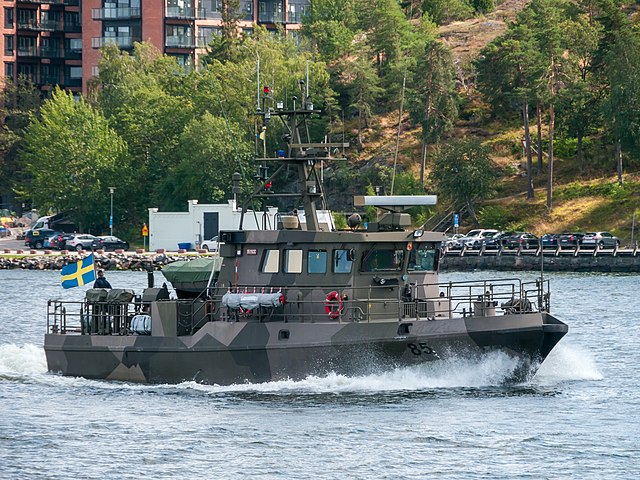
HMS Trygg of the Tapper class
Offshore Patrol Vessels
V57 class PBs (1953)
Built in Stockholm in 1953, commissioned 1954, fitted with minelaying, attached to the coastal artillery corps. Discarded in 1985.
Specs: 115t/135t, 29.9/32.5 x 5.3 x 2.3m. 1 shafts Nohab diesel MG8 500 bhp 13.5 kts, 1x 20mm, crew 17.
Bevakningsbat 61 class PBs (1960)
Built at Bröderna Larsson Varv & Verskstad, Krietenhamm (N°61-70) in 1960-31 and the coastal artillery yard at Farosund in Gotland. for N°71-77 in 1966-67. Refitted with new pilot hoise ad taller tripod mast, still active in the 1990s. Specs 28t, 21.1 x 4.6 x 1.3m, 2 shafts Volvo-Penta DSIR82 or Scania Vabis TIMD96B diesels, 535-705 bhp for 18 kts.
Dalero class PBs (1984)
 Class: V09 Dalarö, V10 Sandhamn, V11 Östhammar (2008 SVK11). They were built at Djupviks varvet, Rönnäng in 1984-1985. First two discarded 2002. SVK11 still active 2020, TS for reservists. In 2008 she had been recommissioned with small arms only, with two nav. radars.
Specs: Displacement 50t, 23.4 x 5.10 x 1.10, 2 shafts MTU 8V396 TB83 diesels: 2100 hp, 30 kts. Armed with a 40mm/70 Bofors 315, 2 x 1 – 7.6/90, mines. Terma TM-610 radar
Crew 7+3 passengers.
Tapper class PBs (1993)
 The Tapper (brave) were designated successors for the Bevakningsbat class. They were armed with just two 12.7 mm heavy machine guns, four Elma ASW-600 anti-submarine rockets, six depth charges and naval mines. 23 m (75 ft 6 in) x 5.4 m (17 ft 9 in) x 1.9 m (6 ft 3 in), displacement 62 tons, capable of shallow water. 2 diesels 1,200 hp (890 kW): Top speed 25 knots (46 km/h; 29 mph). Crew 8 +10 passengers. Built at Djupviks varv and commissioned 1993-1999, 12 ships for the Navy and amphibious corps. To be retired 2014 but kept with the Crimean invasion and 2022 invasion, and modified from 2020 (first six) with the Kongsberg Maritime sonar for ASW, Drone-jamming equipment. Class: PBR81-92 HSwMS Tapper, Djärv, Dristig, Händig, Trygg, Modig, Hurtig, Rapp, Stolt, Ärlig, Munter, Orädd. Also called the Bevakningsbåt typ 80
Swedish mine warfare vessels
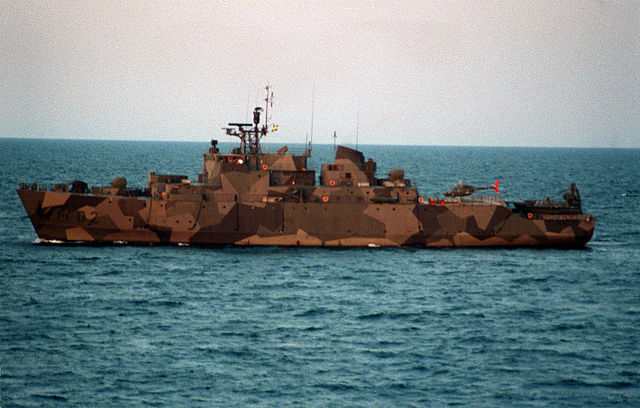
HMS Älvborg (M02)
Reserved for the 2027 Update.
Alvsborg class minelayers (1969)
(To come…)
Minelayer HMS Carslkrona (1980)
(To come…)
Orust class inshore minesweepers (1948)
(To come…)
Hano class coastal minesweepers (1952)
(To come…)
Arko class coastal minesweepers (1958)
(To come…)
Hsingen class inshore minesweepers (1960)
(To come…)
Gassten class inshore minesweepers (1972)
(To come…)
Landsort class inshore minesweepers (1984)
(To come…)
‘SAM’ class remote MCM crafts (1984)
(To come…)
Swedish armed icebreakers
As winter grips most of the Baltic, Swededen’s traffic and military operatiosn relied on icebreakers. In 1966, 4 were in service. The older, 1925 Atle just has been stricken in September 1966, but the 1932 Ymer stayed active until 1976, followed by the 1950s Thule, Oden and recent Tor class. They were armed by at least a 40 mm AA Bofors.
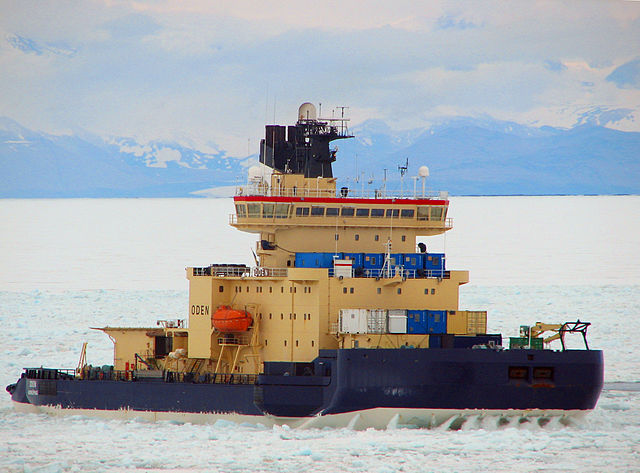
Reserved for the 2027 Update.
Thule (1951)
(To come…)
Oden (1956)
(To come…)
Tor class (1963)
(To come…)
Atle class (1973)
(To come…)
Oden (ii) (1988)
(To come…)
Read More/Src
Conway’s all the world’s fighting ships 1947-95
https://www.navypedia.org
sv.wikipedia.org/ Svenska_marinen
List_of_ships_of_the_Swedish_Navy
forsvarsmakten.se/
militarhistoria.se/
laststandonzombieisland.com
forum.worldofwarships.eu/
marinmuseum.se/
swedish-aircraft-carrier-cruiser-1946
 Latest Facebook Entry -
  X(Tweeter) Naval Encyclopedia's deck archive
 Instagram (@navalencyc)


 French Navy
 Royal Navy
 Russian Navy
 Armada Espanola
 Austrian Navy
 K.u.K. Kriegsmarine
 Dansk Marine
 Nautiko Hellenon
 Koninklije Marine 1870
 Marinha do Brasil
 Osmanlı Donanması
 Marina Do Peru
 Marinha do Portugal
 Regia Marina 1870
 Nihhon Kaigun 1870
 Preußische Marine 1870
 Russkiy Flot 1870
 Svenska marinen
 Søværnet
 Union Navy
 Confederate Navy
 Armada de Argentina
 Imperial Chinese Navy
 Marine Haitienne
 Marinha do Portugal
 Mexico
 Kaiserliche Marine
 1898 US Navy
 Argentina
 Brazil
 Chile
Chile Cuba
Cuba Peru
Peru Bulgaria
 Denmark
 Greece
 Netherlands
 Norway
 Portugal
 Romania
 Sweden
 China
China Thailand
 Sovietskiy Flot
 Royal Canadian Navy
 Royal Australian Navy
 RNZN Fleet
 RIN Fleet
 Chinese Navy 1937
 Kriegsmarine
 Chilean Navy
 Danish Navy
 Finnish Navy
 Hellenic Navy
 Polish Navy
 Romanian Navy
 Turkish Navy
 Royal Yugoslav Navy
 Royal Thai Navy
 Minor Navies
 Albania
 Austria
 Belgium
 Columbia
 Costa Rica
 Cuba
Cuba Czechoslovakia
 Dominican Republic
 Haiti
Haiti Hungary
 Honduras
 Estonia
 Iceland
 Eire
Eire Equador
 Iran
Iran Iraq
Iraq Latvia
 Liberia
 Lithuania
 Mandchukuo
 Morocco
 Nicaragua
 Persia
 San Salvador
 Sarawak
 Uruguay
 Venezuela
 Zanzibar
 Warsaw Pact Navies
 Bulgaria
 Hungary

 Bundesmarine
 Dutch Navy
 Marina Militare
 Yugoslav Navy
 Chinese Navy
 Indian Navy
 Indonesian Navy
 JMSDF
JMSDF North Korean Navy
 Pakistani Navy
 Philippines Navy
 ROKN
ROKN Rep. of Singapore Navy
 Taiwanese Navy
 Vietnam People’s Navy
 IDF Navy
 Saudi Navy
 Royal New Zealand Navy
 Egyptian Navy
 South African Navy


 Ukrainian Navy