
Petr Velikiy
 Russian Ironclad (1877)
The ironclad babochka:
The Petr Velikiy (Peter the Great) was undoubtedly the oldest Russian battleship in service in 1914, the babochka (“Grandma”) of the Russian navy. This battleship knew several lives. It was in its day the very first Russian battleship with turrets and steam alone, a fashion launched by France and Great Britain and quickly followed by the tsar for the Baltic fleet.
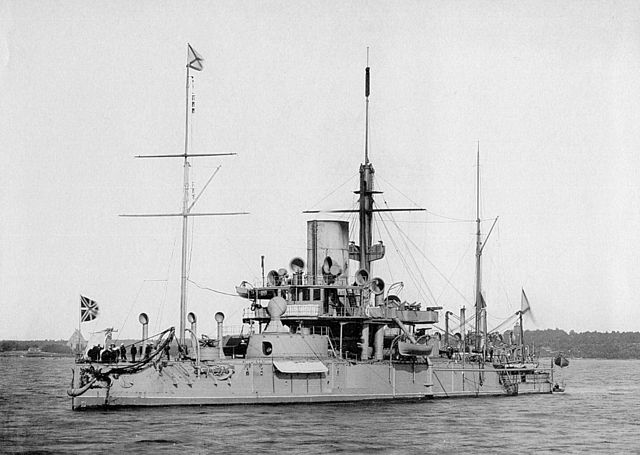
Petr Velikiy in service in the late 1870s
The Russian Ironclad
Probably the biggest and most modern Russian warship drawn in the late 1860s, the Пётр Великий – Peter the Great, was an ironclad turret ship, started in july 1870 at Galerniy Island Shipyard, Saint Petersburg and launched 27 August 1872, for over 5.5 million rubles. The plans betrayed a strong British influence, notably the contemporary HMS Dreadnought (1st) class ironclad of similar configuration, but was initially inspired by the American twin-turret monitor USS Miantonomoh when visiting Kronstadt in August 1866. Rear Admiral A. A. Popov was its designer, and initially proposed a low-freeboard breastwork monitor with full rigging. Peter the Great was completed however in 1876 with a revised design.
From monitor to sea-going Ironclad
From the initial hybrid monitor-cruiser design, submitted to the Naval Technical Committee in 1867, the design evolved as it was ordered the coal carried to be raised from four to five days steaming, triggering design modifications. The design was revised 26 January 1869, but other changes were added by Popov himself, like a central superstructure forward of the breastwork to improve seakeeping and overhanging side armor. The revised design was again submitted and approved in 19 June 1869 but meanwhile the displacement made a jump from 7,496 long tons to 9,462 long tons. While building started, new changed were made to “Kreiser” (cruiser), the rigging was deleted, spar torpedoes added, and after a visit and advice from naval architect Edward Reed, armour was increased to 14in (356 mm). The ship was then renamed in 1872 to celebrate the bicentennial of Peter the Great, founder of the Baltic feet.
Design
Popov’s ironclad was just 100.5 m long at the waterline (330 feets), and on completion her displacement rose to 10,406 long tons (10,573 t). For rigidity and protection, she was subdivided by one centerline and longitudinal, nine transverse and two wing watertight bulkheads, plus complete double bottom. She had a low freeboard and rolled a lot, generally considered as a passable sea-boat. She also had two three-cylinder horizontal return connecting rod-steam engines, each with a propeller. Each was fed by 12 rectangular boilers (36 psi) for a total of 9,000 nominal horsepower (6,700 kW) and a top speed of 13 knots (24 km/h; 15 mph) and 1900 nm of range thanks to a reserve of 1230 tons of coal. Boilers proved of frail construction and showed numerous defects, as built by Scottish-funded St Petersburg Baird Works. Sea trials showed it could only reach 11 knots, and the chimney was raised by about 20 feet, but with little effect.
The main armament comprised four muzzle-loading smoothbore 20-inch (508 mm) guns (US. Rodman design), but eventually, an enlarged version of the German 280mm Krupp was chosen, to produce a 12-inch, 20-caliber type. Rather than the muzzles, the hydraulic turret machinery raised and lowered the guns’ trunnions. Range, at 12.5° was 5,800 yards (5,300 m). The 360 long tons (370 t) Coles type turrets fully revolved in a minute although because of the superstructure, only 310° was practical. Secondary armament was defensive against torpedo-boats, six 4 pdr (3.4-inch (86 mm)) guns (4 bridge, 2 stern), and two Palmcrantz 1 pdr (1-inch (25 mm)) Gatling-type machine guns. There were in addition four telescopic spar-torpedoes mounted in the bow, which mostly acted as a ramming deterrent for other ships.
First service period (1877-1905)
Early on, in the context of the Russo-Turkish war of 1877 and British threat, two 9-inch mortars were fitted on her quarterdeck, later removed in 1880. After many complaints about the machinery (Baird works received a penalty), John Elder & Co., in Glasgow, Scotland, in October 1880 was contracted. Refitting lasted to February 1882. In addition to be reliable and lighter, the machinery allowed the ship to reach 14.36 knots (26.59 km/h; 16.53 mph).
She departed Scotland for a Mediterranean cruise, visiting many ports, then headed north, before reaching Kronstadt on 12 September. In the mid-1880s two 44-millimeter (1.7 in) Engstrem guns replaced the rear deck 4 pdrs, her boilers were replaced in 1892, and by the mid-1890s, four additional 4-pdr were added to each turret, plus six 47 mm (1.9 in) 5-barrel revolving Hotchkiss guns (bridge) four 37mm (1.5 in) Hotchkiss guns (deck). Considered obsolete by then, several reconstruction proposals were made. Eventually, this was postponed until a new minister of the Marine came at the office and decided to convert her as a gunnery training ship.
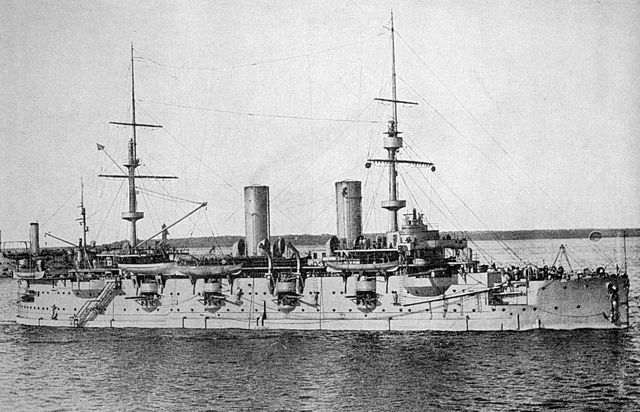
Petr Velikiy as rebuilt
Reconstruction (1905)
The reconstruction plan was approved on 2 February 1904. In 1905-1906 she was entirely rebuilt, with new machines and boilers, two chimneys, two light masts, a high freeboard thanks to a completely redesigned hull, a displacement reduced to 9790 tons and a new armament: Exit the antique 305mm, the artillery now included 4 x 203 mm on the upper deck at the four corners, and 12 x 152 mm on the lower deck in casemates. The rest consisted of small pieces on the main deck.
Petr Veliky was now 321 feet 10 inches (98.09 m) long overall, 62 feet 4 inches (19.0 m) wide, with a 26 feet 7 inches (8.1 m) draft. Displacement was reduced to 9,790 long tons (9,950 t). Top speed was 12.9 knots (23.9 km/h; 14.8 mph) for 714 long tons (725 t) of coal and 1,500 nautical miles (2,800 km; 1,700 mi) range.
The Petr Velikiy at war (1914-18)
She was completed the following year of the Russo-Japanese war. She was in 1914 assigned to the Baltic fleet, but played a secondary role, mainly coastguard and part of the Gunnery Training Detachment through 1917 as planned.
In February 1917 she could have been was renamed Respublikanets or Barrikada (Barricade), by the Soviets (still unconfirmed). Retired afterwards, she was completely disarmed in October 1918 and converted as a depot ship for submarines at Kronstadt, then Helsinki. It was subsequently used as a mines carrier and was renamed Barrikada. Hulked on 21 May 1921 she was used to store mines. Renamed Blokshiv Nr. 1 on 4 December 1923 she was forced aground in shallow water by autumn floods in September 1923. She was refloated and repaired in 5 October 1927 and in January 1932 renamed Blokshiv Nr. 4, then BSh-3 (1949) barrack ship at Kronstadt. She was eventually stricken on 18 April 1959 and scrapped, after a 80+ years long career.
Specifications (1914) |
|
| Dimensions (L-w-h) | 101.7 x 19.2 x 7.5 m 333’8”x63′ x24’9” |
| Total weight, fully loaded | 10,406 long tonnes |
| Armament | 2×2 305mm (12 in), 6x 4pdr, 2x 1pdr HMG, 4 spar Torpedoes |
| Armor |
Belt: 8–14 in (203–356 mm) Citadel: 14 in (356 mm) Deck: 2.5–3 in (64–76 mm) Gun turrets: 14 in (356 mm) |
| Crew | 24 officers + 417 sailors |
| Propulsion | 2 shafts, 2 HRC rod-steam engines, 12 rectangular boilers, 8,258 ihp (6,158 kW) |
| Speed (road) | 13 knots (24 km/h; 15 mph) |
| Range | 2,900 nm (5,400 km; 3,300 mi) @10 knots (19 km/h; 12 mph) |
Gallery
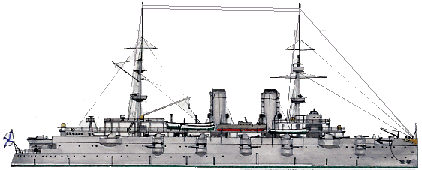
Illustration profile of the Petr Veliki as of 1914
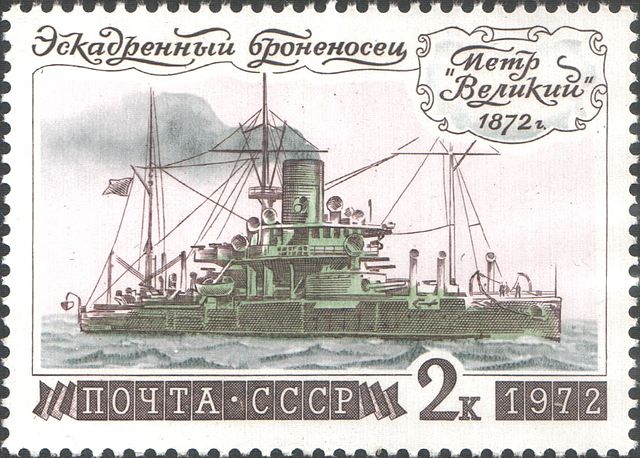
Petr Velikiy on a stamp from 1974.
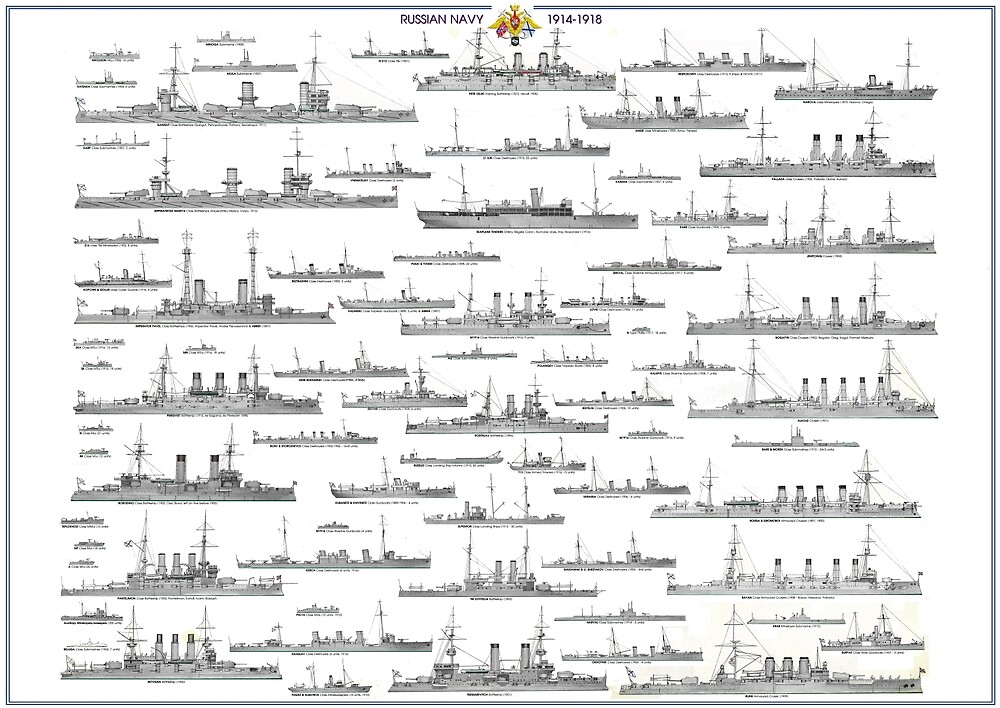
Support us ! Get the Russian ww1 navy poster
 Latest Facebook Entry -
  X(Tweeter) Naval Encyclopedia's deck archive
 Instagram (@navalencyc)


 French Navy
 Royal Navy
 Russian Navy
 Armada Espanola
 Austrian Navy
 K.u.K. Kriegsmarine
 Dansk Marine
 Nautiko Hellenon
 Koninklije Marine 1870
 Marinha do Brasil
 Osmanlı Donanması
 Marina Do Peru
 Marinha do Portugal
 Regia Marina 1870
 Nihhon Kaigun 1870
 Preußische Marine 1870
 Russkiy Flot 1870
 Svenska marinen
 Søværnet
 Union Navy
 Confederate Navy
 Armada de Argentina
 Imperial Chinese Navy
 Marine Haitienne
 Marinha do Portugal
 Mexico
 Kaiserliche Marine
 1898 US Navy
 Argentina
 Brazil
 Chile
Chile Cuba
Cuba Peru
Peru Bulgaria
 Denmark
 Greece
 Netherlands
 Norway
 Portugal
 Romania
 Sweden
 China
China Thailand
 Sovietskiy Flot
 Royal Canadian Navy
 Royal Australian Navy
 RNZN Fleet
 RIN Fleet
 Chinese Navy 1937
 Kriegsmarine
 Chilean Navy
 Danish Navy
 Finnish Navy
 Hellenic Navy
 Polish Navy
 Romanian Navy
 Turkish Navy
 Royal Yugoslav Navy
 Royal Thai Navy
 Minor Navies
 Albania
 Austria
 Belgium
 Columbia
 Costa Rica
 Cuba
Cuba Czechoslovakia
 Dominican Republic
 Haiti
Haiti Hungary
 Honduras
 Estonia
 Iceland
 Eire
Eire Equador
 Iran
Iran Iraq
Iraq Latvia
 Liberia
 Lithuania
 Mandchukuo
 Morocco
 Nicaragua
 Persia
 San Salvador
 Sarawak
 Uruguay
 Venezuela
 Zanzibar
 Warsaw Pact Navies
 Bulgaria
 Hungary

 Bundesmarine
 Dutch Navy
 Marina Militare
 Yugoslav Navy
 Chinese Navy
 Indian Navy
 Indonesian Navy
 JMSDF
JMSDF North Korean Navy
 Pakistani Navy
 Philippines Navy
 ROKN
ROKN Rep. of Singapore Navy
 Taiwanese Navy
 Vietnam People’s Navy
 IDF Navy
 Saudi Navy
 Royal New Zealand Navy
 Egyptian Navy
 South African Navy


 Ukrainian Navy