
 Italy (1886-1920)
A quite powerful Italian protected cruiser
Piemonte was designed at the request of the Italian government, which wanted to strengthen the Regia Marina in the event of a new war against Austria. The order was placed at the world-renowned Armstrong-Elswick shipyard. Chief Engineer Philip Watts took the opportunity to propose the Italian commission a new configuration, giving the ship much larger artillery than the Dogali (ordered three years earlier at the same shipyard). The Piemonte will combined in fact two world premiere: To be the first armed entirely with quick-firing (QF) guns and the fastest cruiser worldwide. However later in her carrer, it appeared the Piemonte was unstable and thus her armament was drastically reduced. She served in the Italo-Turkish war of 1912 with distinction and served as an escort during WW1.
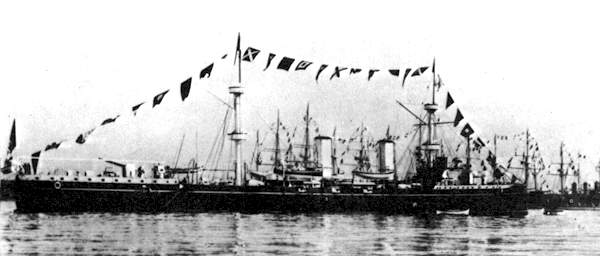
Regia Marina’s Piemonte during a naval review
About the Dogali (1885)
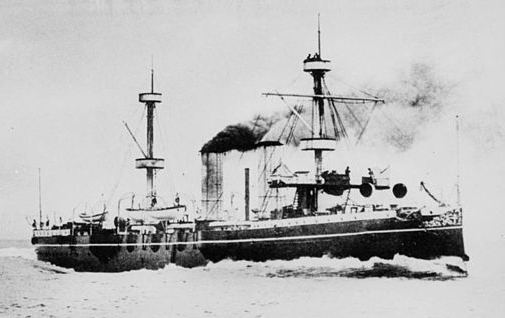
This protected cruiser was designed in 1884 by William Henry White and built the next year at the Armstrong Whitworth shipyard at Elswick. She was the first warship equipped with triple-expansion engines and thus became the fastest cruiser in the world at 17.68 knots (32.74 km/h; 20.35 mph). She was orginally ordered for Greece and carried a potent armament for her 76m long and 2000 tons:
six 152 mm (6.0 in) guns, nine QF mm (2.2 in) guns, six Gatling guns and four 356 mm (14.0 in) torpedo tubes. She was the first ship also to use these Pattern M guns manufactured by Armstrong Whitworth, weighing 2 t (2.0 long tons; 2.2 short tons) apiece. These brand new 32 caliber cannons mounted in sponsons were fitted in 1887, called by the Italians Cannone 152/32 Modello 1887. With these, the Dogali pounded the Boxer rebellion. Each shell weighted 45.3 kg (100 lb), had a muzzle speed of 605 m/s (1,980 ft/s) and compised a Sseparate loading 8.8 kg (19 lb) bagged ballistite charge and projectile. The Dogali was later resold in January 1908 to the Uruguayan government and renamed 25 de Agosto. She served until 1932. That’s why she’s not registered on the WW1 Italian section (yet).
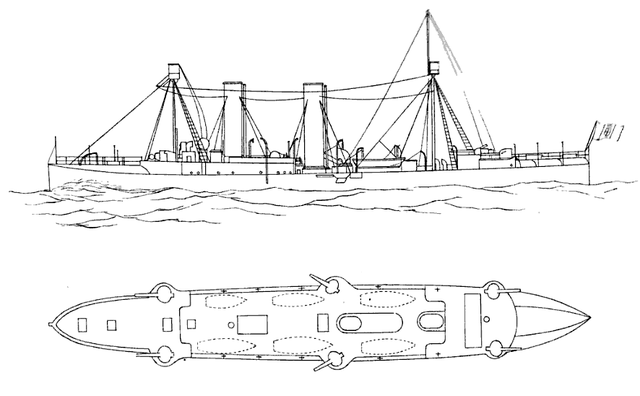
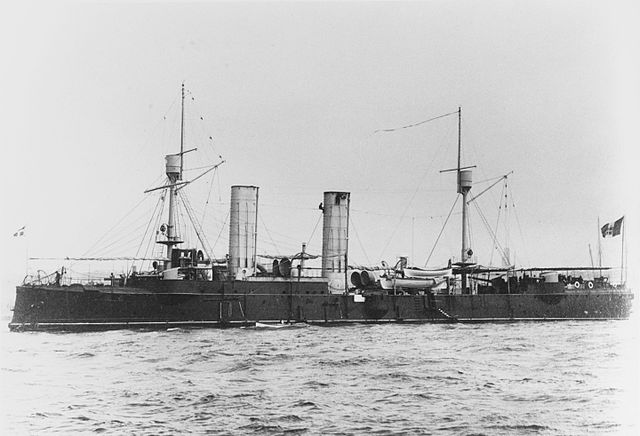
The previous Italian British-built Cruiser Dogali (1885). Already powerfully armed, she was also the first with triple expansion engines and therefore became the fastedt cruiser in the world at that time. But with the next ship, William Henry White promised to out-do himself.
Design of the Piemonte
They were characterized by two heavy military masts and had also a partial double bottom while the large sponsons extended down to 30,5 cm of the water, and were quite wet while her freeboard was only 2.51 m or 8 feet 3 inches on standard load andup to 2m or 6 feet 9 inches deep. She had her six 6-inch L/40 guns in single mounts, one forward and one aft, two on each broadside abreast of the masts mounted in sponsons to allow ahead and astern firing (90° traverse). Secondary battery comprised six 4.7-inch (120 mm) L/40 guns in single mounts. Three were placed on each side, alternating with the 15 cm guns. Tertiary armament comprised ten light quick-firing 57-millimeter (2.2 in) 6-pounder Hotchkiss L/40 guns, but also six 37-millimeter (1.5 in) 1-pounder Hotchkiss L/20 guns, and four 10-millimetre (0.39 in) Maxim machine guns to deal with torpedo boats. Four 1-pounder and the machine guns were all mounted in the military masts for better spotting and traverse. Later they were deposed on the decks and superstructures as her military masts were replaced by light pole masts. For close-quarters she had three 14-inch (356 mm) torpedo tubes, mounted in the bow and the broadside in rotating mounts.
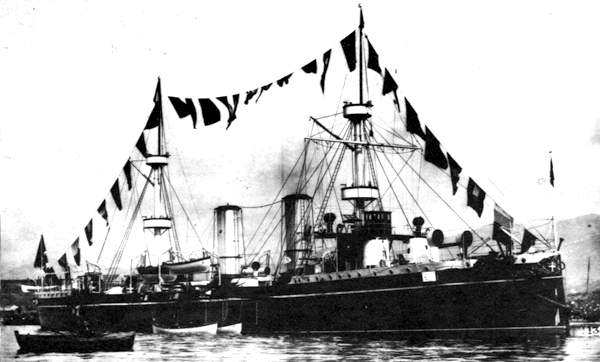
But the optimism of this armament harmed her stability and was reduced in 1891. She kept 2 x 152 mm, 10 x 120 mm, and 6 x 37 mm. In 1913, the 152 mm cannons were removed and the light armament was again revised. Her general protection was good but not complete. She lacked in particular a double-bottomed hull, and ballasts were missing at the level of the engine rooms. Armor protection consisted indeed of a sloped deck about 1 inch (25 mm) (vertical surfaces) up to 3 inches (76 mm) on sloped plates. The conning tower was 3-in thick (76 mm) too nd the gun’s shields were all protected by 4.5 inches (110 mm) of armour. So no protection reached the caliber on board (6 in), but this was considered OK for a protected cruiser. Only Armoured ones had the protection equivalent to match their own calibers.
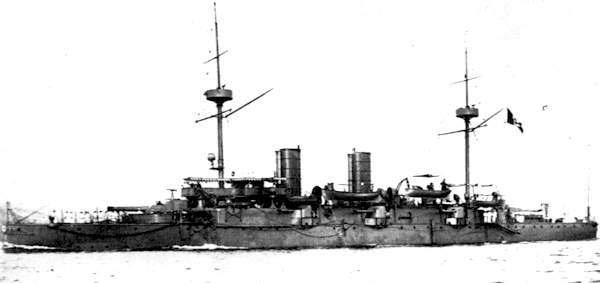
The cruiser Piemonte in the 1890s
However this was by her speed she made headlines, the italians indeed being the first to introduce the world’s fastest cruiser. She was indeed powered by two 4-cylinder Humphrys, Tennant vertical triple-expansion steam engines with a 27 inches (690 mm) stroke and 36 inches (910 mm) bore cylinder, and also 55 inches (1,400 mm) and 60 inches (1,500 mm) for the second and third level. The low-pressure cylinders were split in two for smoother running, a complete novelty at that time. Steam came from four double-ended Scotch marine boilers. Working pressure was 155 psi (1,069 kPa; 11 kgf/cm2) their exhausts being trunked into a pair amidships. Maximum output was 12,000 indicated horsepower (8,900 kW) as designed, for a service top speed of 20.4 knots (37.8 km/h; 23.5 mph). But during her sea trials in May 1889 and using forced draught the output came up to 12,600 ihp (9,400 kW) for 22.3 knots (41.3 km/h; 25.7 mph), the fastest speed on record for such category of ship.
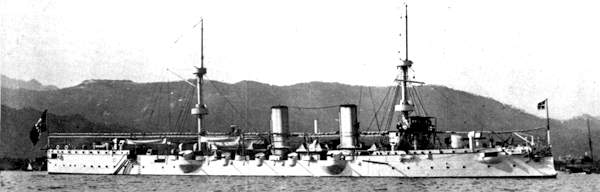
The Piemonte in 1914
Carrer of the Piemonte
The Piemonte was one of the oldest cruisers in service in the Italian Navy in 1914: She has been started in 1887 and completed in 1889. At the start of her career she participated to the annual fleet maneuvers in the First Squadron, made manoeuvers in the Tyrrhenian Sea, returned in drydock to solve her stability issues (armament removal, new masts, etc), and later served in the Red Sea and the Indian Ocean, and in mid-1896 intervened in Brazil to protect Italia interests. She was later modernized and sent in 1901 to the East Asian station. She sailed to Nagasaki, Japan in 1902,
then to the British colony at Weihaiwei, and was an observation vessel during the 1905 Russo-Japanese war, landing some infantry ro reinforce Seoul’s Italian embassy own guards. In 1908 she was back home, and served as a flagship of the torpedo flotilla: Seventeen destroyers, fifty 1st/2nd class torpedo boats.
Her hour of glory came in 1911, after a series of brief engagements against the Turkish Fleet, on January 7, 1912, off Kunfida in the Red Sea, she battered and destroyed an entire Turkish flotilla of no less than 8 Turkish gunboats and one armed yacht: This was the Battle of Kunfuda Bay. She also shelled and blockade the city of Al Hudaydah on 26 January, and Al Hudaydah during the 12 August attack. Alessandro Guidoni once proposed in 1912 to convert her into a regular planes and seaplane carrier. This never took place. She had no other opportunities so favorable during the great war where she served mainly as escort for the 2nd fleet based in Brindisi. She waited idle for a possible Austro-Hungarian sortie, was affected to Salonica, Greece as part of the Anglo-French Levant Squadron. She was stricken and disarmed in 1920.
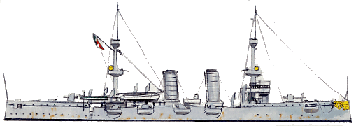
Illustration of the Piemonte in ww1 (1/750) by the author
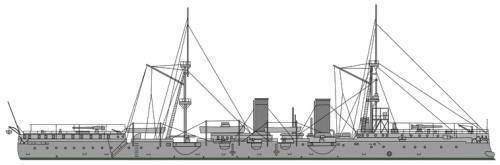
Line Drawing of the Piemonte – The blueprints.
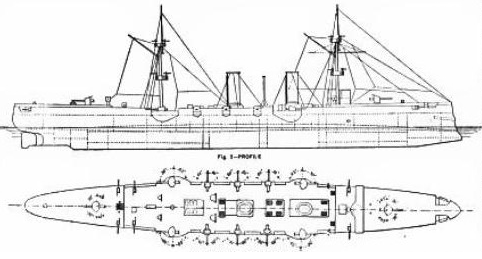
Another Line Drawing of the Piemonte.
Sources/Readmore
https://en.wikipedia.org/wiki/Italian_cruiser_Dogali
https://en.wikipedia.org/wiki/Italian_cruiser_Piemonte
http://www.fr.naval-encyclopedia.com/1ere-guerre-mondiale/marine-italienne1914.php#crois
https://it.wikipedia.org/wiki/Piemonte_(ariete_torpediniere)
http://russiannavy.net/militaryPhotos/engineering/italian/
Conways all the world’s fighting ships 1860-1905
 Latest Facebook Entry -
  X(Tweeter) Naval Encyclopedia's deck archive
 Instagram (@navalencyc)


 French Navy
 Royal Navy
 Russian Navy
 Armada Espanola
 Austrian Navy
 K.u.K. Kriegsmarine
 Dansk Marine
 Nautiko Hellenon
 Koninklije Marine 1870
 Marinha do Brasil
 Osmanlı Donanması
 Marina Do Peru
 Marinha do Portugal
 Regia Marina 1870
 Nihhon Kaigun 1870
 Preußische Marine 1870
 Russkiy Flot 1870
 Svenska marinen
 Søværnet
 Union Navy
 Confederate Navy
 Armada de Argentina
 Imperial Chinese Navy
 Marine Haitienne
 Marinha do Portugal
 Mexico
 Kaiserliche Marine
 1898 US Navy
 Argentina
 Brazil
 Chile
Chile Cuba
Cuba Peru
Peru Bulgaria
 Denmark
 Greece
 Netherlands
 Norway
 Portugal
 Romania
 Sweden
 China
China Thailand
 Sovietskiy Flot
 Royal Canadian Navy
 Royal Australian Navy
 RNZN Fleet
 RIN Fleet
 Chinese Navy 1937
 Kriegsmarine
 Chilean Navy
 Danish Navy
 Finnish Navy
 Hellenic Navy
 Polish Navy
 Romanian Navy
 Turkish Navy
 Royal Yugoslav Navy
 Royal Thai Navy
 Minor Navies
 Albania
 Austria
 Belgium
 Columbia
 Costa Rica
 Cuba
Cuba Czechoslovakia
 Dominican Republic
 Haiti
Haiti Hungary
 Honduras
 Estonia
 Iceland
 Eire
Eire Equador
 Iran
Iran Iraq
Iraq Latvia
 Liberia
 Lithuania
 Mandchukuo
 Morocco
 Nicaragua
 Persia
 San Salvador
 Sarawak
 Uruguay
 Venezuela
 Zanzibar
 Warsaw Pact Navies
 Bulgaria
 Hungary

 Bundesmarine
 Dutch Navy
 Marina Militare
 Yugoslav Navy
 Chinese Navy
 Indian Navy
 Indonesian Navy
 JMSDF
JMSDF North Korean Navy
 Pakistani Navy
 Philippines Navy
 ROKN
ROKN Rep. of Singapore Navy
 Taiwanese Navy
 Vietnam People’s Navy
 IDF Navy
 Saudi Navy
 Royal New Zealand Navy
 Egyptian Navy
 South African Navy


 Ukrainian Navy