
 Steamship of the line. Royal Navy in the Crimean War.
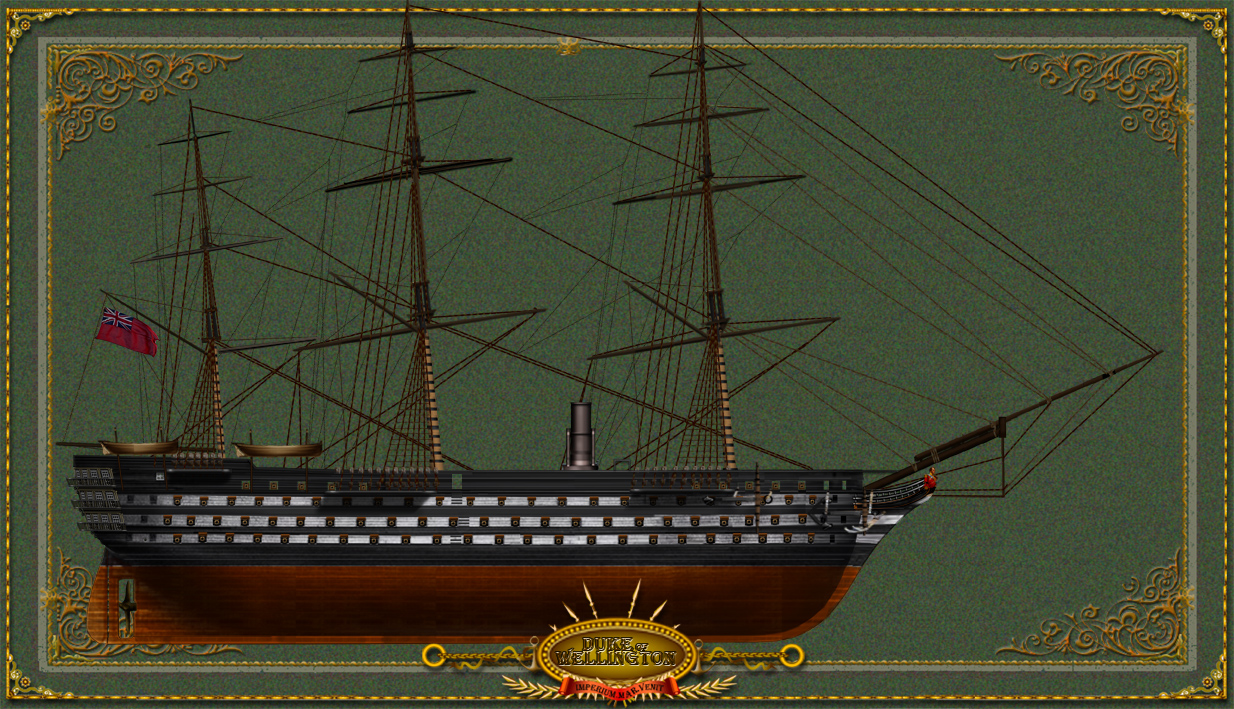
Star of the show: HMS Duke of Wellington (1852)
The Royal Navy Flagship in 1853
When reports on the French building the Napoleon, the first steam-powered, screw propelled steamship of the line came out to British naval intelligence, it caused some turmoil in the admiralty and the House of Commons as well. In 1948, when the ship was launched, the Royal Navy has already ordered many conversions of sailing ships while on the stocks, and in 1851, it was the case for the Windsor Castle, already in construction at Pembroke Dockyard. It was back in 1849, the first of a new class of giant “wooden walls”, heavy four-deckers, the finest designed yet sailing ships of the line, representing the pinnacle of their breed.
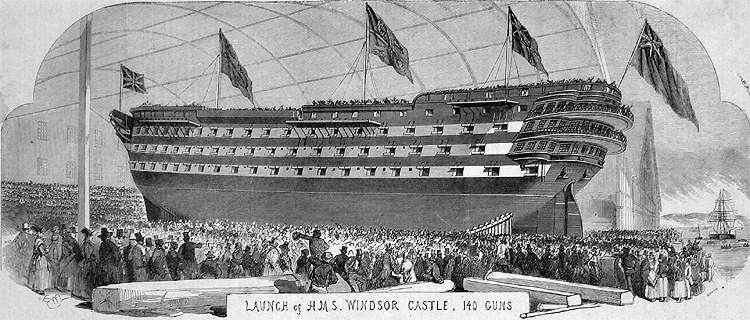
The Windsor Castle was initially designed by Sir William Symonds, but plans and construction were supervised later by his assistant surveyor, John Eyde, and aided in 1852 by capt. Baldwin Walker. But in December 1951, the Admiralty launched a race for a steam-driven battle fleet, the sooner, the better.
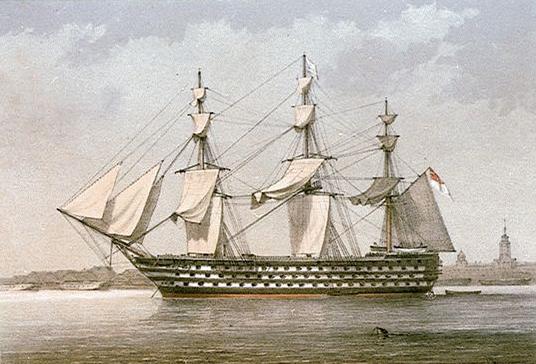
To shorten all delays, many ships in various building or achievement stages, were converted on the stocks, receiving a steam engine, and a screw, already tested with success in various ships, the first being the British SS Archimedes in 1839…

Duke of Wellington 1854 cutaway
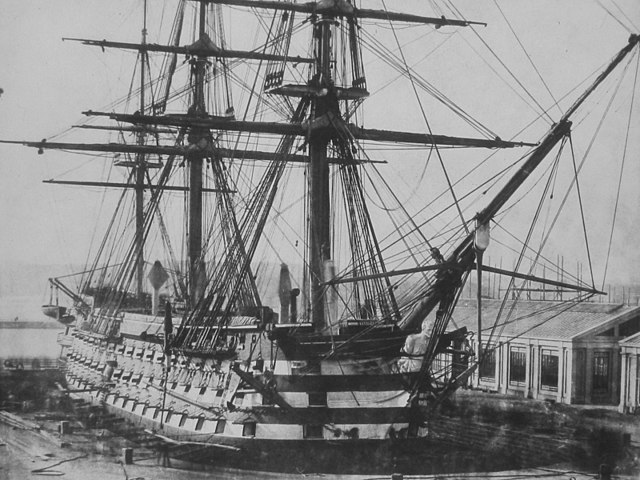
HMS Duke of Wellington at Keyham yard
Conversion of the Windsor Castle, which has already been launched, urged the need to cut the hull in half and lenghtened it by 9 meters to accomodate the steam engine and room for hundred of tons of coal. Total lenght of the hull reached then 73 meters (240 feet, without the bowsprit), and thanks to this early “jumboisation”.
The broadside gained some extra artillery, making herself after re-launching and re-christening (14 september 1852) HMS Duke of Wellington, in honor to the most important man in recent British History, just gone the very same day, the most powerful warship afloat. It dwarved the famous Victory, five generations older, and was on par with the most impressive flagships in the French and Russian fleets, proudly bearing the general’s bust as a figurehead.
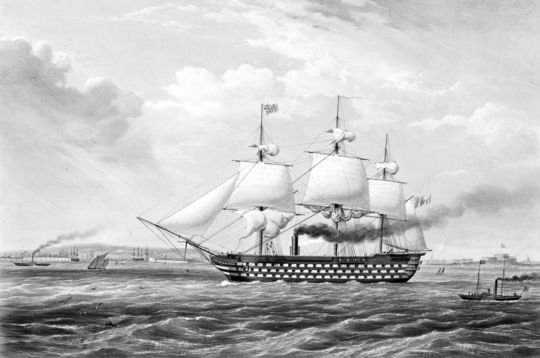
Completion came in january 1853, and the ship tonnage and size immediately captivated the British newspapers. With nearly 5900 tons, and a hundred meters overall, and broadside of 131 guns, totalling 382 tons alone, the ship was a masterpiece, and steam, at least nominally, greatly added to its potential, however its superb sailing capabilities were unchanged, as it was rigged for a maximal efficiency, demonstrated a 10,3 knots under sail alone during 1853 trials. The beam was 60ft (18,3m)and depth 27ft (8,2m).
The mainmast culminated to 55m above the quarterdeck. As it was customary for the time, the hull section was trapezoidal for a better stability. After its first sorties as Flagship of the channel fleet Western squadron, it became the flagship of Vice-admiral Sir Charles Napier, heading for the baltic sea. War just broke out with Russia. In 1853, it returned for the next operations in the baltics, as rear admiral Richard S. Dundas flagship, bombarding Sveaborg fortress.
After the war, she returned in Home waters to be paid off. Indeed, the hasty conversion and steam vibrations caused stresses on the hull, to the point that decomissioning as a mobile warship was the only option. She became a familiar sight for local sailors and an attaction for the photographs, usually called “Napier’s flagship”.
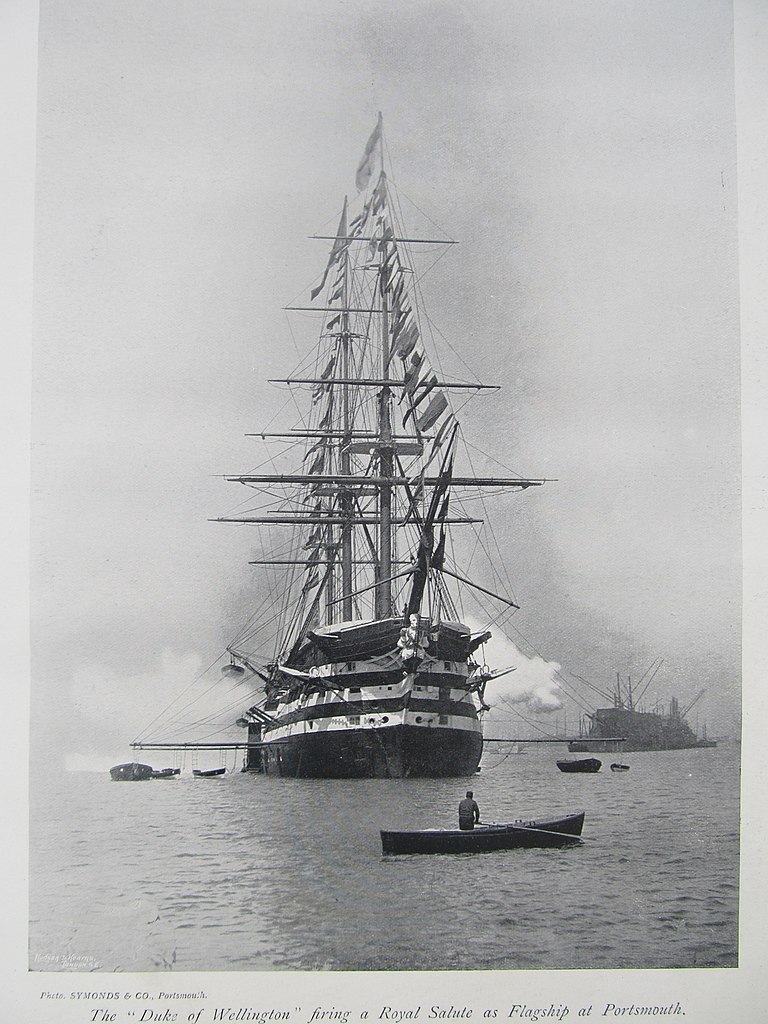
As Portsmouth saluting ship and naval HQ, she was kept moored until she was paid off again in 1888, but remained anchored there, partly restored and decorated for Queen Victoria Birthday fleet review. It last commanding officer was Rear-Admiral Sir David beatty, Britain battlecruiser force apostle. It was dismantled in 1904, its timber probably still part of Thames foreshore at Charlton.
 Latest Facebook Entry -
  X(Tweeter) Naval Encyclopedia's deck archive
 Instagram (@navalencyc)


 French Navy
 Royal Navy
 Russian Navy
 Armada Espanola
 Austrian Navy
 K.u.K. Kriegsmarine
 Dansk Marine
 Nautiko Hellenon
 Koninklije Marine 1870
 Marinha do Brasil
 Osmanlı Donanması
 Marina Do Peru
 Marinha do Portugal
 Regia Marina 1870
 Nihhon Kaigun 1870
 Preußische Marine 1870
 Russkiy Flot 1870
 Svenska marinen
 Søværnet
 Union Navy
 Confederate Navy
 Armada de Argentina
 Imperial Chinese Navy
 Marine Haitienne
 Marinha do Portugal
 Mexico
 Kaiserliche Marine
 1898 US Navy
 Argentina
 Brazil
 Chile
Chile Cuba
Cuba Peru
Peru Bulgaria
 Denmark
 Greece
 Netherlands
 Norway
 Portugal
 Romania
 Sweden
 China
China Thailand
 Sovietskiy Flot
 Royal Canadian Navy
 Royal Australian Navy
 RNZN Fleet
 RIN Fleet
 Chinese Navy 1937
 Kriegsmarine
 Chilean Navy
 Danish Navy
 Finnish Navy
 Hellenic Navy
 Polish Navy
 Romanian Navy
 Turkish Navy
 Royal Yugoslav Navy
 Royal Thai Navy
 Minor Navies
 Albania
 Austria
 Belgium
 Columbia
 Costa Rica
 Cuba
Cuba Czechoslovakia
 Dominican Republic
 Haiti
Haiti Hungary
 Honduras
 Estonia
 Iceland
 Eire
Eire Equador
 Iran
Iran Iraq
Iraq Latvia
 Liberia
 Lithuania
 Mandchukuo
 Morocco
 Nicaragua
 Persia
 San Salvador
 Sarawak
 Uruguay
 Venezuela
 Zanzibar
 Warsaw Pact Navies
 Bulgaria
 Hungary

 Bundesmarine
 Dutch Navy
 Marina Militare
 Yugoslav Navy
 Chinese Navy
 Indian Navy
 Indonesian Navy
 JMSDF
JMSDF North Korean Navy
 Pakistani Navy
 Philippines Navy
 ROKN
ROKN Rep. of Singapore Navy
 Taiwanese Navy
 Vietnam People’s Navy
 IDF Navy
 Saudi Navy
 Royal New Zealand Navy
 Egyptian Navy
 South African Navy


 Ukrainian Navy
My grandfather was on this ship from 03/11/1900 to 29/05/1901, he was called Benjamin Cox
my x3 great granfather served on this ship from 1876 is name was fredrick knight any information on him please
Hi Joshua,
https://www.nationalarchives.gov.uk/help-with-your-research/research-guides/royal-navy-ratings-service-records-1853-1928/
https://www.crewlist.org.uk/
Good search !
Dave