
Navies of third and fourth rate in 1914-18
North, West and Eastern Europe, South America, Asia, Middle East…
Third rate navies:
-Scandinavia: Norwegian, Danish and Swedish Navies
-Western Europe: Dutch, Spanish, Portuguese Navies
-Balkans: Greek, Bulgarian, Romanian Navies
-South America: Brazil, Argentina, Chili, Peru
-Asia: China, Siam
Fourth Rate Navies:
Belgium, Cambodge, Colombia, Costa Rica, Cuba, Equador, Egypt, Haiti, Honduras, Mexico, Paraguay, Persia, Uruguay, Venezuela.
By stating “third rank” we don’t intend to offense any nation, but since the Royal Navy could be assimilated as a naval superpower or “first rank navy”, there were certainly “second rank” ones, namely all from major naval powers at the time, including USA (soon to be first rank, as well as Japan), France, Germany, Italy and Russia. Austro-Hungary was second rank, but probably leaned towards a third rank one, as well as Turkey. In this new chapter we’ll see all these less-known navies, from solid, powerful third rank to very small fleets, more akin hypothetic “fourth rank” ones.
In 1914, Scandinavian countries are in neutrality position. “Third rank” marines were tied to the neutral posture of their countries for the most. Meanwhile, some fell either by choice of force in one or another side: This was the case of the Dutch Fleet, which, far to be negligible in 1914, was one of strongest of the list, although weakened by her geographical split between Europe and the Far East.
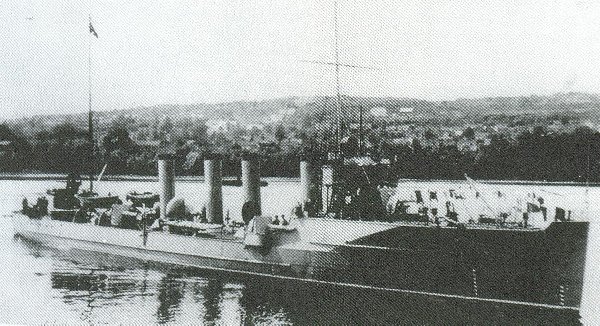
Norwegian Draug class destroyers
Turkey much involved to the side of Austro-Hungary and Germany, and despite being Europe’s “sick man”, the Turkish fleet was in quantity and quality lightyears from what she was earlier in the XIXth Century, especially in the 1870s when she openly rivaled the Russian Navy in the Black Sea and dominated the Eastern Mediterranean, like the old glory days of the Ottoman Empire. But she received an unexpected boost by the arrival of the modern German Cruiser Breslau and Battlecruiser Goeben, following an epic escape (see Admiral Souchon “mad run” to Constantinople).
Unfortunately for the Ottoman Empire, allied might in the Mediterranean was crushing, especially after the arrival of Italy in 1915, added to the Russian and Greek navies, not speaking of the French and British fleets, the latter blocking both gateways to the antique sea, via Gibraltar and the Suez Canal. As a result, the few Turkish successes were attributed to a single minelayer in the Dardanelles.
Rival Greek Navy was Balkan’s main naval power. Romania and Bulgaria, as well as Albania possessed a few valuable units, but carefull stayed neutral after the bloodbath of the recent Balkan war. Of the three Scandinavian navies, which strongly stuck to their non-belligerent status, were focused on coastal defense. Crossing fire with the Hochseeflotte was out of question.
From the Iberian Peninsula, Spanish and Portuguese Navies, still counting a few colonies, only had a minimal strength and stayed neutral. Portugal counted six small cruisers, while Spain which had its nose blooded in 1898, against a rising, reborn young US Navy, still possessed five cruisers and one old battleship, but also three brand new Dreadnought commissioned in UK and partly built locally at the Ferrol Shipyard.
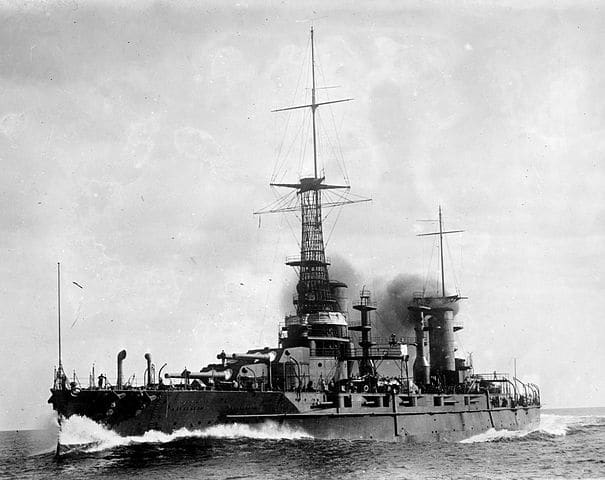
Argentinian Rivadvia class Battleships. Brazil, Argentina and Chile competed for naval supremacy with US or UK ordered dreadnoughts.
South American countries had been well equipped, rival Argentina, Chile and Brazil ordering Dreadnoughts and counting on the extreme smaller units or feeble tonnage. Their naval policy was naturally aligned to the US Navy doctrine and also strayed neutral.
In Asia, young and old Dragons also competed for regional supremacy. Of course Japan was the naval superpower on the rise, blessed by the celebrated Battle of Tsushima ten years ago, inflicting a crushing blow to the Russian Pacific and Black sea fleets. China was no more than a quiet observator, its fleet crippled by her defeat in 1894 at Yalu, again at the masterful hands of the Japanese. Recent events had been merely an appetizer for Nihhon Kaigun indeed, as she will rose to the global third place. China on the other hand, prudently remained neutral, only in situation to guard its waters and patrol the yellow river with a fleet of gunboats. Siam possessed also a diverse aggregate of armed civilian ships, but nonetheless declared war to the central Powers in 1917, a decision of little consequence…
 Latest Facebook Entry -
  X(Tweeter) Naval Encyclopedia's deck archive
 Instagram (@navalencyc)


 French Navy
 Royal Navy
 Russian Navy
 Armada Espanola
 Austrian Navy
 K.u.K. Kriegsmarine
 Dansk Marine
 Nautiko Hellenon
 Koninklije Marine 1870
 Marinha do Brasil
 Osmanlı Donanması
 Marina Do Peru
 Marinha do Portugal
 Regia Marina 1870
 Nihhon Kaigun 1870
 Preußische Marine 1870
 Russkiy Flot 1870
 Svenska marinen
 Søværnet
 Union Navy
 Confederate Navy
 Armada de Argentina
 Imperial Chinese Navy
 Marine Haitienne
 Marinha do Portugal
 Mexico
 Kaiserliche Marine
 1898 US Navy
 Argentina
 Brazil
 Chile
Chile Cuba
Cuba Peru
Peru Bulgaria
 Denmark
 Greece
 Netherlands
 Norway
 Portugal
 Romania
 Sweden
 China
China Thailand
 Sovietskiy Flot
 Royal Canadian Navy
 Royal Australian Navy
 RNZN Fleet
 RIN Fleet
 Chinese Navy 1937
 Kriegsmarine
 Chilean Navy
 Danish Navy
 Finnish Navy
 Hellenic Navy
 Polish Navy
 Romanian Navy
 Turkish Navy
 Royal Yugoslav Navy
 Royal Thai Navy
 Minor Navies
 Albania
 Austria
 Belgium
 Columbia
 Costa Rica
 Cuba
Cuba Czechoslovakia
 Dominican Republic
 Haiti
Haiti Hungary
 Honduras
 Estonia
 Iceland
 Eire
Eire Equador
 Iran
Iran Iraq
Iraq Latvia
 Liberia
 Lithuania
 Mandchukuo
 Morocco
 Nicaragua
 Persia
 San Salvador
 Sarawak
 Uruguay
 Venezuela
 Zanzibar
 Warsaw Pact Navies
 Bulgaria
 Hungary

 Bundesmarine
 Dutch Navy
 Marina Militare
 Yugoslav Navy
 Chinese Navy
 Indian Navy
 Indonesian Navy
 JMSDF
JMSDF North Korean Navy
 Pakistani Navy
 Philippines Navy
 ROKN
ROKN Rep. of Singapore Navy
 Taiwanese Navy
 Vietnam People’s Navy
 IDF Navy
 Saudi Navy
 Royal New Zealand Navy
 Egyptian Navy
 South African Navy


 Ukrainian Navy