
 Union Navy
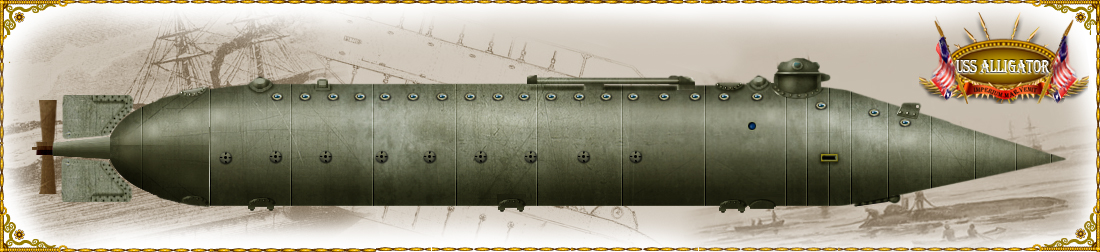
USS Alligator
The first operational USN submersible
The real first military submarine ever buit by an American was the “Turtle”, from David Bushnell, during the war of independance. Before him, Fulton’s Nautilus was often considered to be the first practical submarine, offered to Napoleon, which considered but rejected it after a fail trial. The British soon offered him to buy it, but this was dropped when the war ended with France. His 1808 design was left to the US embassy and forgotten until 1920. He went to the USN to start a new career.
Now, once more under dramatic circumstances, another engineer attempted to give the USN its first submarine. French engineer Brutus de Villeroi, came to america to propose its own design to the admiralty. Despite scepticism at first an no immediate need for such kind of ship, intelligece reports showing the Merrimack was reconstructed changed their opinion, and an order was placed in october 1861 to shipbuilders Neafie & Levy to translate his design into reality for immediate operational purposes, under De Villeroi supervision. Because of the initial pressure on the builders (the ship has to be finished within 40 days starting at 1 November 1861 from contract signature), some problems quickly occured.
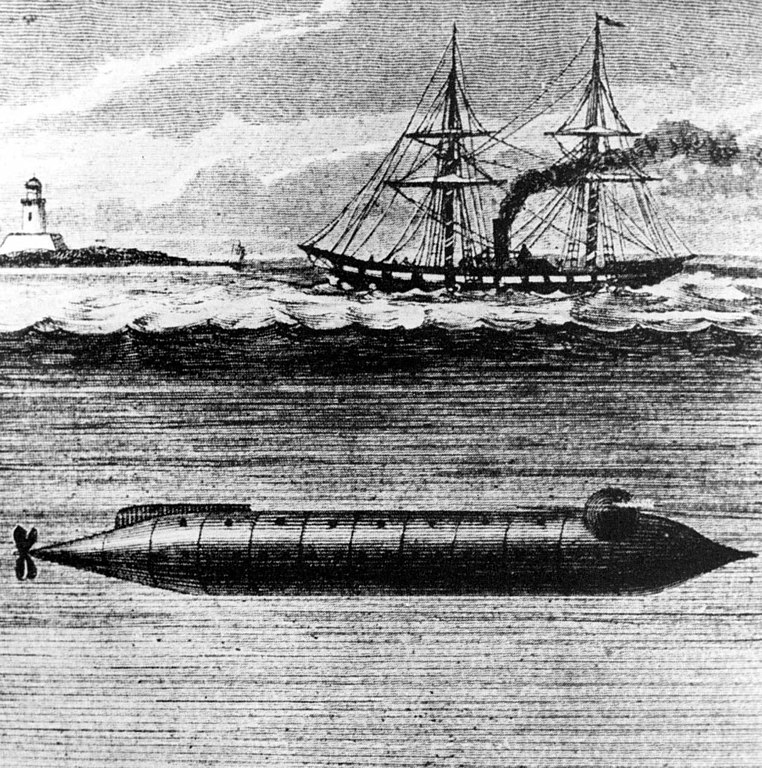
This was a small vessel (30 ft – only 9m), made entirely of iron, with watertight ovale sections (6 ft wide by 8ft high, approx. 1.8 x 2.4m), and conic ends, pierced by a serie of small circular plates for light. It was steered by a tailfin at the rear, but the most unusual feature was its propulsion, made originally of sixteen hand-powered paddles. Air was provided by two tubes floating on the surface and connected to an internal pump.
However, the entire project was proven complex enough and conception dragged on for 180 days. The CSS Alligator was launched enventually on 1 May 1862. The crew was 12, including an officer, two divers, one helmsman and 8 oarsmen, each manning two paddles, thus requiring a narrow hull. The Union submersible was armed with two limpet mines, designed to be activated by the driver when placed under the target.
This boat was transferred to Philadelphia Navy Yard for fittings, and then recruit a crew. The official USN commission came on 13 june, under commander Samuel Eakins, a civilian ship captain. First action began immediately after, without trials, as the Fred Kopp tugged her to Hampton Roads, Virginia via Chesapeake bay.
Finally the ship joined her operational base at Norfolk and was given a tender during the mission, the sidewheel steamer Satellite, part of the North Atlantic Blockading Squadron. There Brutu’s boat was officially named the USS Alligator -after the most common Mississippi predator- where it was soon mandated to operate, reaching Hampton roads on 23 june 1862.
There, since the Merrimack was still not operational, several tasks were envisioned… This included blowing up obstructions near Fort Darling on the James River or the bridge across Swift Creek (Appomatox river), but neither had sufficient deep, as stated by naval commander in charge of the sector, John Rodgers. So after 25 june, she was moored at City Point on the James River, and another mission was devised : Sinking the Virginia II in case she was operational.
For this, the submarine was towed back to Hampton roads. Soo after, the 29, she was sent to Washington Navy Yard for testings, which proved unsatisfactory, according to the new naval commander, Thomas O. Selfridge, Jr. On his request, several changes were made, including a screw propeller connected to a man-handed crankshaft, which in turn dictated an enlargement of the hull. New specifications were 74 feets (14m) in lenght, and a weight of 2,74 tons (surface).
Speed was now 4 knots (7kph), compared to the 2 knots of the ancient paddle propulsion. By late 1862 the Alligator was back in service with a new crew for additional tests and exercizes. During one of these, on 19, March 1863, President Lincoln was observing.
The carrer of this unwanted submarine -with no apparent suitable task- took a new twist when Rear Admiral Samuel Francis du Pont thought to use it together with USS Sumter for attacking and capturing Charleston. However, the two ships encountered bad weather on 2 april near the cape hatteras, and USS Alligator was separated from USS Sumter, immediately drifting and sinking soon after. Fortunately nobody was on board, but this marked the inglorious end of the first USN submarine…
 Latest Facebook Entry -
  X(Tweeter) Naval Encyclopedia's deck archive
 Instagram (@navalencyc)


 French Navy
 Royal Navy
 Russian Navy
 Armada Espanola
 Austrian Navy
 K.u.K. Kriegsmarine
 Dansk Marine
 Nautiko Hellenon
 Koninklije Marine 1870
 Marinha do Brasil
 Osmanlı Donanması
 Marina Do Peru
 Marinha do Portugal
 Regia Marina 1870
 Nihhon Kaigun 1870
 Preußische Marine 1870
 Russkiy Flot 1870
 Svenska marinen
 Søværnet
 Union Navy
 Confederate Navy
 Armada de Argentina
 Imperial Chinese Navy
 Marine Haitienne
 Marinha do Portugal
 Mexico
 Kaiserliche Marine
 1898 US Navy
 Argentina
 Brazil
 Chile
Chile Cuba
Cuba Peru
Peru Bulgaria
 Denmark
 Greece
 Netherlands
 Norway
 Portugal
 Romania
 Sweden
 China
China Thailand
 Sovietskiy Flot
 Royal Canadian Navy
 Royal Australian Navy
 RNZN Fleet
 RIN Fleet
 Chinese Navy 1937
 Kriegsmarine
 Chilean Navy
 Danish Navy
 Finnish Navy
 Hellenic Navy
 Polish Navy
 Romanian Navy
 Turkish Navy
 Royal Yugoslav Navy
 Royal Thai Navy
 Minor Navies
 Albania
 Austria
 Belgium
 Columbia
 Costa Rica
 Cuba
Cuba Czechoslovakia
 Dominican Republic
 Haiti
Haiti Hungary
 Honduras
 Estonia
 Iceland
 Eire
Eire Equador
 Iran
Iran Iraq
Iraq Latvia
 Liberia
 Lithuania
 Mandchukuo
 Morocco
 Nicaragua
 Persia
 San Salvador
 Sarawak
 Uruguay
 Venezuela
 Zanzibar
 Warsaw Pact Navies
 Bulgaria
 Hungary

 Bundesmarine
 Dutch Navy
 Marina Militare
 Yugoslav Navy
 Chinese Navy
 Indian Navy
 Indonesian Navy
 JMSDF
JMSDF North Korean Navy
 Pakistani Navy
 Philippines Navy
 ROKN
ROKN Rep. of Singapore Navy
 Taiwanese Navy
 Vietnam People’s Navy
 IDF Navy
 Saudi Navy
 Royal New Zealand Navy
 Egyptian Navy
 South African Navy


 Ukrainian Navy