
 Confederate Navy
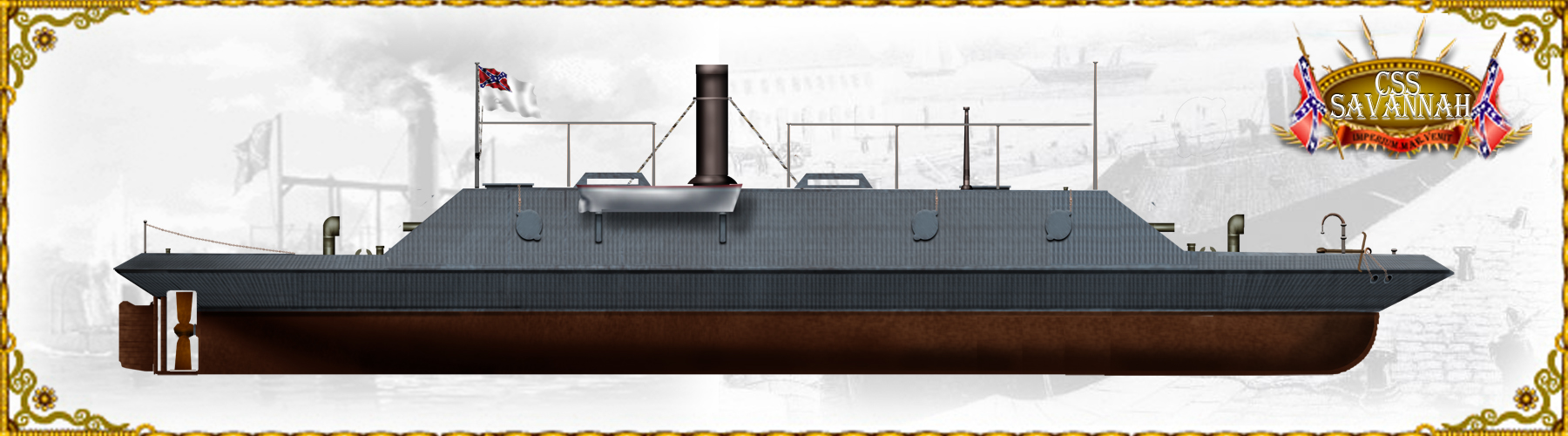
CSS Savannah
CSS Savannah was part of the larger Richmond-class, one of the two classes or casemate ironclad built by the confederate navy during the war. The Richmond class was conceived a genuine design for ships to be built locally with limited resources, but in sufficient numbers, not to turn the tide of the blockade, but protecting harbours and coastal waters. The casemate ironclads were a perfect response for this. Built above existing ships, razed and rebuilt, or brand new, they were armoured above the waterline by iron plates backed by large buffers of timber. Artillery was limited to three to four guns, some beeing smoothbore but most beeing rifled.
The Richmond class was drawed by CSN engineer John L. Porter to fill the requirements of the Confederacy Navy Department (CND) in late 1861, a policy of “home-built ironclads”; The CND ordered nearly 50 ironclads during the war, from which only half were effectively completed before the end of the hostilities. The Richmond class counted six ships, the Palmetto State, Chicora, North Carolina, Raleigh, Richmond and Savannah. They were the first, standardized, well-conceived ships for their limited goals, contrasting with former individual ironclads, much costier, both unsuccessful as blockade runners and too ambitious for harbour defence duties.
They were shallow water pontoons, with a U-bottom section keeled hull, and with its waterline protected by a knuckle of heavy timber. Protection was made of interlocked 21in timber frame, covered with two layers of 2in rolled iron plates, with a 35 degree slope. The narrow upper casemate bridge, and fore and aft lower bridges were covered by a single 2in armour plating, overlapping the timber knuckle.
The artillery comprised four guns, from which the two at casemate ends were able to fire from three portholes, and two broadside guns with shifted positions. This gave a good use of limited artillery and permitted the hull some extra stability, and saving weight. This solution was seen as perfectly fitted for the new CSN policies, allowing more ships to be built in a shorter time, saving cost and training and simplifying logistics. Another later class was built, sometimes called the Charleston or Nashville class, comprising also the CSS Tennessee. They were improved versions of the latter.
The CSS Savannah herself was built by H. F. Willink at Savannah, Georgia, laid down in april 1862, launched in february 1863 and commissioned june 30, 1863. Propulsion was assumed by a steam engine from Confederates Naval Iron Works at Columbus, propelling a single 10 feet screw. Speed was an average 6 knots. The crew comprised 150 sailors and 25 officers, along with ten marines. Armament was made of two fore and aft 7in and Brooke pivot rifles and two broadside 6.4in Brooke rifled guns.
A single 12pdr shield deck howitzer was also mounted. The pilot’s hatch was situated abaft the smokestack. The Savannah became the flagship of the Savannah squadron, comprising also several gunboats, under William W. Hunter and later Robert F. Pinkey command. She served well, guarding the Savannah harbour approaches until late 1864. In december, during USN gen. Sherman march to the sea, she fough valiantly, supporting defensive troops, later, the USN battery involved in the siege, then evacuation, exchanging broadsides with federal batteries before beeing burned by its crew to prevent its capture.
 Latest Facebook Entry -
  X(Tweeter) Naval Encyclopedia's deck archive
 Instagram (@navalencyc)


 French Navy
 Royal Navy
 Russian Navy
 Armada Espanola
 Austrian Navy
 K.u.K. Kriegsmarine
 Dansk Marine
 Nautiko Hellenon
 Koninklije Marine 1870
 Marinha do Brasil
 Osmanlı Donanması
 Marina Do Peru
 Marinha do Portugal
 Regia Marina 1870
 Nihhon Kaigun 1870
 Preußische Marine 1870
 Russkiy Flot 1870
 Svenska marinen
 Søværnet
 Union Navy
 Confederate Navy
 Armada de Argentina
 Imperial Chinese Navy
 Marine Haitienne
 Marinha do Portugal
 Mexico
 Kaiserliche Marine
 1898 US Navy
 Argentina
 Brazil
 Chile
Chile Cuba
Cuba Peru
Peru Bulgaria
 Denmark
 Greece
 Netherlands
 Norway
 Portugal
 Romania
 Sweden
 China
China Thailand
 Sovietskiy Flot
 Royal Canadian Navy
 Royal Australian Navy
 RNZN Fleet
 RIN Fleet
 Chinese Navy 1937
 Kriegsmarine
 Chilean Navy
 Danish Navy
 Finnish Navy
 Hellenic Navy
 Polish Navy
 Romanian Navy
 Turkish Navy
 Royal Yugoslav Navy
 Royal Thai Navy
 Minor Navies
 Albania
 Austria
 Belgium
 Columbia
 Costa Rica
 Cuba
Cuba Czechoslovakia
 Dominican Republic
 Haiti
Haiti Hungary
 Honduras
 Estonia
 Iceland
 Eire
Eire Equador
 Iran
Iran Iraq
Iraq Latvia
 Liberia
 Lithuania
 Mandchukuo
 Morocco
 Nicaragua
 Persia
 San Salvador
 Sarawak
 Uruguay
 Venezuela
 Zanzibar
 Warsaw Pact Navies
 Bulgaria
 Hungary

 Bundesmarine
 Dutch Navy
 Marina Militare
 Yugoslav Navy
 Chinese Navy
 Indian Navy
 Indonesian Navy
 JMSDF
JMSDF North Korean Navy
 Pakistani Navy
 Philippines Navy
 ROKN
ROKN Rep. of Singapore Navy
 Taiwanese Navy
 Vietnam People’s Navy
 IDF Navy
 Saudi Navy
 Royal New Zealand Navy
 Egyptian Navy
 South African Navy


 Ukrainian Navy