
Profintern class cruisers
 Soviet Navy
Chervona Ukrainia, Profintern, Krazny Krim
The “admirals class” planned in 1913. The ships studied there are from two very similar classes: The Admiral Nakhimov and Svetlana classes of the Tsarist Navy, ordered in 1913, launched in 1916, but never completed due to the onset of the civil war. Another launched later became the Krasny Kavkaz, after a total reconstruction. These ships were more deserving of the description of rusty sheet piles in their basin when in 1921 it was decided to save them for completion again, after the civil war.
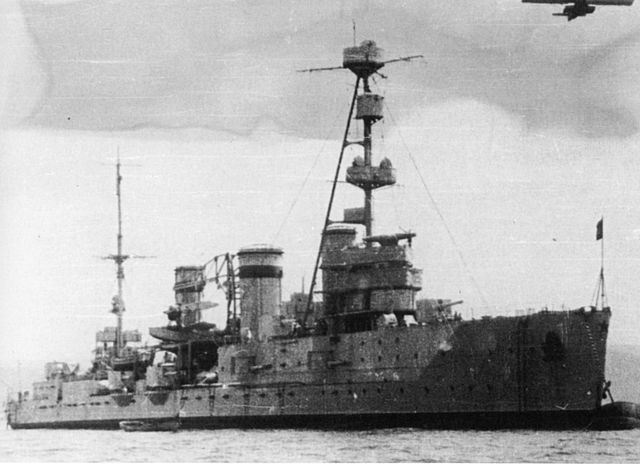
Genesis of the Svetlana class
In 1910, the Russian Duma approved construction of modern dreadnought, whereas there were no modern cruisers or destroyers to follow them. It was only after the first Gangut-class battleship was ordered, that the Russian admiralty proposed a cruiser design to the Duma, which was approved as part of the 1912–1916 shipbuilding program. These four brand-new light cruisers were to scout for the battleships but also act as flotilla leaders teaming up with the new Novik class destroyers.
First design sketch of the future Svetlana class went back to 1907, however, numerous revisions occurred amidst specification changes over the years. by early 1912 the Admiralty decided to plan a design contest for a 4,100–5,100 metric-ton cruiser armed withat least twelve 130mm Pattern 1913 guns. They had to be capable of 30 knots (56 km/h; 35 mph), with light side armor.
They also had to resemble to the dreadnoughts under construction and lay mines. As submissions from shipyards failed to meet requirements, the admiralty passed new requirements for an heavier ship, of about 1500 tons. Eventually, both Russo-Baltic and Putilov Shipyards 6,700 ton designs were accepted and combined in November 1912.
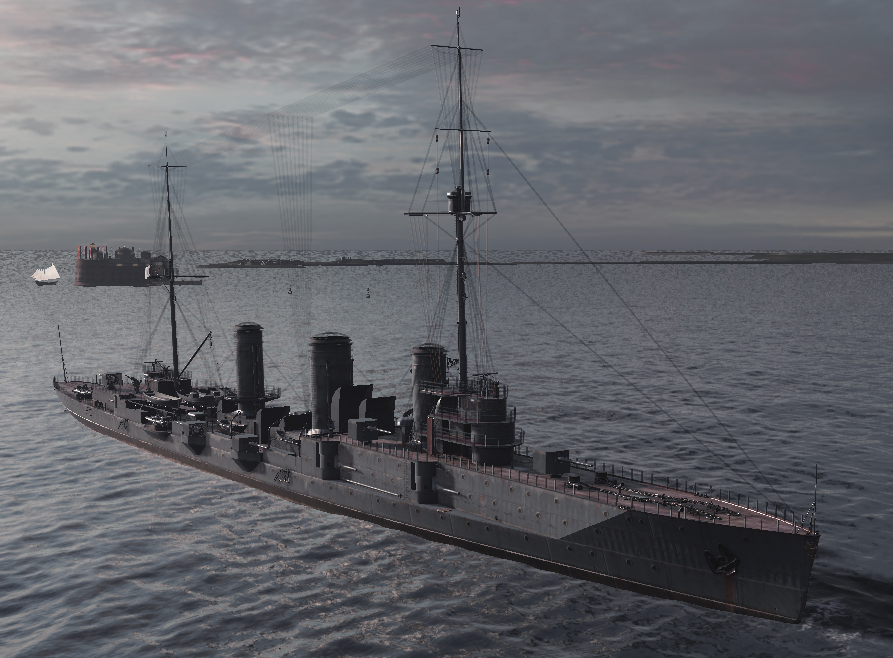
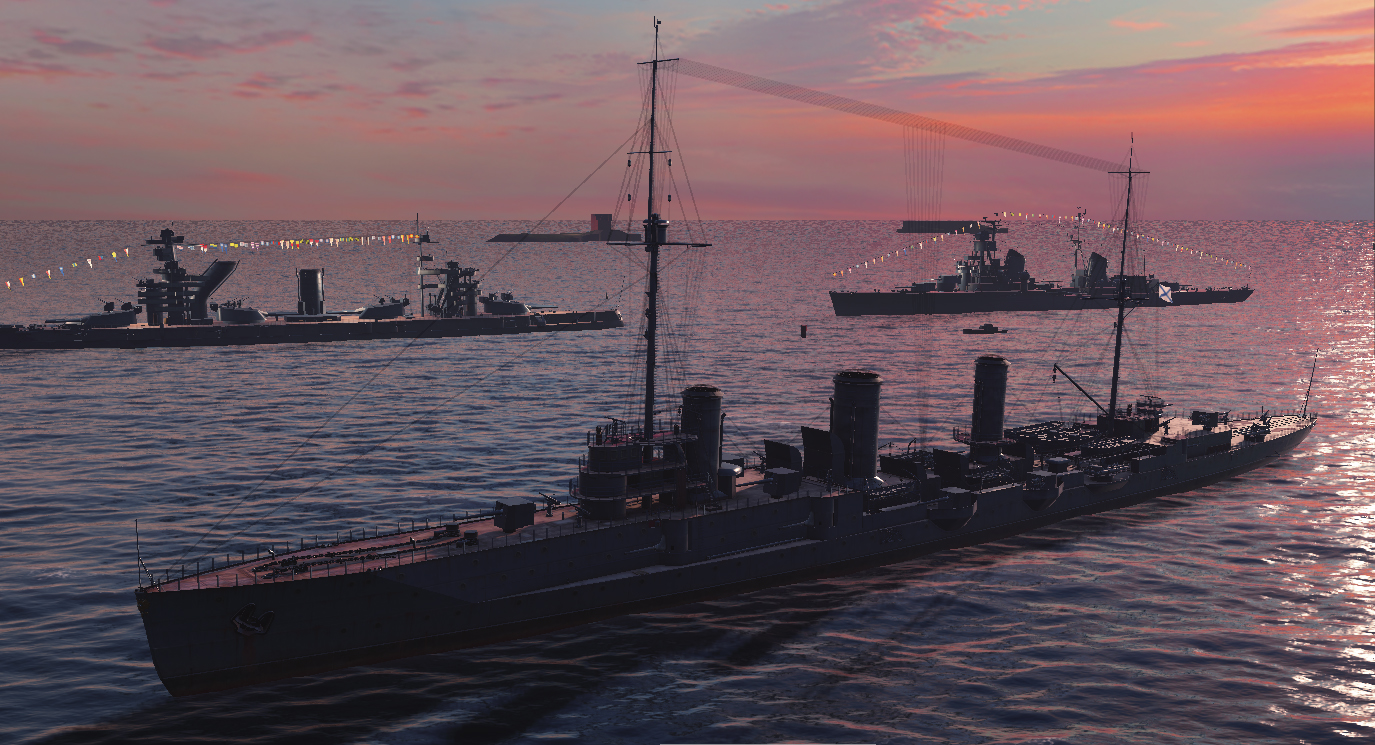
Wow’s rendition of the Svetlana before reconstruction
By February 1913, however, development of the new Svetlana class was hampered by funds reallocated to the new Borodino-class battlecruisers which were eventually never completed, shipyards had to agree to reduce their bill to 8,300,000 rubles while the ships could be speed downgraded to 29.5 knots. Two ships from each yard were ordered on 13 February. During construction, Frahm anti-roll tanks were added as well as installations to use a future seaplane.
The Profintern (ex Svetlana, of the Svetlana class) was the first to be completed on the original plan in 1925. She spent another three years of testing before being admitted in service with the new Soviet Navy. Her sister-ship, the Chervonia Ukraina (ex. Admiral Nakhimov, of the Nakhimov class), was completed in 1922, but again, her trials went on until 1927 and she was pressed into service afterward. By 1930 they had a completely outdated design, with pre-war machinery delivering only 22 knots instead of 29 predicted, and their underpowered artillery (130 mm) placed on the decks, forecastle and barbettes in single shielded mounts were noted as imprecise in heavy weather.
The first serie (Svetlana) was to consist of four ships. Only the first was completed.
- Svetlana (LD 07/12/1913) > Profintern 1922 Comp 1926 Renamed Krasny Krim 1939 BU 1960
- Admiral Butakov (LD 29/11/1913) launched 8/1916 BU incomplete 1956
- Admiral Spiridov (LD 29/11/1913) launched 9/1916 Hulked 1947
- Admiral Greig (LD 07/11/1913) launched 12/1916 stranded 12/1938
The second serie also comprised four ships: Two completed (*one on a very different design)
- Admiral Nakhimov (LD 31/10/1913) > Chervonia Ukraina 1926 Foundered 11/1941
- Admiral Lazarev* (LS 31/10/1913) > Krazny Kavkaz 1932 sunk 1950s
- Admiral Kornilov (LD 7.14) BU incomplete 1922
- Admiral Istomin (LD 7.14) BU incomplete 1938
It should be noted also that alongside these new cruisers, Russia ordered two modern cruisers in Germany: The little-known Murarev Amurski class. Both were laid down at Schichau, Dantzig in 9.13, launched in April and November 1914 and not surprisingly, requisitioned in August 1914. They were completed in December 1914 and September 1915 as SMS Stettin and Pillau respectively.
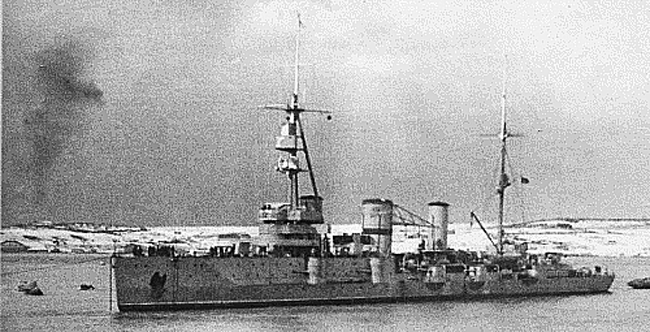
Krazny Krim (Profintern, ex-Svetlana) during ww2, Ukraine winter 1941
Design of the Svetlana/Nakhimov class
Propulsion
These cruisers were approximatively the same length of the battleships, but their profile was quite different. They measured 158.4 meters long, 15.3 meters wide for a 5.56 meters draught and finally displaced 6,860 metric tons (6,750 long tons) standard. Propulsion consisted in four geared Curtis-AEG-Vulkan steam turbines connected each to a propeller shaft, and fed by 13 Yarrow boilers. In total this powerplant was rated for 50,000 designed shaft horsepower (37,000 kW), enough to give them the required 29.5 knots. Their range was about 3,350 nmi (6,200 km; 3,860 mi) at 14 knots (26 km/h; 16 mph) thanks to 1,167 long tons of fuel oil (Kransy Krim figures).
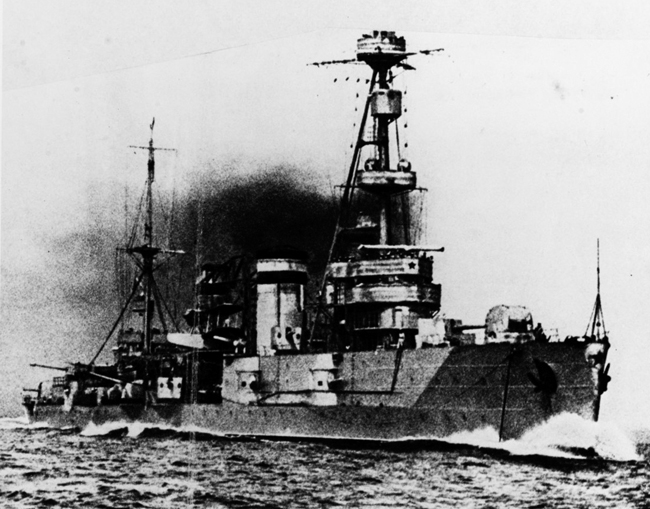 Bow of the Profintern
Armament
While the planned armament of twelve 1913 pattern 130 mm guns was kept, the increase in size allowed the engineers to add three more guns, all in shielded single mounts. Six were located on the main deck in casemates. They were the more problematic in bad weather. The other were located on the decks, forecastle and aft, and on the superstructures and broadsides. These guns could hit a target at 15,364 meters (16,802 yd) when elevated at +20°. They fired a 36.86kg (81.3 lb) shell at 823 m/s (2,700 ft/s) and with a trained crew of gunners, eight rounds per minute.
The secondary armament of the Svetlana class ships was reduced to four 38-caliber 63.3 mm (2.5 in) AA guns with a +75° elevation. The hull’s broadsides also comprised two 450 mm (17.7 in) torpedo tubes. Also as specified, rails and fittings allowed to carry and operate 100 mines. Before the end of their construction, the original AA guns were replaced by 76.2mm/30 (3.00 in) Lender AA guns. 102mm (4.0 in) AA guns were also planned for the rest of the serie.
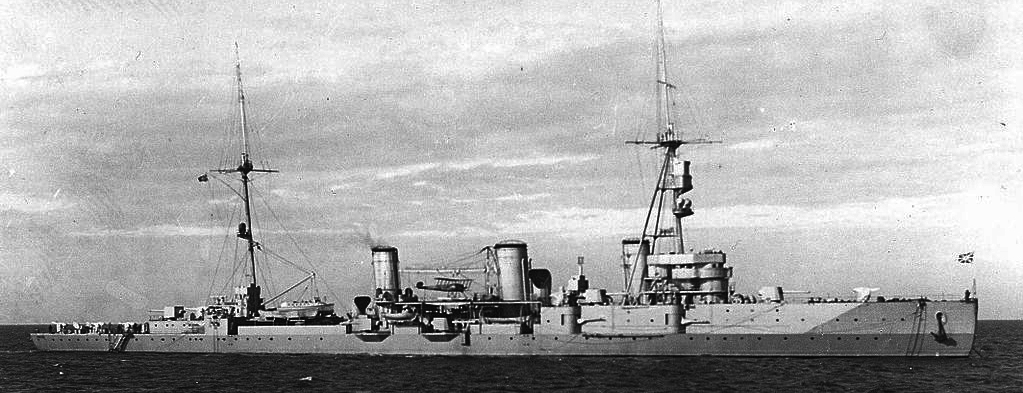 Chervonia Ukraina in the 1930s
Protection
Due to their high speed, the Svetlana class cruisers were intended as light, agile cruisers, so protection was an afterthought. However as specified early on, they received a waterline belt of 76 mm, extending all along the hull and and up to 0.91 meters (3 ft) below the waterline. The upper part awas protected by a 25-millimeter (0.98 in) strake of armor between the lower and main decks. Both decks were 20 mm (0.79 in) thick. The funnel base was protected by 25 mm. The conning tower was 76 mm thick and the gun shields only 25 mm, only sufficient for shrapnells.
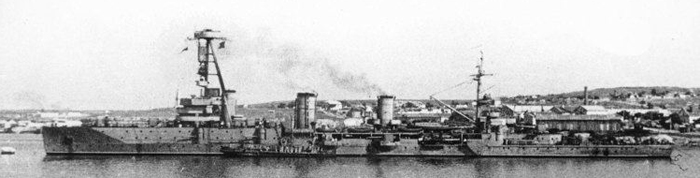 Krazny Krim during ww2
Modernization of 1939 and 1941
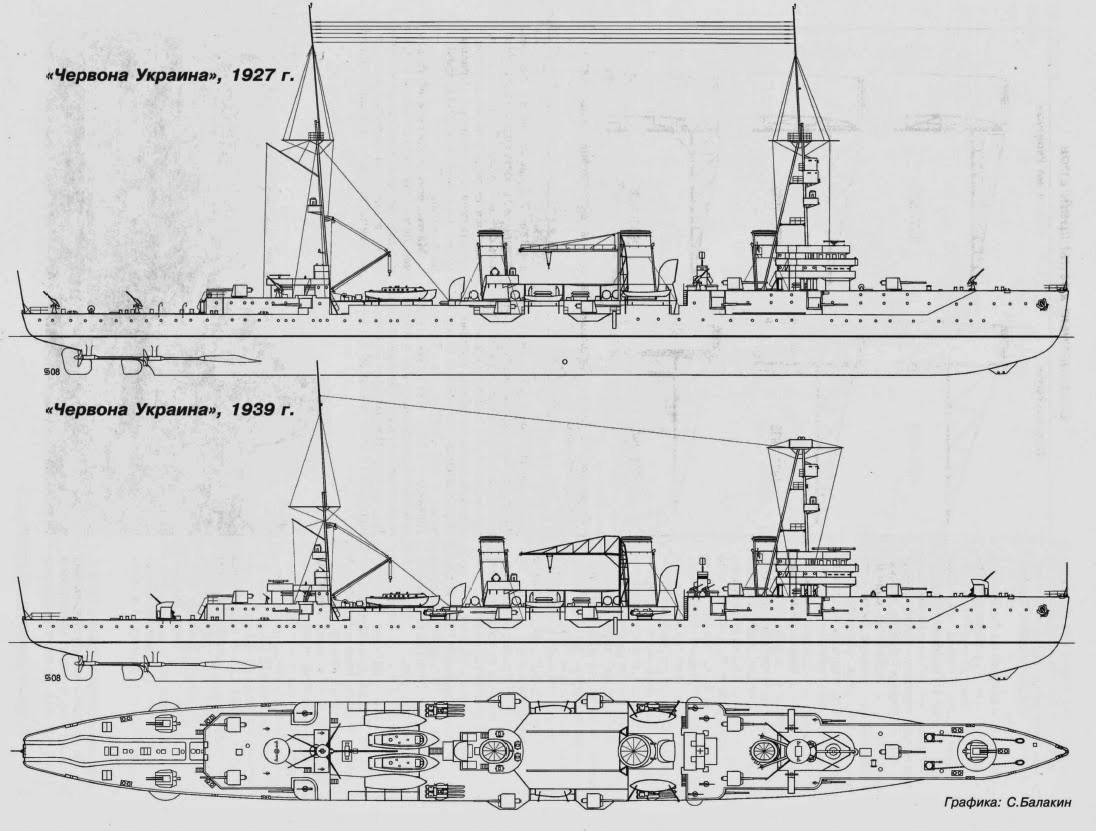
The Profintern was sent to the Black Sea in 1929. She will be modernized in 1939, receiving new modern rangefinders, had her catapult, cranes and planes removed to improve stability while gaining a more effective AA than the original four 65 mm guns, with six new long-range, fast-firing 75 mm AA guns, just like her sister-ship. She was to be renamed Krasny Krim and re-enter active service in November, only to return a few times later for another modernization of the AAA that ended in 1941. For her part, Chervona Ukraina receive a modernisaton of the same type between 1939 and 1941.
The Profintern class in action
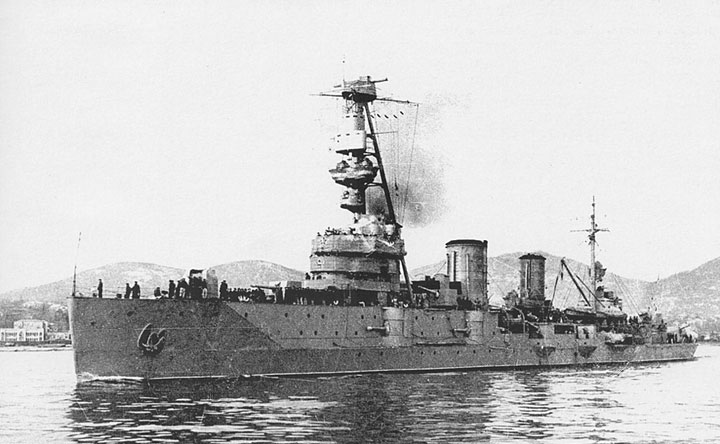
Chervonia Ukraina was also on duty in the Black Sea during the German invasion. She defended Odessa and Sevastopol. During these operations, she was attacked by Stukas of Stgswr 77 on November 12, 1941, and was severely damaged. She would sink the next day despite all the effort of her dedicated crews.
After the fall of the fortress of Sevastopol, Krasny Krim escaped to Poti, and from there led many offensive sorties, receiving two new 76mm AA cannons, and in 1945 one of the first Soviet Navy aerial radar, of American design and manufacture. In March 1945, she became a training ship, withdrawn from the front. She held that role until 1958.

wow’s Profintern 3D rendition profile
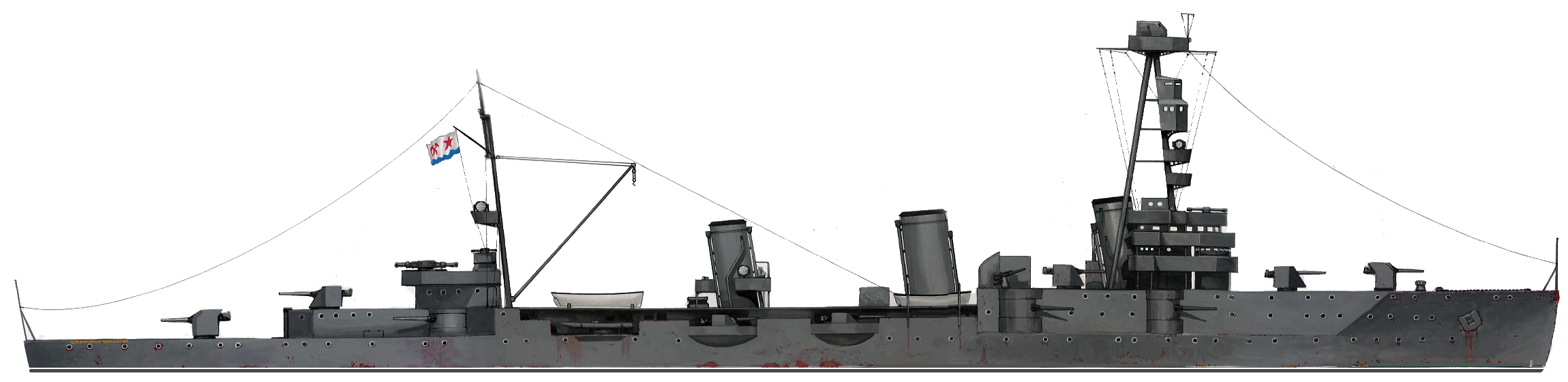
Author’s illustration of the Chervonia Ukraina in 1941
Specifications
Displacement: 7560t (metric tons) to 8330t standard, 9030t Fully Loaded (8,890 long tons; 9,950 short tons)
Dimensions: 169,50 x 15.70 x 6.20 m (523 ft 4 in x 51 ft 6 in x 21 ft 8 in)
Propulsion: 4 shafts, 2 Brown-Boveri geared turbines, 12 Yarrow oil-fired boilers, 55 000 hp (41,000 kW)
Speed & Range: 29 knots (33 mph; 54 km/h), Range: 3,500 nmi (6,480 km) @15 knots (28 km/h)
Armour: 20mm (decks) to 76 mm (turrets, conning tower)
Crew: 850
Armament: 10 x 130mm (5.5 in), 6 x 75mm (3 in), 16 x 45mm AA (in), 4 x 12,7mm AA (0.5 in), 12 x 533 mm TTs (4×3), 100 mines, 3 seaplanes (before 1939).
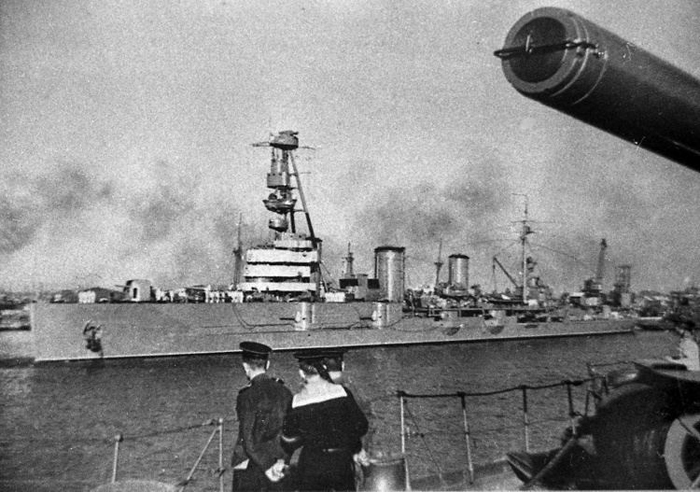 Krazny Krim in the black sea during ww2
Sources/read More
//en.wikipedia.org/wiki/Admiral_Nakhimov-class_cruiser
//weaponsandwarfare.com/2015/05/25/svetlana-class-cruiser
//www.navypedia.org/ships/russia/ru_cr_svetlana.htm
Meister, Jürg (1979). Soviet Warships of the Second World War.
J.Gardiner’s Conway’s All the World’s Fighting Ships: 1906-1922.
Annapolis, Maryland: Naval Institute Press

 Latest Facebook Entry -
  X(Tweeter) Naval Encyclopedia's deck archive
 Instagram (@navalencyc)


 French Navy
 Royal Navy
 Russian Navy
 Armada Espanola
 Austrian Navy
 K.u.K. Kriegsmarine
 Dansk Marine
 Nautiko Hellenon
 Koninklije Marine 1870
 Marinha do Brasil
 Osmanlı Donanması
 Marina Do Peru
 Marinha do Portugal
 Regia Marina 1870
 Nihhon Kaigun 1870
 Preußische Marine 1870
 Russkiy Flot 1870
 Svenska marinen
 Søværnet
 Union Navy
 Confederate Navy
 Armada de Argentina
 Imperial Chinese Navy
 Marine Haitienne
 Marinha do Portugal
 Mexico
 Kaiserliche Marine
 1898 US Navy
 Argentina
 Brazil
 Chile
Chile Cuba
Cuba Peru
Peru Bulgaria
 Denmark
 Greece
 Netherlands
 Norway
 Portugal
 Romania
 Sweden
 China
China Thailand
 Sovietskiy Flot
 Royal Canadian Navy
 Royal Australian Navy
 RNZN Fleet
 RIN Fleet
 Chinese Navy 1937
 Kriegsmarine
 Chilean Navy
 Danish Navy
 Finnish Navy
 Hellenic Navy
 Polish Navy
 Romanian Navy
 Turkish Navy
 Royal Yugoslav Navy
 Royal Thai Navy
 Minor Navies
 Albania
 Austria
 Belgium
 Columbia
 Costa Rica
 Cuba
Cuba Czechoslovakia
 Dominican Republic
 Haiti
Haiti Hungary
 Honduras
 Estonia
 Iceland
 Eire
Eire Equador
 Iran
Iran Iraq
Iraq Latvia
 Liberia
 Lithuania
 Mandchukuo
 Morocco
 Nicaragua
 Persia
 San Salvador
 Sarawak
 Uruguay
 Venezuela
 Zanzibar
 Warsaw Pact Navies
 Bulgaria
 Hungary

 Bundesmarine
 Dutch Navy
 Marina Militare
 Yugoslav Navy
 Chinese Navy
 Indian Navy
 Indonesian Navy
 JMSDF
JMSDF North Korean Navy
 Pakistani Navy
 Philippines Navy
 ROKN
ROKN Rep. of Singapore Navy
 Taiwanese Navy
 Vietnam People’s Navy
 IDF Navy
 Saudi Navy
 Royal New Zealand Navy
 Egyptian Navy
 South African Navy


 Ukrainian Navy
Proofread your documents before you publish them! I have seen many punctuation and spelling errors.