
 German Empire, Light Cruiser
One of the oldest German cruisers in 1914: SMS Gefion was the second oldest German cruiser in service when the first world war broke out (After SMS Kaiserin Augusta (1892)). She was planned in 1890 as an unprotected cruiser of the German Kaiserliche Marine, intended for colonial duties and scouting. She was named after an earlier sail frigate, named herself after the goddess Gefjon of Norse mythology.
She had an impressive main battery of ten 10.5-centimeter (4.1 in) guns, was capable of 19.5 knots (36.1 km/h; 22.4 mph) and a 3,500 nautical miles (6,500 km; 4,000 mi). This was the longest range of any German warship by then, but her compromised design led to an unsuccessful cruiser, soon made obsolete by the Gazelle class.
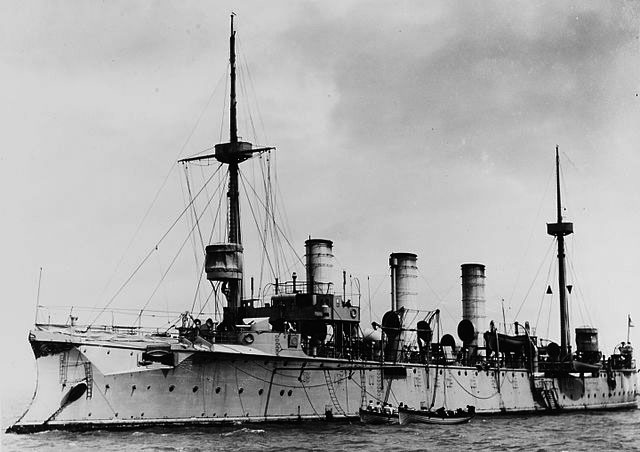
SMS Gefion at anchor in the 1890s
Design of the Gefion
During peacetime the Gefion was to serve as a gunboat, showing the flag and patrolling German colonial routes, suppress native insurrections. By times of war, she was intended to serve as a commerce raider and fleet scout. A duality forced by a tight, small German naval budget. In many respects, Gefion was a scaled-down Kaiserin Augusta, thinner and without armor. Many compromises were took for this triple role, and she was one time classified as a cruiser-corvette, authorized in the 1890–91 budget. Schichau-Werke Yard was awarded the contract in late 1891 but she was then the last unprotected cruiser built for the Navy. Gefion displaced 4,275 t (4,207 long tons; 4,712 short tons) fully loaded.
The hull was designed with transverse and longitudinal steel frames. However the lower stem and stern were still made of bronze ones. They were all covered with wood planking. A metal sheath extended one meter above the waterline to reduce fouling. She had three heavenly spaced funnels and two main pole mast with spotting tops, but rolled badly and made severe leeway, bad gunnery platform. Metacentric height was .55 m (1 ft 10 in). In addition her decks were wet in heavy seas. But she was also agile despite a single rudder, and had a tight turning radius.
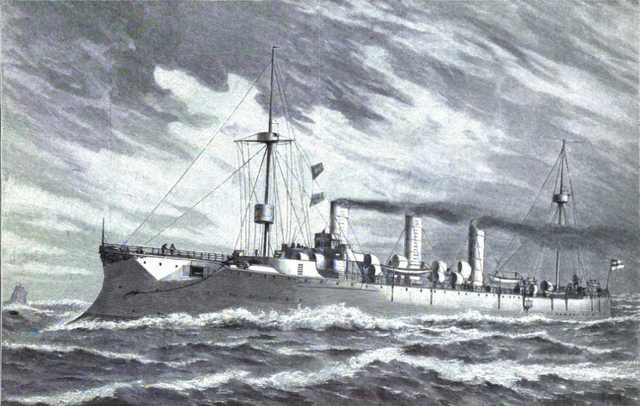
Illustration of the Gefion in the East Asia Squadron
For propulsion, she had two vertical, 3-cylinder triple expansion engines and each shaft was ended by a 3-bladed screw propeller 4.2 m (14 ft) in diameter. Six coal-fired, transverse and cylindrical double water-tube boilers provided the steam. The powerplant was rated for 9,000 indicated horsepower (6,700 kW), top speed as designed was 19 knots (35 km/h; 22 mph). However during her trials with forced heating she reached 9,827 ihp (7,328 kW), producing a top speed of speed of 20.5 kn (38.0 km/h; 23.6 mph). She carried also 860 t (850 long tons; 950 short tons) of coal in wartime. In addition, Electrical power came from three generators, together producing 40 kilowatts (54 hp, 67 volts) in all.
Armament-wise, Gefion was once designed to be armed with 15-centimeter (5.9 in) guns, but due to her expected metacentric height this was wisely turned down to fifteen lighter 10.5 cm (4.1 in) SK L/35 guns. A grand total of 807 rounds of ammunition were stored and dispatched between these. Top range was 10,800 m (35,400 ft), and she carried also six 5 cm (2.0 in) SK L/40 guns with 1,500 rounds total, which were able to deliver their payload up to 6,200 m (20,300 ft) afar.
Two 45 cm (18 in) deck-mounted torpedo tubes completed this arsenal, with five torpedoes in store. Protection was not completely absent though, but was limited to a light armored deck, steel plates a with a wood cover 25 mm (0.98 in) thick, but 30 mm (1.2 in) sloped sides. The engine rooms however were better protected with 100 mm (3.9 in) thick plating on top of 180 mm (7.1 in) of teak.
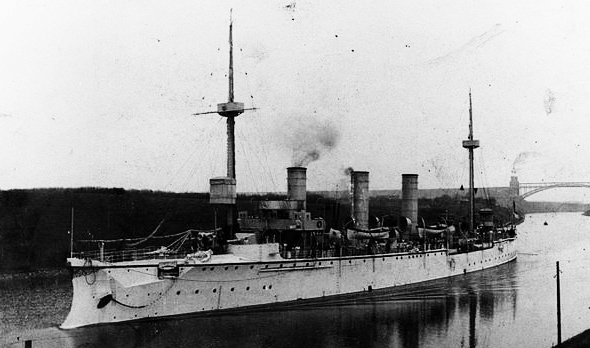
SMS Gefion htrough the Kiel canal
Career of the Gefion
Kapitän zur See Graf Kurt von Haugwitz was commanding the ship during her sea trials, which started on 27 June 1894 at Kiel, lasting until 2 October. Poor ventilation was noted during this summer, and she returned to Kaiserliche Werft in Kiel to have this problem fixed and other points, until mid-1895. She was commissioned on 5 June 1895 and present for the opening celebration of the Kaiser Wilhelm Canal.
She escorted the Imperial yacht Hohenzollern to the king of Sweden and the Cowes Regatta, Leith in the Firth of Forth. From 17 August, she participated in the annual fleet maneuvers, searching for the missing TB S 41 last seen in Jammer Bay on 28 August. She conducted further sea trials to confirm her cruising radius, also as an escort. By February 1896, she was a watch ship in Kiel. She escorted again Wilhelm II’s yacht voyage to Norway and helped pull free the stranded French steamer SS Chanzy.
In April 1897 she carried Admiral Hans von Koester to Sassnitz in April to celebrate the first telegraph cable between Germany and Sweden. She also served as a training ship for stokers. She reseumed her escort of the Hohenzollern, once for a meeting with Czar Nicholas II of Russia.
In December SMS Gefion was assigned to the new II Division of the East Asia Squadron commanded by Prince Heinrich, brother of the kaiser. Together with Kaiserin Augusta and the rebuilt Deutschland she left Germany for the newly conquered base at Tsingtau (Kiautschou Bay concession) and arrived on 5 May 1898. The rest of the squadron was already there under command of Vizeadmiral (Vice Admiral) Otto von Diederichs.
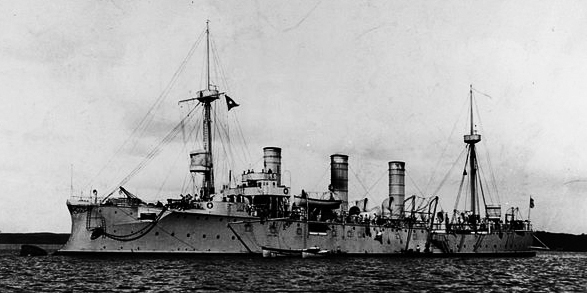
SMS Gefion in 1894-95
Prince Heinrich arrived in 1899 at the head of the squadron, and Gefion sailed to Wusong to assist a damaged SMS Deutschland. She also afterwards steamed up the Yangtze River as far as Hankou. Later she was received as a guest of several Japanese ports like Nagasaki, and later arrived in Vladivostok. She later escorted a damaged (again) SMS Deutschland to Hong Kong for repairs. She escorted her in Bangkok, carrying Prince Heinrich back to Germany.
Vizeadmiral Felix von Bendemann replaced him while the latter joined his new flagship, the protected cruiser Hertha. The squadron cruised in the German central Pacific colonies before managing the tense situation of the Boxer Rebellion in the Shandong Peninsula. The German base at Tsingtau was particularly stroke by the insurgents and a multinational relief expedition under the command of Edward Hobart Seymour was launched. Gefion and other cruisers bombarded Chinese coastal defenses at Tianjin and landing parties too part in the Battle of Taku Forts on 16–17 June 1900. Kapitänleutnant Otto Weniger became her next captain.
He commanded a landing party which stomed the Great Hsi-Ku Arsenal in Tianjin. Gefion was later stationed outside the mouth of the Yangtze but went to Hong Kong for an overhaul. The next year she temporarily commanded Tsingtau in the name of the governor, sailed to Nagasaki, and ended at Shanghai until September, then back to Germany.
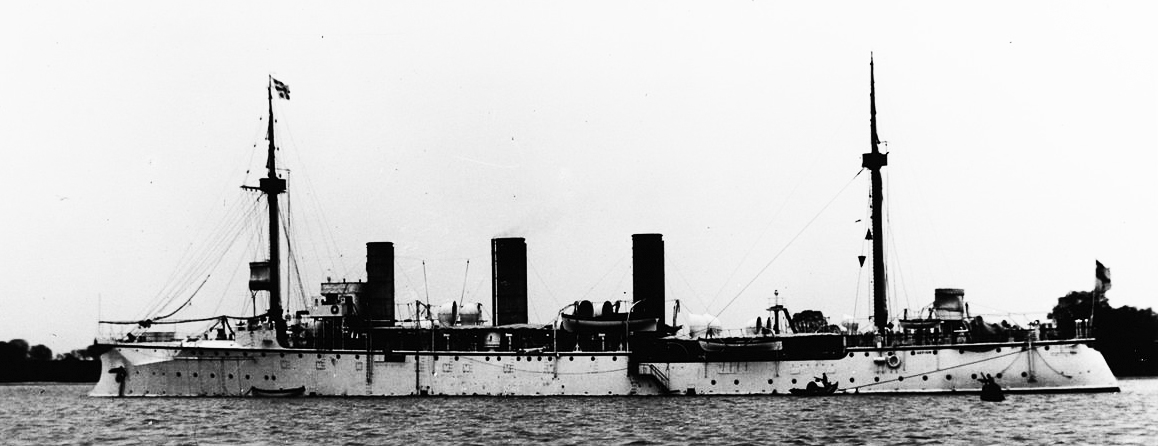
SMS Gefion at the China station, later famous Von Spee’s east asia squadron
SMS Gefion was decommissioned for an intended major reconstruction at the Kaiserliche Werft in Wilhelmshaven, starting by December 1901 and ending in 1904. She received modern and powerful electrical generators. The upper deck was fully enclosed and the upper deck 10.5 cm guns were relocated to protected hull gun ports.
The smaller 50 mm guns abreast of the center funnel were relocated further aft (third funnel). Many other points were modified. After refit she was left in reserve but in August 1914 she was reactivated. On August 10, her Korvettenkapitän Waldeyer could not find a crew however due to manpower shortages, reserved to more modern ships.
Therefore she returned in reserve and Waldeyer was transferred elsewhere a few days later. Gefion was moved to Danzig in 1916 and used as a barracks ship for Kaiserliche Werft yard repaired ships’s crews, for the duration of the war. She was stricken and paid off in 5 November 1919, sold to Norddeutsche Tiefbaugesellschaft, and converted into a diesel-powered freighter (propelled by the engines from the unfinished U-115 and U-116) such was the desperation for trade vessels after the war.
Under her new name Adolf Sommerfeld, she carried 2,600 t on a short route briefly in 1920-23 until new merchant ships were acquired by the company, and she was broken up by Danziger Hoch und Tiefbau in Danzig, 1923.
SMS Gefion 1894 specifications |
|
| Dimensions | 110.4 m (362 ft), Beam 13.2 m (43 ft), 6.47 m (21.2 ft) |
| Displacement | 4,275 t (4,207 long tons; 4,712 short tons) |
| Crew | 13+289 |
| Propulsion | 2 TE engines, 6 (coal) WT boilers, 9,000 ihp (6,700 kW) |
| Speed | 19.5 knots (36.1 km/h; 22.4 mph) |
| Range | 3,500 nmi (6,500 km; 4,000 mi) at 12 kn (22 km/h; 14 mph) |
| Armament | 10 × 105, 6 × 50, 2 × 450 mm TTs. |
| Armor | Decks 25 mm |
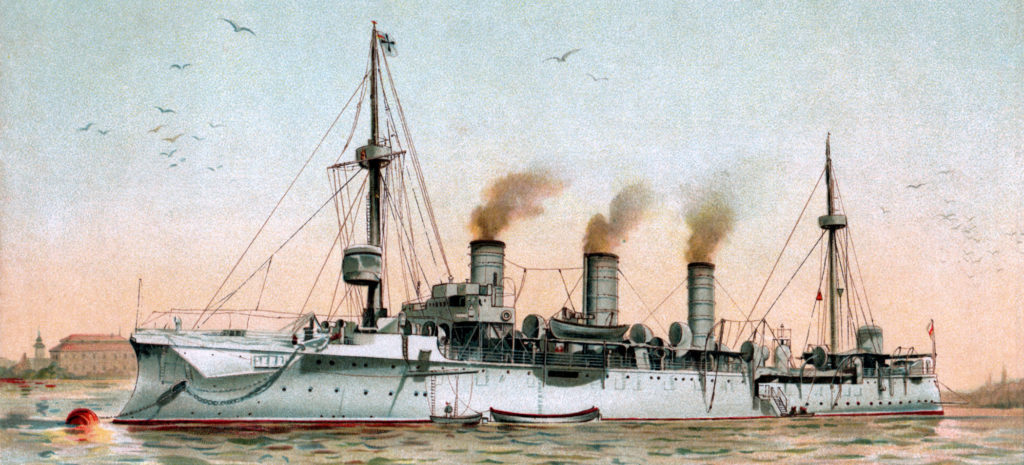
Restored 120 years old Postcard painting by Hugo Graf showing the Gefion before refit.
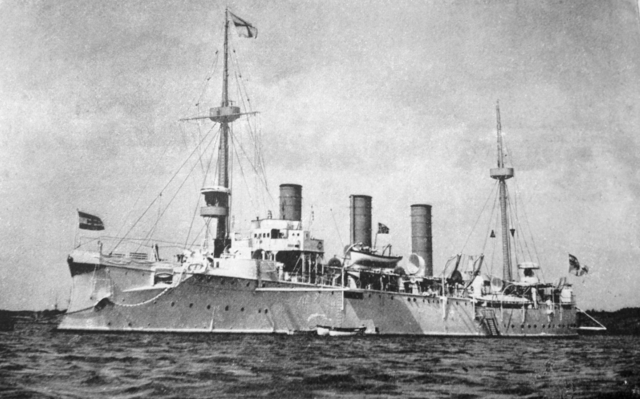
Alfred Jane’s photo showing a view close to what is shown by the postcard.
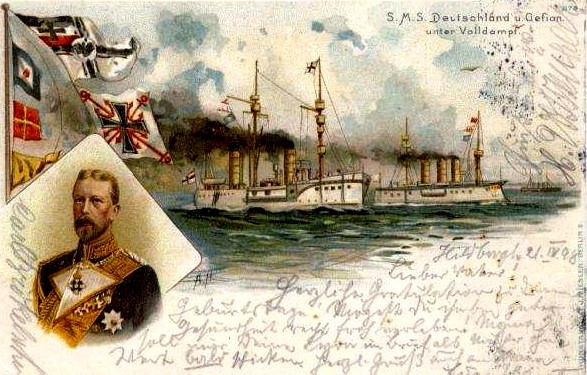
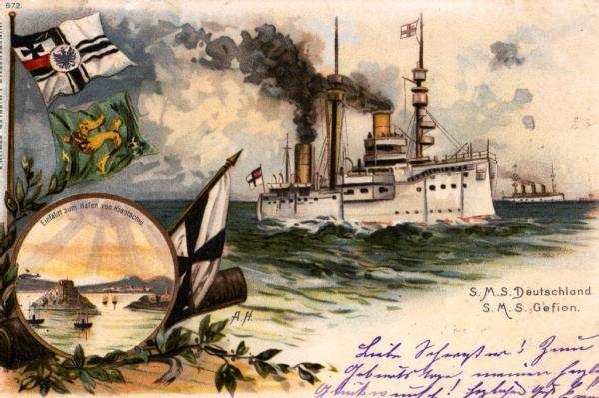
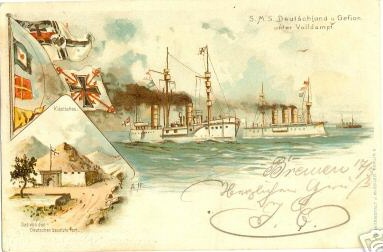
Postcards of the Gefion and Deutschland.
Links
Conway’s all the world fighting ships 1860-1905 & 1906-1921
Dodson, Aidan (2017). “After the Kaiser: The Imperial German Navy’s Light Cruisers after 1918
Gottschall, Terrell D. (2003). By Order of the Kaiser
Hildebrand, Hans H.; Röhr, Albert; Steinmetz, Hans-Otto (1993). Die Deutschen Kriegsschiffe
Sondhaus, Lawrence (1997). Preparing for Weltpolitik: German Sea Power Before the Tirpitz Era
The Gefion on wikipedia
Previous frigate SMS Gefion
Gefion on militaer-wissen.de
Gefion On deutsche-schutzgebiete.de
 Latest Facebook Entry -
  X(Tweeter) Naval Encyclopedia's deck archive
 Instagram (@navalencyc)


 French Navy
 Royal Navy
 Russian Navy
 Armada Espanola
 Austrian Navy
 K.u.K. Kriegsmarine
 Dansk Marine
 Nautiko Hellenon
 Koninklije Marine 1870
 Marinha do Brasil
 Osmanlı Donanması
 Marina Do Peru
 Marinha do Portugal
 Regia Marina 1870
 Nihhon Kaigun 1870
 Preußische Marine 1870
 Russkiy Flot 1870
 Svenska marinen
 Søværnet
 Union Navy
 Confederate Navy
 Armada de Argentina
 Imperial Chinese Navy
 Marine Haitienne
 Marinha do Portugal
 Mexico
 Kaiserliche Marine
 1898 US Navy
 Argentina
 Brazil
 Chile
Chile Cuba
Cuba Peru
Peru Bulgaria
 Denmark
 Greece
 Netherlands
 Norway
 Portugal
 Romania
 Sweden
 China
China Thailand
 Sovietskiy Flot
 Royal Canadian Navy
 Royal Australian Navy
 RNZN Fleet
 RIN Fleet
 Chinese Navy 1937
 Kriegsmarine
 Chilean Navy
 Danish Navy
 Finnish Navy
 Hellenic Navy
 Polish Navy
 Romanian Navy
 Turkish Navy
 Royal Yugoslav Navy
 Royal Thai Navy
 Minor Navies
 Albania
 Austria
 Belgium
 Columbia
 Costa Rica
 Cuba
Cuba Czechoslovakia
 Dominican Republic
 Haiti
Haiti Hungary
 Honduras
 Estonia
 Iceland
 Eire
Eire Equador
 Iran
Iran Iraq
Iraq Latvia
 Liberia
 Lithuania
 Mandchukuo
 Morocco
 Nicaragua
 Persia
 San Salvador
 Sarawak
 Uruguay
 Venezuela
 Zanzibar
 Warsaw Pact Navies
 Bulgaria
 Hungary

 Bundesmarine
 Dutch Navy
 Marina Militare
 Yugoslav Navy
 Chinese Navy
 Indian Navy
 Indonesian Navy
 JMSDF
JMSDF North Korean Navy
 Pakistani Navy
 Philippines Navy
 ROKN
ROKN Rep. of Singapore Navy
 Taiwanese Navy
 Vietnam People’s Navy
 IDF Navy
 Saudi Navy
 Royal New Zealand Navy
 Egyptian Navy
 South African Navy


 Ukrainian Navy