
 Chinese PLAN (1955) – Chengdu, Guiyang, Gulin, Kunming
The Green Tea “Riga”
The 1956′ Chengdu class can be summup as the Chinese “Riga” class. The latter were the standards mass-built Soviet ASW frigates of the Soviet Navy. Although they were delivered at the same time than the four Gnevny (future Type 07 Anshan class destroyers), these frigates arrived from the Soviet big brother shipyards in “kit”, for local assembly. They were hardly equivalent to licence-built ships, based solely on blueprints. Anyway, these ships became the Type 01 Chengdu-class and made the bulk of the very small Chinese PLAN until the arrival of the Luda. In between other frigates will enter service, the Jiangnan class in 1967-69 and the Yintang class in 1973, the two being developments of the Riga hull. Even the later Jianghu mass-production class which spanned 1975-1993 were developments of the same original hull which basically endured the whole cold war for the Chinese the same way PLA’s Type 59 MBTs were declined into the Type 69/79 and 88 MBTs.
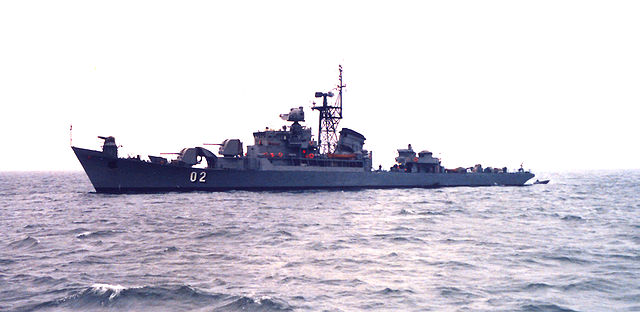
Finnish Hameenmaa, a mineleyer-converted Riga-Class in 1982, giving some idea of the Type 065.
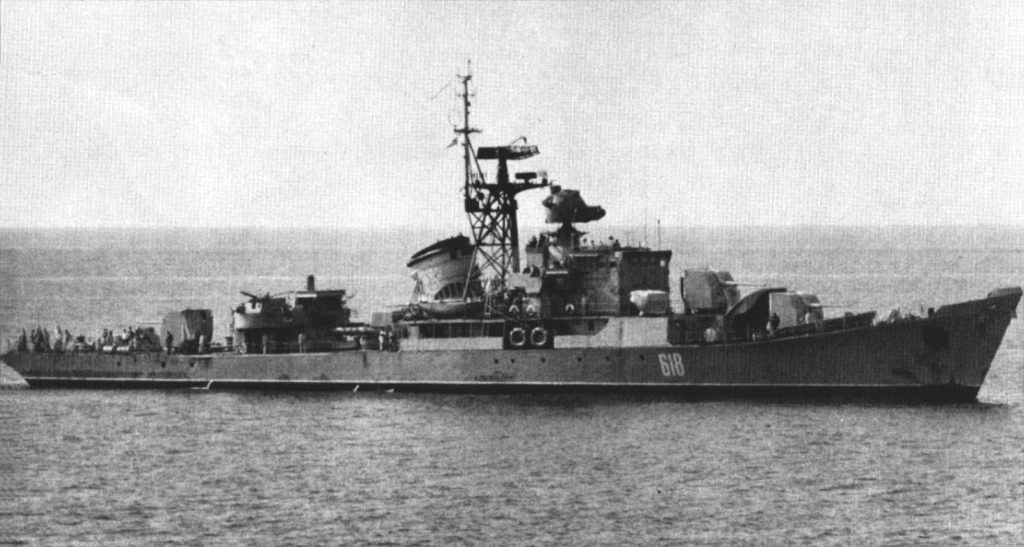
Another Riga class, SKR-61 underway in 1970. Actual photos of the type 065 are really hard to find.
About the “Riga” class
As a foreworld, the Soviet “Riga” class (a NATO designation) was known in USSR as Storozhevoi Korabl (escort ship) Project 50 Gornostay (Ermine stoat). They were basically Soviet reinterpretation in the 1950s of the classic escort destroyers of WW2. The design was simple, rugged and sound, and as customary was produced from 1953 to 1959 to an extent of 69 vessels. It made perfectly sense to distribute these to Warsaw pact nations like East Germany, Bulgaria, Finland and a faithful Asian customer such as Indonesia. There was nothing revolutionary about these ships, which primary armament counted rapid-fire dual purpose guns 100 mm completed by AA an array of 57 and 37mm mounts, while ASW was limited to depth charges and two or three 533 mm torpedo tubes, some ships having a set of MBU 600 anti-submarine rocket launchers later replaced by two RBU 2500. They were easy to recoignise with their fluch deck, pointed prow and central superstructure, including the funnel. Speed, given the nature of submarines at that time, was not paramount, with just 28 knots (52 km/h; 32 mph), but range was, and these surprisingly NOT diesel-powered ships had a comfortable 1,950 nmi (3,610 km; 2,240 mi) range at 14 kn (26 km/h; 16 mph). In Soviet service the Riga were discarded in 1980s, whereas the Chinese Chengdu soldiered on for another decade.
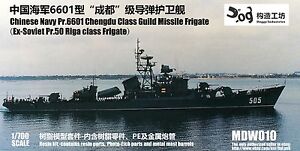
Picture from E-Bay – model kit
Specifics of the Chengdu class
In their new denomination they became the Type 6601 (Chengdu class) these kits were assembled by the Huangpu Shipyard in Guangzhou, and Hudong Shipyard in Shanghai from 1955 to 1958. But soon problems appeared, to start with finding an appropriate power source for these frigates. The Riga class had a TV9 steam turbine the Chinese were incapable of replicating, and at the same time this was a fuel-hungry unit they found unsuitable for their needs. Therefore rather than to start again from the TB-8 and TB-9 models China was currently cloning (with some difficulties), engineers choosed the simpler and proven 37D diesel 9ED743/76 available at that time and already manufactured locally for the Chinese “Whiskey” class submarines. However this power unit was incapable of doing reverse speed, but the 37DR diesel was. The 37D also had a rather low power rate, end performances risked to be weaker than the original Riga. Eventualy the 9EDZ43/76 was chosen for the Type 065. Later on, cloning the 37DR engine proved impossible. To house the massive 9EDZ43/76 PLAN engineers had to split-level the deck for 3/4 of the length. Other improvements concerned the propellers, and tests shows the new vessels were able to reach 21.5 knots.
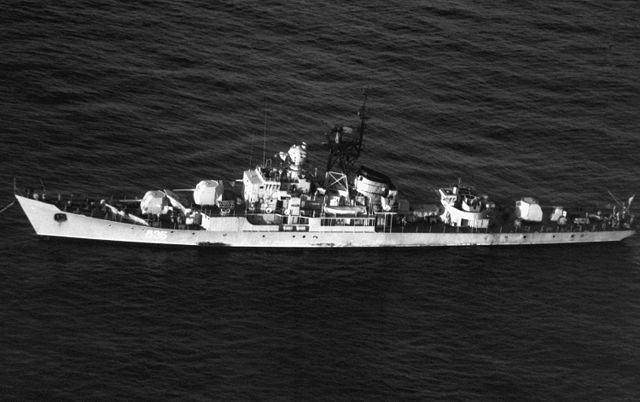
Aerial view of the Riga class, giving some idea of the Chengdu initial design
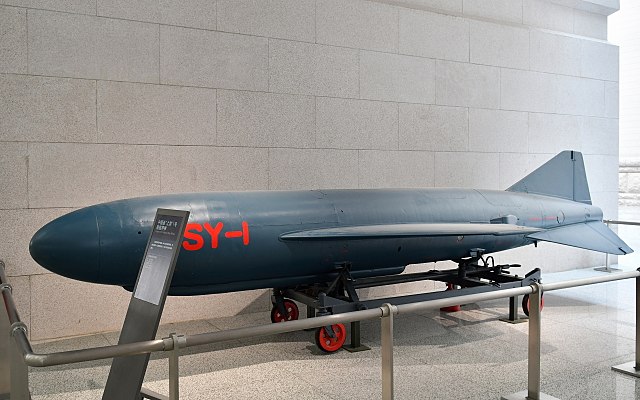
SY-1 antiship missile
Type 01 (Chengdu class)
By the early 1970s, Type 6601 class went through mid-life upgrade with their torpedo tubes replaced by a twin launcher for SY-1 anti-ship missiles. Although redesignated as Type 01, these ships were still called Chengdu class. They were retired in the 1980s.
About the SY-1 missiles:
These were Chinese copies of the Soviet P-15 Termit antiship missile, produced at Factory 320 (Nanchang Aircraft Factory) and designed by Li Tongli and Lu Lin. The Chinese SY-1 missiles replaced the original, unreliable aneroid altimeter of P-15 Termit by a new radar altimeter. The SY-1A, had an even better mono-pulse terminal guidance radar seeker. It was codenamed NATO CSS-N-1 Scrubbrush.
Specifications: 6.55 x 0.76 x 2.4 m (wingspan), Weight 2,095 kg with a 513 kg shaped charge high explosive warhead. It was propelled by a liquid rocket engine coupled to a solid rocket booster and reached Mach 0.8 with a range of 150 km at low altitude, beyond 20 meters. Guidance comprise Inertial and active conical scanning terminal guidance radar, later active monopulse radar. It had a single-shot kill probability of 70%.
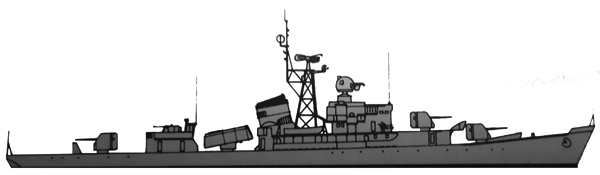
Impression of the Type 065 Frigate (Conways)
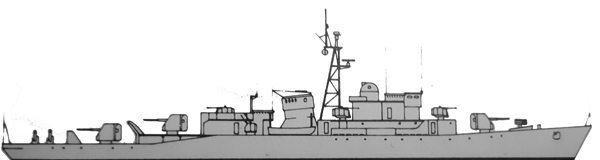
Impression of the following Jiangnan class Frigate (Conways)
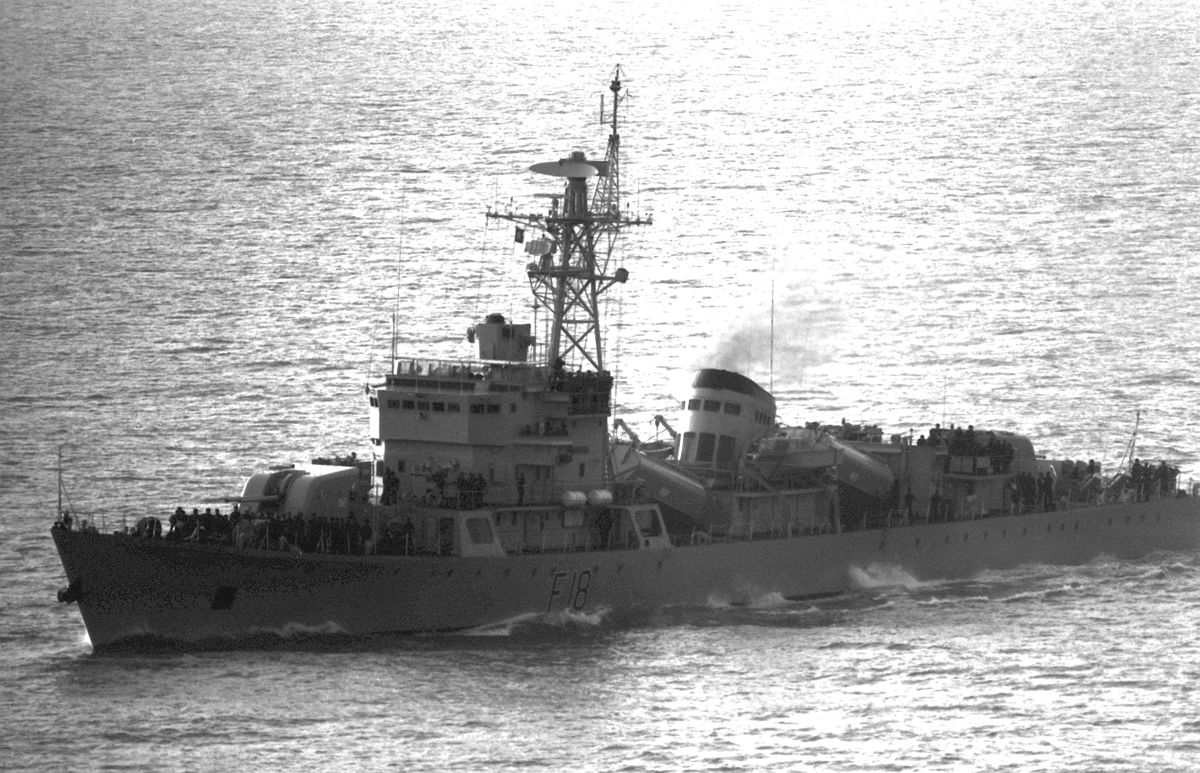
The successor Type 053H surface-warfare frigate.
Read More
The Dragon’s Teeth: The Chinese People’s Liberation Army—Its History By Benjamin Lai
https://en.wikipedia.org/wiki/Type_053_frigate#Versions
Conways’ all the world fighting ships 1947-1995
https://web.archive.org/web/20111005020054/http://www.atrinaflot.narod.ru/2_mainclassships/06_skr_50/0_50.htm
 Latest Facebook Entry -
  X(Tweeter) Naval Encyclopedia's deck archive
 Instagram (@navalencyc)


 French Navy
 Royal Navy
 Russian Navy
 Armada Espanola
 Austrian Navy
 K.u.K. Kriegsmarine
 Dansk Marine
 Nautiko Hellenon
 Koninklije Marine 1870
 Marinha do Brasil
 Osmanlı Donanması
 Marina Do Peru
 Marinha do Portugal
 Regia Marina 1870
 Nihhon Kaigun 1870
 Preußische Marine 1870
 Russkiy Flot 1870
 Svenska marinen
 Søværnet
 Union Navy
 Confederate Navy
 Armada de Argentina
 Imperial Chinese Navy
 Marine Haitienne
 Marinha do Portugal
 Mexico
 Kaiserliche Marine
 1898 US Navy
 Argentina
 Brazil
 Chile
Chile Cuba
Cuba Peru
Peru Bulgaria
 Denmark
 Greece
 Netherlands
 Norway
 Portugal
 Romania
 Sweden
 China
China Thailand
 Sovietskiy Flot
 Royal Canadian Navy
 Royal Australian Navy
 RNZN Fleet
 RIN Fleet
 Chinese Navy 1937
 Kriegsmarine
 Chilean Navy
 Danish Navy
 Finnish Navy
 Hellenic Navy
 Polish Navy
 Romanian Navy
 Turkish Navy
 Royal Yugoslav Navy
 Royal Thai Navy
 Minor Navies
 Albania
 Austria
 Belgium
 Columbia
 Costa Rica
 Cuba
Cuba Czechoslovakia
 Dominican Republic
 Haiti
Haiti Hungary
 Honduras
 Estonia
 Iceland
 Eire
Eire Equador
 Iran
Iran Iraq
Iraq Latvia
 Liberia
 Lithuania
 Mandchukuo
 Morocco
 Nicaragua
 Persia
 San Salvador
 Sarawak
 Uruguay
 Venezuela
 Zanzibar
 Warsaw Pact Navies
 Bulgaria
 Hungary

 Bundesmarine
 Dutch Navy
 Marina Militare
 Yugoslav Navy
 Chinese Navy
 Indian Navy
 Indonesian Navy
 JMSDF
JMSDF North Korean Navy
 Pakistani Navy
 Philippines Navy
 ROKN
ROKN Rep. of Singapore Navy
 Taiwanese Navy
 Vietnam People’s Navy
 IDF Navy
 Saudi Navy
 Royal New Zealand Navy
 Egyptian Navy
 South African Navy


 Ukrainian Navy
My grandfather was a gunner for the 100mm Naval Gun on the Guiyang (508).
Sorry, I meant he was the gunner for the 37mm Anti Aircraft Gun on the Guiyang (508)
Thanks for this point, Jeremy !