
 France (1928-45), Minelayer Diesel Electric Submersibles.
Diamant, Nautilus, Perle, Rubis, Saphir, and Turquoise
France’s most successful ww2 subs
This class of “diamonds” became the best known during the war among french subs, the only ones to gain fame within the allied forces and pass to posterity with a new class of nuclear attack submarines named in homage. This fame also came partly because of their very nature: They were the only allied minelayer submarines available then.
⚠ Note: This post is in writing. Completion expected in late 2023.
❯❯❯❯❯❯❯❯❯❯❯
Development:
Constructed between 1928 and 1935 in Toulon shipyard, this class, was designed to lay mines, and carefully derived from the German UCs of the last war, but with modern solutions and innovations. The class comprised the Diamant, Nautilus, Perle, Rubis, Saphir, and Turquoise. All named after precious gems.
Design:
In particular, they had lateral mine wells of large capacity, designed by Normand-Fenaux. The system, simple and effective, will prove very useful. 32 mines could be housed in these 16 wells. The torpedo armament was reduced to two bow tubes and three (including two 400 mm) in a movable bench at the rear and less refills than usual. These mines were of the Sautier-Harlé HS 4 type, with oar. They exploded on contact with a 220 kg tolite charge, and can be laid down 200 m deep. They were lodged by pairs in each of the sixteen vertical wells inside ballasts, slightly larger than usual.
Operational career:
In service in 1936, one of these units gained prominence during the war. Not only did it escape the fate of the French navy by crossing the channel and joining the allies, but it was also the only allied submarine capable to lay mines, and its Career was meritorious.
The Sapphire, Turquoise and Nautilus were all captured at Bizerte and transferred to the Italians in 1942, and two served for some time under the name of FR112 and 116, in Bizerte. One of them will be sunk on the spot, the others scuttled. The Diamond will sabotaged and scuttled in Toulon in November 1942, while the Perle, which like the Rubis passed early on the allied side, would be sunk by mistake in 1944, a lot common to many French ships.
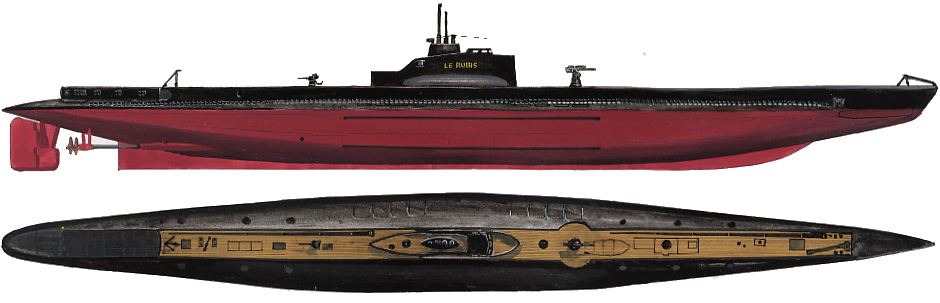
1/400 HD NE illustration of the Rubis in the 1930s.
⚙ specifications |
|
| Dimensions | 66 x 21,5 x 8,4 m |
| Displacement | 761/925 t. FL |
| Crew | 892 |
| Propulsion | 2 screws, 2 electric motors 550 hp each, 2 diesels, 650 hp each. |
| Speed | 12/9 knots surf./sub. (22/17 km/h) |
| Range | 7,000 NM (12 964 km) @7,5 knots, 80 NM sub. |
| Armament | 1 x 65 mm, 2 bow, 4 TT sides 533 mm, 32 oarsmines Sautier-Harlé HS 4. |
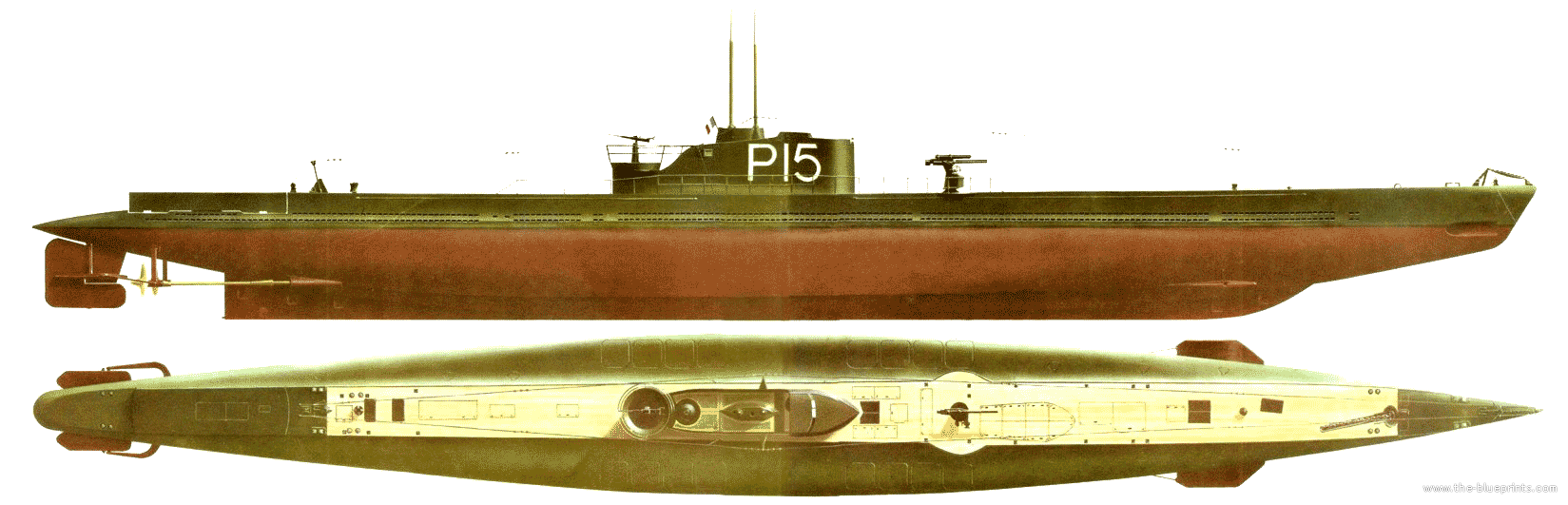
The blueprints – Rubis in wartime markings and FNFL service, 1942

Another profile of Rubis as found in Cape Camaret.
Links/Sources
wikipedia.org Rubis_(1931)
dundee-at-war.net/gallery.htm
uboat.net/allies/warships/
britishpathe.com/video/general-de-gaulle-honours-free-french-navy
 Diamant
Nautilus
Perle
Rubis

wikimedia photo of Rubis in grave difficulties in a minefield off Norway, Coastal Command, Ministry of Information, 1942.
This most famous sub, laid down on 3 April 1929, launched 30 September 1931 and commissioned 4 April 1933, served in Toulon with the 7th, then 5th Submarine Squadrons. In 1937 she was transferred to Cherbourg on the Atlantic coast and by May 1940, she participated actively in the Norwegian campaign, laying mines off the Norwegian coast that allegedly sank four Norwegian vessels and later three merchantmen in July 1940.
The Rubis was captured in the port of Dundee, Scotland during Operation Catapult. However she turned to the Free French Forces quickly under Captain Georges Cabanier command. From there, Rubis career became quite epic, with 22 missions leading to the direct and indirect destruction of twenty-four ships of the axis (for 683 mines laid down) in addition to Norway, adding the Bay of Biscay and the Atlantic to its playgrounds. In fact she operated again in 1944 off Stavanger, claiming two auxiliary submarine chasers and two merchantmen and damaging later two others, and at the end of the year, three auxiliary submarine chasers, a German merchantman, and a minesweeper. In total she sank some 21,000 GRT by far the highest kill ratio of any French vessel.
She was visited by Royal Navy officials, and her crew was decorated notably with De Gaulle’s order of liberation in October 1941. After 1946, she was used as a training ship, retired from service in 1948 and used as a target sonar in the Mediterranean. Her wreck is still visible off Cavalaire, now a lush reef after 70 years.
 Latest Facebook Entry -
  X(Tweeter) Naval Encyclopedia's deck archive
 Instagram (@navalencyc)


 French Navy
 Royal Navy
 Russian Navy
 Armada Espanola
 Austrian Navy
 K.u.K. Kriegsmarine
 Dansk Marine
 Nautiko Hellenon
 Koninklije Marine 1870
 Marinha do Brasil
 Osmanlı Donanması
 Marina Do Peru
 Marinha do Portugal
 Regia Marina 1870
 Nihhon Kaigun 1870
 Preußische Marine 1870
 Russkiy Flot 1870
 Svenska marinen
 Søværnet
 Union Navy
 Confederate Navy
 Armada de Argentina
 Imperial Chinese Navy
 Marine Haitienne
 Marinha do Portugal
 Mexico
 Kaiserliche Marine
 1898 US Navy
 Argentina
 Brazil
 Chile
Chile Cuba
Cuba Peru
Peru Bulgaria
 Denmark
 Greece
 Netherlands
 Norway
 Portugal
 Romania
 Sweden
 China
China Thailand
 Sovietskiy Flot
 Royal Canadian Navy
 Royal Australian Navy
 RNZN Fleet
 RIN Fleet
 Chinese Navy 1937
 Kriegsmarine
 Chilean Navy
 Danish Navy
 Finnish Navy
 Hellenic Navy
 Polish Navy
 Romanian Navy
 Turkish Navy
 Royal Yugoslav Navy
 Royal Thai Navy
 Minor Navies
 Albania
 Austria
 Belgium
 Columbia
 Costa Rica
 Cuba
Cuba Czechoslovakia
 Dominican Republic
 Haiti
Haiti Hungary
 Honduras
 Estonia
 Iceland
 Eire
Eire Equador
 Iran
Iran Iraq
Iraq Latvia
 Liberia
 Lithuania
 Mandchukuo
 Morocco
 Nicaragua
 Persia
 San Salvador
 Sarawak
 Uruguay
 Venezuela
 Zanzibar
 Warsaw Pact Navies
 Bulgaria
 Hungary

 Bundesmarine
 Dutch Navy
 Marina Militare
 Yugoslav Navy
 Chinese Navy
 Indian Navy
 Indonesian Navy
 JMSDF
JMSDF North Korean Navy
 Pakistani Navy
 Philippines Navy
 ROKN
ROKN Rep. of Singapore Navy
 Taiwanese Navy
 Vietnam People’s Navy
 IDF Navy
 Saudi Navy
 Royal New Zealand Navy
 Egyptian Navy
 South African Navy


 Ukrainian Navy