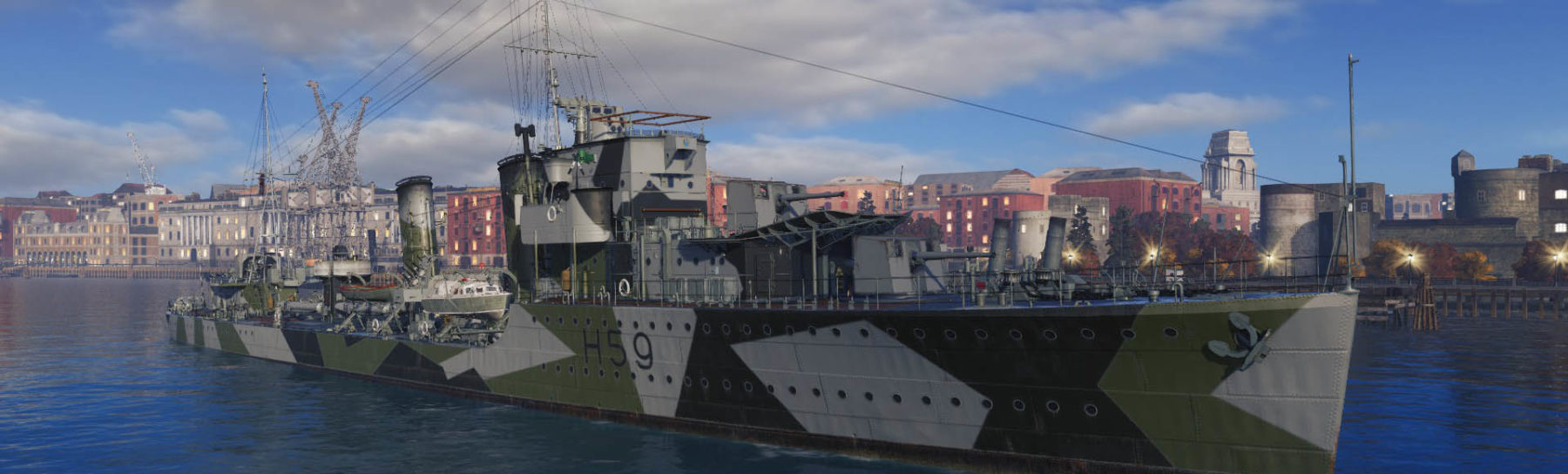
 United Kingdom (1917-1945), 400+ destroyers
Introduction
In 1939, 184 destroyers were in service, dating back for a large part from 1917-18, in particular the large V-W classes, some destroyers leaders, and interwar vessels, from the “A” class to the “Battle” class. It would take too long to detail the career of all ships from all these classes of destroyers built since 1920, and those from the Great War. They had an almost an identical configuration since the Shakespeare and Scott class flotilla leaders entered the fray in 1917-1920. At that time, the armament of these leaders included five 5-in, three 3-in AA guns and 2-pdr, and six torpedo tubes, of the standard 21 in (533 mm) in two triple axial banks amidships. The V-W “standard” classes led by those above were significantly heavier than the previous R, but had four 4-in (102 mm) and four torpedo tubes only, with 500 tonnes less. The practice of having “standard” leaders and destroyers was not unique to the Royal Navy, and it for some years until 1930.
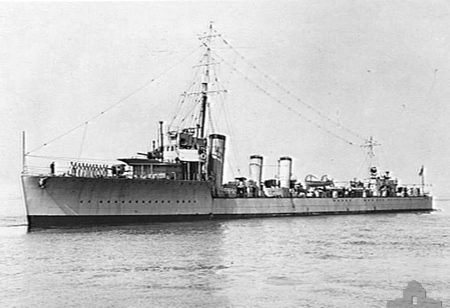
HMAS Anzac, of the Parker class Flotilla Leaders (1915). They were broken up in 1936.
After that, tactics changed and the destroyers reached a much higher standard: By 1939-40, the J/K/N class constituted a clear advance, had a displacement of 2500 tonnes at full load (against 2,000 for the leaders of 1918), six 5-in (120 mm) in twin mounts, 10 torpedo tubes in quintuple banks and a significantly larger AA. As a result, destroyers dating from before 1920 were essentially converted as ASW escorts.
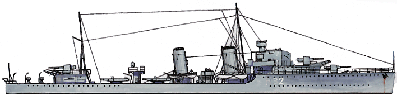
HMS Havant in 1940 (1/750), when it entered service.
Characteristics of British Destroyers
In addition to WW1 models, interwar British destroyers went on the same path of standard models for serial production, and large, well armed, powerful and well equipped leaders, to lead British destroyer flotillas with for the admiralty the aim to construct a flotilla each year. The standard ones were developed from V and W-class classes and they progressed steadily, but when the flotilla leaders stopped, aside the standards a nw kind of heavy destroyer was attempted in 1937 with the tribal class, which was near-imitated again in 1944-45 with the Battle class. Destroyers stayed relatively similar on the long run, only increasing in size and complexity but the design became simplified and cheaper to produce. Soon experience led to increase AA and ASW capabilities, through conversions within the War Emergency Programme. A few destroyers were also built in the Commonwealth, mostly Canadian and Australian versions of the Tribal, like the famous HCMS Haida, now preserved.
British destroyer design, stayed remarkably constant despite incremental changes, the exceptional Tribal-class, and an attempt to produce the more complex, larger and costier J, K and N classes, Ls and Ms, before a return to the simpler War Emergency Programme design.
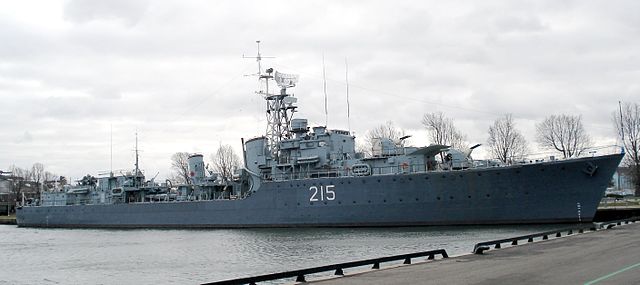
HCMS Haida, a late war Canadian version of the Tribal, as preserved in Ontario.
Hull and propulsion
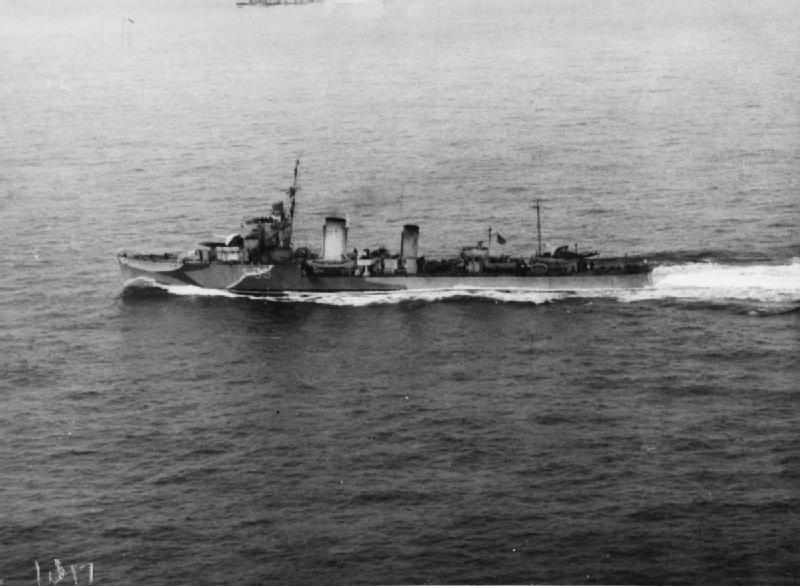
HMS Amazon at full speed in 1942 – iwmcollections.org.uk
This area shows little improvement over the years at least in general shape. The classic forecastle type appeared with the 1903 River class destroyers, and never really evolved since. The base model for WW2 destroyer was the WW1 destroyer leader model of the Scott class, which setup the basic British hull design for the years to come. The forecastle represented about 40% of the total length, the fore section crowded by the bridge and main mast, super-firing shielded gun N°2 and deck level N°1, while the aft section made room for a running platform on top of which were placed the two funnels, and air intakes, access to the boiler room. Just after came the torpedo tubes, for long, triple (see later), and aft guns on the quarterdeck room, plus the aft mast. The prow was generally slightly raked, the stern rounded. This started to change with the 1936 Tribal, which inaugurated twin guns mounts, and a clipper bow. Single mast and single funnel with a slightly more raked bow started to appear with the “J” class in 1938. Transom stern appeared in 1942 with the “Q” class, simplifying construction and helping clear off the depth charges in racks. Due to the increase size and width as well, more AA could be added (see later). Displacement rose from the HMS Amazon (A class preserie, 1926) at 1352 tonnes standard to 1720 on the ‘Tribals’ or 1770 on the J-K-N class up to 2400 on the late serie Battle class (completed postwar).
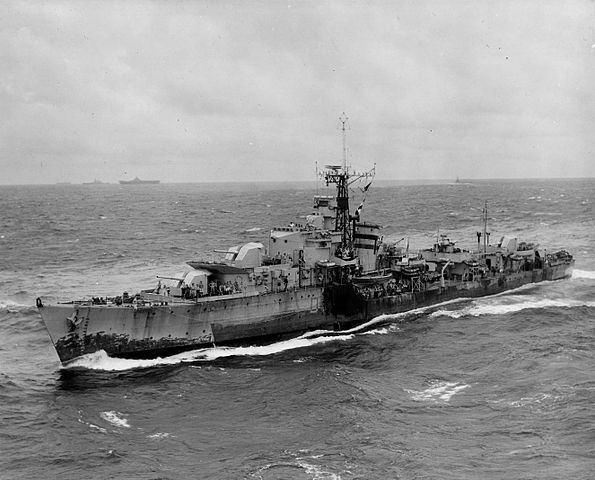
British T-class destroyer, 1945. See a colorized HD version made for the daily mail by Jared Enos
propulsion-wise, the setup was also made by the WWI flotilla leaders: The Scotts had two shaft IR geared steam Turbines, 4 Yarrow boilers, with a total output on the Scott (1917) of 40,000 shp, enough for 26 knots, burning oil only. They were twice as powerful compared to the 1917 V-W, the 1100 tonnes admiralty design (27,000 shp, 34 knots). The A-B class of 1929 had two shafts geared turbines of various manufacturers coupled with three admiralty 3-drum boilers, for an output of 34,000 hp, less than the WWI leaders, but it was more than sufficient to give them 35.25 knots (37 on HMS Amazon and Ambuscade, the prototypes). This power will gradually increase until the wartime J-K-N class to 40,000 shp for 36 knots, turbines being invariably from Parsons and the boilers, two admiralty 3-drum models. The Tribals were a bit off the map here, propelled by two turbines fed by three boilers of the same type, for 44,000 shp, achieving more than 36 knots. They also carried more oil due to the larger hull. Of course the 1943 Battle class was one step further with two larger boilers of the same type giving an output of 50,000 shp, enough to reach 35.75 knots. The admiralty indeed never was interested in achieving 40+ knots speed as French destroyers, and there were reasons for this: Standardization, and the heavy weather of the north sea which prevented to reach these high speeds anyway, only useful on the Mediterranean.
Armament: Guns and AA
Main Guns
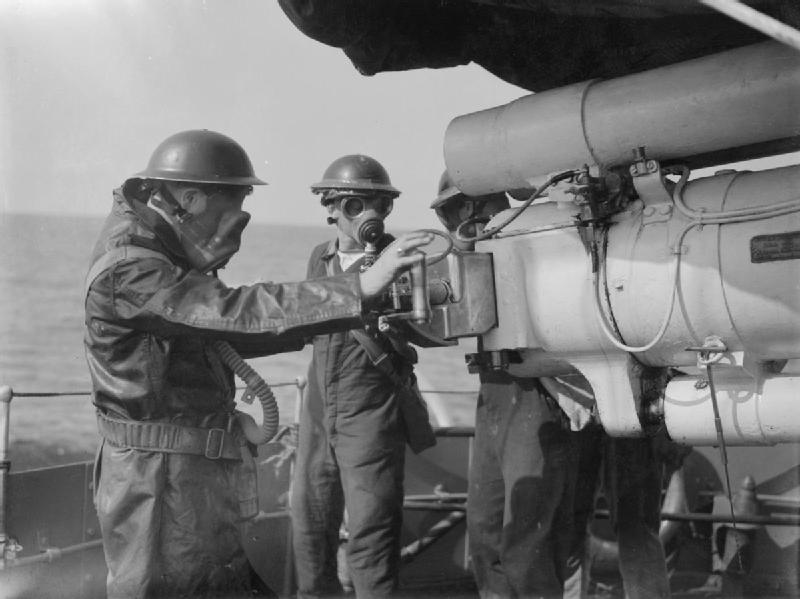
BL 4.7 in gun on HMS Broke, IWM
– QF 4.7 inch – standard main battery gun replaced later by the QF dual purpose 4.5 inch in 1942. No HA version. This was a powerful gun when introduced, and became the ubiquitous artillery for the majority of British Destroyers during WWII.
The original 4.7″ (12 cm) BL Mark I was introduced on the Scott, Shakespeare and Modified V&W classes of 1917-18, in response of the Germans having some destroyers armed with 15 cm (5.9″) guns. It was made of a tapered inner A tube, a full length wire with breech ring and breech bush, interchangeable. They also had a Welin breech block with Vickers mechanism. In total 776 were ordered but only 187 Mark I and Mk I* were completed before cancellation, of which 176 were still in service by 1939, although worn out. These guns also equipped the HMS Amazon and Ambuscade. From 1943 they started to be recycled on smaller ships. The British ordnance however instead of just reboring these WWI guns preferred to develop a brand new one, the Mark II. 32 Mark II were ordered in 1940, with a full length jacket and monobloc barrel.
Also equipped by these were the Athene and Engadine aircraft transports, LCG(L)3 and LCG(L), and the the French destroyers Mistral and Ouragan under British control, as rearmed. A few surviving ships of the smaller R, T and S classes of WWI still had the 4-in (102 mm). No info on the Mark III, probably experimental.
The 4.7 in/45 QF Mark IV was used on the A and B class interwar destroyers, the Mark IX on HMS Codrington (DD leader), C and D, E and F class destroyers and their leaders, G, H, I classes, the ex-Turkish DDs requisitioned (Ithuriel class), ex-Brazilian class requisitioned (Harvester class), and G, H, I class leaders (1935), but also the Q and R class and S,T,U,V classes of 1942.
In 1937 was introduced the Mark XII, adopted on the J ,K, N classes or wartime destroyers in twin mounts. The L and M classes used a longer barrel version, the Mark XI 50 caliber in three twin mount, used exclusively by the L and M class (1940-42)
– QF 4.5 inch The pre-war improvement over the 4.7 in: It existed in AP and HA versions and its mounting allowing AA fire. Smaller caliber but heavier shell, also 45 barrel lenght. It was less frequent on British destroyers, as the Mark IV was used on the Savage, Z, Ca, Ch, Co and Cr classes, the Battle class and Tribal class with Rebuilt Mark V mountings postwar.
But it was also used with fuses on many ships: The carriers Ark Royal (1937) and Illustrious class, the Forth, Maidstone supply ships, and the battleships Queen Elizabeth, Valiant and Renown as modernized (Mk.II and Mk.III), but also some monitors, the Mark III equipped the carrier HMS Implacable, HMS Savage, and the destroyers of the Battle 1942 and Battle 1943 classes but also postwar the carrier Eagle (1951) and Ark Royal (1955). RPM ranged from 12 to 15. They could fire the SAP 58.25 lbs. (23.0 kg), also the approximate Barrel Life was 650 rounds and provision for the Battle class was around 300 rounds, probably less on the Z, Ca, Ch, Co and Cr classes.
– QF 4 inch Mk V – World War I dual-purpose gun and coastal defence gun:
This model was intended to be used as a Dual Purpose (DP) weapon, and was a reasonably good AAA gun but lacked punch in anti-ship role, even against small vessels. It replaced the 4″/45 (10.2 cm) Mark V HA gun common on Cruisers. Some destroyers were rearmed as AA ships with twin masked mounts, four of them, of the L and M classes. however they were critiicized both for their barrel life and poor accuracy, according to John Campbell, blamed on projectiles with poor centering at the muzzle. The Mark XVI had an A tube and jacket from the muzzle and removable breech ring plus down-sliding breech block. Worked both on QF and Semi-Automatic mode, with different breech mechanism settings. Some 2,555 Mark XVI and XVI* guns and 238 Mark XXI were manufactured while Canada made 504 Mark XVI* and 135 Mark XXI guns and Australia 45 Mark XVI* guns, giving the scale of the effort. The QF 4 inch Mk XVI was superseded the earlier QF 4 inch Mk V. It was deployed on the “Hunt” and “Weapon” classes, the Canadian “Tribal” class, the “L” class destroyers as converted, HMS Lance, Legion, Lively and Gurkha, and “P” class destroyer HMS Petard, British “Tribal” class as converted as AA vessels and the Australian sloops HMAS Parramatta, Warrego, Bathurst and Kanimbla, plus many British sloops and auxiliary AA ships and ather vessels. The Polish also used it, the destroyer Blyskawica, completed and rearmed by the British.
– QF 6 pounder: Also called 6-pdr/10cwt or 2.244″/47 (57 mm) QF Mark I, it was usd by on some WWI era destroyers.
It was also developed as a coast defense gun by the Army to fire on E-boats and other small craft. Prototype tested in 1928, produced from 1934. 22 transferred to the Navy rearming WWI dstroyers. A tube, part length jacket, breech ring. Semi-automatic sliding breech block. Some were located in Valetta harbour. They managed to sink five Italian torpedo boats and Maiales (human torpedoes) in two minutes during the night attack of 25/26th July 1941, as being capable of 40 RPM from each barrel with good crews. Range was 11,300 yards (10,330 m) at 45° elevation.
– 3 in gun (lend-lease): US-built gun used on the 50 lend-lease destroyers transferred in 1940, see the US section. Sub-divided into the 3″/23.5 (7.62 cm) Marks 4 and 14, 7, 9, 11 and 13 and the 3″/50 (7.62 cm) Mark 10, 17, 18, 19, 20, 21 and 22.
AA Guns
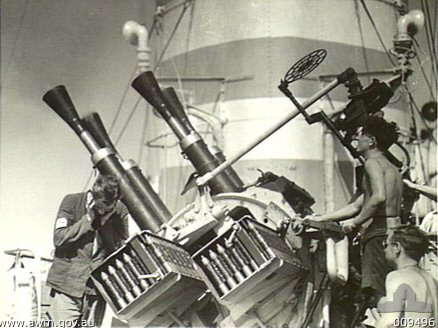
2-pdr ‘pom-pom’ on HMAS Parramatta
– QF 12 pdr: Used a a DP guns on early destroyers (WWI), also called 3″/45 (76.2 cm) or 20cwt QF HA. Declined into the Marks I, II, III and IV. It was Britain’s first designed-for-the-purpose AAA weapon, developed before WWI, widely used by the Navy and the Army. It had an A tube, full length wire, jacket, breech ring, and a vertical sliding breech-block with semi-automatic action. It was used on Destroyers of the “A” through “I” classes.
– QF 2 pounder (“pom-pom”): Quite ubiquitous, it was declined into many sub-variants: 2-pdr/50 [4 cm (1.75″) Mark IX and Mark X, 2-pdr/25 [4 cm (1.75″)] Mark XI, 2-pdr/39 [4 cm (1.75″)] Mark XII, and 2-pdr/50 [4 cm (1.75″) Mark XIV, but they were more common on HDML and Motor Launches. It was relatively short barrel and the Swedish Bofors was by far preferred.
– QF 40 mm (Bofors): The British water-cooled version was developed from the Dutch Hazemeyer mount in Britain in 1940, as seen on the Dutch minelayer Willem van der Zaan. The Black Swan class sloop HMS Whimbrel in November 1942 was the first to test it. Poduction combined in the Empire, UK, Australia and Canada is not accurately known in the range of about 2,800 plus those supplied from the US. 442 Mark IV and 342 Mark XI were in service by 1945 and 786 US-built at the same date.
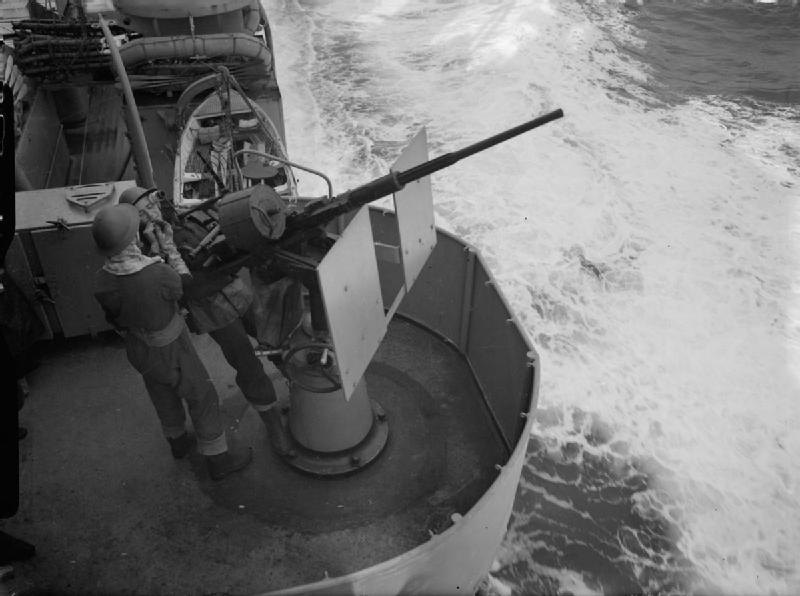
– QF 20 mm (Oerlikon): Production in UK started in Ruislip, London by the fall of 1940 from the Swiss model, purchased in 1938. The first produced were installed frim April 1941. It was superseded by Bofors 40/L60 40mm gun from 1943 in all three branches.
– QF 0.5 inch (Vickers) – mounted as an anti-aircraft weapon but, in practice quite ineffective.
– QF 0.303 (Lewis): Generally mounted in quad mount, tandem. Lacking punch against planes from the 1940s, but a very short range.
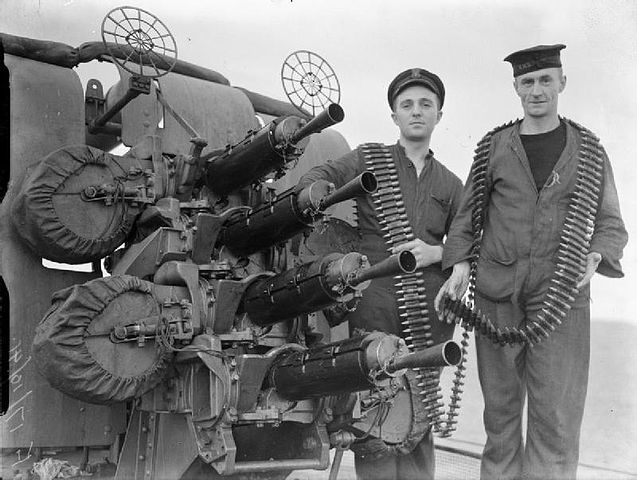
Armament: Torpedoes
Prewar models (flotilla leaders, V-W class): The 21 inches (53.3 cm) Mark IV and Mark IV*, Mark V were used. The latter were still used on A and B interwar destroyers. The latter dated back from 1918, powered by a wet-heater, weighting 3,828 lbs. (1,736 kg) for an overall Length of 23 ft 3 in (7.086 m) a range of 5,000 yards (4,570 m) at 40 knots or 13,500 yards/25 knots setting.
21 inch Mark IX (designed 1928): Fist deployed on the A class, and later models and used until the end of the war.
Characteristics: Weight 3,732 lbs. (1,693 kg) overall length 23 ft 10.5 in (7.277 m). Powered by a Burner-cycle engine providing 264 hp at 41 knots. Depending on the settings and models, the range was between 10,500 yards (9,600 m) at 36 knots to 15,000 yards (13,700 m) at 35 knots, but the double star could reach 41 knots (36 for older models). It was used in virtually all wartime emergency programme destroyers.
21 inch Mark X (1940): A peculiar model, it was known as the Mark X, X* models. However the Mark X was only used on Polish destroyers and the Mark X* on the ex-Brazilian Havant class destroyers. They were modified to fit these tubes and therefore produced in 1940-41 in small numbers. The latter carried a 661 lbs. (300 kg) TNT warhead and could reach 47 knots, but over 3,280 yards (3,000 m), extended to 13,120 yards (12,000 m) at 29 knots. They were propelled by a classic wet-heater, with four settings.
21 inch Mark XI (1944): This was the standard electric torpedo, inspired by captured German G7e-T2 torpedoes. Powered by electric batteries, this 3,632 lbs. (1,647 kg), 22 ft 5 in (6.833 m) long model carried a 710 lbs. (322 kg) TNT warhead to 5,500 yards (5,000 m) at 28 knots at max range as the motor produced 98 BHP at 1,755 rpm. Of course its main advantage was stealthiness, by not leaving a trail of bubbles. It was designed in particular for the crystal waters of the Mediterranean but found little use in 1944-45.
ASW Armament
Depth charges: These were of the Type A-B, C/C*, D/D*, D Mark III, Type E, F and Egerton model for WWI stocks. In 1940 was introduced the Mark VII Heavy, set for 91 m max (300 feets) and carrying a 290 Ibs. TNT charge. It was introduced in 1942. The British also testd magnetic fuses models, not adopted in service. There was also the torped-tubes launched Mark X, X*, X**. More on a dedicated post on British ASW vessels.
All in all, British ships (all types) thrown or droped 5,174 depth-charges for 85.5 confirmed kills, so a ratio of 60.8 DCs spent for each kill.
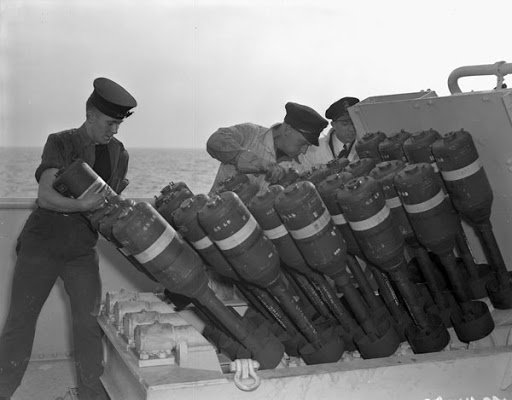
Early ASWRL models were tested, like the Fairlie Mortar, tested on HMS Whitehall in 1941 and HMS Diana in 1942. It consisted in five mortars for DCs mounted at the prow. The Parsnip was the former Fairlie Mortar redesigned as a ten-barrel model as a Plan B to back the Hedgehog. It was also unsuccessful.
Spigot mortar: Replacing the models above from 1942, but transitional as it was refined as the Hedgehog.
Hedgehog: Classic rocket-launcher (the first) introduced in 1942 but really efficient combined with a precise sonar in 1944.
Squid mortar: This 3-barrel, 12-in mortar was rushed into service in 1943 and tested on HMS Ambuscade. It was replaced by the Limbo.
Note: All these specific ASW weapons will be reviewed in greater detail in a future British ASW vessels article.
Radars, HFDF and SONAR:
Radars (The Polish and British were pioneers) were at first reserved to the largest ships, due to their weight essentially, but with time simpler, short range models found their way in destroyers from 1941. Their effectiveness against surface threats was prove time and again, giving a decisive advantage in night actions against the Italian Regia Marina notably, such as Cape Bon and Sfax. These were modified transmitters in the microwave portion of the radio spectrum and this low power 1st generation was installed in coastal centers, and played a vital part in the Battle of Britain. However in 1940, the invention of the resonant-cavity magnetron allowed to reduce components enough to fit the radar on any ship. Bell Labs soon duplicated it and perfected the model, which saw a wide use in USN service.
Inside the Navy, His Majesty’s Signal School (HMSS) made early demonstrations of previous experiments made at Orfordness and Bawdsey Manor, from Portsmouth, with the task of developing wireless valves used at Orford Ness. This led to an Admiralty RDF model, later developed at Witley and Haslemere in Surrey. In the end, this unit was integrated onto the Admiralty Signal Establishment (ASE).
The Royal Navy used numerous models, we will concentrate on those carried by destroyers: Surface Warning/Gun Control (Type 281), Air Search/Gunnery Director (Type 282-285), Microwave Warning/Fire Control (Type 271), the lighter of them all. The Type 272-273 were early models used on destroyers. The most common derivative of the Type 277 was the light Type 276 for destroyers. It replaced the first generation Type 271, considered internally as a failure because of its poor range and lack of accuracy. But it was given to corvettes and small ships, protected by a unique “lantern” radome, mounted directly over the radar operator’s cabin. Tested in March 1941 it consisted in a cavity magnetron and sealed crystal detectors, and really became powerful by 1944-45.
Huff-Duff:
Another electronic device widely used by Destroyers and smaller vessels for ASW detection was a simple antenna, the Huff-Duff. Its colloquial nickname came from its acronym HF/DF, standing for High-frequency direction finding. Its purpose was to intercept HF signals emitted by U-Boat radios to the HQ at Lorient. It became with the Sonar one of the strenghts of Allies intelligence, locating German U-boats and commerce raiders in the Atlantic.
ASV (fleet air arm):
Outside the Navy, the fleet air arm also receive its own model, the Air-Surface Vessel Mark I, using electronics similar to AI sets. It was the world’s first aircraft radar to enter service in early 1940. In 1942-43 it was gradually improved to the ASV Mk.II which power allowed to detect submarines on the surface.
Sonars:
This device went back to WWI, and it was perfected during the interwar, in power, accuracy and range. The ealiest ones were the Type 112 (1920) fitted to the V-W class destroyers. The Type 119 was introduced on the B class destroyers in 1930, and the Type 121 had the first retractable dome. It was first tested in 1931 and deployed on D, E, F, G class destroyers. The Type 124 appeared in 1934 and was a rectractable type, fitted on the C,H,I,J,K and Tribal class destroyers, and retrofitted as well in WWI era and interwar models. The smaller Type 128, first tested on HMS Acheron in 1937, was used by the A, L class and Hunt-class destroyer escorts. The Type 141 was the designation of USN sonars fitted on the lend-lease twon-class destroyers, some refitted with a dome similar to the Type 141, and setup to British range and bearing recorders. At last, the Type 147 was first tested in May 1943 on HMS Albuscade and deployed on later war destroyers, combined with the Squid ASWRL. The Type 144 was a version of 1942 designed to work with the Hedgehog, found on destroyers equipped with this weapon.
British destroyer tactics:
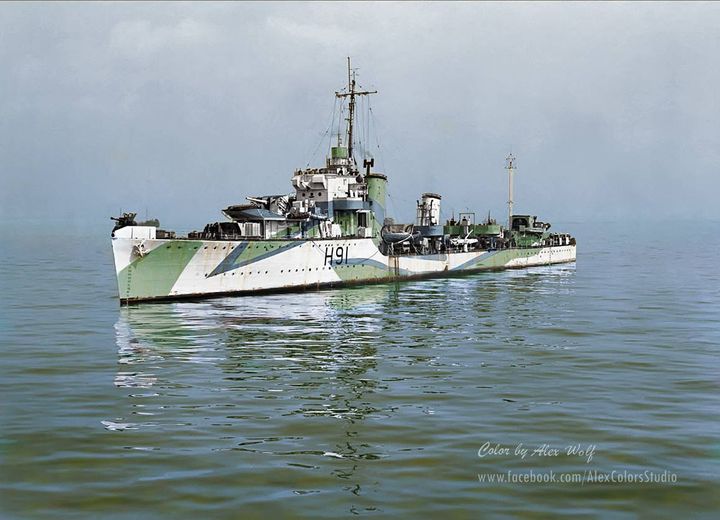
Colorized photo of HMS Bulldog, colorized by Alex Wolf (war in colors)
They appear in WW2 and were little changed in the 1930s, but accounting for the growing threat of aviation. Destroyers were already used to deal with submarines in WW1, equipped with depht charges and Y-guns. WW2 brought a whole new level in ASW warfare, but dedicated vessels were gradually preferred for escort duties rather than the versatile and costly destroyers.
Allied destroyers were engaged in the Arctic, Atlantic, Pacific and Indian Oceans, North and Mediterranean seas. In total, some 389 Australian, British and Canadian destroyers saw 150 losses or fatally damaged (total constructive loss or repairs deemed unpractical, not worth it). New weapons appeared, such as the hedgehog and the spigot and squid mortars, while detection also grew dramatically with the adoption of radar. Destroyers were used to escort convoys, a fleet or task force, perform aggressive moves, most often to protect, and raiding enemy merchant and naval ships. In Norway or Guadalcanal they also carried troops and were used in shore bombardment in many operations, like larger ships. For this reason the armament stayed as versatile as it was possible, with a main artillery able to deal with small ships, other destroyers, submarines or even light cruisers, torpedoes to sink all size of ships if they could close enough, AA to protect against air attack (although their small size limited the amount of AA that can be carried), and of course ASW warfare.
DDs has been jack-of all trades, notably ferrying troops back from the Dunkirk’s beaches in 1940, or carrying them in Norway, sometimes paying a heavy price (in Dunkirk in particular, which conducted Churchill to ask quick replacements and to the US, 50 older destroyers to be leased. One of the important role of destroyers has been escort; a role for which they were gradually replaced by cheaper and more suited vessels, frigates, corvettes and escort DDs.
British practice was generally to keep recent fleet destroyers for the Fleet and relegate older models to escort duties, but this proved unsatisfactory as the powerful powerplants still were gas-guzzlers limiting range for escort, and if armament address surface, air and submarine threats, this affected their stability and in the middle of the atlantic, the ASW threat was the only real one. In the end, convy duties urged more destroyers, that were already stretched between multiple theaters of operations. Smaller mass-built cheap vessels were irgently needed to free destroyers from this task.
At first the British adapted elderly British and later US destroyers (the four pipers) for ASW warfare, oftn removing part of the boilers to make room for more oil. The Hunt-class escort destroyers ordered before the war, in early 1939, were a feoresight of the Admiralty and proved only suited for the North Sea and Mediterranean due to their range. But soon, civilian yards will answer the call, delivering smaller ships for the North Atlantic: The Flower and Castle-class corvettes, River, Loch and Bay-class frigates, Black Swan-class sloops, in effect freed destroyers from escort duties by 1944.
Wartime actions showed some remarkable use of destroyers of their own as well:
The Battle of Cape Bon (Tunisia) in 1941: The British 4th Destroyer Flotilla (HMS Sikh, HMS Maori, HMS Legion and Dutch Isaac Sweers) intercepted, and defeated in battle the Italian cruisers Alberto di Giussano and Alberico da Barbiano. Both were -irony there- designed as destroyers hunters…
Capture of U-110 in 1941:
Operation Primrose was the detachment of a destroyer, HMS Bulldog, from convoy OB318 to capture U-110 and its top-secret Enigma cipher machine and associated documentation, a clear win for the allies.
St. Nazaire Raid, 1942 From the fifty lent destroyers from the US, HMS Campbeltown rose to fame. Known as the ex-USS Buchanan she was disguised as a German destroyer and loaded with commandos, plus explosives for the very dangerous but ultimately successful raid, ramming and destroying the local dry dock, the largest on this coast for German battleships such as the Bismarck and Tirpitz.
Battle of North Cape, 1943: This battle which saw the Scharnhorst sunk by a squadron composed of HMS Savage, Saumarez, Scorpion, HNoMS Stord, HMS Opportune, Virago, Musketeer and Matchless. It was like a wolf pack against a bear.
Battle of the Malacca Strait: IJN Haguro, a heavy cruiser, was intercepted engaged and sunk by the 26th Destroyer Flotilla (HMS Saumarez, Verulam, Venus and Virago) off Penang, on 16 May 1945.
WW1-era British destroyers
R class destroyers (1916-17)
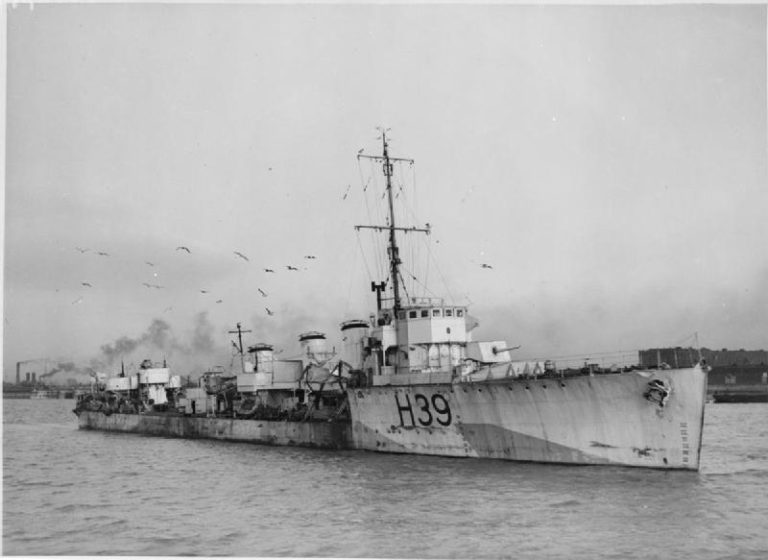
HMS Skate of R class in 1942
A few of this mass of R-class, improved S-class, were still active in 1939: HMS Skate participated in the Second World War, and HMS Radiant, sold in Siam in 1920 was active as Phra Ruang in 1942 during the French-Siamese war. Sea the WW1 DD section.
Shakespeare class leaders (1916-20)
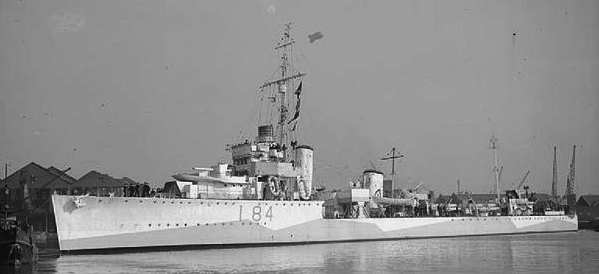
Thornycroft presented in admiralty competition in 1916 destroyers leaders who were to take the squadron of class V buildings and respond to the new German destroyers, which – according to intelligence service – had parts of 140 mm. Due to lack of time to develop new naval artillery pieces of equivalent caliber, a proven 4.7 inches (120 mm) field gun was adapted, relatively slow to reload to naval standards.
No less than five masked pieces constituted the endowment of this class, which became in fact the best armed of the moment. The Shakespeare were a new standard in the matter within the Royal Navy. Out of 7 ships will be ordered, two were cancelled in April 1919, and the Rooke and Keppel completed in the 1920s. The Shakespeare, the Spencer and the Wallace took part in the conflict.
They were followed by Scott class ships built at Cammell Laird’s. After the war, the Rooke will be renamed Broke while the Shakespeare and the Spencer will be put in reserve then sent for scrapping in 1936. In 1939, the survivors of this class were Wallace, Broke and Keppel, whose speed and weapons remained at Royal Navy standards.
Was later added the Huff-Duff and the sonar as standard, as well as ASW grenade launchers with a large supply, while removing their parts of 120 mm, two were retained. The Broke was one of the rare Allied ships destroyed during Operation Torch: She was sent to the bottom on November 8, 1942, by a coastal battery held by French faithful to Vichy, defending the port of Algiers. The Wallace will be rebuilt as an anti-aircraft destroyer and served as an Atlantic escort with the Spencer.
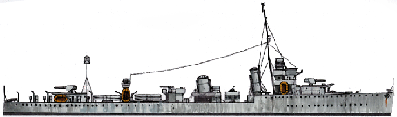
Auhor’s rendition of HMS Broke, of the Shakespeare class
Characteristics (Shakespeare, 1939):
-Displacement: 1500 t. standard -2 145 t. Full Load
-Dimensions: 101 m long, 9.6 m wide, 3.8 m draft (full load).
-Propulsion: 2 shaft Brown-Curtis turbines, 4 Yarrow boilers, 40,000 hp.
-Maximum speed 36 knots, RA 3000 nautical miles at 12 knots.
-Armour: 80 mm gun shields.
-Armament: 2 x 120 mm (2×1), 1 x 76 mm MK VI AA, 2 x 40 mm AA, 6 x 533 mm TTs (2×3), 1 Hedgehog, 8 mortars, 98 ASM grenades.
-Crew: 195
V/W class destroyers (1917-18)
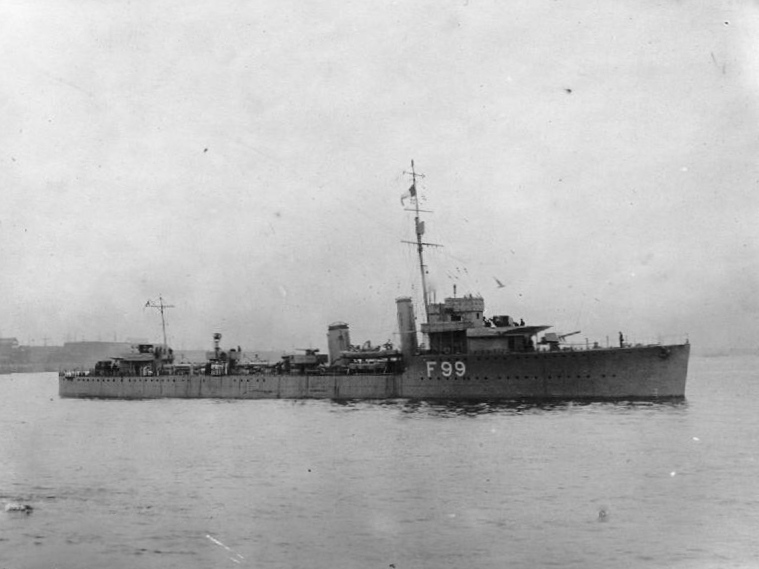
HMS Valentine, 1917 IWM
The “V” class of the great war formed the backbone of the light forces of the Royal Navy during the interwar period. These were 26 units organized in squadrons and led by the 5 Shakespeare-type leaders (see above). They proceeded from a new design resulting from false information coming from the British secret services that the Germans were secretly preparing a new standard of powerfully armed destroyers of more than 1200 tonnes.
The Vs were therefore dimensioned, their bridge reinforced to accommodate new banks of triple torpedo tubes. Bigger, taller, they held the sea better in bad weather and were better adapted to the Atlantic. The gun platforms were protected by steel steps, to break the blades, which was still new at the time. Their entire construction gave the impression of great robustness. They were de facto, much more massive than their German equivalents of the same era, more comfortable in the Baltic.
All took part in the great war: Built quickly, the last of the V series were accepted in service in June1918. A unit jumped on mines in August 1918, and one was also lost following a Soviet mine in 1919, and the third of a torpedo launched by a star also Soviet. Subsequently, four buildings were withdrawn from service in 1936 and cannibalized to keep the units in operation. 18 were in service in 1939, two of which were quickly paid to the Australian Navy (RAN).
A conversion into AA destroyer escort (AAE) was carried out on 7 units during 1940, when being equipped with new 102 mm DP turrets with rapid fire, four AA 20 mm Oerlikon guns under mask and an ASW complement of 45 vehicles for two lockers and two mortars. Their autonomy had also been increased, with almost 10 tonnes of additional fuel oil. Eight other British destroyers of this class were converted into long-range escorts (designed to escort convoys to the USA). For this, several boilers were sacrificed for the benefit of additional fuel oil reserves.
Their speed therefore fell to 25 knots, having only 15,000 hp “underfoot”. The equipment of this conversion specializing in ASM (LRE for Long Range Escort) fight included two to three pieces of 120 mm, 2 Bofors and 6 Oerlikon, but especially 110 grenades in traps, reserves, and 4 to 6 mortars.
Two others were converted to SRE (Short range escort): They kept their machinery and speed intact, but their armament was also changed. Some kept a bank of torpedo tubes. Others saw the addition later in the war of a Hedgehog (ASM rocket launcher) or sometimes a 47 mm Q-Gun with ultra-rapid fire, designed to fire at the kiosks of diving units.
The SREs carried out their standard electronic equipment including a Huff-Duff antenna (trigonometric tracking) and a sonar. Solid, these ships therefore waged their second war in thirty years. They were scrapped in 1946-47. The remaining units were untouched, except for the possibility of replacing one of their banks of torpedo tubes with a 47 mm rapid-fire cannon, the addition of 33 ASM grenades and two to four 20 mm AA guns.
Casualties in combat were relatively few: There was the Venetia, lost on a mine in Nov. 1940, the Vimiera which suffered the same fate in January 1942, and the Vortigern, torpedoed by a U-Boote in March 1942. In 1942, they all had a Huff-duff** antenna and an asdic-sonar.
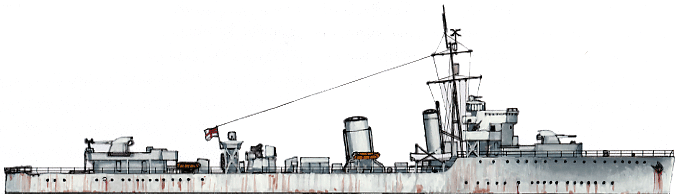
HMS Viceroy in 1943, with her white livery for winter escorts of Murmansk convoys. Example of AAE conversion
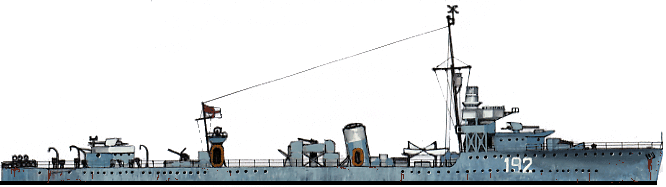
HMS Viscount in August 1942, in “western approach” livery (North Atlantic convoys) Example of LRE conversion. (1/400)
Characteristics
-Displacement: 1500 t. standard -2 145 t. Full Load
-Dimensions: 101 m long, 9.6 m wide, 3.8 m draft (full load).
-Propulsion: 2 shaft Brown-Curtis turbines, 4 Yarrow boilers, 40,000 hp.
-Maximum speed 36 knots, RA 3000 nautical miles at 12 knots.
-Armor: 80 mm guns shields.
-Armament: 2 x 120 mm (2×1), 1 x 76 mm MK VI AA, 2 x 40 mm AA, 6 x 533 mm TTs (2×3), 1 Hedgehog, 8 mortars, 98 ASW grenades.
-Crew: 195
Scott class destroyers (1917-18)
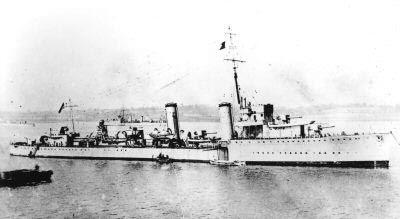
HMS Scott in 1917 – AWM
The Scott class was derived directly from the Shakespeare class. It was a series of eight squadron leaders launched in slight deferral. The Scott was indeed launched at the end of 1917 and the others during 1918, at Cammel Laird and Hawthorne Leslie. Only three took part in the last operations of the great war.
All but one (the Scott torpedoed on November 18, 1918) were operational in 1939, without modernization. The Scotts in their time confirmed the successful design of the Shakespeare. These buildings were in fact taken over to inspire the “standard” destroyers of the next generation.
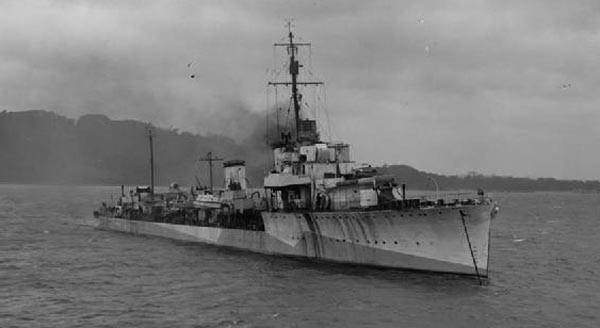
HMS Douglas in WW2
They also served as a basis for plans for destroyers sold for export. In 1942, the needs of the escort led to a drastic modernization. All thus lost their upper rear part (C) in favor of a 76 mm AA gun soon enough. It also involved replacing one of their banks of torpedo tubes with an artillery bench A, and at the front an ASW (P-Gun) 47 mm rapid-fire cannon, at the front for three units, another was equipped with a Hedgehog (Malcolm) with the addition of ASW grenades and two to four 20 mm AA guns.
They also all had a Huff-duff** antenna and an asdic-sonar. The Stuart was sent to serve with the RAN. They had a very active career and were broken up in 1947.
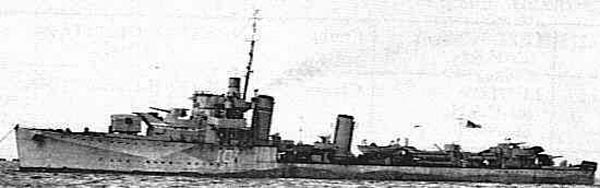
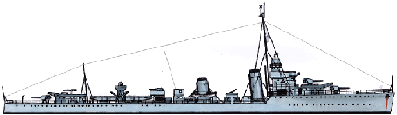
HMS Campbell, light blue livery 1939
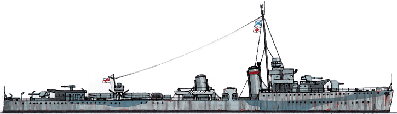
HMS Montrose in 1943, Murmansk convoys
Characteristics
-Displacement: 1850 t. standard -2235 t. Full Load
-Dimensions: 101.3 m long, 9.7 m wide, 3.8 m draft (full load).
-Propulsion: 2 shafts Parsons turbines, 4 Yarrow boilers, 40,000 hp.
-Maximum speed 36 knots, RA 3000 nautical miles at 12 knots.
-Armor: Maximum masks of parts 80 mm.
-Armament: 3 x 120 mm (3×1), 1 x 76 mm MK VI AA, 2 x 40 mm AA, 6 x 533 mm TTs (2×3), 4 ASW mortars, 70 grenades.
-Crew: 164
W class destroyers (1918)
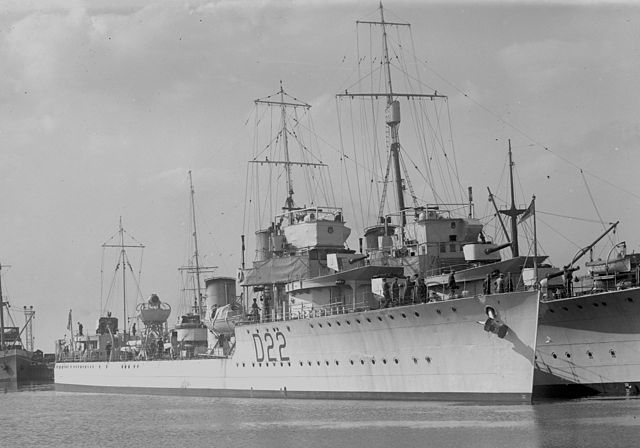
HMS Waterhen
This very important series was derived from the upsizing performed by wing leaders such as Shakespeare and Scott. Their tonnage was much higher, their armament reinforced, comprising four pieces of 102 mm QF under masks and six torpedo tubes in two axial benches. Their hull was reinforced for the harsh conditions of the North Atlantic.
A good part was operational at the end of the war, some participants in the blockade of Zeebrugge and Ostend. The hms Warwick will be seriously damaged there, but later towed by the hms Velox and repaired, it will resume service. The Waterhen and Voyager will be sent to the RAN (Royal Australian Navy) in 1933, the Walrus hit a reef and sank in 1938, while eighteen others were in service with equipment almost unchanged since their commissioning.
The imperatives of the escort missions quickly imposed their reconversion: 5 units were taken in hand for reconversion in SRE (Short Range Escort) 5 in AAE (Anti-aircraft escorts) and two in SRE (Short Range) with in particular a double Y-Gune to 76 mm rapid fire and 20 ASM grenades.
The others received an AA complement of 20 mm Oerlikon pieces and two 40 mm bofors, more in some cases a Y-Gun piece and 28 to 34 ASM grenades as well as mortars, all at the stern. From 1942, all received standard Huff-Duff and a recent asdic-sonar. 7 of them were sunk, including 6 in Europe by U-boats and Stukas, and one, hms Waterhen, by Japanese aviation in the Far East. The survivors were placed in reserve in 1945-46 and BU soon after.

HMS Wakeful (wow)
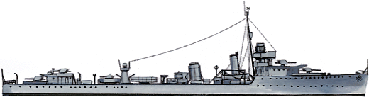
HMS Walpole in gray “western approach” livery, Atlantic, 1942. Note the Y-Gun instead of the bank of torpedo tubes B
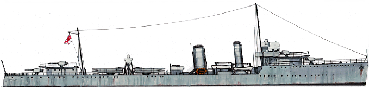
HMS Wolsey in 1939, with the standard livery of the time, medium gray hull and pale gray superstructures, and white bands of squadrons on the funnels.
Characteristics (Walpole, SRE 1942)
Displacement: 1665 t. standard 1710 t. Full Load
Dimensions: 95 m long, 9 m wide, 3.2 m draft (full load).
Propulsion: 2 propellers, 2 Parsons / Brown-Curtis turbines, 4 Yarrow boilers, 27,000 hp.
Performances: Maximum speed 34 knots, RA 2,500 nautical miles at 12 knots.
Armor: Maximum masks of parts 80 mm.
Armament: 4 x 102 mm (4×1), 2 x 76 mm MK VI AA ASM, 3 x 40 mm AA, 3 x 533 mm TT (1×3), 20 ASW grenades.
Crew: 134
British escort destroyers: The Hunt class
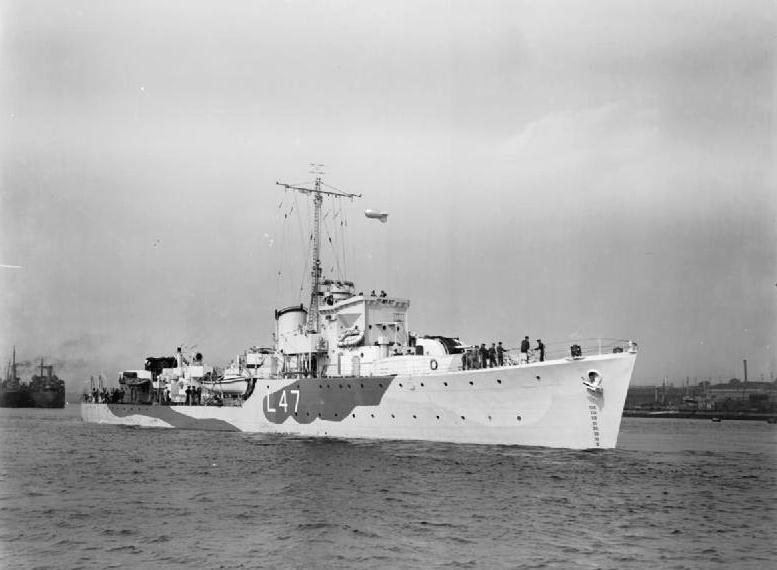
HMS Blean, Hunt type III destroyer.
No less than 86 escort destroyers were also built during the war, mirroring those in the US, but with much lower quantities, and they were started much earlier, in early 1939. They were the inspirators for US equivalents, but had loads of problems and were not very popular with their crews. The Hunt class nevertheless was complementary to the River, loch and Bay class ships or the smaller Flower and Castle class corvettes, in having more firepower, being also faster and more versatile. They were built in four series, the first launch from December 1939, the last (serie IV) in September 1942. By that time, the RN staff decided this type was superfluous and concentrated on cheaper escorts, while at the same time, the Royal Navy benefited from US transfers, 32 destroyer escorts of the GMT class and 46 of the TE class, called collectively the Captain class Frigates. They also received 21 Tacoma class Frigates, named the Colony class, delivered via lend-lease in 1944.
The names choices reflected their main purpose, to hunt any disruption to the convoys, whether u-Boats when surfaced or submerged, E-Boats or aircraft. All were named after British large hunting domains. The initial serie was plagued by stability problems, solved on the Type 2, better armed, and nearly 200 tonnes larger, while the type 3 (1941-42) was slightly lighter, and returned to the type 1 armament, but introduced a twin 21 inches torpedo tubes bank to better deal with E-Boats and any target of opportunity. The serie 4 was a one-off experiment by Thornycroft, larger with a longer forecastle, same armament as the type 2 and 3 but with a triple TT bank.
Hunt Serie I: These initial 23 ships has been planned as reduced version of destroyers, with 4-in guns armaments instead of 4.7 in. The initial plan called for six twin guns, but errors in calculations conducted to a flawed design, very unstable. Therefore the main armament was reduced t just two twin guns, of the Mark XVI HA dual purpose QF type. In addition they had a single quadruple pom-Pom 40 mm AA gun and 50 deep charges. They were built at Camell Laird, Yarrow, Vickers-Armstrong, John Brown, Swan Hunter, Scotts, White and Stephens. Just three were launched in 1939: Athertone, Eglington, and Hambledon, the rest in 1940. Construction was fast.
The Hunt Serie II Thirty-three of these were built with more beam for stability. Instead of stabilizers, three of these had extra oil tanks. Later in the war single bofors were added on some ships. DC provision rose to 60 and main armament now comprised three twin 6-in/45 Mark XVI HA and a quadruple pompom 40mm. Three were transferred to the free Polish Navy. There were a few losses during the war: HMS Dulverton in 13/11/1943, by an HS 293 flying bomb, Eridge in august 1942 by Italian MAS, Heythorpe in march 1943 by an U-Boat as well as Grove in june 1942 and Puckeridge in Sept. 1943, and Hurworth in october 1943 by mines, like Oakley and Southwold. Many sere sold after the war: Greece, Germany, Norway, Denmark and India.
The Hunt Serie III were not larger vessels, they had a lower draft, were displaced less. These tenwty-eight ships launched in 1941-42 were back to the Type I armament, just two 4-in twin mounts, one replaced by a twin TT banks to give them more versatility. AA was the same, but they carried ten DCs more (70). Six were lost in action, one by collision. After the war, they were sold mostly to Greece, Germany and Norway.
The Hunt Serie IV: They were the a clear step-up with 1700-1750 tonnes of displacement, 90.22 m (296 feets) overall, 10.16 m (34 ft 10 in) in width, 3.58 m in draft and were launched in June and September 1942 (HMS Brecon and Brissenden) with a forecastle extended to the rear ‘B’ DP mount. Basically they were an experiment, limited to just two ships but the Hunt serie was deiscontinued while at the same time, about 76 US-built destroyer escorts, named the “captain class”, were transferred ender lend-lease.
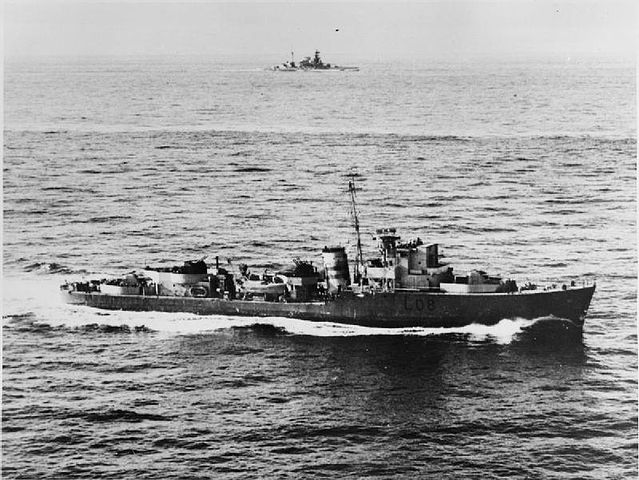
HMS Exmoor, a Type II hunt class (IWM)
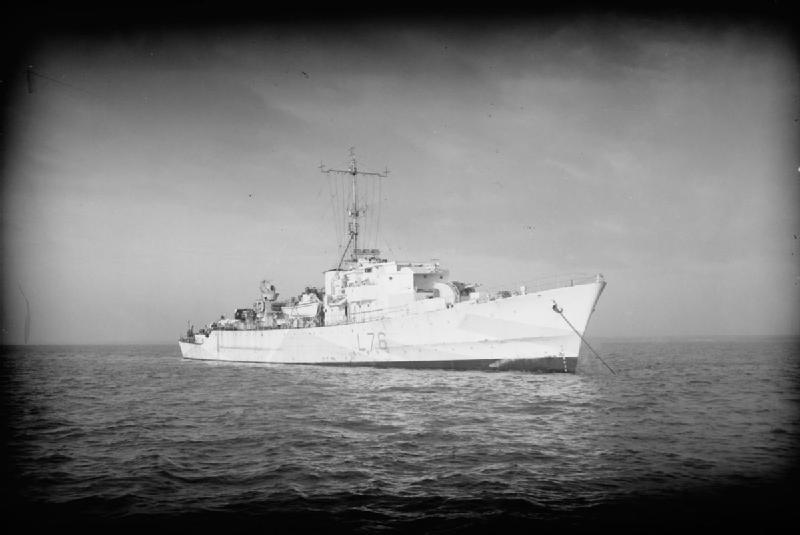
HMS Brecon, Type IV (AWM)
British lend-lease destroyer: 50 “four-pipers”
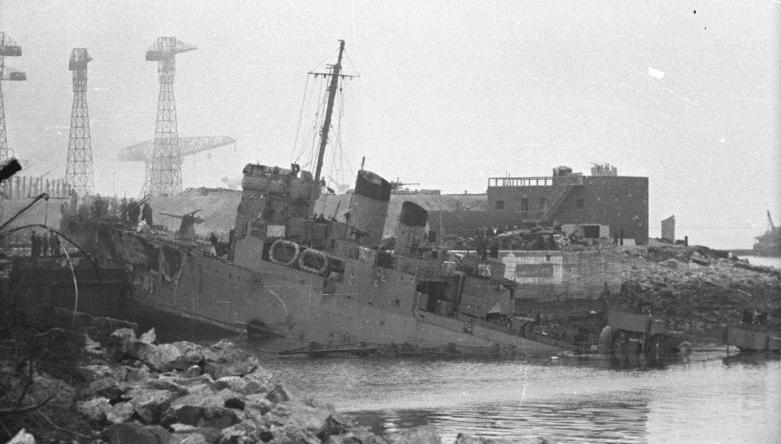
HMS Campbeltown at Saint Nazaire, probably the most famous of the British “four pipers” (bundesarchiv).
Also used for convoy escort at the beginning of the war were fifty ex-US destroyers of the old Caldwell class of 1917-1920, the famous “four-pipers”. After difficulties, President Roosevelt forced the Congress to agree to their transfer, despite arguments of an obvious breech of neutrality. Yhey were delivered in November 1940, at the insisting demand of Winston Churchill after the crippling losses of the 1940 campaigns of Norway, France (notably Dunkirk) and the Atlantic.
They were no more popular with British crews because of their very wet decks in the North Atlantic, but they were fast and rugged, and they were rearmed often for the purpose, with additional deep charges, sonar, radar, huff-duff over time, and TTs deposed as superfluitous.





 Latest Facebook Entry -
  X(Tweeter) Naval Encyclopedia's deck archive
 Instagram (@navalencyc)


 French Navy
 Royal Navy
 Russian Navy
 Armada Espanola
 Austrian Navy
 K.u.K. Kriegsmarine
 Dansk Marine
 Nautiko Hellenon
 Koninklije Marine 1870
 Marinha do Brasil
 Osmanlı Donanması
 Marina Do Peru
 Marinha do Portugal
 Regia Marina 1870
 Nihhon Kaigun 1870
 Preußische Marine 1870
 Russkiy Flot 1870
 Svenska marinen
 Søværnet
 Union Navy
 Confederate Navy
 Armada de Argentina
 Imperial Chinese Navy
 Marine Haitienne
 Marinha do Portugal
 Mexico
 Kaiserliche Marine
 1898 US Navy
 Argentina
 Brazil
 Chile
Chile Cuba
Cuba Peru
Peru Bulgaria
 Denmark
 Greece
 Netherlands
 Norway
 Portugal
 Romania
 Sweden
 China
China Thailand
 Sovietskiy Flot
 Royal Canadian Navy
 Royal Australian Navy
 RNZN Fleet
 RIN Fleet
 Chinese Navy 1937
 Kriegsmarine
 Chilean Navy
 Danish Navy
 Finnish Navy
 Hellenic Navy
 Polish Navy
 Romanian Navy
 Turkish Navy
 Royal Yugoslav Navy
 Royal Thai Navy
 Minor Navies
 Albania
 Austria
 Belgium
 Columbia
 Costa Rica
 Cuba
Cuba Czechoslovakia
 Dominican Republic
 Haiti
Haiti Hungary
 Honduras
 Estonia
 Iceland
 Eire
Eire Equador
 Iran
Iran Iraq
Iraq Latvia
 Liberia
 Lithuania
 Mandchukuo
 Morocco
 Nicaragua
 Persia
 San Salvador
 Sarawak
 Uruguay
 Venezuela
 Zanzibar
 Warsaw Pact Navies
 Bulgaria
 Hungary

 Bundesmarine
 Dutch Navy
 Marina Militare
 Yugoslav Navy
 Chinese Navy
 Indian Navy
 Indonesian Navy
 JMSDF
JMSDF North Korean Navy
 Pakistani Navy
 Philippines Navy
 ROKN
ROKN Rep. of Singapore Navy
 Taiwanese Navy
 Vietnam People’s Navy
 IDF Navy
 Saudi Navy
 Royal New Zealand Navy
 Egyptian Navy
 South African Navy


 Ukrainian Navy
Your information is vibrant and comprehensive. Wonderful. We are Greggie Morebooks Presents…check us out in the Kindle Store, particularly our Talking Sea series. Go to the store and put Greggie Morebooks in the find field. At present, we have 118 books up there in a bunch of genres. We are now working on a 3-volume set called “The King’s Destroyers” about the 123 destroyers lost in WWII. We will be back and forth on your website to check our accuracy and more. Congratulations. Our flagship book in the Talking Sea series features HMS Glowworm H92…Out of the Darkness and Into the Light. Shoot us back a note, and tell us what you think of our navy works. By the way, you can publish our email address…we can use the promotion.
Hello,
You state the Battle Class destroyers took no part in the war. This is wrong. HMS Barfleur was completed by Swan Hunters on Tyneside in January 1945 and was in Valletta on VE Day on her way to join the British Pacific Fleet where she performed part of the Destroyer Screen for HMS Indefatigable. She was present with the Fleet when the Japanese signed the surrender. She was attacked by Kamikaze, but evaded.
After VJ Day she had an independent commission, “Showing the Flag” around the Far East and Australasia, after repatriating British, American and Commonwealth POWs. She returned to the UK in 1946.
That would be the sole exception.
Chapter SONARS:
The type 141 was the designation of US Navy sonars fitted on the lend-lease TWON (?)-class destroyers,
Characteristics (F class 1939)
Displacement: 1400 t. standard 205 t. Full Load ==> 205 t full load ??
Thx for spotting, fix underway