Abarth
A brilliant motorcycle racer of the 1920s:
 The firm founded by Karl Abarth would spearhead the revival of grassroots motor racing in a rebuilding Italy. Born in Vienna, Austria, in 1908, he began as an apprentice draftsman at Castagna in Italy, where he honed his skills working on motorcycle and sidecar chassis. He also loved to test-ride them—and rode fast, very fast—securing five world titles as a factory rider and winning his famous wager to travel from Ostend to Vienna faster than the Orient Express. However, on the eve of World War II, a serious accident ended his brilliant racing career.
1945: With Porsche:
In 1945, he was running a small motorcycle manufacturing workshop in Yugoslavia when his father summoned him to Merano, in Northern Italy. He was to take over the Porsche "dealership"—which was, in fact, the agency representing the firm's design, patent, and equipment interests. There, he met Ferry (Ferdinand was imprisoned in France at the time), engineer Rodolfo Hrueska, and—most importantly—Piero Dusio. Dusio was the head of Cisitalia, a fledgling sports car brand that would make headlines both for its racing success and for the distinct honor of having one of its models exhibited at the Museum of Modern Art in New York.1947: With Cisitalia:
Though newly established, he was well-connected; in 1947, he sold Dusio the plans for a Porsche Formula 1 car featuring a flat-12 engine, four overhead camshafts, twin superchargers, and all-wheel drive. Porsche's finances were saved for the time being, but the same could not be said for a portion of Cisitalia; following Piero Dusio's departure for Argentina due to financial troubles, this part of the business fell into the hands of his closest associate, Carlo (Karl) Abarth, in 1949, along with some of the Turin workshops and the technical team. It was Piero's son, Carlo Dusio, who inherited the remainder of the business, using it to relaunch the brand in 1950. "Abarth & Co." had been founded the previous year; its racing team—bearing the famous scorpion emblem (Abarth's zodiac sign)—would field top Italian drivers of the era, such as Nuvolari, Farina, and Taruffi, in Formula 2 (1100cc) competition. Since Cisitalia cars were based on the Fiat 1100, Abarth naturally focused on tuning and developing similar mechanical components from the Piedmontese manufacturer.The Abarth Workshop: Tuning and Preparation.

From 1950 onwards, his workshop funded its racing activities through special tuning work for gentleman drivers. As early as 1949, he produced special models based (indirectly) on Cisitalia designs, such as the 604-A (delivering 83 hp and a top speed of 190 km/h). Coupé variants introduced in 1950 continued the winning streak. He also began manufacturing parts and even bodywork accessories; Carlo Abarth was a high-caliber "tuner" long before the term became commonplace. He started with special exhaust systems—known as "Marmitta"—and eventually progressed to fully tuning Fiat 600s, boosting their output to as much as 65 hp.
From Special Models to Complete Cars. However, the second "true" Abarth was released in 1955. It was a spider based on the Fiat 1100—a platform Abarth was already utilizing—known as the 207-A. Only three units were produced, all featuring coachwork by Boano. A series of special models followed, with bodies crafted by Vignale, Ghia, Boano, and Bertone, aimed primarily at the US market. Yet, true fame would come from Abarth’s comprehensive reworking of lightweight, widely available, and easy-to-maintain platforms: the famous "yogurt pots," the Fiat 500 and 600. The Fiat 500 and 600 "transfigured" by the wizard.
The first fully modified Fiat 600s appeared in 1955. These were ultra-lightweight cars featuring engines with displacements increased first to 747 cc and later to 847 cc. In 1957, Abarth 750s swept the top three spots at the Mille Miglia. In fact, the Abarth 750, 850, and 1000 TC models dominated their respective classes in most competitions. While the first modified Fiat Abarth 600 debuted in 1956, the Fiat Abarth 500 Sport was unveiled in Turin in 1957. Its small twin-cylinder engine originally produced 20 hp; Abarth boosted this to 32 hp and later 38 hp, with displacements ranging from 594 cc to 694 cc. In 1963, the Fiat 500D—already tuned to 27 hp—received a completely reworked engine that reached 32 hp the following year thanks to a new carburetor; this was followed by the Abarth 695 S and SS models, producing 30 hp and 38 hp respectively. The latter offered front disc brakes as an option. Fitted with flared fenders, these models feature an open engine cover to ensure constant, efficient cooling. They remain the most refined Abarth variants based on the "yogurt pot" platform.
The Porsche-Abarth Adventure:
In 1959, the "Wizard" faced one of the greatest challenges of his career. A longtime friend, Ferry Porsche, entrusted him with the task of putting the young 356 models on a weight-loss regimen in preparation for GT-class racing. Working with 1,600cc Carrera GS engines producing 115 hp With the flat-four engine sometimes tuned to produce 135 hp in supercharged form, these cars featured a very low, sleek body designed by Franco Scaglione and an ultra-spartan interior. This radical weight-saving regimen allowed the car to shed 140 kg compared to the standard model. The 21 units produced distinguished themselves in racing, winning their class at the Nürburgring 1000 km and the Targa Florio the following year. Today, it is the most sought-after special-series Porsche, having even inspired replicas.Monstrous 600s: The 1000 TC.
The highest-performing modified Fiat 600 arrived in 1970 as an evolution of the 850 TC. The 1000 TC featured a heavily modified engine delivering 112 hp at high revs (8,300 rpm). Weighing just 600 kg, it could reach speeds of 190 km/h—more than double that of the original model. Yet, much like the Mini Cooper—or later, the Alpine A106 and even the Porsche 356—its true element was the twisty circuit or the mountain road. The Mille Miglia, a precursor to modern rallying, saw numerous special Abarths win or place at the top of their class over the course of a decade. However, the Fiat 600's rather poor aerodynamics prompted a collaboration with Ugo Zagato, a designer who championed sporting character over mere elegance. The first Zagato-bodied Abarths:He created bodies for Carlo that were so low and compact that he had to design a "double-bubble" roof to prevent the driver and co-driver from banging their heads when hitting bumps on the road. This unique feature was born of experience, resulting from the combination of extremely stiff suspension and the uneven surfaces of small Italian roads. The particularly cramped nature of the Fiat 600-based Abarths made them "sports cars" in the rawest sense of the word. Their aluminum bodies meant they barely tipped the scales over the 500 kg mark. This made them highly effective road cars, powered by modified Fiat engines ranging from 47 to 55 hp. The *Bialbero* (twin overhead camshaft) version would become the pinnacle of the line in 1959. Meanwhile, the first "high-performance" Abarth 1000 GT models were released in 1958. Initially, a prototype was produced through a collaboration between Alfa Romeo and Abarth—designed by Franco Scaglione at Bertone (998 cc, 88 hp)—which served as the basis for the Zagato 1000 GT the following year, later joined by the excellent *Bialbero* model in 1961.
The OT models:
In 1965, the new small, mass-market Fiat—the 850 (named for its 850 cc displacement)—was launched, featuring a more substantial four-cylinder engine. The initial Abarth versions were unveiled that same year as the OT850, with an engine producing between 42 and 50 hp, followed by the OT1000 and its 54 hp. However, the real bombshell arrived in Turin in 1964, featuring a heavily modified four-cylinder engine that delivered a staggering 154 hp. Its appearance matched its performance, featuring a widened track and impressive tires barely concealed by prominent fenders, a stiffened suspension, and a completely redesigned interior boasting bucket seats and a comprehensive, sporty, yet functional dashboard. The OT1600, with its 1,592 cc engine, proceeded to dominate its class. This coupé spawned a final variant in 1968: the OT2000, powered by a 2,064 cc Abarth-Simca engine. Highly sought after due to its rarity—with no more than five units built—it delivered 185 hp via twin carburetors. The OTSS2000 racing versions, introduced in 1970, would go on to produce 203 hp. The Fiat 850 was styled by Bertone, resulting in a series of Spiders and coupés—the latter often fitted with a hardtop. These evolved into the 62 hp OT1000, followed by the OTS1000 coupé, which featured a lowered profile, new bodywork, and twin carburetors (delivering 74 hp).Simca-Abarths triumph on the racetrack.
In the 1960s, the "Scorpion" marque offered an extensive lineup comprising over twenty models. These included modified versions of the Fiat 1500 and 1600—such as the 1500s Rallye (1961)—as well as models developed in collaboration with the French brand Simca. Through this partnership, Abarth reunited with old acquaintances from the Cisitalia era: engineers Amedeo Gordini and Dante Giacosa. Indeed, the Simca-Abarths proved to be the highest-performing models of all. The first units rolled out in 1962, with engine displacements ranging from 1,200 to 2,000 cc; the latter reached top speeds of 250 km/h in road-going trim and 270 km/h in racing configuration. They were derived from the Simca 1000. The pursuit of records, begun in the late 1950s, significantly boosted the brand's image. Over a hundred records would be set, the first major one being the class world speed record achieved by the Pinin Farina-designed 1000SP (320 km/h in 1959).The "Wizard's" mechanical experiments.
One might think Abarth was forever wedded to small-displacement engines (four-cylinders), given how thoroughly he dominated ...comfortably dominating the under-2,000 cc categories. However, in 1966, the Abarth stand drew an unusual crowd around a magnificent piece of engineering: a 6,000 cc V12 engine designed to deliver 600 hp on the test bench. This marvel—intended for prototype racing and with future F1 ambitions alongside the sport's giants—ended up in a museum due to regulatory changes that capped the category at 3 liters. The following year, an 8-cylinder version was derived from it; featuring dual overhead cams (DOHC), it would power the new, compact Fiat 124s in rallies and hill climbs.The latter models emerged following the launch of the new Fiat 124—the Spider in 1966 and the Coupé in 1967. The Spider would be produced by Pininfarina for Fiat under the "Spidereuropa" name until 1985—a longevity that inevitably brings the Alfa Romeo Spider to mind. Abarth soon took charge of the 124 Coupés, and a supercharged version was created in 1972 to homologate the cars for entry into one of the first World Rally Championships, where they would distinguish themselves for years to come.
The End of the Scorpion: Integration into the Fiat Group.
However, in 1971, Carlo Abarth’s health began to fail; following surgery, he decided to hand the reins to Fiat. The group acquired the firm and continued producing competition specials—particularly for rallying, where the brand remained a formidable force under the direction of Aurelio Lampredi (formerly of Ferrari), while the racing department came under the command of Enzo Osella. The 1970s thus saw a succession of spirited models, ranging from the legendary 124 to the more restrained 131 and Autobianchi A112. It was the latter that carried the Scorpion emblem with a measure of genuine effectiveness. Since its founder’s death in Vienna in 1979—surrounded by his family—Fiat has continued to use the name for promotional purposes; in reality, however, the dynamic qualities of the models bearing the badge share nothing with the formidable GTs of the 1960s.Models featured:
-Abarth 204A Coupé-Abarth 209A
-Abarth 500 Sport
-Abarth 750
-Abarth 1000 TC
-Abarth 750 Bialbero Zagato
-Abarth 1000 Bialbero GT
-Abarth OT1600 (850 Coupé)
-Abarth-Simca 1300 GT
-Abarth 1600
-Abarth 1600s Rallye
-Abarth Scorpione OT1000
-Abarth OT1300
-Fiat Abarth 128 Rallye
-Fiat Abarth 131 Rallye
-Fiat Abarth Ritmo 130 TC
ABARTH 750 BIALBERO (1958)
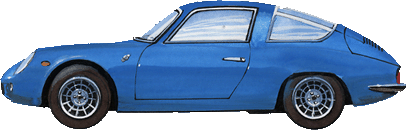
This legendary early Abarth featured bodywork by Ugo Zagato—the perfect choice for a design prioritizing lightness and compactness.
2-seater Berlinetta, Rear-engine, rear-wheel drive.
V4 engine, 1.0L, twin overhead cams (DOHC), 95 DIN hp
Top speed: 170 km/h – 0–100 km/h in 6 seconds
600 kg.
Highly sought after by collectors (with a market value of around €274,000) and boasting an impressive racing record, this car was one of the first creations from the "Scorpion" brand. Like many of the firm's other models, it was based on the Fiat 600—the famous "yogurt pot" and quintessential people's car—whose extreme compactness, lightness, and robust engine made it an ideal platform for modification. Equipped with a powerful engine featuring twin large carburetors and aerodynamic Zagato bodywork—distinguished by the signature "double-bubble" roof design that allowed for a lower profile—the car dominated the Mille Miglia for several years and won numerous other events. Production ended in 1961; while the exact number of units built is unknown, it is estimated to be in the hundreds.
Abarth 1000 Bialbero GT (1960)
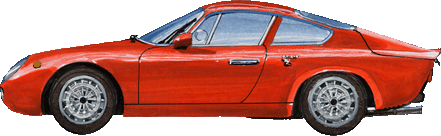
Taille de guêpe et ligne réussie pour cette petite berlinette à hautes performances.
Berlinette 2 places, Moteur Transversal arrière - transmission arrière.
4 cyl. en ligne, 8 soupapes, 982CC, 2 ACT, 92 cv DIN @ 7100 T/min.
0-100 Km/h: 7 sec. ;1000 D.A.: - sec. ;Vitesse max.: 200 Km/h.
570 Kgs. Longueur 3,590 mmm; Largeur 1,390 mm; Hauteur 1,170 mm; Empattement 2,000 mm
En suivant l'évolution logique de la 750, ce nouveau modèle possède le châssis renforcé de la Fiat 500, avec un moteur modifié à presque un litre de cylindrée, le tout habillé très légèrement, sur une structure tubulaire, d'une caisse en fibre de verre basse et très aérodynamique.
ABARTH SIMCA 1300 GT (1962)
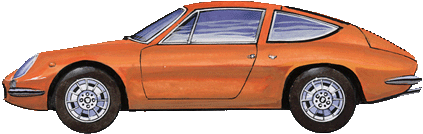
Se basant sur les Simca plus puissantes du marché Français, Abarth réalisa ses plus sérieuses sportives.
Berlinette 2 places: Moteur Transversal arrière - transmission arrière.
4 cylindres en ligne, 8 soupapes, 1.3 L, 2 ACT, 90 cv DIN @ 6000 T/min.
Longueur: 3555 mm; Largeur: 1480 mm; Hauteur: 1140 mm; Empattement: 2090 mm, 630 Kgs.
0-100 Km/h: 7 sec. ;1000 D.A.: - sec. ;Vitesse max.: 200 Km/h.
L'Abarth-Simca 1300 se subdivise en deux modèle, celui de 1962, S1, développant 92cv et le modèle de 1963, S2, 125cv à 7200 T/min. Ce dernier modèle atteignait sans encombre 230 Km/h. sa diffusion est restée limitée aux amateurs de courses, car une telle vitesse sur un si petit empattement demande une concentration diabolique.
ABARTH SCORPIONE OT 1000 (1971)
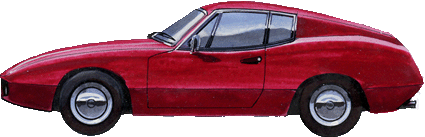
Née coupé Lombardini, cette adaptation quelque peu artificielle ressemblait à un de ces nombreux kits sur base VW Beetle.
Berlinette 2 places. Moteur arrière, transmission arrière.
Empattement: 2100 mm, 750 Kgs.
4 cylindres en V, 2 Litres, 2 ACT, 95 cv DIN @ 6500T/min.
Connu aussi comme le coupé lombardini, ou la Giannini 850 Grand Prix, l'Abarth Scorpione est une adaptation du châssis et de la mécanique de la Fiat 850 coupé, dont des séries spéciales furent dérivées par la célèbre firme. Son Kit carrosserie fut repris par d'autres protagonistes, offrant à ce coupé spécial des performances très convaincantes.